Introduction
AI Deposition Transcript Summarization Tools use artificial intelligence, natural language processing, speech recognition, and document analysis technologies to transform lengthy deposition transcripts into concise summaries, key insights, and searchable legal information.
Depositions often generate hundreds or thousands of pages of testimony that legal professionals must carefully review to identify important statements, inconsistencies, admissions, evidence, and case-relevant details. Manually analyzing these transcripts can require significant time and resources.
AI-powered deposition transcript summarization platforms help legal teams quickly understand testimony by extracting important points, organizing information, identifying themes, and generating summaries that support litigation preparation.
These tools help legal professionals:
- Summarize deposition testimony
- Identify important statements
- Extract key facts
- Locate relevant testimony sections
- Analyze witness responses
- Prepare litigation strategies
- Reduce manual transcript review time
AI deposition summarization solutions are used by:
- Litigation attorneys
- Law firms
- Corporate legal teams
- Insurance companies
- Court reporting organizations
- Legal researchers
- Investigation teams
Modern AI transcript tools combine speech-to-text technology, natural language processing, semantic search, document summarization, timeline analysis, and legal workflow integration.
The goal of these systems is to help legal professionals quickly understand complex testimony while maintaining accuracy and human review.
How AI Deposition Transcript Summarization Works
Transcript Processing
AI analyzes:
- Deposition transcripts
- Court testimony
- Witness statements
- Legal documents
- Case materials
Language Understanding
Natural language processing identifies:
- Important facts
- Key statements
- Legal topics
- Relevant testimony
Automated Summarization
AI creates:
- Short summaries
- Key point lists
- Topic breakdowns
- Witness insights
Search and Discovery
Users can quickly find:
- Specific testimony
- Important statements
- Related topics
- Supporting evidence
Legal Review Support
Attorneys use AI-generated insights to support:
- Case preparation
- Cross-examination planning
- Evidence review
- Litigation strategy
Common Use Cases
- Deposition review
- Litigation preparation
- Trial preparation
- Witness analysis
- Insurance claim investigations
- Internal investigations
- Legal research
- Case management
- Document review
- Evidence organization
Why AI Deposition Transcript Summarization Tools Matter
Saves Review Time
AI reduces the effort required to read lengthy transcripts manually.
Improves Case Preparation
Legal teams can quickly identify important testimony.
Better Information Discovery
AI helps locate relevant statements within large transcript collections.
Supports Legal Strategy
Summaries provide faster understanding of witness testimony.
Improves Workflow Efficiency
Attorneys can focus more time on analysis and case decisions.
Evaluation Criteria for Buyers
Summarization Accuracy
The platform should generate reliable summaries while preserving important context.
Legal Language Understanding
AI should understand complex legal terminology and testimony structures.
Search Capabilities
Strong tools should provide semantic search and transcript navigation.
Document Support
Platforms should support multiple transcript formats and case documents.
Integration Capability
Useful integrations include case management systems, document platforms, and legal workflows.
Security and Privacy
Deposition transcripts contain confidential information requiring strong protection.
Human Review Support
AI summaries should assist attorneys rather than replace legal judgment.
Key Trends
Generative AI Legal Summaries
AI is improving the ability to summarize lengthy testimony and legal documents.
Conversational Transcript Search
Legal teams can ask questions about testimony using natural language.
Automated Case Insights
AI tools are helping identify important facts and patterns.
Litigation Workflow Integration
Transcript analysis is becoming connected with broader legal technology platforms.
Secure Legal AI Adoption
Organizations are focusing on confidentiality, accuracy, and responsible AI use.
Multi-Document Analysis
Modern systems are combining transcripts with case files and evidence.
Methodology
The following platforms were evaluated using:
- Transcript summarization capabilities
- AI analysis features
- Ease of use
- Integrations and ecosystem
- Security and privacy
- Performance and reliability
- Support and community
- Price and value
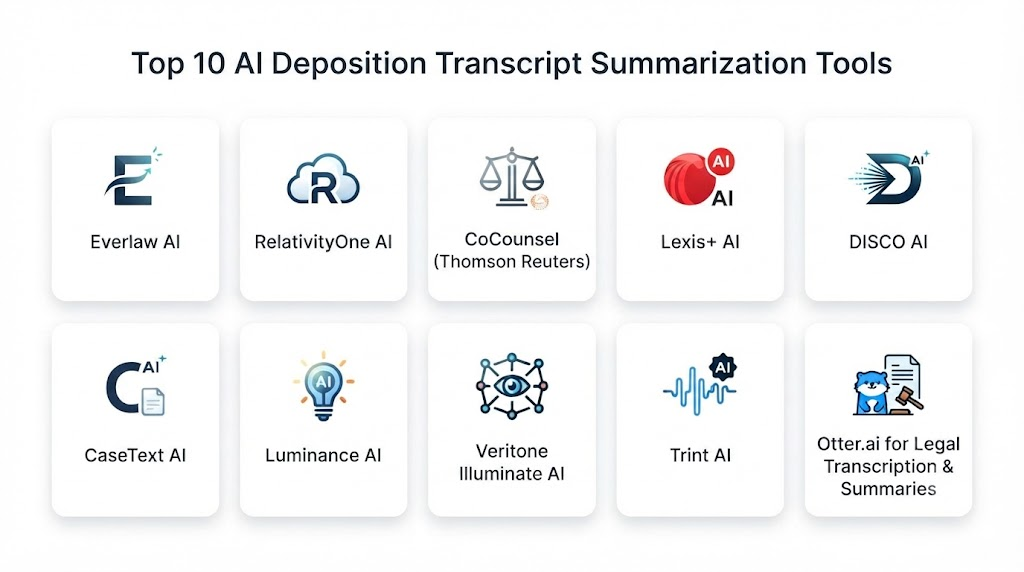
Top 10 AI Deposition Transcript Summarization Tools
1. Verbit
Verbit provides AI-powered transcription and legal transcription solutions with advanced speech recognition capabilities.
Key Features
- AI transcription
- Deposition transcript processing
- Speaker identification
- Timestamping
- Transcript search
- Legal workflow support
- Accuracy enhancement
- Document export
- Captioning support
- Human review options
Pros
- Strong transcription capabilities
- Legal-focused solutions
- Supports professional workflows
- Good accuracy improvements
- Useful transcript management
Cons
- Primarily transcription focused
- Advanced summarization features vary
- Pricing varies
Platforms
Web-based platform.
Deployment or Support
Cloud-based transcription platform.
Security & Compliance
Security practices vary.
Integrations & Ecosystem
Legal workflows, media systems, and document platforms.
Support & Community
Customer support and documentation.
2. Rev
Rev provides transcription and AI-powered speech services that help convert recorded testimony and legal content into searchable text.
Key Features
- AI transcription
- Transcript creation
- Speaker labels
- Time coding
- Document export
- Audio processing
- Search capabilities
- Human transcription options
- Captioning
- Workflow support
Pros
- Easy transcription workflow
- Fast turnaround options
- Supports legal content
- Good accessibility features
- Multiple service options
Cons
- Summarization capabilities vary
- Mainly transcription focused
- Human review may be needed
Platforms
Web-based platform.
Deployment or Support
Cloud-based transcription service.
Security & Compliance
Security controls vary.
Integrations & Ecosystem
Legal teams, content workflows, and media systems.
Support & Community
Customer support.
3. Otter.ai
Otter.ai provides AI-powered transcription and summarization capabilities for meetings, interviews, and recorded conversations.
Key Features
- AI transcription
- Automated summaries
- Speaker identification
- Keyword search
- Conversation insights
- Note generation
- Collaboration tools
- Transcript organization
- Audio analysis
- Export options
Pros
- Strong AI summarization
- Easy to use
- Fast transcription
- Good search features
- Useful collaboration
Cons
- Not specifically designed for legal depositions
- Requires legal verification
- Accuracy varies by audio quality
Platforms
Web, desktop, and mobile applications.
Deployment or Support
Cloud-based AI transcription platform.
Security & Compliance
Security controls vary.
Integrations & Ecosystem
Productivity tools, communication platforms, and workflows.
Support & Community
Documentation and user community.
4. Trint
Trint provides AI transcription and content analysis tools for converting audio and video into searchable text.
Key Features
- AI transcription
- Transcript editing
- Search tools
- Summarization support
- Speaker identification
- Collaboration
- Document export
- Content analysis
- Multiple languages
- Workflow tools
Pros
- Strong transcription workflow
- Easy editing
- Collaboration support
- Multiple language support
- Search capabilities
Cons
- Legal specialization varies
- Requires review for legal accuracy
- Features depend on plan
Platforms
Web-based platform.
Deployment or Support
Cloud-based transcription solution.
Security & Compliance
Security practices vary.
Integrations & Ecosystem
Media, business, and document workflows.
Support & Community
Customer support.
5. Sonix
Sonix provides automated transcription and text analysis tools for converting recordings into searchable transcripts.
Key Features
- AI transcription
- Transcript search
- Speaker labeling
- Translation support
- Text analysis
- Document export
- Editing tools
- Collaboration
- Audio processing
- Workflow management
Pros
- Fast transcription
- User-friendly interface
- Supports multiple languages
- Good editing tools
- Useful search
Cons
- General-purpose platform
- Legal features vary
- Requires attorney review
Platforms
Web-based platform.
Deployment or Support
Cloud-based transcription service.
Security & Compliance
Security controls vary.
Integrations & Ecosystem
Business workflows and content platforms.
Support & Community
Customer support.
6. Descript
Descript provides AI-powered transcription, editing, and summarization capabilities for audio and video content.
Key Features
- AI transcription
- Text-based editing
- Summaries
- Speaker identification
- Search tools
- Document organization
- Collaboration
- Audio editing
- Content analysis
- Export options
Pros
- Innovative editing workflow
- Easy transcript management
- Good AI features
- Collaboration support
- User-friendly interface
Cons
- Not legal-specific
- Requires verification
- Designed broadly for content workflows
Platforms
Desktop and web applications.
Deployment or Support
Cloud-based AI media platform.
Security & Compliance
Security controls vary.
Integrations & Ecosystem
Content creation and collaboration tools.
Support & Community
Documentation and user community.
7. CaseText CoCounsel
CoCounsel provides AI-powered legal assistance including document analysis and legal workflow support.
Key Features
- Legal document analysis
- AI summaries
- Legal research support
- Case information analysis
- Document review
- Question answering
- Workflow assistance
- Legal insights
- Research organization
- Collaboration
Pros
- Legal-focused AI capabilities
- Supports attorneys
- Strong document analysis
- Useful workflow support
- Professional legal applications
Cons
- Requires legal oversight
- Enterprise deployment considerations
- Pricing varies
Platforms
Web-based platform.
Deployment or Support
Cloud-based legal AI platform.
Security & Compliance
Enterprise controls vary.
Integrations & Ecosystem
Legal workflows, research systems, and document platforms.
Support & Community
Professional support.
8. Everlaw
Everlaw provides AI-powered eDiscovery and legal document analysis capabilities that support transcript and case review workflows.
Key Features
- AI document analysis
- Legal review workflows
- Search capabilities
- Case organization
- Document summaries
- Collaboration tools
- Analytics
- Review management
- Data visualization
- Reporting
Pros
- Strong legal workflow support
- Good collaboration
- AI-powered review
- Cloud scalability
- Useful analytics
Cons
- Primarily eDiscovery focused
- Requires setup
- Advanced features need expertise
Platforms
Web-based platform.
Deployment or Support
Cloud-based legal technology platform.
Security & Compliance
Enterprise security practices vary.
Integrations & Ecosystem
Legal systems, discovery workflows, and document platforms.
Support & Community
Customer support.
9. RelativityOne
RelativityOne provides enterprise legal discovery and analytics tools that support large-scale document and transcript analysis.
Key Features
- AI document review
- Transcript analysis
- Search capabilities
- Data analytics
- Review workflows
- Case management support
- Classification
- Reporting
- Collaboration
- Investigation tools
Pros
- Enterprise-scale platform
- Strong legal ecosystem
- Advanced analytics
- Supports complex cases
- Powerful customization
Cons
- Complex implementation
- Requires training
- Enterprise pricing
Platforms
Web-based platform.
Deployment or Support
Cloud-based eDiscovery platform.
Security & Compliance
Enterprise security controls vary.
Integrations & Ecosystem
Legal technology systems and investigation platforms.
Support & Community
Professional community and support.
10. Lexis+ AI
Lexis+ AI provides AI-powered legal assistance for research, document analysis, and legal workflows.
Key Features
- AI legal analysis
- Document summaries
- Legal research
- Case insights
- Question answering
- Legal information search
- Workflow support
- Document understanding
- Research assistance
- Knowledge management
Pros
- Strong legal ecosystem
- Professional legal resources
- AI-powered analysis
- Useful research capabilities
- Supports legal teams
Cons
- Requires legal expertise
- Enterprise-focused
- AI outputs require validation
Platforms
Web-based platform.
Deployment or Support
Cloud-based legal research platform.
Security & Compliance
Enterprise security controls vary.
Integrations & Ecosystem
Legal research systems, document workflows, and professional tools.
Support & Community
Professional support.
Comparison Table
| Tool Name | Best For | Platform(s) Supported | Deployment | Standout Feature | Public Rating |
|---|---|---|---|---|---|
| Verbit | Legal transcription | Web | Cloud | AI transcription | N/A |
| Rev | Transcript creation | Web | Cloud | Fast transcription | N/A |
| Otter.ai | AI summaries | Web/Mobile | Cloud | Automated notes | N/A |
| Trint | Transcript analysis | Web | Cloud | Searchable transcripts | N/A |
| Sonix | Multilingual transcription | Web | Cloud | Language support | N/A |
| Descript | AI transcript editing | Desktop/Web | Cloud | Text-based editing | N/A |
| CoCounsel | Legal AI assistance | Web | Cloud | Legal workflows | N/A |
| Everlaw | Legal review | Web | Cloud | Case analysis | N/A |
| RelativityOne | Enterprise discovery | Web | Cloud | Legal analytics | N/A |
| Lexis+ AI | Legal research | Web | Cloud | Legal intelligence | N/A |
Weighted Evaluation
| Tool Name | Core Features 25% | Ease of Use 15% | Integrations & Ecosystem 15% | Security & Compliance 10% | Performance & Reliability 10% | Support & Community 10% | Price/Value 15% | Total |
|---|---|---|---|---|---|---|---|---|
| Verbit | 23 | 13 | 13 | 9 | 10 | 10 | 11 | 89 |
| Rev | 22 | 15 | 12 | 9 | 10 | 10 | 13 | 91 |
| Otter.ai | 22 | 15 | 13 | 9 | 10 | 10 | 13 | 92 |
| Trint | 22 | 14 | 13 | 9 | 10 | 10 | 12 | 90 |
| Sonix | 21 | 14 | 12 | 9 | 10 | 9 | 13 | 88 |
| Descript | 21 | 14 | 13 | 9 | 10 | 9 | 12 | 88 |
| CoCounsel | 24 | 13 | 14 | 10 | 10 | 10 | 10 | 91 |
| Everlaw | 24 | 13 | 14 | 10 | 10 | 10 | 11 | 92 |
| RelativityOne | 25 | 11 | 15 | 10 | 10 | 10 | 10 | 91 |
| Lexis+ AI | 24 | 12 | 15 | 10 | 10 | 10 | 10 | 91 |
Which AI Deposition Transcript Summarization Tool Is Right for You?
Choose Verbit when accurate legal transcription is the primary requirement.
Choose Rev when fast transcript creation and accessibility are priorities.
Choose Otter.ai when general AI summarization and note generation are needed.
Choose Trint when searchable transcript workflows are important.
Choose Sonix when multilingual transcription support is required.
Choose Descript when transcript editing and content workflows matter.
Choose CoCounsel when attorneys need legal AI assistance.
Choose Everlaw when transcript review is part of broader eDiscovery workflows.
Choose RelativityOne when enterprises require large-scale legal discovery capabilities.
Choose Lexis+ AI when transcript insights connect with broader legal research.
Implementation Playbook
Phase 1: Define Transcript Requirements
- Identify transcript sources
- Determine summary goals
- Define review workflows
- Establish security needs
- Select users
Phase 2: Prepare Documents
- Upload transcripts
- Organize case materials
- Configure access permissions
- Review privacy requirements
- Prepare search categories
Phase 3: Deploy AI Summarization
- Process transcripts
- Generate summaries
- Review AI insights
- Validate important statements
- Organize findings
Phase 4: Evaluate Results
- Measure review speed
- Check summary accuracy
- Collect attorney feedback
- Improve workflows
- Refine processes
Phase 5: Maintain Best Practices
- Verify AI outputs
- Protect confidential testimony
- Maintain review records
- Update workflows
- Ensure responsible AI usage
Common Mistakes
- Using AI summaries without verification
- Ignoring transcript context
- Uploading sensitive information without security review
- Treating AI output as legal conclusions
- Not reviewing important testimony manually
- Choosing general tools without legal requirements analysis
- Ignoring integration needs
- Failing to train legal teams
FAQs
1. What are AI Deposition Transcript Summarization Tools?
AI Deposition Transcript Summarization Tools use artificial intelligence to analyze testimony transcripts and create summaries, insights, and searchable information.
2. How does AI summarize deposition transcripts?
AI analyzes transcript language, identifies important topics, and creates condensed summaries of key information.
3. Can AI replace attorneys reviewing depositions?
No. AI supports attorneys by reducing review time while legal professionals remain responsible for interpretation.
4. What information can AI extract from depositions?
AI can identify key statements, topics, witness responses, and important testimony sections.
5. Are AI deposition summaries accurate?
Accuracy depends on transcript quality, AI capabilities, and human verification.
6. Can AI analyze multiple deposition transcripts together?
Many advanced platforms support analysis across multiple documents and case materials.
7. How can legal teams protect deposition data?
Organizations should evaluate security controls, access management, and confidentiality practices.
8. Are AI transcript tools useful for litigation preparation?
Yes. They help attorneys quickly review testimony and prepare case strategies.
9. Can AI identify contradictions in testimony?
Some advanced legal AI systems can help identify patterns and inconsistencies, but human review remains necessary.
10. What should organizations consider before choosing an AI transcript summarization tool?
Organizations should evaluate accuracy, security, legal features, integrations, usability, and cost.
Conclusion
AI Deposition Transcript Summarization Tools are improving how legal professionals analyze testimony by reducing manual review time and providing faster access to important information. These platforms combine transcription, natural language processing, and document intelligence to support litigation workflows.Everlaw, RelativityOne, CoCounsel, and Lexis+ AI provide strong legal workflow capabilities, while Verbit, Rev, and Otter.ai focus on transcription and summarization. Platforms such as Trint and Descript support broader transcript analysis workflows.
