Introduction
AI Legal Research Assistants use artificial intelligence, natural language processing, machine learning, and legal databases to help lawyers, legal professionals, researchers, and organizations find relevant legal information faster and more efficiently.
Traditional legal research often requires professionals to manually review large volumes of case law, statutes, regulations, legal opinions, and documents. While this process is essential, it can be time-consuming and requires significant expertise to identify relevant information.
AI-powered legal research assistants simplify this workflow by analyzing legal documents, understanding legal questions, identifying relevant authorities, summarizing information, and helping professionals make informed decisions.
These tools help legal teams:
- Search legal information faster
- Analyze case law
- Review regulations
- Summarize legal documents
- Identify relevant precedents
- Improve research efficiency
- Support legal decision-making
AI legal research solutions are used by:
- Law firms
- Corporate legal departments
- Government organizations
- Legal researchers
- Compliance teams
- Universities
- Individual attorneys
Modern AI legal research platforms combine legal databases, semantic search, document analysis, citation support, analytics, and AI-powered assistance.
The goal of these systems is to reduce repetitive research work while helping legal professionals access relevant information more efficiently.
How AI Legal Research Assistants Work
Legal Data Processing
AI systems analyze:
- Case law
- Statutes
- Regulations
- Legal opinions
- Court documents
- Contracts
- Legal publications
Natural Language Understanding
Users can ask legal questions using conversational language instead of complex search queries.
Relevant Information Discovery
AI identifies:
- Similar cases
- Applicable laws
- Relevant arguments
- Supporting authorities
- Related documents
Legal Summarization
AI helps create:
- Case summaries
- Research notes
- Legal overviews
- Document insights
Research Assistance
The system supports lawyers by:
- Suggesting sources
- Organizing findings
- Improving workflow efficiency
Common Use Cases
- Case law research
- Statutory research
- Litigation preparation
- Contract analysis support
- Compliance research
- Regulatory monitoring
- Legal education
- Due diligence assistance
- Legal writing support
- Knowledge management
Why AI Legal Research Assistants Matter
Faster Legal Research
AI reduces the time required to locate relevant legal information.
Better Information Discovery
Semantic search helps professionals find related legal materials beyond keyword matching.
Improved Productivity
Lawyers can focus more time on analysis and strategy instead of repetitive searching.
Document Understanding
AI can summarize and organize complex legal information.
Knowledge Management
Organizations can improve access to internal and external legal knowledge.
Evaluation Criteria for Buyers
Legal Database Quality
A strong platform should provide reliable and comprehensive legal information.
Search Accuracy
AI should understand legal concepts and return relevant results.
Citation Support
Legal professionals need accurate references and source verification.
Document Analysis
Platforms should support legal document review and summarization.
Workflow Integration
Important integrations include legal practice management systems, document platforms, and research workflows.
Security and Privacy
Legal information requires strong data protection and confidentiality controls.
User Experience
The platform should be easy for legal professionals with different technical backgrounds.
Key Trends
AI-Powered Legal Search
Legal research is moving from keyword-based search toward conversational and semantic search.
Generative AI Legal Assistance
AI tools are helping summarize documents, explain concepts, and support legal workflows.
Faster Case Analysis
AI is improving the speed of reviewing large volumes of legal information.
Legal Knowledge Management
Organizations are using AI to organize internal legal knowledge.
Responsible AI Adoption
Legal teams are focusing on accuracy, transparency, confidentiality, and human review.
Integration With Legal Workflows
AI research tools are becoming connected with broader legal technology ecosystems.
Methodology
The following platforms were evaluated using:
- Legal research capabilities
- AI features
- Ease of use
- Integrations and ecosystem
- Security and privacy
- Performance and reliability
- Support and community
- Price and value
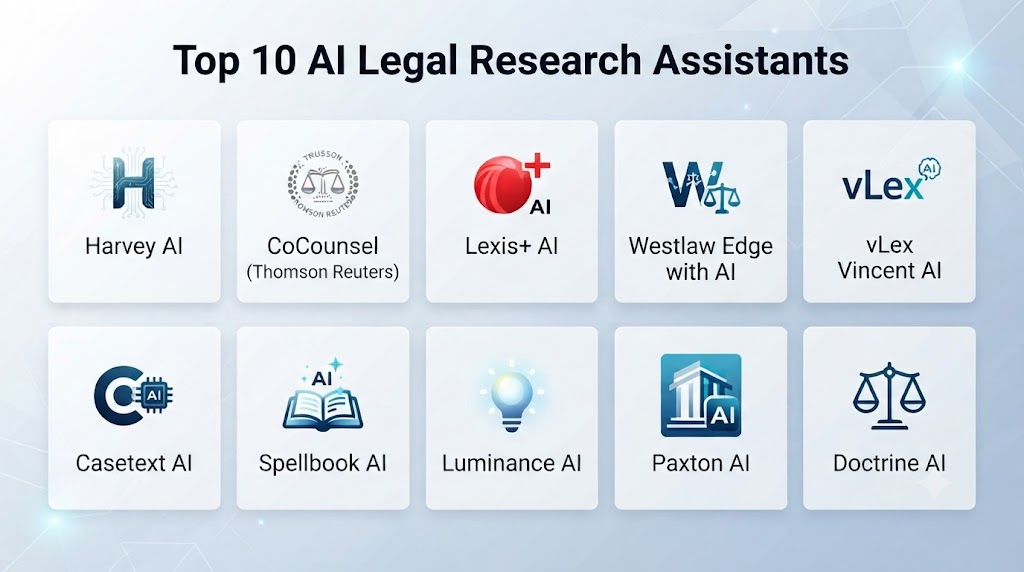
Top 10 AI Legal Research Assistants
- Lexis+ AI
- Westlaw Edge
- CoCounsel
- vLex Vincent AI
- Bloomberg Law AI
- Casetext
- Harvey
- Fastcase
- Luminance
- Paxton AI
1. Lexis+ AI
Lexis+ AI provides AI-powered legal research assistance by combining conversational search, legal databases, and document analysis capabilities.
Key Features
- AI legal search
- Case law research
- Legal summaries
- Document analysis
- Citation support
- Legal drafting assistance
- Research insights
- Natural language queries
- Legal database access
- Workflow support
Pros
- Strong legal database foundation
- Advanced AI search capabilities
- Useful research workflows
- Supports legal professionals
- Comprehensive legal resources
Cons
- Enterprise-focused pricing
- Requires legal expertise
- AI outputs require verification
Platforms
Web-based legal research platform.
Deployment or Support
Cloud-based legal technology platform.
Security & Compliance
Enterprise security controls vary.
Integrations & Ecosystem
Legal research systems, document workflows, and legal technology platforms.
Support & Community
Professional support and documentation.
2. Westlaw Edge
Westlaw Edge provides legal research capabilities with AI-powered search, analytics, and legal insights.
Key Features
- AI legal search
- Case analysis
- Legal analytics
- Citation analysis
- Statutory research
- Litigation insights
- Research recommendations
- Document analysis
- Legal database access
- Workflow tools
Pros
- Extensive legal database
- Strong legal analytics
- Trusted by legal professionals
- Advanced research tools
- Reliable citation resources
Cons
- Enterprise pricing
- Requires training
- Best suited for professional users
Platforms
Web-based platform.
Deployment or Support
Cloud-based legal research solution.
Security & Compliance
Enterprise security features.
Integrations & Ecosystem
Legal systems, research workflows, and professional tools.
Support & Community
Professional support resources.
3. CoCounsel
CoCounsel provides AI-powered legal assistance for research, document review, and legal workflow support.
Key Features
- Legal research assistance
- Document review
- Contract analysis
- Legal summaries
- Drafting support
- Question answering
- Case analysis
- Workflow automation
- Research support
- Document insights
Pros
- Strong AI assistance
- Supports multiple legal tasks
- Improves productivity
- Useful document workflows
- Conversational interface
Cons
- Requires human review
- AI limitations in complex matters
- Enterprise deployment considerations
Platforms
Web-based platform.
Deployment or Support
Cloud-based legal AI platform.
Security & Compliance
Enterprise controls vary.
Integrations & Ecosystem
Legal research systems, document workflows, and professional tools.
Support & Community
Enterprise support.
4. vLex Vincent AI
vLex Vincent AI provides AI-powered legal research by analyzing global legal information and helping users discover relevant legal materials.
Key Features
- AI legal research
- Global legal database
- Case analysis
- Document summarization
- Legal search
- Citation discovery
- Research assistance
- Legal insights
- Document review
- Knowledge discovery
Pros
- Large legal information coverage
- AI-powered research
- Useful global legal insights
- Strong search capabilities
- Supports legal professionals
Cons
- Requires legal expertise
- AI suggestions need validation
- Coverage varies by jurisdiction
Platforms
Web-based platform.
Deployment or Support
Cloud-based legal research platform.
Security & Compliance
Security practices vary.
Integrations & Ecosystem
Legal research systems and professional workflows.
Support & Community
Documentation and customer support.
5. Bloomberg Law AI
Bloomberg Law provides legal research, analytics, and AI-supported tools for legal professionals.
Key Features
- Legal research
- Case analysis
- Litigation analytics
- Regulatory information
- Legal documents
- AI assistance
- News integration
- Workflow tools
- Research alerts
- Legal insights
Pros
- Strong legal and regulatory coverage
- Combines research and news
- Useful analytics
- Professional workflow support
- Enterprise capabilities
Cons
- Enterprise-focused
- Requires subscription
- Advanced features need training
Platforms
Web-based platform.
Deployment or Support
Cloud-based legal platform.
Security & Compliance
Enterprise security controls.
Integrations & Ecosystem
Legal research systems, analytics tools, and professional workflows.
Support & Community
Professional support.
6. Casetext
Casetext provides AI-assisted legal research and document analysis tools designed to improve legal workflows.
Key Features
- AI legal search
- Case research
- Document analysis
- Legal summaries
- Research assistance
- Citation support
- Legal writing support
- Question answering
- Document review
- Workflow tools
Pros
- User-friendly AI interface
- Efficient research workflows
- Helpful document analysis
- Accessible for smaller legal teams
- Strong AI capabilities
Cons
- Requires verification
- Features vary by plan
- Best suited for supported jurisdictions
Platforms
Web-based platform.
Deployment or Support
Cloud-based legal AI platform.
Security & Compliance
Security controls vary.
Integrations & Ecosystem
Legal workflows and research platforms.
Support & Community
Documentation and customer support.
7. Harvey
Harvey provides AI-powered legal assistance for research, drafting, analysis, and professional legal workflows.
Key Features
- Legal research support
- Document analysis
- Drafting assistance
- Legal reasoning support
- Contract review
- Knowledge management
- Workflow assistance
- AI conversations
- Legal insights
- Enterprise deployment
Pros
- Strong legal AI focus
- Supports multiple legal tasks
- Useful for professional workflows
- Enterprise capabilities
- Advanced language understanding
Cons
- Requires legal oversight
- Enterprise implementation needed
- Pricing varies
Platforms
Web-based platform.
Deployment or Support
Cloud-based enterprise AI platform.
Security & Compliance
Enterprise security controls vary.
Integrations & Ecosystem
Legal systems, document workflows, and enterprise applications.
Support & Community
Enterprise support.
8. Fastcase
Fastcase provides legal research tools with search capabilities and access to legal databases.
Key Features
- Legal search
- Case law research
- Statutory research
- Citation tools
- Legal database access
- Research analytics
- Document tools
- Legal insights
- Workflow support
- Research organization
Pros
- Accessible legal research
- Useful search tools
- Supports legal professionals
- Broad legal resources
- Cost-effective options
Cons
- AI capabilities vary
- Advanced features may require additional tools
- Database coverage varies
Platforms
Web-based platform.
Deployment or Support
Cloud-based legal research platform.
Security & Compliance
Security controls vary.
Integrations & Ecosystem
Legal workflows and research systems.
Support & Community
Documentation and customer support.
9. Luminance
Luminance provides AI-powered legal document analysis and contract review capabilities.
Key Features
- Document analysis
- Contract review
- AI insights
- Due diligence support
- Document organization
- Risk identification
- Legal workflows
- Data analysis
- Review automation
- Collaboration tools
Pros
- Strong document analysis
- Useful contract workflows
- Supports legal teams
- Improves review efficiency
- AI-powered insights
Cons
- More focused on documents than research
- Requires implementation
- Enterprise-oriented
Platforms
Web-based platform.
Deployment or Support
Cloud-based legal technology platform.
Security & Compliance
Enterprise controls vary.
Integrations & Ecosystem
Document management systems and legal workflows.
Support & Community
Enterprise support.
10. Paxton AI
Paxton AI provides AI-powered legal assistance for research, drafting, and legal workflow support.
Key Features
- Legal research assistance
- Document analysis
- Legal drafting
- AI question answering
- Case insights
- Research summaries
- Legal workflows
- Knowledge support
- Productivity tools
- Collaboration features
Pros
- AI-focused legal assistance
- User-friendly interface
- Supports multiple legal tasks
- Helps improve productivity
- Accessible legal AI
Cons
- Requires review of outputs
- Newer platform ecosystem
- Features vary
Platforms
Web-based platform.
Deployment or Support
Cloud-based AI platform.
Security & Compliance
Security controls vary.
Integrations & Ecosystem
Legal workflows and productivity tools.
Support & Community
Documentation and support.
Comparison Table
| Tool Name | Best For | Platform(s) Supported | Deployment | Standout Feature | Public Rating |
|---|---|---|---|---|---|
| Lexis+ AI | Legal research | Web | Cloud | AI legal search | N/A |
| Westlaw Edge | Professional legal research | Web | Cloud | Legal analytics | N/A |
| CoCounsel | AI legal workflows | Web | Cloud | Legal task assistance | N/A |
| vLex Vincent AI | Global legal research | Web | Cloud | AI discovery | N/A |
| Bloomberg Law AI | Legal analytics | Web | Cloud | Research + intelligence | N/A |
| Casetext | AI research support | Web | Cloud | Conversational research | N/A |
| Harvey | Legal AI assistance | Web | Cloud | Legal workflow support | N/A |
| Fastcase | Legal database research | Web | Cloud | Legal search | N/A |
| Luminance | Document analysis | Web | Cloud | Contract intelligence | N/A |
| Paxton AI | Legal AI assistance | Web | Cloud | AI productivity support | N/A |
Weighted Evaluation
| Tool Name | Core Features 25% | Ease of Use 15% | Integrations & Ecosystem 15% | Security & Compliance 10% | Performance & Reliability 10% | Support & Community 10% | Price/Value 15% | Total |
|---|---|---|---|---|---|---|---|---|
| Lexis+ AI | 25 | 12 | 15 | 10 | 10 | 10 | 10 | 92 |
| Westlaw Edge | 25 | 12 | 15 | 10 | 10 | 10 | 10 | 92 |
| CoCounsel | 24 | 14 | 14 | 9 | 10 | 10 | 11 | 92 |
| vLex Vincent AI | 24 | 13 | 14 | 9 | 10 | 10 | 11 | 91 |
| Bloomberg Law AI | 24 | 12 | 15 | 10 | 10 | 10 | 10 | 91 |
| Casetext | 23 | 14 | 13 | 9 | 10 | 10 | 12 | 91 |
| Harvey | 24 | 13 | 14 | 10 | 10 | 9 | 10 | 90 |
| Fastcase | 22 | 14 | 13 | 9 | 10 | 10 | 12 | 90 |
| Luminance | 23 | 12 | 13 | 10 | 10 | 9 | 11 | 88 |
| Paxton AI | 22 | 14 | 12 | 9 | 9 | 9 | 12 | 87 |
Which AI Legal Research Assistant Is Right for You?
Choose Lexis+ AI when legal teams need comprehensive AI-powered legal research.
Choose Westlaw Edge when advanced legal analytics and trusted research resources are priorities.
Choose CoCounsel when organizations need AI support across multiple legal workflows.
Choose vLex Vincent AI when global legal research capabilities are important.
Choose Bloomberg Law AI when legal intelligence and analytics are required.
Choose Casetext when user-friendly AI legal research is preferred.
Choose Harvey when enterprise legal AI assistance is needed.
Choose Fastcase when accessible legal research tools are important.
Choose Luminance when document analysis and contract review are priorities.
Choose Paxton AI when organizations need AI-powered legal productivity assistance.
Implementation Playbook
Phase 1: Define Research Needs
- Identify legal workflows
- Determine research requirements
- Select user groups
- Define security expectations
- Establish success metrics
Phase 2: Prepare Data and Systems
- Connect legal databases
- Configure user access
- Review privacy requirements
- Train legal teams
- Establish workflows
Phase 3: Deploy AI Research Tools
- Create research processes
- Test AI outputs
- Review citations
- Build internal guidelines
- Monitor usage
Phase 4: Measure Impact
- Track research efficiency
- Review accuracy
- Collect feedback
- Improve workflows
- Optimize adoption
Phase 5: Maintain Responsible Usage
- Verify AI outputs
- Protect confidential information
- Maintain human oversight
- Update policies
- Review performance
Common Mistakes
- Treating AI output as legal advice
- Failing to verify citations
- Ignoring confidentiality requirements
- Using AI without legal review
- Choosing tools without database evaluation
- Not training legal teams
- Overlooking jurisdiction differences
- Depending only on automated summaries
FAQs
1. What are AI Legal Research Assistants?
AI Legal Research Assistants use artificial intelligence to help legal professionals search, analyze, and summarize legal information.
2. How do AI legal research tools work?
They analyze legal databases and documents to identify relevant cases, laws, regulations, and legal insights.
3. Can AI replace lawyers in legal research?
No. AI supports lawyers by improving research efficiency while legal professionals remain responsible for analysis and decisions.
4. Are AI legal research tools accurate?
Accuracy depends on the platform, data sources, and human verification of results.
5. What types of legal information can AI analyze?
AI can assist with case law, statutes, regulations, contracts, legal documents, and research materials.
6. Can small law firms use AI legal research tools?
Yes. Many solutions support different organization sizes depending on requirements.
7. How do legal teams protect confidential data when using AI?
Organizations should review security controls, access management, and data handling policies.
8. Can AI help summarize legal documents?
Yes. Many platforms provide document summaries and research insights.
9. What should lawyers verify in AI-generated research?
Lawyers should verify sources, citations, legal interpretation, and jurisdiction relevance.
10. What should organizations consider before selecting an AI legal research assistant?
Organizations should evaluate database quality, AI capabilities, security, integrations, usability, and cost.
Conclusion
AI Legal Research Assistants are transforming how legal professionals discover information, analyze documents, and manage research workflows. These tools help reduce repetitive work while improving access to legal knowledge.Lexis+ AI and Westlaw Edge provide comprehensive professional research capabilities, while CoCounsel, Harvey, and Casetext focus on broader AI-powered legal workflows. Platforms such as vLex Vincent AI and Bloomberg Law AI support advanced legal research and analytics.
