Introduction
AI Smart City Control Center Copilots use artificial intelligence, machine learning, computer vision, natural language processing, predictive analytics, and automation to help city administrators monitor, analyze, and manage urban operations more efficiently.
Modern cities operate thousands of connected systems, including traffic networks, public safety services, utilities, environmental monitoring systems, transportation platforms, and citizen service channels. Managing these complex systems through traditional control centers requires significant human effort and continuous monitoring.
AI-powered smart city control center copilots act as intelligent assistants for city operators by analyzing real-time data, identifying unusual events, generating insights, and recommending actions.
These solutions help cities:
- Monitor urban operations in real time
- Detect incidents faster
- Improve emergency response
- Optimize city resources
- Support decision-making
- Improve citizen services
- Manage complex infrastructure
AI smart city control center copilots are used by:
- Municipal governments
- Smart city programs
- Emergency management departments
- Transportation authorities
- Public safety agencies
- Utility providers
- Urban operations centers
Modern platforms combine AI assistants, IoT analytics, digital twins, video intelligence, predictive modeling, geographic information systems, and automated workflows.
The goal of these solutions is to create centralized, intelligent city operation centers that help governments respond faster and make better decisions.
How AI Smart City Control Center Copilots Work
Data Collection
AI systems collect information from:
- IoT sensors
- Traffic cameras
- Public safety systems
- Weather systems
- Utility networks
- Citizen service platforms
- Geographic data
Real-Time Analysis
AI analyzes:
- City events
- Infrastructure conditions
- Traffic patterns
- Emergency situations
- Public service requests
Intelligent Recommendations
AI provides:
- Incident summaries
- Response suggestions
- Resource recommendations
- Operational insights
Automated Workflows
Platforms support:
- Alerts
- Task assignments
- Emergency coordination
- Department communication
Continuous Learning
AI improves using:
- Historical city data
- Operational outcomes
- Human feedback
- New patterns
Common Use Cases
- Smart city command centers
- Emergency response coordination
- Traffic monitoring
- Public safety operations
- Disaster management
- Utility monitoring
- Environmental management
- Citizen service automation
- Urban planning
- Infrastructure monitoring
Why AI Smart City Control Center Copilots Matter
Faster Incident Response
AI helps operators identify and respond to incidents quickly.
Better City Visibility
Control centers gain a unified view of city operations.
Improved Resource Management
AI helps allocate teams and resources efficiently.
Predictive Decision-Making
Cities can identify risks before major problems occur.
Better Citizen Services
AI helps governments deliver faster and more reliable services.
Evaluation Criteria for Buyers
Real-Time Intelligence
Systems should analyze city data continuously.
AI Assistant Capability
Platforms should provide useful operational recommendations.
Data Integration
Important integrations include:
- IoT platforms
- GIS systems
- Emergency systems
- Transportation platforms
- Utility networks
Visualization Capability
Solutions should provide:
- Dashboards
- Maps
- Alerts
- Operational views
Security and Privacy
Smart city systems require strong protection.
Scalability
Platforms should support city-wide operations.
Automation Features
Solutions should automate repetitive operational tasks.
Key Trends
AI-Powered City Operations
Cities are adopting AI assistants for centralized management.
Digital Twin Smart Cities
Urban digital models are improving planning and decision-making.
Real-Time Urban Analytics
AI is helping cities understand live conditions.
Predictive Public Services
Governments are moving from reactive responses to proactive services.
Connected Infrastructure
IoT networks are expanding city intelligence.
Responsible AI Governance
Cities are focusing on transparency, privacy, and ethical AI use.
Methodology
The following platforms were evaluated using:
- AI capabilities
- Smart city support
- Real-time analytics
- Integration ecosystem
- Automation features
- Scalability
- Security
- Reliability
- Support
- Price and value
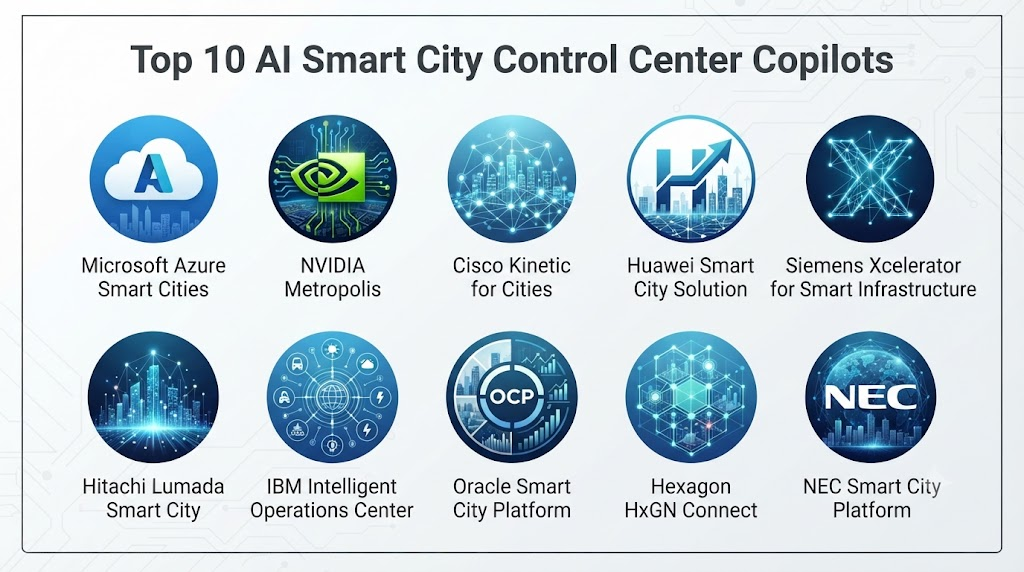
Top 10 AI Smart City Control Center Copilots
1. Microsoft Azure Smart City Solutions
Microsoft Azure provides cloud AI, IoT, analytics, and digital transformation capabilities for smart city operations.
Key Features
- AI city analytics
- IoT data management
- Digital dashboards
- Predictive analytics
- Data integration
- Cloud intelligence
- AI assistants
- Security management
- Workflow automation
- Urban analytics
Pros
- Strong cloud ecosystem
- Advanced AI capabilities
- Scalable infrastructure
- Flexible integrations
- Enterprise security
Cons
- Requires technical expertise
- Cloud dependency
- Implementation planning needed
Platforms
Cloud platform.
Deployment or Support
Cloud deployment.
Security & Compliance
Enterprise cloud security controls.
Integrations & Ecosystem
IoT devices, government systems, analytics platforms, and enterprise applications.
Support & Community
Enterprise support.
2. NVIDIA Metropolis
NVIDIA Metropolis provides AI-powered computer vision capabilities for smart city environments.
Key Features
- Video analytics
- AI vision models
- Traffic monitoring
- Public safety analytics
- Edge AI processing
- Object detection
- Real-time insights
- AI applications
- Camera intelligence
- Automation
Pros
- Advanced computer vision
- Strong edge AI capabilities
- Real-time analytics
- Supports smart surveillance
- Developer ecosystem
Cons
- Requires AI infrastructure
- Hardware considerations
- Technical expertise needed
Platforms
Cloud and edge platforms.
Deployment or Support
Edge and cloud deployment.
Security & Compliance
Security depends on implementation.
Integrations & Ecosystem
Cameras, IoT devices, AI applications, and city systems.
Support & Community
Developer and enterprise support.
3. IBM Intelligent Operations Center
IBM provides intelligent operations solutions for managing city services.
Key Features
- City data integration
- Operational dashboards
- Event management
- Analytics
- Incident tracking
- Decision support
- Collaboration tools
- Reporting
- Data visualization
- Workflow management
Pros
- Designed for city operations
- Strong analytics
- Enterprise capabilities
- Supports multiple departments
- Good integration options
Cons
- Complex deployment
- Enterprise-focused
- Requires expertise
Platforms
Cloud and enterprise platforms.
Deployment or Support
Hybrid deployment.
Security & Compliance
Enterprise security controls.
Integrations & Ecosystem
Government systems, IoT platforms, databases, and analytics tools.
Support & Community
Enterprise support.
4. Cisco Kinetic Smart City Platform
Cisco provides IoT connectivity and smart city infrastructure solutions.
Key Features
- IoT data management
- Connected infrastructure
- Network intelligence
- Data analytics
- Device management
- Security controls
- Smart city connectivity
- Data integration
- Monitoring
- Automation
Pros
- Strong networking capabilities
- Reliable infrastructure
- IoT expertise
- Enterprise scalability
- Security features
Cons
- Requires integration
- Technical implementation
- Infrastructure-focused
Platforms
Cloud and enterprise platforms.
Deployment or Support
Hybrid deployment.
Security & Compliance
Enterprise security controls.
Integrations & Ecosystem
IoT devices, sensors, networks, and city applications.
Support & Community
Enterprise support.
5. Siemens Smart Infrastructure
Siemens provides intelligent infrastructure management solutions.
Key Features
- Building intelligence
- Energy management
- Infrastructure monitoring
- IoT integration
- Automation
- Analytics
- Urban systems management
- Digital solutions
- Operational insights
- Reporting
Pros
- Strong infrastructure expertise
- Industrial reliability
- Smart building capabilities
- Energy management
- Enterprise scale
Cons
- Complex deployments
- Infrastructure investment needed
- Enterprise-focused
Platforms
Cloud and enterprise platforms.
Deployment or Support
Hybrid deployment.
Security & Compliance
Enterprise security controls.
Integrations & Ecosystem
Buildings, utilities, IoT systems, and infrastructure platforms.
Support & Community
Enterprise support.
6. Hitachi Lumada Smart City Solutions
Hitachi Lumada provides data-driven smart city capabilities.
Key Features
- Data analytics
- IoT integration
- Urban intelligence
- Predictive insights
- Digital transformation
- Data platforms
- Operational analytics
- Visualization
- AI solutions
- Decision support
Pros
- Strong analytics
- Smart city experience
- Enterprise capabilities
- Data-driven approach
- Good integration
Cons
- Enterprise implementation
- Requires expertise
- Complex solutions
Platforms
Cloud and enterprise platforms.
Deployment or Support
Hybrid deployment.
Security & Compliance
Enterprise security controls.
Integrations & Ecosystem
IoT systems, government platforms, and enterprise applications.
Support & Community
Enterprise support.
7. Huawei Smart City Solutions
Huawei provides smart city infrastructure and digital government solutions.
Key Features
- City operation platforms
- IoT management
- Video intelligence
- Data analytics
- Public safety support
- Urban management
- Connectivity
- AI services
- Cloud infrastructure
- Dashboards
Pros
- Broad smart city portfolio
- Strong connectivity solutions
- Large infrastructure capabilities
- IoT support
- Scalable deployments
Cons
- Regional availability varies
- Implementation complexity
- Requires infrastructure planning
Platforms
Cloud and enterprise platforms.
Deployment or Support
Hybrid deployment.
Security & Compliance
Security controls vary.
Integrations & Ecosystem
IoT devices, networks, government systems, and cloud platforms.
Support & Community
Enterprise support.
8. Google Cloud Smart City Platform
Google Cloud provides AI, analytics, and data capabilities for smart city applications.
Key Features
- Data analytics
- AI models
- Geospatial intelligence
- Cloud infrastructure
- Data processing
- Machine learning
- Visualization
- APIs
- Data integration
- Urban insights
Pros
- Strong AI infrastructure
- Advanced analytics
- Scalable cloud platform
- Developer ecosystem
- Flexible solutions
Cons
- Requires technical expertise
- Custom development needed
- Cloud dependency
Platforms
Cloud platform.
Deployment or Support
Cloud deployment.
Security & Compliance
Google Cloud security controls.
Integrations & Ecosystem
Maps, IoT systems, applications, and analytics platforms.
Support & Community
Google Cloud support.
9. Oracle Smart City Solutions
Oracle provides cloud solutions for government and urban operations.
Key Features
- Data management
- Government applications
- Analytics
- Citizen services
- Cloud infrastructure
- Workflow automation
- Reporting
- Data integration
- AI capabilities
- Operational insights
Pros
- Enterprise government solutions
- Strong database capabilities
- Good analytics
- Scalable cloud platform
- Integration options
Cons
- Enterprise-focused
- Requires configuration
- Implementation effort
Platforms
Cloud platform.
Deployment or Support
Cloud deployment.
Security & Compliance
Enterprise security controls.
Integrations & Ecosystem
Government systems, databases, and enterprise applications.
Support & Community
Enterprise support.
10. Bentley iTwin Platform
Bentley iTwin provides digital twin technology for infrastructure intelligence.
Key Features
- Digital twins
- Infrastructure visualization
- Asset monitoring
- Simulation
- Engineering data management
- Collaboration
- Analytics
- Infrastructure insights
- Data integration
- Urban modeling
Pros
- Strong infrastructure modeling
- Digital twin capabilities
- Engineering focus
- Good visualization
- Collaboration features
Cons
- Requires expertise
- Infrastructure-focused
- Implementation effort
Platforms
Cloud platform.
Deployment or Support
Cloud deployment.
Security & Compliance
Enterprise security controls.
Integrations & Ecosystem
Engineering systems, GIS platforms, IoT systems, and infrastructure applications.
Support & Community
Enterprise support.
Comparison Table
| Tool Name | Best For | Platform(s) Supported | Deployment | Standout Feature | Public Rating |
|---|---|---|---|---|---|
| Azure Smart City Solutions | Cloud smart cities | Cloud | Cloud | AI and IoT analytics | N/A |
| NVIDIA Metropolis | Video intelligence | Cloud/Edge | Hybrid | Computer vision | N/A |
| IBM Intelligent Operations Center | City operations | Cloud/Enterprise | Hybrid | Operations management | N/A |
| Cisco Kinetic | Connected infrastructure | Cloud/Enterprise | Hybrid | IoT connectivity | N/A |
| Siemens Smart Infrastructure | Infrastructure management | Cloud/Enterprise | Hybrid | Smart infrastructure | N/A |
| Hitachi Lumada | Urban analytics | Cloud/Enterprise | Hybrid | Data intelligence | N/A |
| Huawei Smart City | Digital cities | Cloud/Enterprise | Hybrid | City platforms | N/A |
| Google Cloud Smart City | AI analytics | Cloud | Cloud | Data intelligence | N/A |
| Oracle Smart City | Government operations | Cloud | Cloud | Enterprise systems | N/A |
| Bentley iTwin | Digital twins | Cloud | Cloud | Infrastructure modeling | N/A |
Weighted Evaluation
| Tool Name | Core Features 25% | Ease of Use 15% | Integrations & Ecosystem 15% | Security & Compliance 10% | Performance & Reliability 10% | Support & Community 10% | Price/Value 15% | Total |
|---|---|---|---|---|---|---|---|---|
| Azure Smart City Solutions | 25 | 13 | 15 | 10 | 10 | 10 | 12 | 95 |
| NVIDIA Metropolis | 24 | 13 | 14 | 10 | 10 | 10 | 11 | 92 |
| IBM Intelligent Operations Center | 24 | 12 | 15 | 10 | 10 | 10 | 10 | 91 |
| Cisco Kinetic | 23 | 13 | 15 | 10 | 10 | 10 | 12 | 93 |
| Siemens Smart Infrastructure | 24 | 12 | 14 | 10 | 10 | 10 | 10 | 90 |
| Hitachi Lumada | 23 | 12 | 14 | 10 | 10 | 10 | 11 | 90 |
| Huawei Smart City | 23 | 12 | 14 | 10 | 10 | 10 | 11 | 90 |
| Google Cloud Smart City | 24 | 13 | 15 | 10 | 10 | 10 | 12 | 94 |
| Oracle Smart City | 23 | 12 | 15 | 10 | 10 | 10 | 11 | 91 |
| Bentley iTwin | 23 | 12 | 14 | 10 | 10 | 10 | 11 | 90 |
Which AI Smart City Control Center Copilot Is Right for You?
Choose Microsoft Azure Smart City Solutions when cloud AI and IoT capabilities are required.
Choose NVIDIA Metropolis when computer vision and real-time video intelligence are priorities.
Choose IBM Intelligent Operations Center when centralized city operations management is needed.
Choose Cisco Kinetic when connected infrastructure is the priority.
Choose Siemens Smart Infrastructure when infrastructure management is important.
Choose Hitachi Lumada when data-driven urban transformation is required.
Choose Huawei Smart City Solutions when large-scale city platforms are needed.
Choose Google Cloud Smart City Platform when AI analytics and cloud intelligence are priorities.
Choose Oracle Smart City Solutions when government enterprise systems are required.
Choose Bentley iTwin when digital twins and infrastructure modeling are important.
Implementation Playbook
Phase 1: Define Smart City Goals
- Identify city challenges
- Select operational areas
- Define AI use cases
- Establish performance goals
- Identify stakeholders
Phase 2: Build Data Foundation
- Connect IoT systems
- Integrate city databases
- Deploy analytics platforms
- Establish security policies
- Prepare operational workflows
Phase 3: Deploy AI Copilot
- Configure AI models
- Create dashboards
- Enable alerts
- Connect departments
- Test operations
Phase 4: Measure Impact
- Improve response times
- Reduce operational costs
- Monitor service quality
- Analyze city performance
- Improve citizen experience
Phase 5: Maintain AI Operations
- Update models
- Monitor accuracy
- Review governance
- Improve workflows
- Maintain cybersecurity
Common Mistakes
- Deploying AI without clear objectives
- Ignoring data quality
- Poor system integration
- Weak privacy controls
- Lack of human oversight
- Not involving city departments
- Ignoring cybersecurity
- Failing to measure outcomes
FAQs
1. What are AI Smart City Control Center Copilots?
AI Smart City Control Center Copilots are intelligent systems that help city operators monitor, analyze, and manage urban operations.
2. How does AI help smart city control centers?
AI analyzes city data and provides insights, alerts, and recommendations.
3. Can AI manage entire cities automatically?
AI supports city teams but human decision-making remains important.
4. What data do smart city copilots use?
They use IoT sensors, cameras, transportation data, public service systems, and geographic information.
5. Are smart city AI systems secure?
Cities need strong cybersecurity, privacy policies, and governance practices.
6. Can AI improve emergency response?
Yes. AI can help identify incidents and coordinate responses faster.
7. What cities use AI control centers?
Many smart city programs use AI for transportation, utilities, safety, and citizen services.
8. How do digital twins help smart cities?
Digital twins allow cities to simulate and analyze infrastructure conditions.
9. Can AI integrate with existing city systems?
Many platforms integrate with IoT, GIS, government systems, and infrastructure platforms.
10. What should cities consider before selecting an AI smart city copilot?
Cities should evaluate AI capabilities, integrations, security, scalability, cost, and governance.
Conclusion
AI Smart City Control Center Copilots are transforming urban management by combining artificial intelligence, IoT, analytics, and automation into centralized operational platforms.Microsoft Azure, NVIDIA Metropolis, IBM Intelligent Operations Center, Cisco Kinetic, Siemens, and Google Cloud provide powerful capabilities for building intelligent city operations, while digital twin platforms support infrastructure-focused management.The most successful smart city AI implementations combine technology with strong governance, reliable data, cybersecurity, and collaboration between city departments. AI helps cities become more responsive, efficient, sustainable, and citizen-focused.
