Introduction
AI Renewable Output Prediction Tools use artificial intelligence, machine learning, weather intelligence, time-series forecasting, and energy analytics to predict renewable energy generation from sources such as solar, wind, hydro, and other clean energy systems.
Renewable energy production is highly dependent on changing environmental conditions. Weather patterns, cloud coverage, wind speed, temperature, seasonal variations, and equipment performance can significantly affect energy output. Traditional forecasting methods often struggle to manage these complex and rapidly changing variables.
AI-powered renewable forecasting platforms analyze historical production data, weather information, satellite data, sensor readings, and operational conditions to generate accurate predictions of future renewable energy output.
These tools help organizations:
- Forecast solar and wind generation
- Improve renewable energy integration
- Optimize grid operations
- Reduce energy uncertainty
- Improve battery storage planning
- Support energy trading decisions
- Increase renewable reliability
AI renewable output prediction solutions are used by:
- Renewable energy companies
- Utility providers
- Independent power producers
- Grid operators
- Energy traders
- Smart grid operators
- Government energy agencies
Modern platforms combine artificial intelligence, weather forecasting, IoT monitoring, digital twins, predictive analytics, and automated energy management.
The goal of these solutions is to make renewable energy more predictable, efficient, and easier to integrate into modern power systems.
How AI Renewable Output Prediction Works
Data Collection
AI systems analyze:
- Historical renewable generation data
- Weather forecasts
- Satellite imagery
- Solar radiation data
- Wind speed information
- Turbine and equipment sensors
- Grid conditions
Pattern Analysis
Machine learning identifies:
- Seasonal generation patterns
- Weather impacts
- Equipment performance trends
- Production variations
Output Forecasting
AI predicts:
- Hourly generation
- Daily output
- Long-term production trends
- Renewable availability
Grid Optimization Support
Forecasts help with:
- Energy scheduling
- Storage management
- Grid balancing
- Market participation
Continuous Improvement
AI models improve using:
- New production data
- Forecast accuracy results
- Weather updates
- Operational feedback
Common Use Cases
- Solar power forecasting
- Wind power forecasting
- Renewable energy scheduling
- Battery storage optimization
- Grid balancing
- Energy trading
- Renewable asset management
- Power purchase agreement planning
- Microgrid operations
- Smart energy management
Why AI Renewable Output Prediction Tools Matter
Better Renewable Integration
AI helps grid operators manage variable renewable energy sources.
Improved Forecast Accuracy
Machine learning captures complex weather and production patterns.
Reduced Energy Waste
Better predictions improve energy planning.
Lower Operational Costs
Organizations can optimize generation and storage decisions.
Increased Grid Stability
Accurate renewable forecasts support reliable electricity supply.
Evaluation Criteria for Buyers
Forecast Accuracy
Tools should provide reliable renewable generation predictions.
Weather Intelligence
Platforms should integrate:
- Weather forecasts
- Satellite data
- Environmental conditions
Renewable Support
Solutions should support:
- Solar farms
- Wind farms
- Hybrid renewable systems
Real-Time Analytics
Platforms should process changing conditions quickly.
Integration Capability
Important integrations include:
- SCADA systems
- IoT sensors
- Energy management systems
- Grid platforms
- Weather services
Scalability
Solutions should support large renewable portfolios.
Security
Energy systems require strong cybersecurity controls.
Key Trends
AI-Based Renewable Forecasting
Energy companies are adopting AI to improve renewable predictability.
Advanced Weather Analytics
AI is combining weather data with energy models.
Digital Twin Renewable Assets
Virtual models are improving renewable performance analysis.
Renewable Trading Optimization
Forecasting is helping energy companies make better market decisions.
Hybrid Energy Management
AI is coordinating renewable generation with storage systems.
Autonomous Energy Operations
AI is enabling more automated renewable management.
Methodology
The following platforms were evaluated using:
- AI forecasting capabilities
- Renewable energy support
- Weather integration
- Analytics features
- Grid compatibility
- Scalability
- Security
- Reliability
- Support
- Price and value
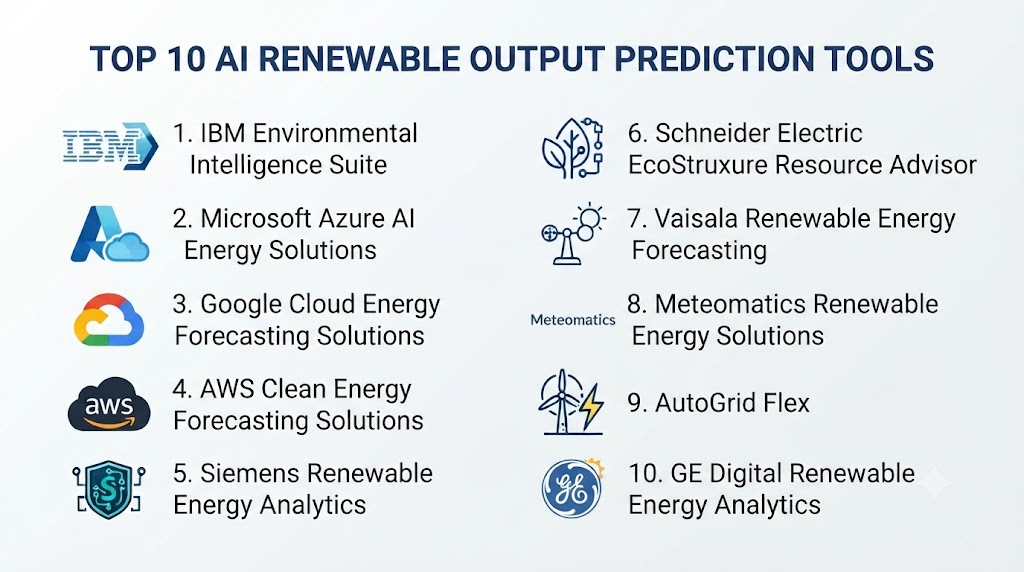
Top 10 AI Renewable Output Prediction Tools
1. IBM Environmental Intelligence Suite
IBM provides AI-powered environmental and energy analytics capabilities for renewable forecasting.
Key Features
- Renewable forecasting
- Weather intelligence
- AI analytics
- Environmental monitoring
- Predictive models
- Risk analysis
- Data integration
- Energy insights
- Reporting
- Automation
Pros
- Strong AI analytics
- Weather intelligence capabilities
- Enterprise scalability
- Good environmental data support
- Flexible integrations
Cons
- Requires configuration
- Enterprise-focused
- Implementation effort
Platforms
Cloud platform.
Deployment or Support
Cloud deployment.
Security & Compliance
Enterprise security controls.
Integrations & Ecosystem
Energy platforms, weather systems, IoT devices, and enterprise applications.
Support & Community
Enterprise support.
2. Microsoft Azure AI Energy Solutions
Microsoft Azure provides AI and cloud capabilities for renewable energy forecasting.
Key Features
- Machine learning forecasting
- Energy analytics
- IoT integration
- Renewable monitoring
- Predictive models
- Data processing
- Digital twin support
- Automation
- Reporting
- Security management
Pros
- Strong AI ecosystem
- Scalable cloud infrastructure
- Flexible development
- Enterprise integrations
- Strong security
Cons
- Requires technical expertise
- Cloud dependency
- Custom development may be needed
Platforms
Cloud platform.
Deployment or Support
Cloud deployment.
Security & Compliance
Enterprise cloud security controls.
Integrations & Ecosystem
Energy systems, IoT platforms, analytics tools, and cloud applications.
Support & Community
Microsoft support ecosystem.
3. Google Cloud Energy Forecasting Solutions
Google Cloud provides AI infrastructure for renewable energy analytics.
Key Features
- Machine learning models
- Renewable forecasting
- Data analytics
- Weather data processing
- AI development tools
- Data visualization
- APIs
- Automation
- Cloud analytics
- Energy insights
Pros
- Advanced AI capabilities
- Strong analytics infrastructure
- Scalable platform
- Flexible development
- Large ecosystem
Cons
- Requires technical knowledge
- Cloud-based
- Custom solutions needed
Platforms
Cloud platform.
Deployment or Support
Cloud deployment.
Security & Compliance
Google Cloud security controls.
Integrations & Ecosystem
Energy systems, APIs, data platforms, and cloud services.
Support & Community
Google Cloud support.
4. AWS Clean Energy Forecasting Solutions
AWS provides cloud services for renewable energy analytics and forecasting.
Key Features
- Machine learning
- Energy data processing
- Renewable analytics
- IoT integration
- Forecasting models
- Data storage
- Visualization
- Automation
- API support
- Predictive insights
Pros
- Scalable infrastructure
- Strong IoT ecosystem
- Flexible AI services
- Reliable cloud platform
- Developer-friendly
Cons
- Requires AWS expertise
- Configuration required
- Cloud costs vary
Platforms
AWS cloud platform.
Deployment or Support
Cloud deployment.
Security & Compliance
AWS security controls.
Integrations & Ecosystem
IoT devices, renewable platforms, analytics systems, and cloud services.
Support & Community
AWS support ecosystem.
5. Siemens Renewable Energy Analytics
Siemens provides renewable energy management and forecasting solutions.
Key Features
- Renewable output forecasting
- Wind and solar analytics
- Asset monitoring
- Grid integration
- Performance analysis
- Energy optimization
- Data visualization
- Reporting
- Predictive analytics
- Automation
Pros
- Strong renewable expertise
- Utility-scale support
- Good asset analytics
- Enterprise reliability
- Grid integration capabilities
Cons
- Complex deployment
- Enterprise-focused
- Requires expertise
Platforms
Cloud and enterprise platforms.
Deployment or Support
Hybrid deployment.
Security & Compliance
Enterprise security controls.
Integrations & Ecosystem
Renewable assets, grid systems, IoT sensors, and energy platforms.
Support & Community
Enterprise support.
6. Schneider Electric EcoStruxure Resource Advisor
Schneider Electric provides renewable energy analytics and management capabilities.
Key Features
- Renewable monitoring
- Energy analytics
- Forecasting support
- Sustainability reporting
- Energy management
- Data visualization
- Performance tracking
- Automation
- Portfolio management
- Reporting
Pros
- Strong energy management
- Sustainability focus
- Good analytics
- Enterprise capabilities
- Wide ecosystem
Cons
- Requires implementation
- Enterprise-oriented
- Configuration needed
Platforms
Cloud platform.
Deployment or Support
Cloud deployment.
Security & Compliance
Enterprise security controls.
Integrations & Ecosystem
Energy systems, renewable assets, IoT platforms, and business applications.
Support & Community
Enterprise support.
7. Vaisala Renewable Energy Forecasting
Vaisala provides weather-based renewable energy forecasting solutions.
Key Features
- Weather forecasting
- Solar prediction
- Wind forecasting
- Renewable analytics
- Environmental monitoring
- Forecast accuracy tools
- Data services
- Reporting
- Grid support
- Decision support
Pros
- Strong weather expertise
- Renewable-focused solutions
- Accurate environmental data
- Industry experience
- Specialized forecasting
Cons
- Specialized platform
- Requires integration
- Focused on energy forecasting
Platforms
Cloud and enterprise platforms.
Deployment or Support
Cloud deployment.
Security & Compliance
Security controls vary.
Integrations & Ecosystem
Weather systems, renewable assets, energy platforms, and grid operators.
Support & Community
Professional support.
8. Meteomatics Renewable Energy Solutions
Meteomatics provides weather intelligence for renewable energy forecasting.
Key Features
- Weather data analytics
- Solar forecasting
- Wind forecasting
- Meteorological models
- API access
- Energy prediction
- Data visualization
- Environmental analytics
- Automation
- Reporting
Pros
- Strong weather intelligence
- Renewable focus
- High-resolution data
- Flexible APIs
- Good forecasting support
Cons
- Requires technical integration
- Weather-data focused
- Custom implementation needed
Platforms
Cloud platform.
Deployment or Support
Cloud deployment.
Security & Compliance
Security controls vary.
Integrations & Ecosystem
Energy systems, APIs, renewable platforms, and analytics tools.
Support & Community
Professional support.
9. AutoGrid Flex
AutoGrid provides AI-powered renewable energy and demand flexibility management.
Key Features
- Renewable integration
- Energy forecasting
- Demand response
- Grid optimization
- Distributed energy management
- AI analytics
- Load management
- Reporting
- Automation
- Energy flexibility
Pros
- Strong renewable integration
- AI-driven optimization
- Utility-focused
- Demand management support
- Flexible platform
Cons
- Requires integration
- Specialized solution
- Utility-focused
Platforms
Cloud platform.
Deployment or Support
Cloud deployment.
Security & Compliance
Security controls vary.
Integrations & Ecosystem
Utilities, batteries, renewable systems, smart meters, and grid platforms.
Support & Community
Professional support.
10. GE Digital Renewable Energy Analytics
GE Digital provides analytics solutions for renewable energy assets.
Key Features
- Renewable asset monitoring
- Performance analytics
- Forecasting support
- Wind analytics
- Solar insights
- Predictive maintenance
- Data management
- Reporting
- Optimization
- Automation
Pros
- Strong industrial expertise
- Renewable asset support
- Predictive analytics
- Enterprise capabilities
- Operational insights
Cons
- Enterprise deployment
- Requires expertise
- Complex implementation
Platforms
Cloud and enterprise platforms.
Deployment or Support
Hybrid deployment.
Security & Compliance
Enterprise security controls.
Integrations & Ecosystem
Renewable assets, industrial systems, IoT platforms, and energy applications.
Support & Community
Enterprise support.
Comparison Table
| Tool Name | Best For | Platform(s) Supported | Deployment | Standout Feature | Public Rating |
|---|---|---|---|---|---|
| IBM Environmental Intelligence | Weather-based forecasting | Cloud | Cloud | Environmental analytics | N/A |
| Azure AI Energy Solutions | Cloud AI forecasting | Cloud | Cloud | Machine learning | N/A |
| Google Cloud Energy Forecasting | AI analytics | Cloud | Cloud | Data intelligence | N/A |
| AWS Clean Energy Forecasting | Cloud applications | Cloud | Cloud | Scalable processing | N/A |
| Siemens Renewable Analytics | Utility renewable assets | Cloud/Enterprise | Hybrid | Renewable optimization | N/A |
| Schneider EcoStruxure Resource Advisor | Energy management | Cloud | Cloud | Sustainability analytics | N/A |
| Vaisala Renewable Forecasting | Weather forecasting | Cloud/Enterprise | Cloud | Weather intelligence | N/A |
| Meteomatics | Weather APIs | Cloud | Cloud | High-resolution data | N/A |
| AutoGrid Flex | Renewable flexibility | Cloud | Cloud | Grid optimization | N/A |
| GE Digital Renewable Analytics | Asset analytics | Cloud/Enterprise | Hybrid | Performance insights | N/A |
Weighted Evaluation
| Tool Name | Core Features 25% | Ease of Use 15% | Integrations & Ecosystem 15% | Security & Compliance 10% | Performance & Reliability 10% | Support & Community 10% | Price/Value 15% | Total |
|---|---|---|---|---|---|---|---|---|
| IBM Environmental Intelligence | 24 | 13 | 14 | 10 | 10 | 10 | 11 | 92 |
| Azure AI Energy Solutions | 25 | 14 | 15 | 10 | 10 | 10 | 12 | 96 |
| Google Cloud Energy Forecasting | 24 | 13 | 15 | 10 | 10 | 10 | 12 | 94 |
| AWS Clean Energy Forecasting | 24 | 13 | 15 | 10 | 10 | 10 | 12 | 94 |
| Siemens Renewable Analytics | 25 | 12 | 15 | 10 | 10 | 10 | 10 | 92 |
| Schneider EcoStruxure | 24 | 12 | 15 | 10 | 10 | 10 | 11 | 92 |
| Vaisala Forecasting | 23 | 13 | 14 | 10 | 10 | 10 | 11 | 91 |
| Meteomatics | 22 | 13 | 14 | 10 | 10 | 10 | 12 | 91 |
| AutoGrid Flex | 23 | 13 | 14 | 10 | 10 | 10 | 11 | 91 |
| GE Digital Renewable Analytics | 24 | 12 | 14 | 10 | 10 | 10 | 10 | 90 |
Which AI Renewable Output Prediction Tool Is Right for You?
Choose IBM Environmental Intelligence Suite when weather intelligence and energy analytics are important.
Choose Microsoft Azure AI Energy Solutions when scalable AI forecasting is required.
Choose Google Cloud Energy Forecasting Solutions when advanced data analytics are needed.
Choose AWS Clean Energy Forecasting Solutions when cloud flexibility is preferred.
Choose Siemens Renewable Energy Analytics when utility-scale renewable management is required.
Choose Schneider Electric EcoStruxure Resource Advisor when sustainability analytics are important.
Choose Vaisala Renewable Energy Forecasting when weather accuracy is the priority.
Choose Meteomatics Renewable Energy Solutions when high-quality weather data is required.
Choose AutoGrid Flex when renewable flexibility management is needed.
Choose GE Digital Renewable Energy Analytics when renewable asset optimization is important.
Implementation Playbook
Phase 1: Define Renewable Forecasting Goals
- Identify renewable assets
- Define forecasting requirements
- Select prediction intervals
- Establish accuracy targets
- Identify operational goals
Phase 2: Prepare Renewable Data
- Connect energy sensors
- Integrate weather sources
- Collect historical production data
- Configure data pipelines
- Establish security controls
Phase 3: Deploy AI Forecasting
- Train forecasting models
- Configure dashboards
- Connect energy systems
- Enable alerts
- Test predictions
Phase 4: Measure Results
- Improve forecast accuracy
- Optimize renewable scheduling
- Reduce uncertainty
- Improve grid integration
- Increase operational efficiency
Phase 5: Maintain AI Models
- Update models
- Monitor accuracy
- Improve data quality
- Review forecasting results
- Maintain governance
Common Mistakes
- Ignoring weather data quality
- Using limited historical information
- Poor sensor integration
- Not validating forecasts
- Weak cybersecurity practices
- Ignoring renewable variability
- Poor model maintenance
- Lack of operational review
FAQs
1. What are AI Renewable Output Prediction Tools?
AI Renewable Output Prediction Tools use artificial intelligence to forecast energy production from renewable sources.
2. How does AI predict renewable energy output?
AI analyzes weather data, historical generation, sensor information, and environmental conditions.
3. Who uses renewable forecasting tools?
Utilities, renewable energy companies, grid operators, and energy traders use these platforms.
4. Can AI forecast solar and wind energy?
Yes. AI models can predict output from solar, wind, and other renewable sources.
5. Why is renewable forecasting important?
Accurate forecasts help improve grid stability and energy planning.
6. Can AI improve renewable energy trading?
Yes. Forecasting helps organizations make better market decisions.
7. Are AI renewable forecasting systems accurate?
Accuracy depends on data quality, weather information, and model performance.
8. Can AI support battery storage management?
Yes. Forecasts help optimize when energy should be stored or released.
9. Are renewable forecasting platforms secure?
Organizations should implement cybersecurity and data protection practices.
10. What should organizations consider before selecting an AI renewable forecasting tool?
Organizations should evaluate accuracy, integrations, scalability, security, renewable support, and cost.
Conclusion
AI Renewable Output Prediction Tools are helping energy organizations make renewable power more predictable, efficient, and reliable.Microsoft Azure, Google Cloud, AWS, IBM, Siemens, and Schneider Electric provide powerful forecasting capabilities, while specialized providers such as Vaisala and Meteomatics deliver advanced weather-based renewable intelligence.The most effective renewable forecasting strategy combines AI technology with accurate environmental data, energy expertise, strong security, and continuous model improvement. AI enables cleaner energy systems and supports the transition toward a more sustainable power future.
