Introduction
AI Solar Farm Performance Analytics Tools use artificial intelligence, machine learning, computer vision, predictive analytics, and operational intelligence to help solar energy operators monitor, analyze, and optimize photovoltaic (PV) farm performance.
Solar farms contain thousands of panels, inverters, tracking systems, sensors, and electrical components that require continuous monitoring to maintain maximum energy output. Factors such as weather changes, shading, dust accumulation, equipment degradation, and inverter faults can reduce solar generation efficiency.
Traditional solar monitoring methods often depend on manual inspections and basic performance reports. These approaches may fail to identify hidden problems quickly or provide detailed insights into long-term asset performance.
AI-powered solar analytics platforms analyze operational data, weather conditions, energy production patterns, equipment health information, and visual inspection data to identify performance issues and recommend improvements.
These tools help organizations:
- Monitor solar asset performance
- Detect equipment issues
- Improve energy production
- Identify underperforming panels
- Optimize maintenance schedules
- Reduce operational costs
- Improve renewable energy reliability
AI solar performance analytics solutions are used by:
- Solar farm operators
- Renewable energy companies
- Utility providers
- Independent power producers
- Asset management teams
- Energy investors
- Smart grid operators
Modern platforms combine AI analytics, IoT monitoring, drone inspections, digital twins, satellite imagery, and predictive maintenance.
The goal of these solutions is to maximize solar farm efficiency, improve asset reliability, and increase renewable energy output.
How AI Solar Farm Performance Analytics Works
Data Collection
AI systems collect:
- Solar generation data
- Inverter performance data
- Weather information
- Panel sensor data
- Satellite imagery
- Drone inspection data
- Maintenance records
Performance Analysis
AI evaluates:
- Energy output patterns
- Panel efficiency
- Equipment health
- Production losses
- Environmental impacts
Anomaly Detection
Machine learning identifies:
- Faulty panels
- Inverter issues
- Performance drops
- Unexpected energy losses
Optimization Recommendations
AI provides:
- Maintenance priorities
- Performance improvements
- Operational recommendations
- Energy optimization insights
Continuous Learning
AI improves through:
- Historical production data
- Maintenance outcomes
- Weather changes
- Operational feedback
Common Use Cases
- Solar farm monitoring
- PV performance optimization
- Inverter fault detection
- Panel degradation analysis
- Drone-based inspections
- Predictive maintenance
- Energy production forecasting
- Asset benchmarking
- Renewable portfolio management
- Operational reporting
Why AI Solar Farm Performance Analytics Tools Matter
Increased Energy Production
AI identifies issues that reduce solar output.
Faster Fault Detection
Operators can discover problems before major production losses occur.
Reduced Maintenance Costs
Predictive insights help optimize field operations.
Better Asset Management
Organizations gain visibility across solar portfolios.
Improved Renewable Reliability
Analytics support consistent clean energy production.
Evaluation Criteria for Buyers
Performance Monitoring
Tools should provide real-time visibility into solar assets.
AI Analytics Capability
Platforms should support:
- Anomaly detection
- Predictive analytics
- Performance modeling
Asset Coverage
Solutions should monitor:
- Solar panels
- Inverters
- Trackers
- Batteries
- Electrical systems
Data Integration
Important integrations include:
- SCADA systems
- IoT sensors
- Weather platforms
- Asset management systems
Visualization
Platforms should provide:
- Dashboards
- Alerts
- Reports
- Performance comparisons
Scalability
Solutions should support small installations and large solar portfolios.
Security
Energy infrastructure requires strong cybersecurity.
Key Trends
AI-Based Solar Optimization
Solar operators are adopting AI to improve production efficiency.
Computer Vision Inspections
AI image analysis is improving panel defect detection.
Digital Twin Solar Farms
Virtual models are improving performance analysis.
Predictive Maintenance
AI is helping prevent equipment failures.
Renewable Asset Intelligence
Organizations are using AI to manage large solar portfolios.
Automated Solar Operations
AI is enabling smarter renewable energy management.
Methodology
The following platforms were evaluated using:
- AI analytics capabilities
- Solar asset support
- Performance monitoring features
- Predictive maintenance
- Integration capabilities
- Scalability
- Security
- Reliability
- Support
- Price and value
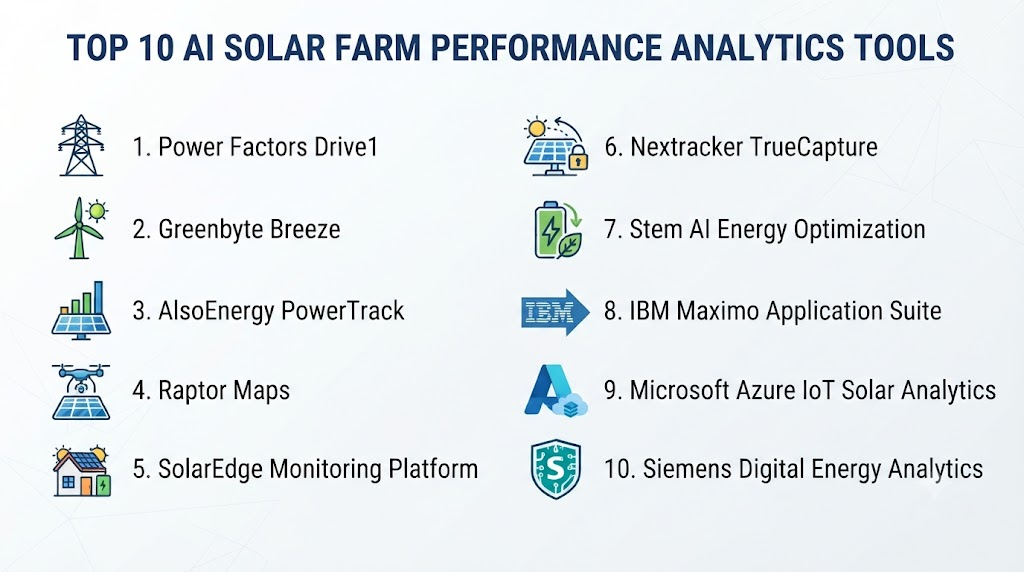
Top 10 AI Solar Farm Performance Analytics Tools
1. Power Factors Drive
Power Factors provides renewable energy asset management and analytics solutions.
Key Features
- Solar performance monitoring
- Asset analytics
- Performance benchmarking
- Data management
- Fault detection
- Reporting
- Portfolio monitoring
- Predictive analytics
- Automated workflows
- Renewable intelligence
Pros
- Renewable energy focused
- Strong portfolio management
- Good analytics capabilities
- Supports large solar fleets
- Enterprise-ready
Cons
- Enterprise implementation
- Requires integration
- Advanced features need configuration
Platforms
Cloud platform.
Deployment or Support
Cloud deployment.
Security & Compliance
Enterprise security controls.
Integrations & Ecosystem
Solar assets, SCADA systems, IoT devices, and renewable management platforms.
Support & Community
Enterprise support.
2. Greenbyte Breeze
Greenbyte Breeze provides renewable asset monitoring and analytics.
Key Features
- Solar monitoring
- Performance analysis
- Data visualization
- Fault detection
- Asset comparison
- Reporting
- Renewable analytics
- Alerts
- Data integration
- Portfolio insights
Pros
- Renewable industry expertise
- Strong monitoring capabilities
- Good visualization
- Supports multiple assets
- Easy performance tracking
Cons
- Requires setup
- Integration effort
- Advanced AI varies
Platforms
Cloud platform.
Deployment or Support
Cloud deployment.
Security & Compliance
Security controls vary.
Integrations & Ecosystem
Solar farms, wind assets, SCADA systems, and energy platforms.
Support & Community
Professional support.
3. AlsoEnergy PowerTrack
AlsoEnergy provides solar monitoring and asset performance management.
Key Features
- Solar monitoring
- Performance analytics
- Data collection
- Fault detection
- Reporting
- Energy insights
- Asset management
- Alerts
- Visualization
- Analytics
Pros
- Solar-focused platform
- Strong monitoring
- Good reporting
- Supports large installations
- Industry experience
Cons
- Requires configuration
- Enterprise-focused
- Integration needed
Platforms
Cloud platform.
Deployment or Support
Cloud deployment.
Security & Compliance
Security controls vary.
Integrations & Ecosystem
Solar systems, inverters, sensors, and energy platforms.
Support & Community
Professional support.
4. Raptor Maps
Raptor Maps provides AI-powered solar inspection and asset intelligence.
Key Features
- Drone inspections
- Thermal imaging analysis
- AI defect detection
- Solar asset mapping
- Performance analytics
- Reporting
- Data visualization
- Inspection workflows
- Asset tracking
- Collaboration
Pros
- Strong solar inspection capabilities
- AI image analysis
- Good defect detection
- Drone integration
- Solar-specific workflows
Cons
- Inspection-focused
- Requires drone data
- Integration needed
Platforms
Cloud platform.
Deployment or Support
Cloud deployment.
Security & Compliance
Security controls vary.
Integrations & Ecosystem
Drones, solar farms, inspection systems, and asset platforms.
Support & Community
Professional support.
5. SolarEdge Monitoring Platform
SolarEdge provides solar monitoring and optimization capabilities.
Key Features
- Solar production monitoring
- Inverter analytics
- Performance tracking
- Alerts
- Energy reports
- System optimization
- Remote monitoring
- Data visualization
- Fault identification
- Asset insights
Pros
- Strong solar ecosystem
- Good inverter monitoring
- Real-time visibility
- Easy deployment
- Solar-focused
Cons
- Primarily SolarEdge ecosystem
- Limited outside integrations
- Asset compatibility varies
Platforms
Cloud platform.
Deployment or Support
Cloud deployment.
Security & Compliance
Security controls vary.
Integrations & Ecosystem
SolarEdge systems, monitoring devices, and energy applications.
Support & Community
Customer support.
6. Nextracker TrueCapture
Nextracker provides AI-driven solar tracking optimization.
Key Features
- Solar tracker optimization
- Energy yield improvement
- Weather analysis
- Solar positioning
- Performance analytics
- Automated adjustments
- Data monitoring
- Optimization algorithms
- Reporting
- Energy insights
Pros
- Improves solar output
- Strong tracker expertise
- AI optimization
- Renewable-focused
- Good performance insights
Cons
- Focused on tracking systems
- Requires compatible hardware
- Specialized solution
Platforms
Cloud and hardware platforms.
Deployment or Support
Hybrid deployment.
Security & Compliance
Security controls vary.
Integrations & Ecosystem
Solar trackers, solar farms, monitoring systems, and energy platforms.
Support & Community
Enterprise support.
7. Stem AI Energy Optimization
Stem provides AI-powered energy optimization solutions.
Key Features
- Energy analytics
- Solar optimization
- Battery management
- Forecasting
- AI recommendations
- Energy insights
- Demand management
- Reporting
- Automation
- Optimization
Pros
- Strong AI energy optimization
- Supports storage integration
- Good analytics
- Automated decisions
- Energy management expertise
Cons
- Broader energy focus
- Requires integration
- Implementation effort
Platforms
Cloud platform.
Deployment or Support
Cloud deployment.
Security & Compliance
Enterprise security controls.
Integrations & Ecosystem
Solar systems, batteries, energy platforms, and grid systems.
Support & Community
Professional support.
8. IBM Maximo Application Suite
IBM Maximo provides AI-powered asset management for renewable infrastructure.
Key Features
- Predictive maintenance
- Asset monitoring
- AI analytics
- Work management
- IoT integration
- Asset health scoring
- Reporting
- Maintenance workflows
- Data analysis
- Automation
Pros
- Strong enterprise asset management
- AI capabilities
- Flexible integrations
- Supports multiple industries
- Scalable platform
Cons
- Requires configuration
- Enterprise-focused
- Implementation effort
Platforms
Cloud and enterprise platforms.
Deployment or Support
Hybrid deployment.
Security & Compliance
Enterprise security controls.
Integrations & Ecosystem
IoT systems, solar assets, ERP systems, and maintenance platforms.
Support & Community
Enterprise support.
9. Microsoft Azure IoT Solar Analytics
Microsoft Azure provides AI and IoT capabilities for solar monitoring.
Key Features
- IoT monitoring
- Machine learning
- Solar analytics
- Predictive models
- Data processing
- Digital twins
- Dashboards
- Automation
- Cloud analytics
- Security management
Pros
- Flexible AI platform
- Strong IoT capabilities
- Scalable infrastructure
- Customizable solutions
- Enterprise security
Cons
- Requires technical expertise
- Custom development needed
- Cloud dependency
Platforms
Cloud platform.
Deployment or Support
Cloud deployment.
Security & Compliance
Enterprise cloud security controls.
Integrations & Ecosystem
Solar systems, IoT devices, analytics tools, and enterprise applications.
Support & Community
Microsoft support ecosystem.
10. Siemens Digital Energy Analytics
Siemens provides digital energy solutions for renewable asset optimization.
Key Features
- Solar analytics
- Energy management
- Asset monitoring
- Performance optimization
- Predictive insights
- Data analytics
- Grid integration
- Reporting
- Automation
- Digital solutions
Pros
- Strong energy expertise
- Enterprise capabilities
- Grid integration support
- Advanced analytics
- Industrial reliability
Cons
- Complex deployment
- Enterprise-focused
- Requires expertise
Platforms
Cloud and enterprise platforms.
Deployment or Support
Hybrid deployment.
Security & Compliance
Enterprise security controls.
Integrations & Ecosystem
Solar assets, energy systems, IoT platforms, and grid applications.
Support & Community
Enterprise support.
Comparison Table
| Tool Name | Best For | Platform(s) Supported | Deployment | Standout Feature | Public Rating |
|---|---|---|---|---|---|
| Power Factors Drive | Solar portfolio analytics | Cloud | Cloud | Renewable asset intelligence | N/A |
| Greenbyte Breeze | Renewable monitoring | Cloud | Cloud | Performance tracking | N/A |
| AlsoEnergy PowerTrack | Solar monitoring | Cloud | Cloud | Solar analytics | N/A |
| Raptor Maps | Solar inspection | Cloud | Cloud | AI defect detection | N/A |
| SolarEdge Monitoring | Solar systems | Cloud | Cloud | Inverter analytics | N/A |
| Nextracker TrueCapture | Solar tracking | Cloud/Hardware | Hybrid | Yield optimization | N/A |
| Stem AI Optimization | Energy optimization | Cloud | Cloud | AI energy management | N/A |
| IBM Maximo | Asset management | Cloud/Enterprise | Hybrid | Predictive maintenance | N/A |
| Azure IoT Solar Analytics | Custom AI solutions | Cloud | Cloud | IoT + AI | N/A |
| Siemens Digital Energy | Enterprise energy | Cloud/Enterprise | Hybrid | Energy optimization | N/A |
Weighted Evaluation
| Tool Name | Core Features 25% | Ease of Use 15% | Integrations & Ecosystem 15% | Security & Compliance 10% | Performance & Reliability 10% | Support & Community 10% | Price/Value 15% | Total |
|---|---|---|---|---|---|---|---|---|
| Power Factors Drive | 25 | 13 | 15 | 10 | 10 | 10 | 11 | 94 |
| Greenbyte Breeze | 23 | 14 | 14 | 10 | 10 | 10 | 11 | 92 |
| AlsoEnergy PowerTrack | 23 | 13 | 14 | 10 | 10 | 10 | 11 | 91 |
| Raptor Maps | 22 | 14 | 13 | 10 | 10 | 10 | 11 | 90 |
| SolarEdge Monitoring | 22 | 15 | 12 | 10 | 10 | 10 | 12 | 91 |
| Nextracker TrueCapture | 23 | 13 | 13 | 10 | 10 | 10 | 11 | 90 |
| Stem AI Optimization | 23 | 13 | 14 | 10 | 10 | 10 | 11 | 91 |
| IBM Maximo | 24 | 12 | 15 | 10 | 10 | 10 | 11 | 92 |
| Azure IoT Solar Analytics | 24 | 13 | 15 | 10 | 10 | 10 | 12 | 94 |
| Siemens Digital Energy | 24 | 12 | 15 | 10 | 10 | 10 | 10 | 91 |
Which AI Solar Farm Performance Analytics Tool Is Right for You?
Choose Power Factors Drive when renewable portfolio analytics are required.
Choose Greenbyte Breeze when renewable monitoring is the priority.
Choose AlsoEnergy PowerTrack when solar asset monitoring is needed.
Choose Raptor Maps when AI-powered solar inspections are important.
Choose SolarEdge Monitoring Platform when SolarEdge-based systems are used.
Choose Nextracker TrueCapture when tracker optimization is required.
Choose Stem AI Energy Optimization when solar and storage optimization is needed.
Choose IBM Maximo Application Suite when enterprise asset management is required.
Choose Microsoft Azure IoT Solar Analytics when custom AI solutions are preferred.
Choose Siemens Digital Energy Analytics when enterprise energy optimization is needed.
Implementation Playbook
Phase 1: Define Solar Analytics Goals
- Identify performance challenges
- Select monitoring requirements
- Define optimization targets
- Identify critical assets
- Establish success metrics
Phase 2: Prepare Solar Data
- Connect monitoring systems
- Collect inverter data
- Integrate weather information
- Add sensor data
- Establish cybersecurity controls
Phase 3: Deploy AI Analytics
- Train AI models
- Configure dashboards
- Enable alerts
- Create workflows
- Test recommendations
Phase 4: Measure Results
- Increase energy output
- Reduce downtime
- Improve maintenance planning
- Optimize asset performance
- Track improvements
Phase 5: Maintain AI Systems
- Update models
- Monitor accuracy
- Improve data quality
- Review insights
- Maintain governance
Common Mistakes
- Poor data collection
- Ignoring weather impacts
- Lack of inverter monitoring
- Weak system integration
- Not validating AI insights
- Ignoring maintenance feedback
- Poor cybersecurity planning
- Failing to update models
FAQs
1. What are AI Solar Farm Performance Analytics Tools?
AI Solar Farm Performance Analytics Tools use artificial intelligence to monitor and optimize solar energy production.
2. How does AI improve solar farm performance?
AI identifies faults, analyzes production patterns, and recommends optimization actions.
3. Who uses solar performance analytics tools?
Solar operators, utilities, renewable companies, and asset managers use these solutions.
4. Can AI detect faulty solar panels?
Yes. AI can identify performance issues through sensor data and image analysis.
5. What data do solar analytics platforms use?
They use production data, inverter information, weather data, and inspection records.
6. Can AI improve solar energy output?
Yes. AI helps identify losses and improve operational efficiency.
7. Do AI solar tools support large solar farms?
Many platforms support utility-scale solar portfolios.
8. Can AI help with predictive maintenance?
Yes. AI predicts equipment issues before failures occur.
9. Are solar analytics platforms secure?
Organizations should implement cybersecurity controls for renewable infrastructure.
10. What should companies consider before selecting an AI solar analytics tool?
Companies should evaluate analytics capability, integrations, scalability, security, accuracy, and cost.
Conclusion
AI Solar Farm Performance Analytics Tools are transforming renewable energy operations by improving visibility, detecting issues faster, and maximizing solar asset performance.Power Factors, Greenbyte, AlsoEnergy, IBM Maximo, Microsoft Azure, and Siemens provide strong analytics capabilities, while specialized platforms such as Raptor Maps and Nextracker focus on solar inspection and optimization.The most effective solar analytics strategy combines AI technology with reliable data, operational expertise, cybersecurity, and continuous improvement. AI enables solar operators to increase efficiency, reduce costs, and deliver more reliable clean energy.
