Introduction
Navigating the complexities of Indian taxation, regulatory compliance, and corporate financial management can be a daunting endeavor for individuals, startups, and established enterprises alike. Whether you are aiming to minimize personal tax liabilities, launch a tech startup, or manage cross-border investments as a Non-Resident Indian (NRI), securing qualified financial guidance is essential. Hiring a certified financial expert ensures that your organization stays fully compliant with changing statutory mandates while unlocking strategic avenues for tax optimization, risk mitigation, and sustainable commercial expansion. Finding the right accounting professional was historically limited to physical networking, word-of-mouth recommendations, or regional directory listings. Today, centralized platforms like BestCaNow allow you to search for a verified chartered accountant near me, schedule a remote online CA consultation, or browse an extensive chartered accountant directory tailored precisely to your niche.
Understanding the Role of a Chartered Accountant
A Chartered Accountant (CA) is a credentialed financial strategist who has completed rigorous examinations, practical training, and regulatory certifications governed by the Institute of Chartered Accountants of India (ICAI). CAs serve as essential advisors across direct and indirect taxation, corporate governance, financial reporting, statutory audits, and cross-border transactions.
Unlike basic bookkeepers who handle day-to-day data entry and routine transaction tracking, a CA delivers executive-level advisory solutions. They analyze balance sheet health, structure tax-efficient corporate models, oversee company filings with the Ministry of Corporate Affairs (MCA), and ensure statutory audit mandates are fulfilled smoothly.
Core Responsibilities of Modern CAs
- Taxation Strategy: Formulating compliant frameworks for personal and corporate income tax, international tax treaties, transfer pricing, and capital gains optimization.
- Audit and Governance: Conducting statutory, internal, tax, and forensic audits to certify financial transparency, internal controls, and regulatory integrity.
- Corporate Compliance: Managing Registrars of Companies (ROC) disclosures, drafting board resolutions, and maintaining statutory registers under the Companies Act.
- Financial Advisory: Assisting with corporate valuations, capital structure design, risk assessment, debt financing preparation, and venture capital fundraising.
Why Professional CA Services Matter for Growth
Operating without professional accounting support exposes individuals and growing enterprises to severe legal, administrative, and financial liabilities. India’s regulatory environment evolves rapidly—frequent tax modifications, GST notifications, and compliance updates mean that missing a deadline or misinterpreting statutory provisions can result in costly penalties, interest charges, or legal disputes.
Partnering with an experienced income tax consultant near me or a certified GST consultant near me offers operational security. Professional guidance ensures your business takes full advantage of legal deductions, tax exemptions, and input tax credits while keeping all books audit-ready year-round.
Strategic Advantages of Professional Advisory
- Financial Precision: Verified financial statements eliminate accounting discrepancies that could otherwise undermine bank credit ratings or deter potential equity investors.
- Penalty Elimination: Timely tax return filings and accurate Tax Deducted at Source (TDS) calculations shield your business from recurring late fees and interest liabilities.
- Core Operational Focus: Outsourcing compliance and accounting workflows frees up internal resources, allowing business leaders to focus on core product development, marketing, and revenue growth.
Essential Services Offered by Chartered Accountants
Chartered Accountants provide a diverse array of financial, legal, and operational services suited to different growth stages and personal finance requirements.
1. Direct Taxation and Financial Planning
Direct tax advisory covers personal income tax, corporate tax, and capital gains planning. Key deliverables include annual income tax return filing, advance tax estimations, foreign asset reporting, and representing clients before tax authorities during assessment proceedings or dispute notices.
2. GST Advisory and Return Filing
GST compliance requires systematic tracking of tax invoices, continuous reconciliations, and filing monthly or quarterly statutory returns. A dedicated GST consultant near me assists with initial GST registration, Input Tax Credit (ITC) optimization, annual return filings (GSTR-9/9C), and resolving mismatch notices issued by tax authorities.
3. Corporate Registration and Secretarial Services
Launching a corporate entity requires strict adherence to legal incorporation steps. Utilizing a CA for company registration ensures error-free name approvals, drafting Memorandum and Articles of Association (MOA/AOA), obtaining PAN/TAN, securing Director Identification Numbers (DIN), and maintaining ROC compliance.
4. Audit and Assurance Services
Audits independently verify the accuracy and fairness of financial records. Dedicated audit services near me conduct statutory audits under the Companies Act, tax audits under Section 44AB of the Income Tax Act, and internal process reviews to safeguard internal controls.
Comparative Analysis: Key Financial Decisions
Making informed decisions about legal structures and consultation methods requires comparing costs, compliance loads, and operational trade-offs.
Comparison Table 1: Online CA Consultation vs In-Person Consultation
| Features | Online CA Consultation | In-Person Consultation |
| Accessibility | Global; schedule and connect from anywhere via video or web portals | Regional; tied to local physical office visits and fixed business hours |
| Document Sharing | Encrypted digital uploads, cloud drives, and online portals | Physical document delivery, paper filing, or hand delivery |
| Turnaround Time | Fast; flexible appointment slots and rapid digital communications | Subject to office appointment availability and travel times |
| Advantages | Cost-effective, zero travel overhead, access to nationwide experts | Direct personal rapport, physical review of original paper files |
| Limitations | Requires stable internet connection and basic digital literacy | Geographically restricted, higher transit time and meeting overheads |
| Best Use Cases | Routine tax filing, quick strategy queries, remote business setups | Complex physical inventory audits, litigation hearings, court representation |
| Cost Considerations | Generally lower fees due to reduced administrative overheads | Includes local administrative, physical documentation, and transit costs |
Comparison Table 2: Sole Proprietorship vs LLP vs Private Limited Company
| Features | Sole Proprietorship | Limited Liability Partnership (LLP) | Private Limited Company (Pvt Ltd) |
| Legal Status | Unincorporated; owner and business are a single legal entity | Separate legal entity distinct from its partners | Separate legal entity distinct from its directors/shareholders |
| Liability | Unlimited personal liability for business debts | Limited to each partner’s agreed financial contribution | Limited to the nominal value of unpaid share capital |
| Registration Needs | Basic local trade license / GST registration | Mandatory MCA registration and LLP agreement | Formal MCA incorporation, MOA/AOA drafting, and DIN allocations |
| Compliance Load | Minimal annual filing requirements | Moderate annual ROC and financial disclosures | High statutory ROC compliance, mandatory audits, and secretarial filings |
| Fundraising Ability | Extremely limited; relies on personal capital or micro-loans | Moderate; limited to borrowing or adding new equity partners | High; ideal structure for attracting venture capital and angel funding |
| Advantages | Simple setup, minimal costs, complete operational autonomy | Limited liability protection with lower compliance than corporate entities | Highest commercial credibility, easy transfer of equity, investor preference |
| Limitations | High personal financial risk, limited expansion capability | Cannot issue stock options (ESOPs) to employees | Higher setup, ongoing maintenance, and mandatory audit expenses |
| Cost Considerations | Lowest initial registration and compliance costs | Moderate setup and annual compliance expenses | Highest initial incorporation, secretarial, and audit fees |
Comparison Table 3: In-House Accountant vs External Chartered Accountant
| Features | In-House Accountant | External Chartered Accountant |
| Primary Focus | Daily bookkeeping, customer invoicing, vendor payments, basic payroll | Strategic tax planning, statutory audits, corporate structuring, compliance |
| Qualifications | General commerce/finance degree or bookkeeping certification | ICAI certified member holding a valid Certificate of Practice (COP) |
| Availability | Full-time employee presence during standard working hours | Retainer, project-based, or contractual engagement model |
| Advantages | Immediate on-site access, deep familiarity with daily operations | High-level regulatory expertise, certified audit authority, objective perspective |
| Limitations | Fixed monthly salary overhead, benefits, and office equipment costs | Not dedicated to daily data entry or routine record maintenance |
| Best Use Cases | High-volume daily transactions requiring immediate ledger entries | Complex tax strategy, annual return certifications, audits, regulatory filings |
| Cost Considerations | Recurring fixed monthly salary, health benefits, and operational overhead | Scalable, milestone-driven, or annual retainer fee structure |
Specialized Accounting Needs: Startups, MSMEs, and NRIs
Different economic actors face distinct regulatory and taxation challenges. A one-size-fits-all accounting strategy often leads to compliance oversights or missed financial incentives.
CA Services for Startups and MSMEs
Startups operate in dynamic, capital-intensive environments that require forward-looking financial management. Partnering with a specialized CA for startups helps founders build scalable cap tables, structure employee stock option plans (ESOPs), manage seed grants, and prepare financial projections for investor due diligence.
Micro, Small, and Medium Enterprises (MSMEs) benefit from strategic guidance to navigate government subsidy schemes, secure priority sector lending, and enforce delayed payment protections under the MSMED Act.
Foreign Investments and NRI Tax Considerations
Non-Resident Indians managing assets or earnings in India face intricate tax structures. An experienced NRI tax consultant in India helps navigate Double Taxation Avoidance Agreements (DTAA), Foreign Exchange Management Act (FEMA) regulations, lower TDS certification requests under Section 197, repatriation procedures via Form 15CA/15CB, and foreign asset disclosures.
How to Choose the Right Chartered Accountant
Selecting a CA is a critical operational decision. The right partner acts as a trusted extension of your leadership team, identifying financial risks and optimizing your tax profile.
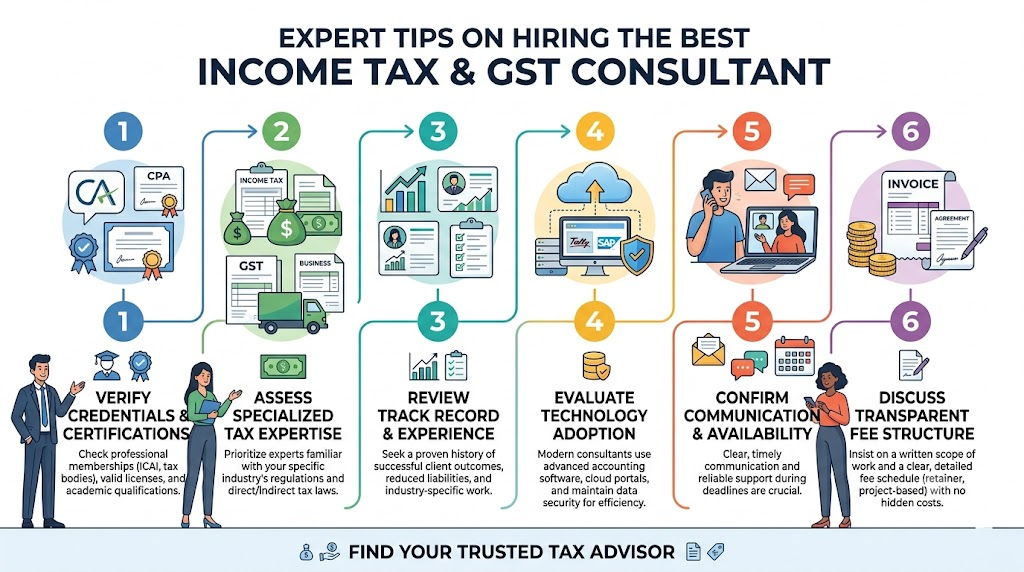
- Verify ICAI Credentials: Always confirm that the professional is an active member registered with the Institute of Chartered Accountants of India (ICAI) and holds a valid Certificate of Practice (COP).
- Evaluate Niche Expertise: Ensure the professional specializes in your specific domain—corporate governance, cross-border tax, startup advisory, or GST compliance.
- Assess Digital Capabilities: Modern accounting practices leverage cloud software, encrypted file sharing, and remote collaboration portals to streamline communications and document management.
- Demand Transparent Pricing: Insist on a clear, itemized engagement contract specifying scope, deliverables, and fee structures to eliminate unexpected billing surprises.
Best Practices for Financial & Tax Compliance
Implementing proactive financial management workflows ensures seamless audit cycles and eliminates statutory non-compliance risks.
- Separate Business and Personal Finances: Maintain completely distinct bank accounts for business transactions to preserve ledger clarity and simplify audit trails.
- Digitize Records Immediately: Utilize secure cloud storage and accounting software to snapshot, categorize, and archive purchase invoices and receipts as they occur.
- Conduct Monthly Reconciliations: Perform monthly bank and GST reconciliations to detect discrepancies early rather than rushing during year-end tax preparation.
- Set Statutory Deadline Reminders: Calendar automated alerts for monthly GST filings, quarterly advance tax payments, TDS deposits, and annual ROC disclosures.
- Retain Records Securely: Store statutory registers, tax returns, and audited financial statements for a minimum of seven years to comply with statutory retention rules.
Expert Tips for Managing Your Accounting Operations
- Consult Before Major Transactions: Seek CA advice before executing significant commercial agreements, property sales, or fundraising rounds to structure transactions efficiently.
- Monitor Input Tax Credit (ITC): Frequently reconcile your purchase registers against vendor disclosures on the GST portal (GSTR-2B) to avoid losing eligible tax credits.
- Maintain Tax Reserve Accounts: Set aside collected GST funds and estimated income tax liabilities in a dedicated reserve account each month to protect cash flow.
- Schedule Pre-Year-End Reviews: Conduct financial reviews in Q3 or early Q4 to optimize legitimate deductions and capital investments before the fiscal year closes.
- Standardize Your Chart of Accounts: Keep ledger categories consistent over time to perform meaningful financial comparisons and trend analysis.
Common Accounting Mistakes to Avoid
- Delaying Tax Returns: Rushing filings at the deadline increases error rates, leads to portal congestion, and risks late filing fees or interest charges.
- Inadequate Invoice Documentation: Missing vendor GSTINs, incorrect addresses, or incomplete invoice details can lead tax authorities to reject Input Tax Credit claims.
- Selecting Advisors Based Solely on Cost: Choosing a financial advisor based only on the lowest fee often leads to poor service quality, missed deadlines, and unoptimized tax positioning.
- Overlooking Statutory Due Dates: Missing ROC or MCA annual return deadlines triggers daily penalty fees that accumulate over time.
- Failing to Deduct TDS on Time: Neglecting to deduct or deposit Tax Deducted at Source (TDS) within statutory windows results in interest penalties and the disallowance of business expenses under tax laws.
The Future of Digital Accounting Services
The accounting industry is undergoing a digital transformation. Cloud accounting platforms, automated bank feeds, AI-driven reconciliation engines, and virtual consultations are replacing slow, paper-heavy workflows.
Using a curated directory platform allows business owners and individuals to search nationwide, compare specialized CA profiles, evaluate client feedback, and book consultations seamlessly. This digital ecosystem democratizes access to top-tier financial expertise regardless of geographical boundaries.
Why Choose BestCaNow for Your Accounting Needs
Finding a verified financial professional should be simple and transparent. BestCaNow connects individuals, startups, and enterprises with qualified Chartered Accountants and tax experts across India and internationally.
- Curated Directory: Access verified CA profiles filtered by location, years of experience, domain specialization, and consultation mode.
- Specialized Expertise: Discover dedicated professionals, including an income tax consultant near me, a certified GST consultant near me, or a experienced CA for startups.
- Flexible Engagement Options: Choose between flexible online CA consultation sessions or schedule traditional in-person meetings.
- Transparent Profile Information: Review professional qualifications, service specializations, and client feedback before scheduling a meeting.
- Comprehensive Support: Find tailored guidance whether you need a chartered accountant near me for local business filings or an NRI tax consultant in India for cross-border tax advisory.
Frequently Asked Questions (FAQs)
FAQ 1: How do I choose between an online CA consultation and an in-person meeting?
Select an online consultation if you value convenience, quick scheduling, digital file sharing, and access to domain specialists across different cities. Choose an in-person meeting if your situation involves physical document verification, complex statutory audits, or local court representations requiring face-to-face interaction.
FAQ 2: What credentials should I verify before hiring a Chartered Accountant?
Verify that the professional is an active member registered with the Institute of Chartered Accountants of India (ICAI). Check their official Membership Number and confirm they hold a valid Certificate of Practice (COP) if they are offering independent public auditing or tax representation services.
FAQ 3: Why should a startup hire a CA for company registration instead of using generic online templates?
A qualified CA evaluates your long-term business goals to recommend the ideal legal structure (such as an LLP or Private Limited Company). They draft customized Memorandum and Articles of Association, structure founder equity, set up tax registrations, and ensure full MCA compliance from day one.
FAQ 4: What is the main difference between a tax consultant and a Chartered Accountant?
A general tax consultant may assist with basic return filing but may lack formal statutory certification. A Chartered Accountant is a regulated professional certified by the ICAI, authorized to conduct statutory audits, sign financial statements, handle complex litigation, and offer certified business advisory services.
FAQ 5: How often should my business file GST returns?
GST filing frequency depends on your chosen tax scheme and annual turnover. Regular taxpayers file monthly returns (such as GSTR-1 and GSTR-3B), whereas smaller businesses opted into the QRMP scheme file returns quarterly with monthly tax payments. Your CA can help select the optimal schedule.
FAQ 6: What documentation is required for an online income tax consultation?
You will typically need your PAN card, Aadhaar card, Form 16/16A, bank account statements for the financial year, investment proofs (under Section 80C, 80D, etc.), capital gains statements from stockbrokers or real estate transactions, and details of any secondary income sources.
FAQ 7: How can an NRI tax consultant in India help with international tax matters?
An NRI tax consultant determines residency status under Indian tax law, applies Double Taxation Avoidance Agreements (DTAA) to prevent double taxation, assists with lower TDS certificate applications, and manages compliant fund repatriations using Form 15CA/15CB filings.
FAQ 8: What are the risks of filing income tax returns past the statutory deadline?
Filing returns past the deadline attracts late fees under Section 234F, triggers penal interest on unpaid tax liabilities under Section 234A, and forfeits your right to carry forward certain business or capital losses to offset future income.
FAQ 9: Do small MSMEs require statutory audit services?
Statutory audit requirements depend on your legal business structure and annual turnover. Registered companies require statutory audits regardless of turnover, while sole proprietorships and partnerships require tax audits once annual turnover exceeds thresholds specified under Section 44AB of the Income Tax Act.
FAQ 10: Can a Chartered Accountant assist with business loans and bank financing?
Yes, CAs prepare detailed Project Reports (DPR), draft audited financial statements, calculate debt-service coverage ratios (DSCR), and issue certified Net Worth Certificates that commercial banks and financial institutions require during credit appraisals.
FAQ 11: How do CAs charge for their professional advisory services?
Pricing structures vary based on engagement scope. CAs may charge fixed fees for single filings or corporate registrations, hourly rates for specialized consulting, or recurring monthly or annual retainer fees for ongoing bookkeeping, GST, and payroll support.
FAQ 12: What is the benefit of using a specialized CA for startups?
Startup-focused CAs understand key nuances like cap table management, ESOP valuation frameworks, founder agreements, regulatory compliance for angel investment, and applying for DPIIT startup recognition tax exemptions.
FAQ 13: What should I do if I receive a tax notice from the Income Tax Department?
Do not panic. Share the notice with your CA immediately. They will analyze the query, gather supporting financial documents, draft a formal legal response, and submit the clarification through the official e-filing portal on your behalf.
FAQ 14: How does a GST consultant help maximize Input Tax Credit (ITC)?
A GST consultant reconciles your purchase registers against vendor filings on the portal (GSTR-2B), flags missing or delayed credits, alerts you to vendor filing errors, and ensures legal credit claims without exposing your business to penalty risks.
FAQ 15: How can I find a trusted chartered accountant directory?
Platforms like BestCaNow provide organized directories where you can filter certified professionals by city, years of experience, specialization area, and customer ratings to find the right partner for your needs.
Conclusion
Managing taxation, audit obligations, and statutory compliance requires technical precision and continuous diligence. Whether you are an individual managing personal investments, a startup founder scaling an enterprise, or an NRI managing international tax treaties, partnering with the right financial expert is crucial for long-term stability and success. Working with qualified Chartered Accountants protects your enterprise from statutory penalties, optimizes tax liabilities, and keeps your financial records audit-ready. Modern digital platforms make finding verified CAs faster and more transparent than ever. By evaluating credentials, defining clear engagement scopes, and leveraging online consultations, you can build a resilient financial foundation for your business.
