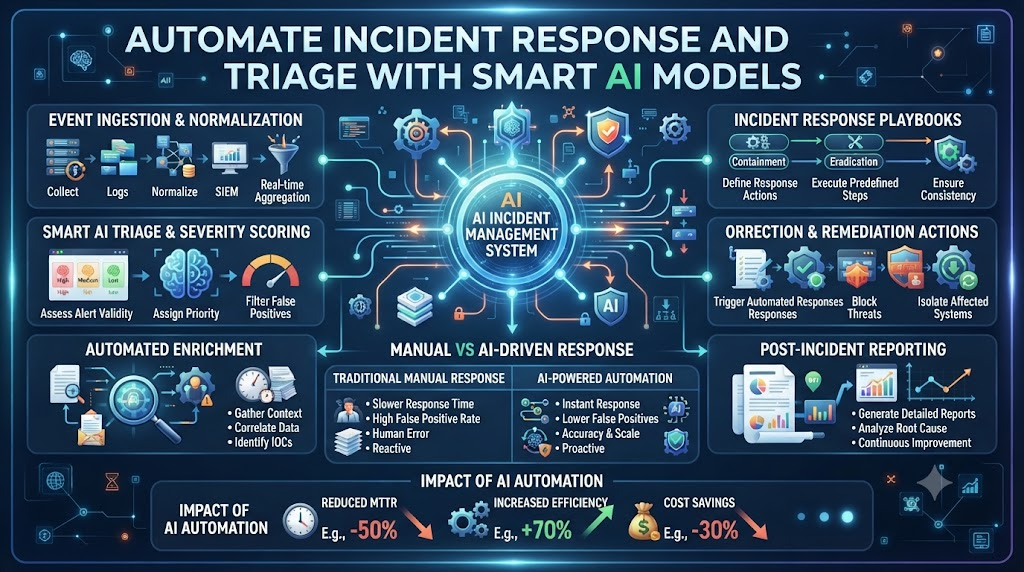
Defending a modern corporate network feels like chasing shadows in a storm. Security teams drown in thousands of daily alerts while real threats hide in plain sight. Traditional rule-based security systems fail because they only spot known attack patterns. Hackers change tactics every single hour to bypass static defenses. Modern organizations solve this crisis by deploying artificial intelligence for real-time threat detection. These smart tools analyze millions of log events instantly to flag unusual behaviors. Platforms like AIUniverse.xyz give you the exact frameworks needed to build resilient security operations. You can connect your telemetry data, train behavioral models securely, and spot advanced persistent threats before they cause damage. Let us explore the core tools, underlying techniques, and practical strategies that make artificial intelligence essential for modern cybersecurity defense. Understanding these technical elements helps you protect critical data assets, reduce alert fatigue, and stay ahead of sophisticated criminal networks.
Understanding Modern Cybersecurity Threats
The threat landscape grows more complex with each passing day. Cyber criminals launch automated ransomware campaigns that bypass perimeter walls instantly. Insider threats move quietly through internal servers without triggering alarms. Traditional firewalls cannot see these subtle movements because traffic looks normal on the surface. You need deep visibility into every packet moving across your network. Artificial intelligence provides this visibility by learning normal user habits. It flags deviations immediately before data exfiltration occurs.
Attackers now use machine learning tools to automate their own exploits. They scan enterprise perimeters for unpatched vulnerabilities in seconds. If your defense relies only on human monitoring, you will always arrive too late. Automated threats demand automated countermeasures operating at machine speed. AI systems evaluate threat indicators around the clock without getting tired. This continuous vigilance forms the backbone of modern digital security.
Why Legacy Security Tools Break Down
Older security products rely on static signatures and hardcoded rules. Every time a new malware variant appears, analysts must write a new rule. This manual process creates dangerous gaps in your defense posture. Hackers simply tweak their code to generate a new signature. Your static scanners pass the modified file without raising any flags. This cat-and-mouse game wastes precious analyst hours every single week.
Legacy systems also flood security operations centers with thousands of false alarms. Each false positive drains team energy and creates dangerous alert fatigue. Analysts miss genuine breaches because they spend hours chasing phantom threats. You need intelligent filtering to separate real danger from harmless background noise. Modern machine learning cuts through this clutter by understanding context and intent.
The Role of Machine Learning in Threat Detection
Machine learning models ingest massive volumes of security log data simultaneously. They process endpoint telemetry, firewall logs, and user activity records together. Supervised learning algorithms spot known attack signatures with extreme speed and accuracy. Unsupervised models hunt for zero-day exploits without needing prior examples. These models learn what normal network behavior looks like over time. Any unusual deviation triggers an automated alert for your security team.
Training these models requires clean historical data from your own environment. You feed historical attack logs and normal traffic patterns into the learning pipeline. The algorithm adjusts its internal weights to minimize classification errors. Over time, the model becomes exceptionally skilled at spotting subtle intrusion attempts. This adaptive learning ensures your defense gets smarter with every single interaction.
Behavioral Analytics and Baseline Modeling
User and entity behavior analytics monitor how people interact with your systems. Every employee has a unique pattern of logging in and accessing files. An AI model maps these normal routines over a baseline training period. If an account suddenly downloads thousands of sensitive records at midnight, the system acts. It recognizes that this activity falls far outside the established user baseline.
This behavioral approach catches compromised credentials even when passwords are correct. Hackers using stolen credentials cannot mimic every single human habit. They type at different speeds, access unusual folders, and use unfamiliar devices. Behavioral models spot these microscopic anomalies instantly. You can revoke access before the intruder steals valuable intellectual property.
Automating Incident Triage and Response
When a security alert fires, speed is your most critical asset. Human analysts take precious minutes to investigate every single log entry. Automated triage systems reduce this response window to mere milliseconds. The AI engine reviews the alert context, checks threat intelligence feeds, and scores severity. It determines whether the threat is genuine or a harmless false positive.
High-risk threats trigger immediate automated containment actions across the network. The system isolates infected endpoints, revokes compromised tokens, and blocks malicious IP addresses. Your human analysts only step in to review complex root cause analysis reports. This automation eliminates human bottlenecks during active cyber attacks. Your organization maintains continuous protection even outside normal business hours.
Network Traffic Analysis Using Neural Networks
Enterprise networks generate petabytes of packet capture data every single day. Manual inspection of this traffic volume remains completely impossible for human teams. Deep neural networks analyze packet headers and payloads at line rate. They spot hidden command-and-control beaconing signals buried inside encrypted tunnels. Hackers often hide malware communication inside standard HTTPS traffic to evade detection.
Advanced neural models inspect traffic frequency, packet sizes, and timing patterns instead. They identify the subtle heartbeat of a remote access Trojan instantly. Once spotted, the network security platform drops the malicious connection automatically. Your internal data remains secure because the exfiltration attempt fails at the perimeter. Continuous traffic analysis stops lateral movement before damage spreads.
Endpoint Detection and Automated Remediation
Endpoints represent the primary entry point for modern ransomware and spyware. Laptops, servers, and mobile devices sit on the front lines of defense. Endpoint detection and response agents monitor process execution in real time. If a program attempts unauthorized registry modifications or file encryptions, the agent reacts. It terminates the malicious process before it infects neighboring drives.
Cloud-based AI engines coordinate defense intelligence across your entire device fleet. If one laptop detects a novel malware strain, the platform updates all endpoints. Every device in your organization gains instant immunity against the new threat. This collaborative defense model prevents widespread infections across remote workforce environments. Automated remediation scripts restore modified files from secure backups immediately.
Integrating SIEM and SOAR Platforms
Security information and event management tools collect logs from every system. Security orchestration, automation, and response tools execute automated remediation workflows. Combining these platforms with artificial intelligence creates a unified security nervous system. The SIEM feeds raw telemetry data into the machine learning analytics engine. The SOAR platform executes the playbooks triggered by the AI detection models.
This integration removes the friction between disparate security software products. Analysts view unified threat dashboards instead of jumping between ten different screens. Incident timelines display clear attack paths from initial compromise to final containment. You gain complete operational clarity across your entire technology stack. Streamlined workflows improve team morale and drastically lower burnout rates.
Overcoming False Positives and Alert Fatigue
Alert fatigue is the silent killer of effective cybersecurity operations. When analysts face five thousand alerts daily, they start ignoring them. A single missed alert can result in a catastrophic data breach. AI models reduce false positive rates by correlating multiple weak signals together. A single failed login is ignored, but paired with an unusual geolocation, it escalates.
Contextual scoring ensures your team only investigates high-probability security events. Machine learning models learn from analyst feedback to improve future accuracy. When an analyst marks an alert as a false positive, the model updates itself. This closed-loop feedback mechanism tunes out recurring harmless noise automatically. Your security operations center focuses entirely on authentic, high-impact threats.
Zero Trust Architecture and AI Enforcement
Perimeter security is dead because corporate networks no longer have clear boundaries. Remote workers, cloud servers, and mobile devices span the entire globe. Zero trust architecture assumes that every user and device is untrusted by default. Artificial intelligence enforces this strict philosophy by continuously verifying identity and behavior. Every request for data access undergoes real-time risk scoring.
If a user’s context changes during a session, the system re-evaluates their permissions. Sudden shifts in location, device posture, or typing speed trigger step-up authentication. The user must prove their identity before accessing sensitive database records. AI manages these continuous access decisions without frustrating legitimate employees. You achieve absolute security compliance across your entire distributed workforce.
Real-World Stories About Server Crashes and Support Crises
- Scenario 1: The Midnight Ransomware Assault — A manufacturing firm suffered a midnight ransomware deployment on their primary database server. Traditional antivirus tools failed because the malware used obfuscated evasion scripts. An AI endpoint agent detected unusual file renaming patterns and isolated the server instantly. This automated containment saved the company millions in potential extortion fees and downtime.
- Scenario 2: The Stolen Credentials Crisis — A financial services employee had their VPN credentials harvested through a targeted phishing attack. The attacker logged in from a foreign country at three in the morning. Behavioral analytics spotted the anomalous geolocation and typing cadence immediately. The system revoked the session token and alerted security before any funds were transferred.
- Scenario 3: The Cloud Misconfiguration Leak — A developer accidentally exposed an enterprise storage bucket containing customer personal records. Cloud security posture management tools flagged the permission change using automated policy checks. The remediation platform revoked public access permissions within forty seconds. Zero data was exfiltrated by external scrapers.
- Scenario 4: The Distributed Denial of Service Storm — An e-commerce retailer faced a massive botnet attack designed to crash their checkout servers during a major sale. Machine learning traffic analyzers identified the bot signatures within seconds of launch. Edge proxies scrubbed malicious traffic while letting genuine shoppers complete purchases normally. Website uptime remained at one hundred percent throughout the event.
- Scenario 5: The Insider Threat Exfiltration — A departing employee attempted to download proprietary source code onto a personal USB drive. Data loss prevention systems integrated with AI behavioral tracking flagged the unusual volume. The system blocked the USB port and locked the user account pending investigation. Intellectual property theft was successfully intercepted.
- Scenario 6: The Supply Chain Software Compromise — A trusted software vendor shipped an update containing a hidden backdoor vulnerability. Network traffic analysis tools detected unusual outbound beaconing from the internal update server. The security operations center received an immediate high-priority alert. Analysts patched the affected systems before lateral movement occurred.
- Scenario 7: The Zero-Day Exploit Breach — Hackers launched a zero-day exploit against an unpatched enterprise web application server. Unsupervised anomaly detection models noticed unexpected memory injection activity. The system terminated the rogue worker process and generated a forensic memory dump. Human engineers patched the vulnerability the next morning.
- Scenario 8: The Phishing Campaign Flood — A coordinated spear-phishing campaign targeted eighty percent of executive email accounts simultaneously. Natural language processing email filters analyzed message payloads and linguistic cues. The system quarantined every malicious email before users could click the links. No corporate credentials were compromised during the attack.
- Scenario 9: The Alert Fatigue Breakdown — A mid-sized healthcare provider suffered a major breach because their team ignored thousands of low-priority alerts. Implementing an AI triage layer reduced daily alert volume by ninety percent. Analysts could finally focus on genuine high-risk security incidents. Future audit reports showed zero missed intrusion attempts.
- Scenario 10: The API Security Blind Spot — A retail platform released new mobile application programming interfaces with weak authentication controls. Automated vulnerability scanners abused the endpoints to scrape pricing data. AI anomaly detection spotted the abnormal scraping frequency and rate-limited the attacker IPs. API integrity and business data remained fully protected.
Comparative Analytical Table of Security Approaches
| Security Metric / Feature | Traditional Rule-Based Defense | Modern AI Threat Detection |
| Detection Speed | Hours or days after human review | Milliseconds via real-time telemetry |
| Zero-Day Exploit Handling | Fails completely without prior signatures | Spots behavioral anomalies automatically |
| False Positive Rate | Extremely high, causing severe alert fatigue | Low, tuned continuously via closed-loop feedback |
| Analyst Workload | High manual triage of thousands of alerts | Focused investigation of scored high-risk events |
| Adaptability | Rigid, requires manual rule rewriting | Dynamic, learns continuously from new data |
Common Mistakes and Pitfalls in AI Security Deployment
- Mistake 1: Relying on Outdated Training Data — Feeding old attack logs into your machine learning pipeline creates blind spots for modern threats. Solution: Update your training datasets continuously with fresh threat intelligence feeds and recent telemetry records.
- Mistake 2: Ignoring Model Explainability — Deploying a black-box AI model that blocks traffic without explaining why frustrates your security team. Solution: Choose transparent platforms that provide clear explanations and risk scores for every automated action.
- Mistake 3: Failing to Fine-Tune Baseline Models — Using default model thresholds without adjusting them for your specific enterprise environment causes excessive false alarms. Solution: Run a dedicated baseline learning period of at least thirty days to map normal user behavior accurately.
- Mistake 4: Treating AI as a Complete Human Replacement — Sacking your entire security team under the assumption that artificial intelligence handles everything creates catastrophic vulnerabilities. Solution: Use AI to automate routine triage while keeping skilled human analysts in charge of strategic decisions.
- Mistake 5: Neglecting API and Integration Security — Leaving your security analytics platform disconnected from your firewall and endpoint tools prevents automated remediation. Solution: Build robust API integrations that let your detection engine execute containment playbooks instantly.
- Mistake 6: Overlooking Prompt Injection Risks in AI Tools — Allowing attackers to manipulate your security models using crafted input data compromises your entire defense. Solution: Implement strict input sanitization and adversarial robustness checks across all machine learning pipelines.
- Mistake 7: Failing to Monitor Model Drift — Assuming an AI model stays accurate forever without checking for performance degradation leads to silent failures. Solution: Audit model accuracy metrics monthly and retrain algorithms when environmental changes alter baseline behavior.
- Mistake 8: Storing Telemetry in Insecure Silos — Collecting sensitive enterprise log data without proper encryption violates compliance standards and invites breaches. Solution: Apply enterprise-grade encryption at rest and in transit across all security telemetry data repositories.
- Mistake 9: Launching Without Clear Incident Playbooks — Letting an AI system block traffic without predefined response workflows causes operational chaos during attacks. Solution: Define clear, tested incident response playbooks before activating automated containment features.
- Mistake 10: Skipping Regular Security Audits — Never testing your AI detection tools against simulated red-team attacks leaves your defenses unverified. Solution: Conduct routine penetration testing and red-team exercises to validate your automated threat detection capabilities.
Step-by-Step Implementation Roadmap
- Step 1: Assess Your Current Security Telemetry — Audit your existing firewall logs, endpoint agents, and identity providers to ensure you collect comprehensive security data.
- Step 2: Define Clear Detection Objectives — Determine whether your primary goal is stopping ransomware, detecting insider threats, or securing cloud infrastructure.
- Step 3: Choose the Right AI Security Platform — Select an advanced threat detection platform that supports behavioral analytics, automated triage, and seamless integrations.
- Step 4: Establish Baseline Data Pipelines — Connect your log sources to the AI platform and run an initial training period to map normal user and network activity.
- Step 5: Configure Automated Playbooks — Write and test incident response scripts that handle routine containment actions like isolating endpoints and revoking tokens.
- Step 6: Tune Alert Thresholds and Scoring — Adjust risk scoring parameters during a pilot phase to minimize false positives and eliminate alert fatigue.
- Step 7: Implement Human-in-the-Loop Reviews — Set up collaborative dashboards where security analysts review high-risk AI alerts and provide feedback.
- Step 8: Deploy Automated Enforcement Agents — Roll out endpoint detection and response agents and network monitoring sensors across your entire corporate fleet.
- Step 9: Conduct Red-Team Simulation Tests — Run controlled adversary simulations to verify that your AI models detect and contain active intrusion attempts.
- Step 10: Monitor, Audit, and Retrain Continuously — Review monthly performance metrics, update training datasets, and refine your behavioral models to match evolving threats.
Faqs
1. How does artificial intelligence improve cybersecurity threat detection?
Artificial intelligence improves threat detection by analyzing millions of log events instantly, spotting hidden behavioral anomalies, and automating incident triage to stop attacks before damage occurs.
2. What is the difference between signature-based and AI detection?
Signature-based detection relies on known attack patterns and fails against new threats. AI detection uses machine learning to identify unusual behaviors and zero-day exploits without prior signatures.
3. How do behavioral analytics prevent insider threats?
Behavioral analytics map normal user routines over time. If an account suddenly accesses unusual files or downloads large data volumes, the system flags the anomaly immediately.
4. Can AI completely replace human cybersecurity analysts?
No, AI automates routine alert triage and containment, but human analysts remain essential for strategic decision-making, forensic investigations, and complex root-cause analysis.
5. What causes high false positive rates in security systems?
Rigid rules and unrefined algorithms trigger excessive false alarms. Machine learning reduces false positives by correlating multiple weak signals and learning from analyst feedback.
6. How do I prevent attackers from manipulating security AI models?
You prevent manipulation by implementing strict input sanitization, adversarial robustness checks, and continuous model auditing across all machine learning pipelines.
7. What is the role of RAG in modern threat intelligence?
Retrieval-augmented generation allows security tools to query verified threat intelligence databases and documentation, ensuring accurate answers during incident investigations.
8. How long does it take to train a behavioral security model?
Most platforms require an initial baseline learning period of thirty days to map normal user and network activity accurately before full automated enforcement.
9. Are AI security platforms compliant with data privacy regulations?
Leading platforms use enterprise-grade encryption, role-based access controls, and data redaction to maintain strict compliance with global data protection laws.
10. What is the first step in implementing AI threat detection?
The first step is auditing your existing log collection infrastructure to ensure you gather comprehensive telemetry from endpoints, firewalls, and identity providers.
Final Recommendation and Next Steps
Deploying artificial intelligence for cybersecurity threat detection is no longer optional for modern enterprises. Hackers operate at machine speed, and human-only security teams cannot keep pace with manual tools. Start small by connecting your core endpoint logs to an intelligent analytics platform. Focus first on automating alert triage and establishing reliable behavioral baselines for your users.
Review your security telemetry weekly to spot hidden gaps and refine your automated containment playbooks. Keep your training datasets updated and maintain human oversight to handle complex strategic decisions. Take action today by auditing your current log collection infrastructure, defining your primary threat priorities, and integrating advanced AI tools to secure your digital future.
