Introduction
Agentic Research Assist Platforms are AI-powered systems that help users discover, analyze, synthesize, and validate information across large datasets, documents, and the open web using autonomous AI agents. Unlike traditional research tools or search engines, these platforms do not just retrieve information—they reason over it, break down research tasks into steps, evaluate sources, and generate structured insights.
In 2026, research workflows are becoming increasingly complex due to information overload, fragmented knowledge systems, and the need for faster decision-making. Agentic research platforms solve this by acting as autonomous research assistants that can plan investigations, gather evidence, cross-check claims, summarize findings, and even generate reports with citations and structured reasoning.
These platforms are widely used in academic research, enterprise intelligence, market research, product analysis, legal discovery, and strategic decision-making.
Real-World Use Cases
- Market and competitive intelligence research
- Academic literature review and synthesis
- Legal document analysis and case research
- Product and technology comparisons
- Investment and financial research
- Enterprise knowledge discovery
- Policy and regulatory analysis
Evaluation Criteria for Buyers
When evaluating Agentic Research Assist Platforms, consider:
- Multi-source research capability
- Reasoning and synthesis quality
- Citation accuracy and traceability
- Document and PDF understanding
- Web + internal knowledge integration
- Multi-step autonomous planning
- Evaluation and fact-checking ability
- Integration with enterprise systems
- Security and data privacy controls
- Collaboration and sharing features
- Speed and scalability
- Export and reporting capabilities
Best for: Researchers, analysts, consultants, legal teams, investment professionals, enterprise knowledge workers, product managers, and students performing deep research tasks.
Not ideal for: Users who only need simple search engines, casual browsing, or basic chatbot responses without structured reasoning or synthesis.
What’s Changed in Agentic Research Assist Platforms
- Research agents now perform multi-step autonomous investigations
- Source verification and citation tracing have improved significantly
- Multi-agent research systems are becoming standard
- PDF, video, and multimodal document analysis is now native
- Real-time fact-checking and contradiction detection is common
- Enterprise knowledge graphs are integrated into research workflows
- RAG pipelines are now automated and agent-driven
- Research outputs are increasingly structured like analyst reports
- Browser automation is used for live data gathering
- AI-generated citations are being validated with confidence scoring
- Collaboration between human analysts and AI agents is standard
- Cost-efficient model routing improves large-scale research
Quick Buyer Checklist
Before selecting a platform, verify:
- □ Multi-source research capability (web + documents + databases)
- □ Citation traceability and source transparency
- □ PDF and document understanding
- □ Autonomous research planning capability
- □ Fact-checking and verification mechanisms
- □ Integration with internal knowledge bases
- □ Exportable research reports
- □ Collaboration features for teams
- □ Security and privacy compliance
- □ Model flexibility (single vs multi-model systems)
- □ API or workflow integration options
- □ Observability and research tracking
- □ Scalability for enterprise workloads
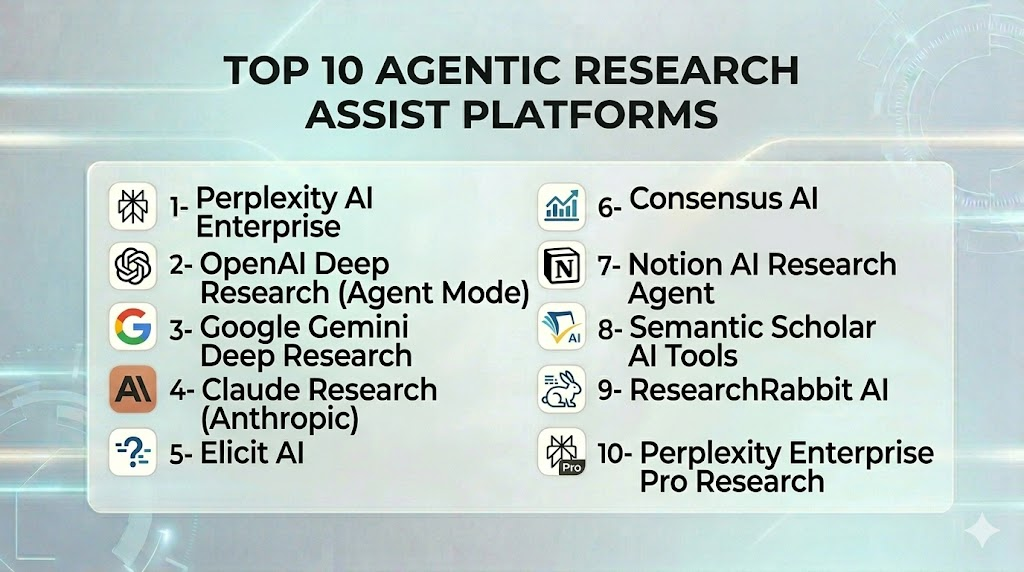
Top 10 Agentic Research Assist Platforms
1- Perplexity AI Enterprise
One-line verdict: Best for real-time web-based autonomous research with strong citations.
Short description:
Perplexity AI Enterprise is a leading agentic research platform that combines real-time web search, reasoning, and source-backed answers for fast, structured research workflows.
Standout Capabilities
- Real-time web research
- Citation-backed answers
- Multi-step reasoning
- Follow-up query planning
- Research summarization
- Source comparison
- Topic deep-dives
AI-Specific Depth
- Model support: Multi-model backend (proprietary + third-party)
- RAG / knowledge integration: Web + enterprise connectors
- Evaluation: Source ranking and validation
- Guardrails: Content filtering and safety systems
- Observability: Query history and research trails
Pros
- Fast and accurate research
- Strong citation system
- Easy to use
Cons
- Limited deep enterprise customization
- Web-dependent outputs
- Less control over workflow logic
Security & Compliance
Enterprise privacy controls (varies by plan).
Deployment & Platforms
- Cloud
- Web
- Mobile
Integrations & Ecosystem
- APIs
- Browser tools
- Enterprise data sources
- Research workflows
Pricing Model
Subscription-based enterprise plans.
Best-Fit Scenarios
- Market research
- Academic research
- Business intelligence
2- OpenAI Deep Research (Agent Mode)
One-line verdict: Best for structured autonomous reasoning and multi-step research synthesis.
Short description:
OpenAI’s Deep Research capability uses agentic workflows to perform structured investigations, synthesize data, and produce analytical reports.
Standout Capabilities
- Autonomous research planning
- Multi-step reasoning
- Document synthesis
- Tool calling for data gathering
- Structured reporting
- Cross-source analysis
- Insight generation
AI-Specific Depth
- Model support: OpenAI models
- RAG / knowledge integration: Web + uploaded data
- Evaluation: Internal reasoning checks
- Guardrails: Safety and policy filters
- Observability: Session-based tracking
Pros
- Strong reasoning quality
- High-quality synthesis
- Flexible workflows
Cons
- Still evolving ecosystem
- Limited enterprise controls
- Requires careful prompt design
Security & Compliance
Varies by deployment and plan.
Deployment & Platforms
- Cloud
- API
- Web interface
Integrations & Ecosystem
- Developer APIs
- Data tools
- Research workflows
- Third-party plugins
Pricing Model
Usage-based + subscription tiers.
Best-Fit Scenarios
- Deep analytical research
- Technical investigations
- Strategic insights
3- Google Gemini Deep Research
One-line verdict: Best for multimodal research across Google’s knowledge ecosystem.
Short description:
Google Gemini Deep Research provides AI-driven research capabilities across web, documents, and multimodal sources with strong reasoning and summarization.
Standout Capabilities
- Multimodal research (text, images, docs)
- Autonomous browsing
- Structured summaries
- Knowledge synthesis
- Research planning
- Google ecosystem integration
- Context-aware insights
AI-Specific Depth
- Model support: Google Gemini models
- RAG / knowledge integration: Google Search + Workspace
- Evaluation: Ranking and confidence scoring
- Guardrails: Safety filters
- Observability: Activity tracking
Pros
- Strong multimodal capabilities
- Deep Google integration
- Fast research workflows
Cons
- Ecosystem dependency
- Limited transparency in ranking logic
- Less customizable workflows
Security & Compliance
Enterprise-grade Google security controls.
Deployment & Platforms
- Cloud
- Web
- Workspace integration
Integrations & Ecosystem
- Google Docs
- Google Drive
- Google Search
- Enterprise APIs
Pricing Model
Subscription-based.
Best-Fit Scenarios
- Enterprise knowledge research
- Academic research
- Document-heavy workflows
4- Claude Research (Anthropic)
One-line verdict: Best for long-form reasoning and document-heavy research.
Short description:
Claude excels in deep contextual analysis, long-document understanding, and structured synthesis for research-intensive workflows.
Standout Capabilities
- Long-context analysis
- Document synthesis
- Research summarization
- Logical reasoning
- Multi-document comparison
- Policy analysis
- Knowledge extraction
AI-Specific Depth
- Model support: Claude models
- RAG / knowledge integration: Document-based retrieval
- Evaluation: Internal reasoning consistency
- Guardrails: Strong safety alignment
- Observability: Session-level tracing
Pros
- Excellent reasoning quality
- Strong document handling
- High safety alignment
Cons
- Limited live web research (depending on setup)
- Fewer integrations than competitors
- Less automation tooling
Security & Compliance
Enterprise-grade controls (plan dependent).
Deployment & Platforms
- Cloud
- API
- Web
Integrations & Ecosystem
- APIs
- Document tools
- Research systems
Pricing Model
Subscription and usage-based.
Best-Fit Scenarios
- Legal research
- Policy analysis
- Academic synthesis
5- Elicit AI
One-line verdict: Best for academic literature review automation.
Short description:
Elicit AI is designed specifically for academic research, enabling structured literature reviews, paper summarization, and evidence extraction.
Standout Capabilities
- Academic paper discovery
- Literature review automation
- Evidence extraction
- Study comparison
- Research synthesis
- Citation mapping
- Structured summaries
AI-Specific Depth
- Model support: Proprietary AI systems
- RAG / knowledge integration: Academic databases
- Evaluation: Citation validation
- Guardrails: Research-focused filtering
- Observability: Research tracking
Pros
- Strong academic focus
- High-quality summaries
- Efficient literature review
Cons
- Narrow use case
- Limited general research capabilities
- Academic database dependency
Security & Compliance
Not publicly stated.
Deployment & Platforms
- Cloud
- Web
Integrations & Ecosystem
- Academic databases
- Export tools
- Research workflows
Pricing Model
Freemium + subscription tiers.
Best-Fit Scenarios
- Academic research
- Scientific literature review
- Thesis preparation
6- Consensus AI
One-line verdict: Best for evidence-based scientific research synthesis.
Short description:
Consensus AI extracts insights from peer-reviewed research and summarizes scientific consensus on specific topics.
Standout Capabilities
- Scientific paper analysis
- Evidence-based answers
- Consensus detection
- Research summarization
- Citation-backed responses
- Study comparison
- Academic synthesis
AI-Specific Depth
- Model support: Proprietary models
- RAG / knowledge integration: Scientific databases
- Evaluation: Evidence scoring
- Guardrails: Academic filtering
- Observability: Query tracking
Pros
- Strong scientific accuracy
- Evidence-based outputs
- Easy to use
Cons
- Limited to scientific domains
- Less flexible for business research
- Database constraints
Security & Compliance
Not publicly stated.
Deployment & Platforms
- Cloud
- Web
Integrations & Ecosystem
- Academic sources
- Research tools
- APIs
Pricing Model
Subscription-based.
Best-Fit Scenarios
- Scientific research
- Healthcare research
- Academic analysis
7- Notion AI Research Agent
One-line verdict: Best for integrated research within productivity workflows.
Short description:
Notion AI combines note-taking, knowledge management, and agentic research capabilities within a unified workspace.
Standout Capabilities
- Knowledge workspace integration
- Research summarization
- Document generation
- Task-based research
- Team collaboration
- Internal knowledge synthesis
- Workflow automation
AI-Specific Depth
- Model support: Multi-model backend
- RAG / knowledge integration: Notion workspace data
- Evaluation: Content refinement
- Guardrails: Workspace permissions
- Observability: Activity logs
Pros
- Strong collaboration
- Integrated workflows
- Easy knowledge organization
Cons
- Limited deep web research
- Dependent on workspace data
- Not fully autonomous
Security & Compliance
Workspace-level enterprise controls.
Deployment & Platforms
- Cloud
- Web
- Desktop
Integrations & Ecosystem
- Notion workspace
- APIs
- Productivity tools
Pricing Model
Subscription-based.
Best-Fit Scenarios
- Team research
- Internal documentation
- Knowledge management
8- Semantic Scholar AI Tools
One-line verdict: Best for AI-enhanced academic paper discovery and citation mapping.
Short description:
Semantic Scholar uses AI to enhance academic research discovery and citation analysis.
Standout Capabilities
- Paper discovery
- Citation mapping
- Research summarization
- Topic clustering
- Academic indexing
- Knowledge graph exploration
- Scientific insights
AI-Specific Depth
- Model support: Proprietary academic models
- RAG / knowledge integration: Scientific publications
- Evaluation: Citation relevance scoring
- Guardrails: Academic filtering
- Observability: Research metrics
Pros
- Strong academic indexing
- High-quality citations
- Free access model
Cons
- Limited business use
- Narrow research scope
- No workflow automation
Security & Compliance
Not publicly stated.
Deployment & Platforms
- Web
Integrations & Ecosystem
- Academic APIs
- Research tools
- Citation systems
Pricing Model
Free + research API access.
Best-Fit Scenarios
- Academic discovery
- Scientific research
- Literature exploration
9- ResearchRabbit AI
One-line verdict: Best for visual academic research discovery and mapping.
Short description:
ResearchRabbit provides AI-powered visual mapping of academic papers and citation networks.
Standout Capabilities
- Citation network visualization
- Paper discovery
- Research tracking
- Collaboration tools
- Topic exploration
- Recommendation engine
- Academic mapping
AI-Specific Depth
- Model support: Proprietary recommendation systems
- RAG / knowledge integration: Academic datasets
- Evaluation: Relevance ranking
- Guardrails: Research filtering
- Observability: Usage tracking
Pros
- Excellent visualization tools
- Strong academic focus
- Easy discovery workflows
Cons
- Narrow research domain
- Limited enterprise use
- No deep reasoning engine
Security & Compliance
Not publicly stated.
Deployment & Platforms
- Web
Integrations & Ecosystem
- Academic databases
- Export tools
- Research workflows
Pricing Model
Freemium model.
Best-Fit Scenarios
- Academic mapping
- Research discovery
- Thesis exploration
10- Perplexity Enterprise Pro Research
One-line verdict: Best for fast, citation-backed enterprise research workflows.
Short description:
Perplexity Enterprise Pro extends real-time research capabilities with enterprise security and collaboration features.
Standout Capabilities
- Real-time research
- Citation-backed answers
- Enterprise collaboration
- Multi-source synthesis
- Document analysis
- Research summaries
- Knowledge discovery
AI-Specific Depth
- Model support: Multi-model system
- RAG / knowledge integration: Web + enterprise data
- Evaluation: Source validation
- Guardrails: Enterprise policy controls
- Observability: Research logs
Pros
- Fast research output
- Strong citation system
- Enterprise-ready features
Cons
- Limited deep workflow customization
- Web dependency
- Less academic specialization
Security & Compliance
Enterprise-grade controls (plan dependent).
Deployment & Platforms
- Cloud
- Web
Integrations & Ecosystem
- APIs
- Enterprise data sources
- Browser tools
Pricing Model
Enterprise subscription.
Best-Fit Scenarios
- Market research
- Business intelligence
- Fast decision support
Comparison Table
| Tool Name | Best For | Deployment | Model Flexibility | Strength | Watch-Out | Public Rating |
|---|---|---|---|---|---|---|
| Perplexity Enterprise | Real-time research | Cloud | Multi-model | Citations | Web dependency | N/A |
| OpenAI Deep Research | Deep reasoning | Cloud/API | Multi-model | Synthesis | Evolving ecosystem | N/A |
| Google Gemini Research | Multimodal research | Cloud | Google models | Ecosystem | Lock-in | N/A |
| Claude Research | Long documents | Cloud/API | Proprietary | Reasoning | Limited web tools | N/A |
| Elicit AI | Academic review | Cloud | Proprietary | Literature review | Narrow scope | N/A |
| Consensus AI | Scientific research | Cloud | Proprietary | Evidence-based | Domain limited | N/A |
| Notion AI | Workspace research | Cloud | Multi-model | Collaboration | Limited autonomy | N/A |
| Semantic Scholar | Academic discovery | Web | Proprietary | Citations | Academic-only | N/A |
| ResearchRabbit | Research mapping | Web | Proprietary | Visualization | Narrow scope | N/A |
| Perplexity Enterprise Pro | Enterprise research | Cloud | Multi-model | Speed + citations | Web reliance | N/A |
Scoring & Evaluation
| Tool | Core | Reliability | Guardrails | Integrations | Ease | Perf/Cost | Security | Support | Weighted Total |
|---|---|---|---|---|---|---|---|---|---|
| Perplexity Enterprise | 9 | 9 | 8 | 8 | 9 | 8 | 8 | 8 | 8.6 |
| OpenAI Deep Research | 9 | 9 | 8 | 8 | 8 | 8 | 8 | 8 | 8.5 |
| Google Gemini Research | 9 | 8 | 8 | 9 | 8 | 8 | 9 | 8 | 8.5 |
| Claude Research | 9 | 9 | 8 | 8 | 8 | 8 | 9 | 8 | 8.6 |
| Elicit AI | 8 | 8 | 8 | 7 | 9 | 8 | 7 | 8 | 8.0 |
| Consensus AI | 8 | 8 | 8 | 7 | 9 | 8 | 7 | 8 | 8.0 |
| Notion AI | 8 | 7 | 7 | 9 | 9 | 9 | 8 | 8 | 8.1 |
| Semantic Scholar | 8 | 8 | 8 | 7 | 9 | 9 | 8 | 8 | 8.1 |
| ResearchRabbit | 7 | 7 | 7 | 7 | 9 | 9 | 7 | 8 | 7.7 |
| Perplexity Enterprise Pro | 9 | 9 | 8 | 9 | 9 | 8 | 8 | 8 | 8.7 |
Which Agentic Research Assist Platform Is Right for You?
Solo / Freelancer
Perplexity AI and Notion AI provide fast, accessible research assistance without complexity.
SMB
Perplexity AI, Notion AI, and Elicit AI offer strong research and knowledge workflows.
Mid-Market
OpenAI Deep Research and Google Gemini Research support structured reasoning and scalable workflows.
Enterprise
Perplexity Enterprise, Google Gemini, and OpenAI Deep Research offer governance and scalability.
Academic Users
Elicit, Consensus AI, Semantic Scholar, and ResearchRabbit are best suited for research-heavy workflows.
Budget vs Premium
Budget users should focus on Elicit and ResearchRabbit; premium users should consider enterprise AI research agents.
Build vs Buy
Buy when you need fast deployment and structured research. Build when you need deeply customized research pipelines.
Common Mistakes & How to Avoid Them
- Trusting outputs without verification
- Ignoring citation accuracy
- Over-relying on single-source research
- Poor prompt structuring
- Lack of evaluation frameworks
- No fact-checking layer
- Ignoring source bias
- Missing governance controls
- Over-automation of critical research
- Not tracking model drift
- Weak integration strategy
- No collaboration workflow
FAQs
1- What is an Agentic Research Assist Platform?
It is an AI system that autonomously conducts multi-step research, analyzes sources, and produces structured insights.
2- How is it different from a search engine?
It doesn’t just retrieve results—it reasons, synthesizes, and validates information across multiple sources.
3- Can these tools replace human researchers?
No, they augment researchers by accelerating data gathering and synthesis.
4- Are citations always accurate?
Not always; validation is still required for critical decisions.
5- Do they support academic research?
Yes, many platforms specialize in literature review and academic synthesis.
6- Can they analyze PDFs and documents?
Yes, most modern platforms support document and multimodal analysis.
7- Do they work with internal company data?
Enterprise versions often support secure knowledge integration.
8- Are these platforms safe for enterprise use?
Yes, with proper governance, security controls, and validation workflows.
9- What is RAG in research platforms?
Retrieval-Augmented Generation, where AI retrieves and reasons over external data.
10- How important is observability?
It helps track research quality, sources, and reasoning steps.
11- Can they detect misinformation?
Some platforms include fact-checking and contradiction detection systems.
12- What is the future of agentic research tools?
They will become autonomous research analysts capable of producing end-to-end intelligence reports.
Conclusion
Agentic Research Assist Platforms are redefining how knowledge work is performed by enabling AI systems to conduct structured, multi-step research with reasoning and synthesis capabilities. Tools like Perplexity AI, OpenAI Deep Research, and Google Gemini are leading real-time research, while Elicit, Consensus AI, and Semantic Scholar dominate academic workflows.
