Introduction
Agentic Sales Assist Platforms are AI-powered systems that help sales teams research prospects, qualify leads, generate outreach, manage pipelines, and even execute parts of the sales cycle autonomously. Unlike traditional CRM tools or sales automation software, these platforms use AI agents that can reason, plan multi-step workflows, interact with business systems, and continuously improve sales outcomes based on data and feedback.
In modern go-to-market environments, sales teams are overwhelmed by data, tools, and customer touchpoints. Agentic sales platforms reduce this complexity by acting as intelligent sales co-pilots or autonomous sales agents that handle repetitive work, surface high-intent leads, personalize outreach at scale, and support deal execution in real time.
These platforms are becoming critical as organizations shift toward AI-driven revenue operations (RevOps), where automation, intelligence, and orchestration are unified.
Real-World Use Cases
- Automated lead qualification and scoring
- Personalized outbound email and LinkedIn outreach
- Pipeline management and deal tracking
- Sales research and account intelligence
- Meeting preparation and follow-up automation
- Revenue forecasting and deal risk analysis
Evaluation Criteria for Buyers
When evaluating Agentic Sales Assist Platforms, consider:
- Autonomous outreach and workflow execution
- CRM integration depth
- Lead scoring accuracy and intelligence
- Multi-channel engagement (email, chat, calls, LinkedIn)
- AI personalization capabilities
- Data enrichment and research abilities
- Human-in-the-loop controls
- Compliance and governance features
- Observability and performance tracking
- Cost efficiency and scalability
- Integration ecosystem
- Vendor lock-in risk
Best for: Enterprise sales teams, SaaS companies, B2B organizations, SDR teams, revenue operations (RevOps), and startups scaling outbound sales.
Not ideal for: Very small businesses with minimal sales activity, or organizations that rely entirely on inbound sales with no structured pipeline process.
What’s Changed in Agentic Sales Assist Platforms
- AI agents now handle full outbound sequences autonomously
- Multi-agent workflows manage research, outreach, and follow-ups
- CRM-native agents are replacing manual SDR tasks
- Real-time intent detection is improving lead prioritization
- Revenue intelligence is increasingly AI-driven
- Conversation intelligence is integrated into workflows
- AI personalization uses dynamic firmographic + behavioral data
- Guardrails prevent spam-like or non-compliant outreach
- Sales forecasting uses agent-based simulation models
- Multimodal inputs (calls, email, chat) are unified
- Human approval workflows are standard for enterprise deployments
- Cost optimization is driven by model routing and automation depth
Quick Buyer Checklist
Before selecting a platform, verify:
- □ CRM integration (Salesforce, HubSpot, etc.)
- □ Autonomous outreach capabilities
- □ Lead scoring and enrichment quality
- □ Multi-channel engagement support
- □ Human approval workflows
- □ AI explainability and transparency
- □ Data privacy and compliance controls
- □ Observability and sales analytics
- □ Workflow customization flexibility
- □ Guardrails against spam or policy violations
- □ API and integration ecosystem
- □ Scalability for large sales teams
- □ Cost predictability
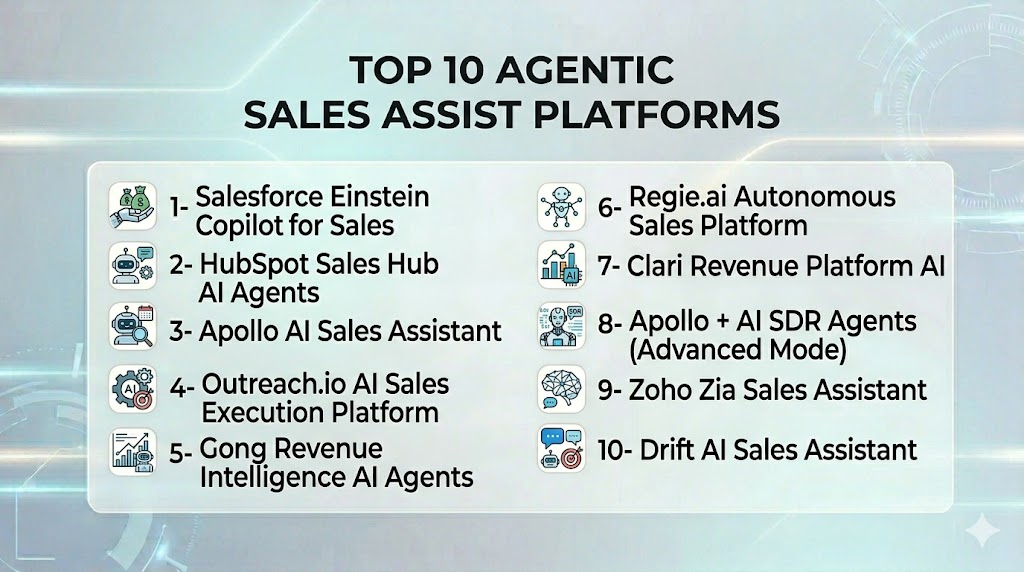
Top 10 Agentic Sales Assist Platforms
1- Salesforce Einstein Copilot for Sales
One-line verdict: Best for enterprise CRM-native agentic sales automation and revenue operations.
Short description:
Salesforce Einstein Copilot enables autonomous sales assistance directly inside Salesforce CRM. It helps teams manage leads, accounts, forecasting, and outreach using AI agents embedded in the revenue workflow.
Standout Capabilities
- CRM-native AI sales assistant
- Autonomous lead prioritization
- Pipeline and forecast intelligence
- Account research automation
- Meeting summarization and follow-ups
- Opportunity risk detection
- Revenue workflow automation
AI-Specific Depth
- Model support: Salesforce-hosted and partner models
- RAG / knowledge integration: Salesforce Data Cloud + CRM data
- Evaluation: Sales performance analytics and monitoring
- Guardrails: Enterprise policy controls and role restrictions
- Observability: CRM activity tracking and AI usage insights
Pros
- Deep CRM integration
- Strong enterprise governance
- End-to-end sales visibility
Cons
- Complex setup
- Salesforce ecosystem dependency
- Premium pricing
Security & Compliance
Enterprise-grade RBAC, audit logs, encryption, and compliance controls (details vary by deployment).
Deployment & Platforms
- Cloud (Salesforce ecosystem)
- Web-based CRM interface
Integrations & Ecosystem
- Salesforce CRM
- Slack
- Marketing Cloud
- Data Cloud
- Third-party APIs
Pricing Model
Enterprise subscription-based licensing (varies by edition).
Best-Fit Scenarios
- Large enterprise sales teams
- CRM-first organizations
- Revenue operations automation
2- HubSpot Sales Hub AI Agents
One-line verdict: Best for SMB and mid-market AI-driven sales automation inside HubSpot CRM.
Short description:
HubSpot Sales Hub uses AI agents to automate outreach, lead scoring, pipeline management, and sales engagement within a unified CRM ecosystem.
Standout Capabilities
- AI-powered lead scoring
- Email outreach automation
- Pipeline tracking
- Sales sequence automation
- Deal insights
- CRM-native workflows
- Meeting automation
AI-Specific Depth
- Model support: HubSpot-hosted AI models
- RAG / knowledge integration: CRM + content + email data
- Evaluation: Sales analytics dashboards
- Guardrails: Role-based permissions
- Observability: Engagement tracking and reporting
Pros
- Easy to use
- Fast deployment
- Strong SMB ecosystem
Cons
- Limited deep autonomy
- Less enterprise customization
- Advanced AI features require higher tiers
Security & Compliance
Standard enterprise controls depending on plan.
Deployment & Platforms
- Cloud
- Web CRM
Integrations & Ecosystem
- HubSpot CRM suite
- Gmail, Outlook
- Marketing tools
- APIs
Pricing Model
Tiered subscription model.
Best-Fit Scenarios
- SMB sales teams
- Inbound + outbound hybrid sales
- Startup revenue teams
3- Apollo AI Sales Assistant
One-line verdict: Best for AI-powered outbound prospecting and lead intelligence.
Short description:
Apollo combines sales intelligence with AI agents that automate prospecting, outreach, and pipeline generation for B2B sales teams.
Standout Capabilities
- AI lead discovery
- Automated outbound sequences
- Email personalization at scale
- Contact enrichment
- Sales intelligence database
- Pipeline automation
- Engagement tracking
AI-Specific Depth
- Model support: Hosted AI models
- RAG / knowledge integration: Contact + firmographic database
- Evaluation: Campaign analytics
- Guardrails: Email compliance rules
- Observability: Engagement tracking dashboards
Pros
- Strong prospecting engine
- Large contact database
- Fast outbound scaling
Cons
- Data accuracy varies
- Limited CRM depth
- Deliverability risks if misused
Security & Compliance
Not publicly stated in full detail.
Deployment & Platforms
- Cloud
- Web platform
Integrations & Ecosystem
- Salesforce
- HubSpot
- Email providers
- APIs
Pricing Model
Freemium + tiered subscription.
Best-Fit Scenarios
- SDR teams
- Outbound sales orgs
- Growth-stage startups
4- Outreach.io AI Sales Execution Platform
One-line verdict: Best for structured enterprise sales engagement and automation workflows.
Short description:
Outreach uses AI to optimize sales engagement, automate sequences, and guide reps through deal execution workflows.
Standout Capabilities
- Sales engagement automation
- AI-driven sequencing
- Pipeline intelligence
- Deal insights
- Forecasting support
- Workflow orchestration
- Multi-channel outreach
AI-Specific Depth
- Model support: Proprietary AI systems
- RAG / knowledge integration: CRM and engagement data
- Evaluation: Performance analytics
- Guardrails: Enterprise policy controls
- Observability: Engagement monitoring
Pros
- Strong enterprise adoption
- Excellent workflow structure
- Deep sales engagement tools
Cons
- Complex onboarding
- Enterprise-focused pricing
- Limited flexibility for small teams
Security & Compliance
Enterprise security features (details vary by contract).
Deployment & Platforms
- Cloud
- Web
Integrations & Ecosystem
- Salesforce
- Microsoft Dynamics
- CRM tools
- Email systems
Pricing Model
Enterprise subscription.
Best-Fit Scenarios
- Enterprise SDR teams
- Structured sales orgs
- Revenue operations teams
5- Gong Revenue Intelligence AI Agents
One-line verdict: Best for AI-driven sales conversation intelligence and deal insights.
Short description:
Gong analyzes sales calls, emails, and meetings to provide AI-driven insights, deal risk detection, and revenue forecasting support.
Standout Capabilities
- Conversation intelligence
- Deal risk analysis
- Revenue forecasting
- AI sales coaching
- Pipeline visibility
- Engagement analytics
- Customer interaction insights
AI-Specific Depth
- Model support: Proprietary AI models
- RAG / knowledge integration: Conversation + CRM data
- Evaluation: Sales performance scoring
- Guardrails: Admin-controlled data access
- Observability: Deep conversation analytics
Pros
- Strong deal intelligence
- Excellent conversation insights
- High enterprise adoption
Cons
- Not an outbound execution tool
- Requires CRM integration
- Premium pricing
Security & Compliance
Enterprise-grade controls (varies by deployment).
Deployment & Platforms
- Cloud
- Web
Integrations & Ecosystem
- Salesforce
- HubSpot
- Zoom
- Microsoft Teams
Pricing Model
Enterprise subscription.
Best-Fit Scenarios
- Sales coaching
- Revenue analytics
- Deal intelligence
6- Regie.ai Autonomous Sales Platform
One-line verdict: Best for AI-native outbound sales automation and content generation.
Short description:
Regie.ai provides autonomous sales agents for generating outbound campaigns, writing emails, and managing prospect engagement.
Standout Capabilities
- AI-generated outbound sequences
- Personalized messaging at scale
- SDR automation
- Prospect targeting
- Campaign optimization
- Workflow automation
- Sales content generation
AI-Specific Depth
- Model support: Multi-model AI systems
- RAG / knowledge integration: CRM + prospect data
- Evaluation: Campaign performance analytics
- Guardrails: Compliance-based content filtering
- Observability: Engagement tracking
Pros
- Strong AI outbound focus
- Good personalization
- SDR efficiency gains
Cons
- Limited CRM depth
- Still evolving enterprise features
- Requires tuning for best results
Security & Compliance
Not publicly stated.
Deployment & Platforms
- Cloud
- Web
Integrations & Ecosystem
- CRM systems
- Email platforms
- Sales tools
Pricing Model
Subscription-based.
Best-Fit Scenarios
- SDR automation
- Outbound campaigns
- Sales content teams
7- Clari Revenue Platform AI
One-line verdict: Best for revenue forecasting and pipeline intelligence.
Short description:
Clari uses AI agents to analyze pipeline data, forecast revenue, and optimize sales execution across organizations.
Standout Capabilities
- Revenue forecasting
- Pipeline intelligence
- Deal inspection
- Sales performance tracking
- AI insights
- Workflow automation
- Risk detection
AI-Specific Depth
- Model support: Proprietary AI models
- RAG / knowledge integration: CRM and pipeline data
- Evaluation: Forecast accuracy tracking
- Guardrails: Admin governance controls
- Observability: Revenue analytics dashboards
Pros
- Strong forecasting accuracy
- Enterprise-grade insights
- Deep pipeline visibility
Cons
- Not an outbound tool
- Requires CRM maturity
- Enterprise pricing
Security & Compliance
Enterprise controls (details vary).
Deployment & Platforms
- Cloud
- Web
Integrations & Ecosystem
- Salesforce
- CRM systems
- BI tools
Pricing Model
Enterprise subscription.
Best-Fit Scenarios
- Revenue operations
- Sales forecasting
- Enterprise planning
8- Apollo + AI SDR Agents (Advanced Mode)
One-line verdict: Best for AI-driven SDR automation at scale.
Short description:
Apollo’s AI SDR capabilities extend beyond prospecting into automated outreach and engagement workflows for outbound sales teams.
Standout Capabilities
- AI SDR automation
- Lead enrichment
- Outreach sequencing
- Contact discovery
- Email personalization
- Pipeline building
- Engagement tracking
AI-Specific Depth
- Model support: Hosted AI models
- RAG / knowledge integration: Prospect database
- Evaluation: Campaign analytics
- Guardrails: Email compliance systems
- Observability: Engagement tracking
Pros
- Scalable outbound system
- Large database
- Fast execution
Cons
- Data quality variability
- Deliverability risks
- Limited enterprise governance
Security & Compliance
Not publicly stated.
Deployment & Platforms
- Cloud
- Web
Integrations & Ecosystem
- CRM systems
- Email tools
- Sales platforms
Pricing Model
Tiered subscription.
Best-Fit Scenarios
- SDR teams
- Growth startups
- Outbound-heavy sales orgs
9- Zoho Zia Sales Assistant
One-line verdict: Best for affordable AI sales assistance in Zoho ecosystem.
Short description:
Zoho Zia provides AI-driven insights, predictions, and automation for sales teams using Zoho CRM.
Standout Capabilities
- Sales predictions
- Lead scoring
- Workflow automation
- CRM insights
- AI recommendations
- Deal analysis
- Sales forecasting
AI-Specific Depth
- Model support: Zoho AI models
- RAG / knowledge integration: CRM data
- Evaluation: Sales analytics
- Guardrails: Role-based controls
- Observability: CRM insights
Pros
- Cost-effective
- Easy CRM integration
- Good SMB fit
Cons
- Limited autonomy
- Smaller ecosystem
- Less enterprise depth
Security & Compliance
Standard enterprise security controls.
Deployment & Platforms
- Cloud
- Web CRM
Integrations & Ecosystem
- Zoho CRM suite
- Email tools
- APIs
Pricing Model
Subscription-based.
Best-Fit Scenarios
- SMB sales teams
- Zoho ecosystem users
- Budget-conscious organizations
10- Drift AI Sales Assistant
One-line verdict: Best for conversational AI-driven inbound sales conversion.
Short description:
Drift focuses on conversational marketing and sales automation, converting inbound leads through AI-powered chat agents.
Standout Capabilities
- Conversational sales AI
- Lead qualification
- Real-time engagement
- Meeting booking automation
- Pipeline acceleration
- Chat-based workflows
- Marketing-sales alignment
AI-Specific Depth
- Model support: Hosted AI models
- RAG / knowledge integration: Website + CRM data
- Evaluation: Engagement analytics
- Guardrails: Conversation policies
- Observability: Chat performance tracking
Pros
- Strong inbound conversion
- Real-time engagement
- Easy deployment
Cons
- Not outbound-focused
- Limited deep CRM functionality
- Requires traffic volume
Security & Compliance
Enterprise-grade controls (varies by plan).
Deployment & Platforms
- Cloud
- Web
Integrations & Ecosystem
- CRM systems
- Marketing platforms
- Chat systems
Pricing Model
Subscription-based.
Best-Fit Scenarios
- Inbound sales teams
- SaaS companies
- Website-driven lead generation
Comparison Table
| Tool Name | Best For | Deployment | Model Flexibility | Strength | Watch-Out | Public Rating |
|---|---|---|---|---|---|---|
| Salesforce Einstein Copilot | Enterprise CRM sales | Cloud | Multi-model | CRM automation | Ecosystem lock-in | N/A |
| HubSpot Sales Hub AI | SMB sales | Cloud | Hosted | Ease of use | Limited depth | N/A |
| Apollo AI | Outbound sales | Cloud | Hosted | Prospecting scale | Data quality | N/A |
| Outreach.io | Enterprise engagement | Cloud | Proprietary | Workflow automation | Complexity | N/A |
| Gong AI | Sales intelligence | Cloud | Proprietary | Deal insights | Not outbound tool | N/A |
| Regie.ai | SDR automation | Cloud | Multi-model | Content generation | Early-stage maturity | N/A |
| Clari | Revenue forecasting | Cloud | Proprietary | Forecast accuracy | Not outbound tool | N/A |
| Zoho Zia | SMB CRM AI | Cloud | Hosted | Affordability | Limited scale | N/A |
| Drift AI | Inbound conversion | Cloud | Hosted | Chat engagement | Traffic dependency | N/A |
| Apollo SDR AI | Outbound automation | Cloud | Hosted | Scale outreach | Compliance tuning | N/A |
Scoring & Evaluation
| Tool | Core | Reliability | Guardrails | Integrations | Ease | Perf/Cost | Security | Support | Weighted Total |
|---|---|---|---|---|---|---|---|---|---|
| Salesforce Einstein Copilot | 9 | 8 | 9 | 9 | 8 | 8 | 9 | 9 | 8.7 |
| HubSpot Sales Hub AI | 8 | 8 | 7 | 8 | 9 | 9 | 8 | 8 | 8.2 |
| Apollo AI | 8 | 7 | 7 | 8 | 9 | 8 | 7 | 8 | 7.9 |
| Outreach.io | 9 | 8 | 9 | 9 | 7 | 8 | 9 | 8 | 8.4 |
| Gong AI | 9 | 9 | 8 | 9 | 8 | 8 | 9 | 9 | 8.7 |
| Regie.ai | 8 | 7 | 7 | 7 | 8 | 8 | 7 | 7 | 7.8 |
| Clari | 9 | 8 | 9 | 9 | 7 | 8 | 9 | 8 | 8.5 |
| Zoho Zia | 7 | 7 | 7 | 8 | 9 | 9 | 8 | 8 | 8.0 |
| Drift AI | 8 | 8 | 7 | 8 | 9 | 8 | 8 | 8 | 8.0 |
| Apollo SDR AI | 8 | 7 | 7 | 8 | 9 | 8 | 7 | 8 | 7.9 |
Which Agentic Sales Assist Platform Is Right for You?
Solo / Freelancer
Drift AI and HubSpot Sales Hub AI offer simple automation for inbound and lightweight outbound workflows.
SMB
HubSpot, Zoho Zia, and Drift provide balanced automation without enterprise complexity.
Mid-Market
Apollo AI, Outreach.io, and Regie.ai support scaling outbound and structured sales workflows.
Enterprise
Salesforce Einstein Copilot, Gong AI, and Clari provide deep intelligence, governance, and forecasting.
Regulated Industries
Focus on platforms with strong audit logs, governance, approval workflows, and CRM-controlled access.
Budget vs Premium
Budget users benefit from Zoho and HubSpot; premium users benefit from Salesforce, Gong, and Clari.
Build vs Buy
Buy when speed, data integration, and scalability matter. Build when you need deeply customized sales intelligence workflows.
Common Mistakes & How to Avoid Them
- Over-automating outbound without compliance controls
- Ignoring CRM data quality
- Poor lead enrichment strategy
- Lack of human review for critical deals
- Not monitoring email deliverability
- Weak sales workflow design
- Ignoring integration limitations
- Underestimating onboarding effort
- No performance tracking system
- Vendor lock-in without abstraction layer
- Misaligned sales and marketing workflows
- Ignoring AI model drift
FAQs
1- What is an Agentic Sales Assist Platform?
It is an AI-powered system that autonomously helps with sales tasks like outreach, lead scoring, and pipeline management.
2- How is it different from traditional sales automation?
Agentic systems can reason, plan, and execute multi-step workflows instead of following static rules.
3- Can these platforms replace SDR teams?
They can automate many SDR tasks but still require human oversight for strategy and complex deals.
4- Are these platforms safe for enterprise use?
Yes, when they include governance, compliance controls, and approval workflows.
5- Do they integrate with CRM systems?
Most platforms deeply integrate with Salesforce, HubSpot, and other CRMs.
6- Can they personalize outreach?
Yes, they use AI to generate personalized emails and messages based on data.
7- What is lead scoring in these platforms?
AI evaluates leads based on intent, behavior, and firmographic data.
8- Do they support multi-channel outreach?
Yes, including email, chat, LinkedIn, and sometimes voice workflows.
9- What are the biggest risks?
Poor data quality, spam compliance issues, and lack of governance.
10- Can small businesses use them?
Yes, SMB-focused tools like HubSpot and Zoho are widely used.
11- What role does observability play?
It helps track AI decisions, performance, and sales outcomes.
12- What is the future of agentic sales platforms?
They will evolve into fully autonomous revenue agents managing entire sales funnels.
Conclusion
Agentic Sales Assist Platforms are redefining how modern sales organizations operate by shifting from manual, repetitive workflows to AI-driven autonomous revenue systems. Enterprise leaders like Salesforce Einstein Copilot, Gong AI, and Clari are setting the standard for intelligent revenue operations, while tools like HubSpot, Apollo, and Drift make AI-powered sales accessible to SMBs and growth teams.
The right platform depends on your sales motion, CRM ecosystem, and automation maturity. Organizations should start with focused pilots, validate lead quality and conversion metrics, implement strong governance, and gradually scale toward full revenue automation. As AI agents mature, sales teams will increasingly operate with AI co-pilots that continuously optimize pipeline generation, engagement, and revenue outcomes.
