Introduction
AI Case Management Prioritization Tools for Social Services use artificial intelligence, machine learning, predictive analytics, natural language processing, and workflow automation to help social service organizations manage cases, prioritize urgent needs, and improve service delivery.
Social service agencies handle complex cases involving healthcare assistance, child welfare, housing support, disability services, financial assistance, and community programs. Case workers often manage large workloads while reviewing extensive documentation, eligibility information, assessments, and service histories.
Traditional case management processes rely heavily on manual reviews, experience-based prioritization, and administrative workflows. These approaches can make it difficult to identify high-priority cases quickly, balance workloads, and provide timely support to vulnerable communities.
AI-powered case prioritization platforms analyze case information, historical patterns, risk indicators, service requirements, and available resources to help agencies organize workloads and make informed decisions.
These tools help organizations:
- Prioritize urgent social service cases
- Improve case worker efficiency
- Identify service needs faster
- Automate administrative workflows
- Support better resource allocation
- Improve citizen and community services
- Enhance case tracking and reporting
AI case management prioritization solutions are used by:
- Government social service departments
- Child welfare agencies
- Healthcare assistance programs
- Housing support organizations
- Community service providers
- Nonprofit organizations
- Public assistance programs
Modern platforms combine AI analytics, case management workflows, document processing, predictive insights, risk assessment, and reporting capabilities.
The goal of these solutions is to help social service teams deliver timely, fair, and effective support while improving operational efficiency.
How AI Case Management Prioritization Works
Case Data Collection
AI analyzes information from:
- Case records
- Applications
- Assessments
- Service history
- Communication records
- Supporting documents
Risk and Need Analysis
Machine learning identifies:
- Urgency indicators
- Service requirements
- Case complexity
- Potential risks
Case Prioritization
AI helps rank cases based on:
- Immediate needs
- Risk factors
- Available resources
- Program requirements
Workflow Assistance
Platforms support:
- Case assignments
- Follow-ups
- Notifications
- Task management
Continuous Improvement
AI models improve through:
- Case outcomes
- Worker feedback
- Updated policies
- Service data
Common Use Cases
- Child welfare case prioritization
- Healthcare support management
- Housing assistance programs
- Disability services
- Family support programs
- Community assistance programs
- Eligibility processing
- Benefits management
- Crisis intervention support
- Social worker workload management
Why AI Case Management Prioritization Tools Matter
Faster Response to Critical Cases
AI helps identify urgent situations requiring immediate attention.
Better Case Worker Productivity
Automation reduces administrative workload.
Improved Resource Allocation
Organizations can distribute resources more effectively.
Consistent Case Evaluation
AI helps standardize prioritization processes.
Better Service Outcomes
Organizations can provide timely assistance to individuals and communities.
Evaluation Criteria for Buyers
Case Prioritization Accuracy
Platforms should provide useful and reliable case insights.
Workflow Management
Solutions should support case assignment, tracking, and follow-up.
Data Integration
Important integrations include:
- Social service databases
- Healthcare systems
- Government platforms
- Document management systems
- Communication tools
Reporting and Analytics
Organizations need visibility into:
- Case trends
- Workloads
- Service outcomes
- Program performance
Security and Privacy
Social service data requires strong protection.
Explainability and Fairness
AI recommendations should be transparent and reviewed carefully.
Scalability
Platforms should support large community service programs.
Key Trends
AI-Assisted Social Services
Organizations are adopting AI to support case workers and improve efficiency.
Predictive Service Analytics
AI is helping identify service needs and resource requirements.
Digital Case Management
Agencies are moving from paper-based workflows to digital platforms.
Human-Centered AI
Organizations are focusing on AI that supports professionals rather than replacing them.
Responsible AI Practices
Fairness, transparency, and privacy are becoming important priorities.
Integrated Public Service Platforms
Social services are connecting multiple systems for better citizen support.
Methodology
The following platforms were evaluated using:
- AI case management capabilities
- Workflow automation features
- Analytics and reporting
- Social service support
- Integration capabilities
- Ease of use
- Security and privacy
- Performance and reliability
- Support and community
- Price and value
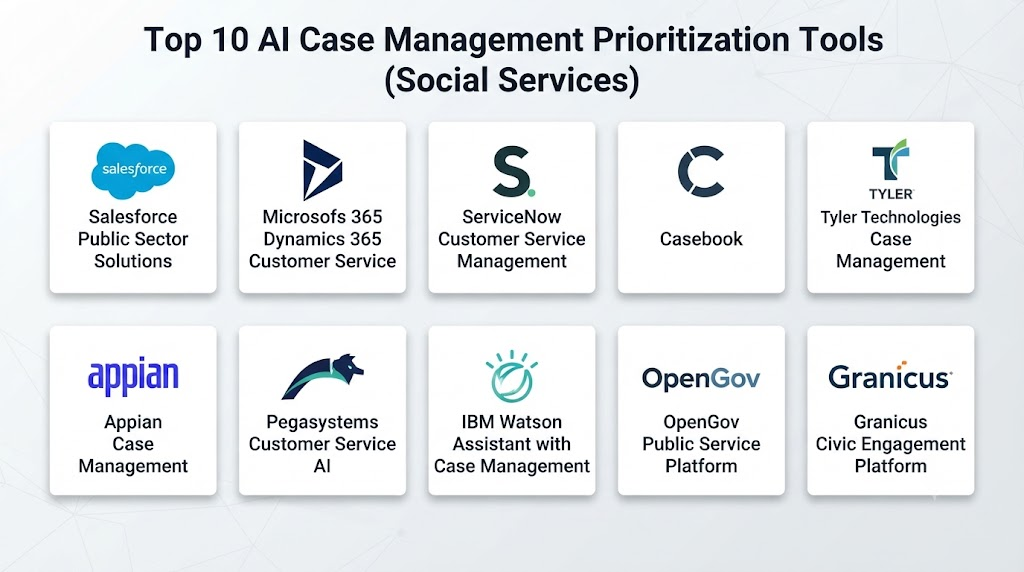
Top 10 AI Case Management Prioritization Tools (Social Services)
1. Salesforce Public Sector Solutions
Salesforce Public Sector Solutions provides digital case management and service delivery capabilities for government organizations.
Key Features
- Case management
- Citizen service workflows
- Data management
- Service tracking
- Automation
- Reporting dashboards
- AI assistance
- Communication management
- Workflow customization
- Integration capabilities
Pros
- Strong public sector focus
- Flexible workflows
- Good data management
- Scalable platform
- Strong ecosystem
Cons
- Requires configuration
- Implementation effort
- Enterprise pricing
Platforms
Cloud-based platform.
Deployment or Support
Cloud deployment.
Security & Compliance
Enterprise security controls.
Integrations & Ecosystem
Government systems, databases, communication platforms, and enterprise applications.
Support & Community
Enterprise support.
2. Microsoft Dynamics 365 Customer Service
Microsoft Dynamics 365 provides customer service and case management capabilities.
Key Features
- Case tracking
- Workflow automation
- AI assistance
- Knowledge management
- Analytics
- Customer communication
- Task management
- Reporting
- Data integration
- Service automation
Pros
- Strong Microsoft ecosystem
- Flexible customization
- Good analytics
- Enterprise scalability
- AI capabilities
Cons
- Requires setup
- Technical expertise needed
- Licensing complexity
Platforms
Cloud platform.
Deployment or Support
Microsoft cloud deployment.
Security & Compliance
Enterprise cloud security controls.
Integrations & Ecosystem
Microsoft services, databases, government systems, and business applications.
Support & Community
Microsoft support ecosystem.
3. ServiceNow Customer Service Management
ServiceNow provides workflow-based case management and service automation.
Key Features
- Case management
- Workflow automation
- Knowledge management
- AI assistance
- Service requests
- Reporting
- Task management
- Process automation
- Analytics
- Integration tools
Pros
- Strong workflow engine
- Enterprise automation
- Good process management
- Scalable platform
- Flexible integrations
Cons
- Implementation complexity
- Requires expertise
- Enterprise-focused
Platforms
Cloud platform.
Deployment or Support
Cloud deployment.
Security & Compliance
Enterprise security controls.
Integrations & Ecosystem
Government systems, databases, and enterprise platforms.
Support & Community
Enterprise support.
4. Casebook
Casebook provides case management software designed for human services organizations.
Key Features
- Social service case management
- Client records
- Case tracking
- Service planning
- Reporting
- Workflow management
- Documentation
- Collaboration tools
- Data organization
- Program management
Pros
- Designed for social services
- User-friendly case workflows
- Supports nonprofit organizations
- Good client management
- Human services focus
Cons
- Specialized platform
- Advanced AI features vary
- Integration requirements
Platforms
Cloud platform.
Deployment or Support
Cloud deployment.
Security & Compliance
Security controls vary.
Integrations & Ecosystem
Human services systems and organizational tools.
Support & Community
Customer support.
5. Tyler Technologies Case Management
Tyler Technologies provides government-focused case management solutions.
Key Features
- Case tracking
- Government workflows
- Citizen services
- Document management
- Reporting
- Data integration
- Workflow automation
- Compliance support
- Service management
- Analytics
Pros
- Government expertise
- Supports large agencies
- Strong integrations
- Scalable solutions
- Public sector focus
Cons
- Enterprise implementation
- Requires training
- Configuration effort
Platforms
Cloud and enterprise platforms.
Deployment or Support
Cloud and enterprise deployment.
Security & Compliance
Enterprise security controls.
Integrations & Ecosystem
Government databases, citizen portals, and enterprise systems.
Support & Community
Enterprise support.
6. Appian Case Management
Appian provides low-code workflow automation and case management capabilities.
Key Features
- Case management
- Process automation
- Workflow design
- Data integration
- AI assistance
- Reporting
- Low-code development
- Task management
- Application building
- Analytics
Pros
- Flexible workflows
- Low-code development
- Strong automation
- Good integration options
- Customizable
Cons
- Requires platform knowledge
- Implementation effort
- Enterprise-oriented
Platforms
Cloud platform.
Deployment or Support
Cloud and enterprise deployment.
Security & Compliance
Enterprise security controls.
Integrations & Ecosystem
Databases, APIs, enterprise applications, and government systems.
Support & Community
Enterprise support.
7. Pegasystems Customer Service AI
Pegasystems provides AI-powered workflow and case management solutions.
Key Features
- Case management
- AI decisioning
- Workflow automation
- Customer service
- Predictive analytics
- Process management
- Task automation
- Reporting
- Data integration
- Rules management
Pros
- Strong decision automation
- Enterprise workflows
- AI capabilities
- Flexible processes
- Good scalability
Cons
- Complex implementation
- Requires expertise
- Enterprise pricing
Platforms
Cloud and enterprise platforms.
Deployment or Support
Cloud and enterprise deployment.
Security & Compliance
Enterprise security controls.
Integrations & Ecosystem
Business systems, government applications, and databases.
Support & Community
Enterprise support.
8. IBM Watson Assistant with Case Management
IBM provides AI assistant capabilities combined with workflow and service management solutions.
Key Features
- AI conversations
- Case assistance
- Knowledge management
- Workflow automation
- Data analysis
- Service support
- Reporting
- Integration APIs
- Automation
- Analytics
Pros
- Strong AI capabilities
- Good conversational support
- Enterprise integration
- Flexible deployment
- Analytics features
Cons
- Requires configuration
- Technical expertise needed
- Enterprise-focused
Platforms
Cloud platform.
Deployment or Support
Cloud deployment.
Security & Compliance
Enterprise security controls.
Integrations & Ecosystem
Enterprise systems, databases, and service platforms.
Support & Community
Enterprise support.
9. OpenGov Public Service Platform
OpenGov provides cloud solutions for government operations and citizen services.
Key Features
- Public service workflows
- Case tracking
- Citizen communication
- Data management
- Reporting
- Process automation
- Service requests
- Digital government tools
- Analytics
- Collaboration
Pros
- Government-focused platform
- Cloud-based
- Improves citizen services
- Good usability
- Supports modernization
Cons
- Government-specific
- Feature availability varies
- Integration planning needed
Platforms
Cloud platform.
Deployment or Support
Cloud deployment.
Security & Compliance
Cloud security controls.
Integrations & Ecosystem
Government systems and service platforms.
Support & Community
Customer support.
10. Granicus Civic Engagement Platform
Granicus provides digital government engagement and service management capabilities.
Key Features
- Citizen communication
- Case tracking
- Digital services
- Engagement management
- Workflow automation
- Reporting
- Notifications
- Service delivery tools
- Data management
- Analytics
Pros
- Strong government communication
- Citizen engagement focus
- Digital service capabilities
- Cloud-based platform
- Good public sector experience
Cons
- Requires configuration
- AI capabilities vary
- Government-focused
Platforms
Cloud platform.
Deployment or Support
Cloud deployment.
Security & Compliance
Security controls vary.
Integrations & Ecosystem
Government platforms, communication systems, and databases.
Support & Community
Customer support.
Comparison Table
| Tool Name | Best For | Platform(s) Supported | Deployment | Standout Feature | Public Rating |
|---|---|---|---|---|---|
| Salesforce Public Sector Solutions | Government case management | Cloud | Cloud | Public service workflows | N/A |
| Microsoft Dynamics 365 | Enterprise service management | Cloud | Cloud | Microsoft integration | N/A |
| ServiceNow CSM | Workflow automation | Cloud | Cloud | Process management | N/A |
| Casebook | Human services | Cloud | Cloud | Social service focus | N/A |
| Tyler Technologies | Government agencies | Cloud | Hybrid | Public sector solutions | N/A |
| Appian Case Management | Custom workflows | Cloud | Hybrid | Low-code automation | N/A |
| Pegasystems AI | Decision automation | Cloud | Hybrid | AI workflows | N/A |
| IBM Watson Assistant | AI assistance | Cloud | Cloud | Conversational AI | N/A |
| OpenGov Platform | Government services | Cloud | Cloud | Digital government | N/A |
| Granicus Platform | Civic engagement | Cloud | Cloud | Citizen communication | N/A |
Weighted Evaluation
| Tool Name | Core Features 25% | Ease of Use 15% | Integrations & Ecosystem 15% | Security & Compliance 10% | Performance & Reliability 10% | Support & Community 10% | Price/Value 15% | Total |
|---|---|---|---|---|---|---|---|---|
| Salesforce Public Sector Solutions | 25 | 13 | 15 | 10 | 10 | 10 | 11 | 94 |
| Microsoft Dynamics 365 | 24 | 13 | 15 | 10 | 10 | 10 | 12 | 94 |
| ServiceNow CSM | 24 | 12 | 15 | 10 | 10 | 10 | 10 | 91 |
| Casebook | 23 | 15 | 12 | 10 | 10 | 10 | 12 | 92 |
| Tyler Technologies | 24 | 12 | 14 | 10 | 10 | 10 | 10 | 90 |
| Appian Case Management | 24 | 12 | 15 | 10 | 10 | 10 | 11 | 92 |
| Pegasystems AI | 24 | 11 | 15 | 10 | 10 | 10 | 10 | 90 |
| IBM Watson Assistant | 23 | 13 | 14 | 10 | 10 | 10 | 11 | 91 |
| OpenGov Platform | 22 | 14 | 13 | 10 | 10 | 10 | 12 | 91 |
| Granicus Platform | 22 | 14 | 13 | 10 | 10 | 10 | 11 | 90 |
Which AI Case Management Prioritization Tool Is Right for You?
Choose Salesforce Public Sector Solutions when government case management scalability is required.
Choose Microsoft Dynamics 365 when organizations need Microsoft ecosystem integration.
Choose ServiceNow CSM when workflow automation is the priority.
Choose Casebook when social service-focused case management is needed.
Choose Tyler Technologies when large government agencies need specialized solutions.
Choose Appian Case Management when flexible workflow customization is important.
Choose Pegasystems AI when intelligent decision automation is required.
Choose IBM Watson Assistant when AI-powered assistance is needed.
Choose OpenGov when digital government services are the focus.
Choose Granicus when citizen engagement and communication are priorities.
Implementation Playbook
Phase 1: Define Social Service Objectives
- Identify case management challenges
- Define prioritization goals
- Review service workflows
- Identify data sources
- Establish success metrics
Phase 2: Prepare Case Data
- Organize case records
- Integrate service databases
- Review privacy requirements
- Define prioritization rules
- Prepare workflows
Phase 3: Deploy AI Assistance
- Configure AI models
- Enable case analytics
- Create dashboards
- Support worker workflows
- Test recommendations
Phase 4: Measure Outcomes
- Improve response times
- Balance workloads
- Track service outcomes
- Monitor fairness
- Improve processes
Phase 5: Maintain Responsible AI
- Review AI recommendations
- Update models
- Monitor bias risks
- Protect privacy
- Maintain transparency
Common Mistakes
- Using AI without human review
- Ignoring fairness concerns
- Poor data quality
- Lack of transparency
- Weak privacy controls
- Automating sensitive decisions completely
- Not involving case workers
- Poor system integration
FAQs
1. What are AI Case Management Prioritization Tools?
These tools use artificial intelligence to analyze case information and help social service organizations prioritize workloads.
2. How does AI help social workers?
AI helps organize cases, identify urgent needs, and reduce administrative tasks.
3. Can AI make decisions about social services?
AI should support professionals, while final decisions remain with authorized staff.
4. What social services use AI case management?
Child welfare, healthcare assistance, housing support, and community services can use these solutions.
5. Are AI case management tools secure?
Organizations should evaluate privacy, security, and access controls.
6. How does AI prioritize cases?
AI analyzes risk indicators, urgency factors, and service requirements.
7. Can these tools integrate with government systems?
Many platforms integrate with databases, citizen portals, and service platforms.
8. How can organizations ensure fair AI decisions?
They should monitor transparency, bias, accuracy, and human oversight.
9. What are the benefits for case workers?
Case workers receive better organization, prioritization support, and workflow automation.
10. What should organizations consider before selecting an AI case management tool?
They should evaluate accuracy, fairness, security, integrations, usability, and cost.
Conclusion
AI Case Management Prioritization Tools are helping social service organizations improve how they manage workloads, identify urgent needs, and deliver community support.Salesforce Public Sector Solutions, Microsoft Dynamics 365, ServiceNow, Casebook, and Appian provide strong case management capabilities, while AI platforms enhance decision support and workflow automation.The most successful social service AI implementations combine intelligent technology with human expertise, ethical practices, transparency, and strong privacy protection. AI should empower case workers to provide faster and more effective support to communities.
