Introduction
AI Permit Application Auto-Review Tools use artificial intelligence, machine learning, natural language processing, document intelligence, and workflow automation to help government agencies and organizations review permit applications faster and more accurately.
Permit approval processes often involve reviewing large volumes of applications related to construction, business licenses, environmental approvals, land use, transportation, and public services. Traditional manual review processes can be slow, require significant administrative effort, and may create delays for applicants.
AI-powered permit review platforms analyze application documents, verify submitted information, identify missing details, check requirements, and assist reviewers in making faster decisions.
These tools help organizations:
- Automate permit application reviews
- Reduce manual administrative workload
- Identify incomplete applications
- Improve review consistency
- Accelerate approval workflows
- Enhance citizen service experiences
- Improve regulatory compliance
AI permit application auto-review solutions are used by:
- Municipal governments
- Building departments
- Planning authorities
- Environmental agencies
- Licensing departments
- Public service organizations
- Regulatory bodies
Modern platforms combine AI document processing, rules engines, workflow automation, data validation, compliance checking, and digital government capabilities.
The goal of these solutions is to make permit processing faster, more transparent, and easier for both government teams and applicants.
How AI Permit Application Auto-Review Works
Application Data Collection
AI systems collect information from:
- Online applications
- Uploaded documents
- Forms
- Drawings
- Supporting records
Document Understanding
AI analyzes:
- Text content
- Forms
- Attachments
- Technical documents
- Regulatory information
Requirement Validation
AI checks:
- Required fields
- Missing documents
- Eligibility criteria
- Regulatory requirements
Automated Review Assistance
Platforms provide:
- Risk indicators
- Review recommendations
- Compliance checks
- Application summaries
Workflow Management
AI connects with:
- Approval systems
- Reviewer workflows
- Citizen portals
- Government databases
Common Use Cases
- Building permit review
- Business license applications
- Construction approvals
- Environmental permits
- Zoning applications
- Land development approvals
- Public works permits
- Healthcare licensing
- Transportation permits
- Government registrations
Why AI Permit Application Auto-Review Tools Matter
Faster Processing Times
AI reduces the time required for application evaluation.
Better Accuracy
Automation helps identify missing information and inconsistencies.
Improved Citizen Experience
Applicants receive faster updates and clearer guidance.
Reduced Administrative Work
Government teams can focus on complex reviews.
Better Compliance Management
AI helps reviewers follow regulatory requirements consistently.
Evaluation Criteria for Buyers
Document Processing Capability
Platforms should accurately analyze application documents.
Rules and Compliance Checking
Solutions should support regulatory requirements.
Workflow Automation
Tools should manage review and approval processes.
Integration Support
Important integrations include:
- Government portals
- Document management systems
- GIS platforms
- Payment systems
- Database systems
Security and Privacy
Government application data requires strong protection.
Scalability
Platforms should support large application volumes.
User Experience
Solutions should be easy for applicants and reviewers.
Key Trends
Digital Government Transformation
Governments are moving permit processes online with AI assistance.
Intelligent Document Processing
AI is improving automated review of complex documents.
Automated Compliance Checking
Organizations are using AI to identify regulatory issues earlier.
Smart City Integration
Permit systems are becoming connected with broader city platforms.
Citizen Self-Service Portals
AI assistants are helping applicants complete forms correctly.
Human-in-the-Loop AI Review
Organizations are combining AI automation with expert approval.
Methodology
The following platforms were evaluated using:
- AI review capabilities
- Document processing features
- Workflow automation
- Government service support
- Integration capabilities
- Ease of use
- Security and privacy
- Performance and reliability
- Support and community
- Price and value
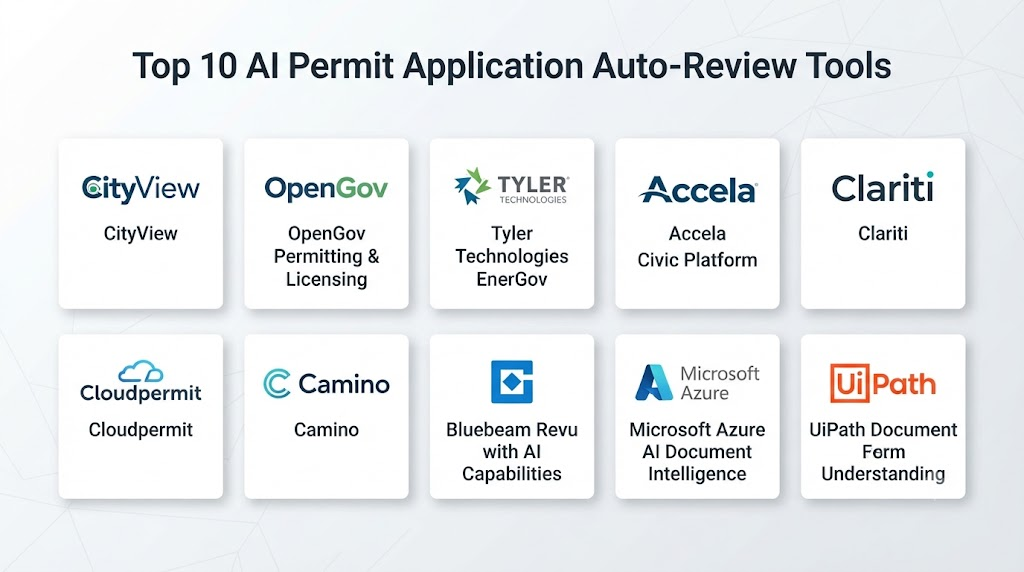
Top 10 AI Permit Application Auto-Review Tools
1. CityView
CityView provides digital permitting and community development solutions for government agencies.
Key Features
- Permit management
- Application workflows
- Document processing
- Inspection management
- Licensing support
- Approval workflows
- Reporting
- Citizen portals
- Data management
- Government integrations
Pros
- Designed for government workflows
- Supports permitting processes
- Improves administrative efficiency
- Strong municipal focus
- Digital application support
Cons
- Government-focused solution
- Requires implementation
- Configuration effort needed
Platforms
Cloud and enterprise platforms.
Deployment or Support
Cloud and enterprise deployment options.
Security & Compliance
Government security controls vary.
Integrations & Ecosystem
Government databases, GIS systems, payment systems, and citizen platforms.
Support & Community
Professional support.
2. OpenGov Permitting & Licensing
OpenGov provides cloud-based government software for permitting and licensing processes.
Key Features
- Online applications
- Permit workflows
- Licensing management
- Application tracking
- Digital approvals
- Reporting dashboards
- Citizen communication
- Workflow automation
- Data management
- Government operations support
Pros
- Cloud-based government platform
- User-friendly workflows
- Strong citizen experience
- Supports digital transformation
- Good reporting features
Cons
- Government-focused
- Requires configuration
- Advanced AI features vary
Platforms
Cloud platform.
Deployment or Support
Cloud deployment.
Security & Compliance
Enterprise cloud security controls.
Integrations & Ecosystem
Government systems, payment platforms, and databases.
Support & Community
Customer support.
3. Tyler Technologies EnerGov
Tyler Technologies EnerGov provides community development and permitting management solutions.
Key Features
- Permit application management
- Plan review workflows
- Licensing
- Inspection scheduling
- Compliance tracking
- Document management
- Citizen portals
- Reporting
- Workflow automation
- Government integrations
Pros
- Strong government adoption
- Comprehensive permitting features
- Supports complex workflows
- Good integration capabilities
- Enterprise scalability
Cons
- Implementation complexity
- Requires training
- Enterprise-focused
Platforms
Cloud and enterprise platforms.
Deployment or Support
Cloud and enterprise deployment.
Security & Compliance
Enterprise security controls.
Integrations & Ecosystem
Government systems, GIS platforms, and enterprise applications.
Support & Community
Enterprise support.
4. Accela Civic Platform
Accela provides cloud-based civic management solutions for permitting and government services.
Key Features
- Permit management
- Application processing
- Workflow automation
- Document management
- Licensing
- Inspections
- Citizen portals
- Reporting
- Data integration
- Compliance workflows
Pros
- Broad government capabilities
- Flexible workflows
- Strong ecosystem
- Supports multiple departments
- Scalable platform
Cons
- Requires customization
- Implementation effort
- Enterprise-oriented
Platforms
Cloud platform.
Deployment or Support
Cloud deployment.
Security & Compliance
Enterprise security controls.
Integrations & Ecosystem
Government databases, GIS systems, payment platforms, and applications.
Support & Community
Enterprise support.
5. Clariti
Clariti provides community development software for government permitting and planning processes.
Key Features
- Permit management
- Planning workflows
- Licensing
- Inspections
- Citizen communication
- Document management
- Application tracking
- Reporting
- Workflow automation
- Data management
Pros
- Government-specific features
- Supports planning workflows
- Improves operational efficiency
- Digital application support
- Good usability
Cons
- Requires setup
- Limited outside government use
- Configuration needed
Platforms
Cloud platform.
Deployment or Support
Cloud deployment.
Security & Compliance
Security controls vary.
Integrations & Ecosystem
Government systems, GIS platforms, and databases.
Support & Community
Customer support.
6. Cloudpermit
Cloudpermit provides digital building permit management solutions.
Key Features
- Online permit applications
- Building permit workflows
- Document submission
- Review tracking
- Communication tools
- Inspection management
- Applicant portals
- Reporting
- Workflow automation
- Digital records
Pros
- Easy online permitting
- Good applicant experience
- Cloud-based platform
- Supports building departments
- Simplifies workflows
Cons
- Focused mainly on permitting
- Regional availability varies
- Advanced AI capabilities vary
Platforms
Cloud platform.
Deployment or Support
Cloud deployment.
Security & Compliance
Cloud security controls.
Integrations & Ecosystem
Government systems and digital service platforms.
Support & Community
Customer support.
7. Camino
Camino provides digital permitting and government service solutions.
Key Features
- Digital permit applications
- Application tracking
- Workflow automation
- Citizen communication
- Data management
- Online services
- Process improvement
- Analytics
- Government workflows
- User portals
Pros
- Modern digital experience
- Improves citizen interaction
- Cloud-based
- Simplifies applications
- Supports government modernization
Cons
- Emerging platform
- Requires adoption
- Feature availability varies
Platforms
Cloud platform.
Deployment or Support
Cloud deployment.
Security & Compliance
Security controls vary.
Integrations & Ecosystem
Government applications and digital platforms.
Support & Community
Customer support.
8. Bluebeam Revu with AI Capabilities
Bluebeam provides document and construction review capabilities.
Key Features
- Document review
- PDF analysis
- Construction workflows
- Markups
- Collaboration
- Plan review support
- Document management
- Project workflows
- Data extraction
- Review assistance
Pros
- Strong construction document capabilities
- Useful for plan reviews
- Good collaboration tools
- Supports technical documents
- Widely used in construction workflows
Cons
- Not a complete permit platform
- Requires integration
- Focused on document review
Platforms
Desktop and cloud platforms.
Deployment or Support
Desktop and cloud deployment.
Security & Compliance
Security depends on deployment.
Integrations & Ecosystem
Construction platforms and document systems.
Support & Community
User community and support.
9. Microsoft Azure AI Document Intelligence
Azure AI Document Intelligence provides AI-based document analysis and extraction capabilities.
Key Features
- OCR processing
- Document classification
- Data extraction
- Form analysis
- Custom AI models
- Document understanding
- API integration
- Workflow automation
- Data processing
- AI analysis
Pros
- Strong AI document capabilities
- Flexible APIs
- Scalable cloud infrastructure
- Developer-friendly
- Enterprise ecosystem
Cons
- Requires technical expertise
- Needs customization
- Cloud dependency
Platforms
Cloud platform.
Deployment or Support
Azure cloud deployment.
Security & Compliance
Enterprise cloud security controls.
Integrations & Ecosystem
Government applications, databases, workflows, and enterprise systems.
Support & Community
Microsoft support ecosystem.
10. UiPath Document Understanding
UiPath provides AI-powered document automation and workflow processing.
Key Features
- Document classification
- Data extraction
- OCR
- AI models
- Workflow automation
- Human validation
- Process automation
- Reporting
- Integration tools
- Robotic process automation
Pros
- Strong automation capabilities
- Flexible workflows
- Good document processing
- Enterprise adoption
- Human review support
Cons
- Requires RPA knowledge
- Implementation effort
- Enterprise-focused
Platforms
Cloud and enterprise platforms.
Deployment or Support
Cloud and enterprise deployment.
Security & Compliance
Enterprise security controls.
Integrations & Ecosystem
Business applications, databases, and automation platforms.
Support & Community
Enterprise support.
Comparison Table
| Tool Name | Best For | Platform(s) Supported | Deployment | Standout Feature | Public Rating |
|---|---|---|---|---|---|
| CityView | Municipal permitting | Cloud/Enterprise | Hybrid | Government workflows | N/A |
| OpenGov Permitting | Digital government services | Cloud | Cloud | Citizen experience | N/A |
| Tyler EnerGov | Enterprise government workflows | Cloud/Enterprise | Hybrid | Community development | N/A |
| Accela Civic Platform | Civic applications | Cloud | Cloud | Flexible workflows | N/A |
| Clariti | Planning and permits | Cloud | Cloud | Government operations | N/A |
| Cloudpermit | Building permits | Cloud | Cloud | Online applications | N/A |
| Camino | Digital permitting | Cloud | Cloud | Modern citizen portal | N/A |
| Bluebeam Revu | Document review | Desktop/Cloud | Hybrid | Plan review | N/A |
| Azure AI Document Intelligence | AI document processing | Cloud | Azure | Document intelligence | N/A |
| UiPath Document Understanding | Workflow automation | Cloud/Enterprise | Hybrid | RPA integration | N/A |
Weighted Evaluation
| Tool Name | Core Features 25% | Ease of Use 15% | Integrations & Ecosystem 15% | Security & Compliance 10% | Performance & Reliability 10% | Support & Community 10% | Price/Value 15% | Total |
|---|---|---|---|---|---|---|---|---|
| CityView | 24 | 13 | 14 | 10 | 10 | 10 | 11 | 92 |
| OpenGov Permitting | 23 | 14 | 14 | 10 | 10 | 10 | 12 | 93 |
| Tyler EnerGov | 25 | 12 | 15 | 10 | 10 | 10 | 10 | 92 |
| Accela Civic Platform | 25 | 12 | 15 | 10 | 10 | 10 | 10 | 92 |
| Clariti | 23 | 14 | 13 | 10 | 10 | 10 | 11 | 91 |
| Cloudpermit | 22 | 15 | 13 | 10 | 10 | 10 | 12 | 92 |
| Camino | 22 | 15 | 13 | 10 | 10 | 10 | 12 | 92 |
| Bluebeam Revu | 22 | 14 | 14 | 10 | 10 | 10 | 11 | 91 |
| Azure AI Document Intelligence | 24 | 13 | 15 | 10 | 10 | 10 | 12 | 94 |
| UiPath Document Understanding | 24 | 13 | 15 | 10 | 10 | 10 | 11 | 93 |
Which AI Permit Application Auto-Review Tool Is Right for You?
Choose CityView when municipal permitting workflows are required.
Choose OpenGov Permitting when improving digital government services is the priority.
Choose Tyler Technologies EnerGov when large government organizations need comprehensive permitting management.
Choose Accela Civic Platform when flexible civic workflows are needed.
Choose Clariti when planning and community development processes are important.
Choose Cloudpermit when online building permits are the main requirement.
Choose Camino when modern citizen-facing permit experiences are needed.
Choose Bluebeam Revu when technical document review is the focus.
Choose Microsoft Azure AI Document Intelligence when AI document analysis is required.
Choose UiPath Document Understanding when automation workflows are the priority.
Implementation Playbook
Phase 1: Define Permit Automation Goals
- Identify review challenges
- Select permit categories
- Define approval workflows
- Identify data sources
- Establish success metrics
Phase 2: Prepare Documents and Rules
- Collect application documents
- Configure review criteria
- Connect databases
- Define compliance rules
- Establish security controls
Phase 3: Deploy AI Review Workflows
- Configure AI models
- Automate document checks
- Create reviewer dashboards
- Enable applicant communication
- Test workflows
Phase 4: Measure Performance
- Reduce processing time
- Improve accuracy
- Track application quality
- Monitor reviewer productivity
- Improve citizen experience
Phase 5: Maintain AI Permit Systems
- Update regulations
- Improve AI models
- Review exceptions
- Monitor security
- Maintain governance
Common Mistakes
- Automating without clear rules
- Ignoring regulatory updates
- Poor document quality management
- Lack of human review
- Weak system integration
- Not training staff
- Ignoring applicant experience
- Overlooking security requirements
FAQs
1. What are AI Permit Application Auto-Review Tools?
AI Permit Application Auto-Review Tools use artificial intelligence to analyze applications, validate information, and support permit approval workflows.
2. How does AI improve permit processing?
AI reduces manual review time by checking documents, identifying missing information, and organizing applications.
3. Can AI approve permits automatically?
AI can assist reviews, but final approval often requires authorized human decisions.
4. What types of permits can AI review?
AI can support building permits, business licenses, environmental permits, and other regulatory applications.
5. Do AI permit tools work with government systems?
Many solutions integrate with government databases, GIS platforms, and citizen portals.
6. Are AI permit systems secure?
Organizations should evaluate security controls, access management, and data protection practices.
7. Can AI review technical documents?
Some platforms can analyze technical documents, forms, and supporting files.
8. How does AI identify incomplete applications?
AI checks required fields, documents, and compliance requirements.
9. What are the benefits for citizens?
Citizens receive faster processing, better updates, and easier application experiences.
10. What should governments consider before selecting an AI permit review tool?
Organizations should evaluate accuracy, workflow features, integrations, security, scalability, and cost.
Conclusion
AI Permit Application Auto-Review Tools are helping governments modernize approval processes by combining artificial intelligence, document intelligence, and workflow automation.Azure AI Document Intelligence, UiPath Document Understanding, Accela, Tyler EnerGov, and OpenGov provide strong capabilities for improving permit workflows, while specialized platforms support municipal and construction-focused requirements.The most effective AI permit review strategy combines automation with regulatory expertise, human oversight, accurate data, and transparent processes. AI helps government organizations deliver faster, more efficient, and citizen-friendly permitting services.
