Introduction
Catalog Management Software helps businesses organize, centralize, enrich, and distribute product information across sales channels and digital storefronts. These tools are especially critical in as ecommerce, marketplaces, omnichannel selling, and personalized customer experiences demand accurate, scalable product data. Rather than relying on fragmented spreadsheets or siloed systems, catalog management platforms provide a single source of truth for product attributes, pricing, images, variants, and descriptions.
Real‑world use cases include:
- Managing product catalogs for ecommerce storefronts, marketplaces, and retail systems.
- Streamlining product updates and versioning across regions and languages.
- Enhancing product data for better SEO and customer discovery.
- Automating solutions for channel syndication (online store, marketplace partners, POS).
- Centralizing variant, pricing, inventory, and media management.
Buyers evaluating Catalog Management Software should consider:
- Ease of centralizing and updating product information.
- Support for omnichannel integrations (marketplaces, ecommerce, POS).
- Workflow and approval automation for product data updates.
- Scalability for large SKUs and variants.
- Support for digital assets (images, videos, descriptions).
- Localization and multi‑currency capabilities.
- Data security, role‑based access, and audit logs.
- Reporting and analytics on product performance.
- Integration with ERP, CRM, analytics, and commerce stacks.
- Cost, deployment flexibility, and support resources.
Best for: Retailers, ecommerce brands, distributors, and manufacturers with large, complex, or multi‑channel product catalogs.
Not ideal for: Small catalogs or single‑store operations where a basic CMS and spreadsheets suffice.
Key Trends in Catalog Management Software
- AI‑assisted product enrichment and automated attribute tagging.
- Headless commerce support with API‑first catalog integration.
- Omnichannel publishing across marketplaces, POS, and digital channels.
- Automated workflow and approval pipelines for product data changes.
- Real‑time syndication and versioning across regions and languages.
- Digital asset management embedded for images, videos, and specs.
- Analytics linked to catalog performance (views, conversion, ROI).
- Multi‑currency and localization support for global ecommerce.
- Integration with ERP/CRM/commerce stacks via connectors and APIs.
- Security, role‑based access, and compliance controls for enterprise governance.
How We Selected These Tools (Methodology)
- Evaluated market adoption among catalog and ecommerce leaders.
- Assessed core catalog features, data modeling, and enrichment tools.
- Verified integration capabilities with sales, ERP, CRM, and marketplace networks.
- Analyzed workflow automation and version control features.
- Reviewed scalability for large SKUs and international catalogs.
- Examined security posture, access controls, and audit capabilities.
- Considered analytics and reporting depth.
- Prioritized innovation in AI enrichment, headless support, and omnichannel sync.
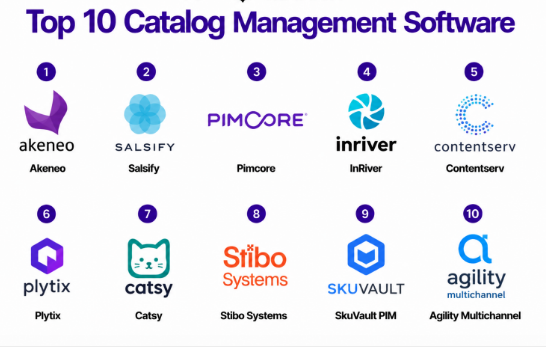
Top 10 Catalog Management Software
1 — Akeneo
Short description: Akeneo is an enterprise‑grade Product Information Management (PIM) platform that centralizes product data, supports multi‑channel publishing, and automates enrichment workflows.
Key Features
- Centralized PIM model with attribute management.
- Channel‑specific product syndication.
- Workflow and approval automation.
- Multi‑language and localization support.
- Digital asset management integration.
Pros
- Excellent for large, complex catalogs.
- Strong multi‑channel publishing capabilities.
Cons
- Enterprise pricing model.
- Implementation may require professional services.
Platforms / Deployment
- Web / Cloud / Hybrid
Security & Compliance
- Role‑based access, encryption
- Not publicly stated
Integrations & Ecosystem
Connects with ecommerce platforms, ERP, marketplaces, and DAM systems.
Support & Community
Documentation, enterprise support, community forums
2 — Salsify
Short description: Salsify combines PIM and digital shelf analytics to help brands deliver consistent product experiences across channels and measure catalog performance.
Key Features
- PIM with omnichannel syndication.
- Digital experience analytics.
- Workflow automation.
- Marketplace publishing.
- Product data health scoring.
Pros
- Analytics tied to product performance.
- Scales across channels and regions.
Cons
- Higher cost for analytics tiers.
- Can be complex for smaller catalogs.
Platforms / Deployment
- Web / Cloud
Security & Compliance
- Encryption, access controls
- Not publicly stated
Integrations & Ecosystem
ERP, ecommerce platforms, marketplace feeds
Support & Community
Help docs, enterprise success support
3 — Pimcore
Short description: Pimcore offers a unified platform combining PIM, DAM, and digital experience management, ideal for brands needing rich media and data centralization.
Key Features
- PIM + DAM unified workspace.
- API‑first headless support.
- Automated workflows.
- Localization and variant management.
- Integration ecosystem.
Pros
- Strong digital asset and product data unification.
- Headless and API support for flexible architecture.
Cons
- Complexity can be high for beginners.
- Requires technical expertise.
Platforms / Deployment
- Web / Cloud / Self‑hosted
Security & Compliance
- Role access, audit logs
- Not publicly stated
Integrations & Ecosystem
ERP, CRM, ecommerce, analytics
Support & Community
Documentation, forums, expert services
4 — InRiver
Short description: InRiver is a PIM platform focused on B2B and complex product environments, enabling rich data modeling and multi‑marketplace syndication.
Key Features
- B2B catalog modeling.
- Multi‑marketplace publishing.
- Workflow orchestration.
- Product templates and schemas.
- Localization and multi‑currency support.
Pros
- Strong B2B catalog modeling.
- Good marketplace integration tools.
Cons
- Pricing geared to enterprise.
- May require implementation support.
Platforms / Deployment
- Web / Cloud
Security & Compliance
- Encryption, access control
- Not publicly stated
Integrations & Ecosystem
ERP, marketplace connectors
Support & Community
Enterprise support, knowledge base
5 — Contentserv
Short description: Contentserv provides catalog and product experience management with rich data modeling, analytics, and omnichannel delivery.
Key Features
- PIM with data governance.
- Omnichannel publishing.
- Data analytics on product health.
- Workflow automation.
- Digital media support.
Pros
- Strong governance and data quality tools.
- Good analytics for product health.
Cons
- Licensing cost can be high.
- Implementation complexity.
Platforms / Deployment
- Web / Cloud
Security & Compliance
- Encryption, audit logs
- Not publicly stated
Integrations & Ecosystem
ERP, ecommerce, CRM
Support & Community
Documentation, enterprise support
6 — Plytix
Short description: Plytix is a user‑friendly PIM solution for small to mid‑sized brands, offering product data centralization and simple syndication workflows.
Key Features
- Central product repository.
- Channel export tools.
- Variant and attribute management.
- Digital asset links.
- Data quality checks.
Pros
- Easy to adopt for smaller catalogs.
- Simple UI and workflow.
Cons
- Limited advanced features for large enterprises.
- Fewer automation options.
Platforms / Deployment
- Web / Cloud
Security & Compliance
- Payment encryption
- Not publicly stated
Integrations & Ecosystem
Ecommerce connectors, CSV export
Support & Community
Help docs, email support
7 — Catsy
Short description: Catsy provides PIM and multi‑channel catalog management primarily for mid‑sized brands and distributors, emphasizing simplicity and channel syndication.
Key Features
- PIM with attribute and variant management.
- Channel syndication (marketplaces, ecommerce).
- Digital asset management.
- User permissions.
- Product change workflows.
Pros
- Robust channel syndication for mid market.
- Simpler than enterprise tools.
Cons
- Less headless/advanced API support.
- Analytics are basic.
Platforms / Deployment
- Web / Cloud
Security & Compliance
- Encryption
- Not publicly stated
Integrations & Ecosystem
Ecommerce, marketplace connectors
Support & Community
Documentation, support tickets
8 — Stibo Systems
Short description: Stibo offers enterprise master data management (MDM) with PIM capabilities focused on large catalogs and consistent data across systems.
Key Features
- Strong MDM + PIM combination.
- Data governance tools.
- Global catalog syndication.
- Workflows and approvals.
- Variant and localization support.
Pros
- Enterprise‑grade data governance.
- Scales for very large catalogs.
Cons
- Enterprise pricing and complexity.
- Requires technical deployment.
Platforms / Deployment
- Web / Cloud / Hybrid
Security & Compliance
- Encryption, audit trails
- Not publicly stated
Integrations & Ecosystem
ERP, analytics, ecommerce
Support & Community
Enterprise support
9 — SkuVault PIM
Short description: SkuVault PIM extends inventory management with product catalog centralization, ideal for retailers and multichannel sellers focused on fulfillment sync.
Key Features
- Product catalog centralization.
- SKU and inventory sync.
- Multi‑channel publishing.
- Variant management.
- Reporting dashboard.
Pros
- Ties inventory and catalog together.
- Good for multichannel sellers.
Cons
- Not as deep in digital asset mgmt.
- Less advanced for large enterprise catalogs.
Platforms / Deployment
- Web / Cloud
Security & Compliance
- Payment encryption
- Not publicly stated
Integrations & Ecosystem
Inventory systems, ecommerce
Support & Community
Documentation, support
10 — Agility Multichannel
Short description: Agility Multichannel offers PIM for brands seeking scalable catalog management with workflow automation, syndication, and data governance.
Key Features
- Data modeling and governance.
- Omnichannel syndication.
- Product workflows.
- Localization and variants.
- Analytics and audit logs.
Pros
- Good balance of features and scalability.
- Strong governance tools.
Cons
- Mid‑enterprise focus; not ideal for small catalogs.
- Setup requires planning.
Platforms / Deployment
- Web / Cloud
Security & Compliance
- Encryption, audit trails
- Not publicly stated
Integrations & Ecosystem
ERP, ecommerce, analytics
Support & Community
Documentation, enterprise support
Comparison Table (Top 10)
| Tool Name | Best For | Platform(s) Supported | Deployment | Standout Feature | Public Rating |
|---|---|---|---|---|---|
| Akeneo | Enterprise catalogs | Web / Cloud / Hybrid | Cloud/Hybrid | Multi‑channel publishing | N/A |
| Salsify | Brand experience | Web / Cloud | Cloud | Analytics + PIM | N/A |
| Pimcore | Unified PIM + DAM | Web / Cloud / Self‑hosted | Hybrid | API‑first & DAM | N/A |
| InRiver | B2B product complexity | Web / Cloud | Cloud | Marketplace syndication | N/A |
| Contentserv | Gov & experience | Web / Cloud | Cloud | Data governance | N/A |
| Plytix | SMB catalog needs | Web / Cloud | Cloud | Simple UI | N/A |
| Catsy | Mid‑market brands | Web / Cloud | Cloud | Channel syndication | N/A |
| Stibo Systems | Large enterprise | Web / Cloud / Hybrid | Cloud/Hybrid | Enterprise MDM | N/A |
| SkuVault PIM | Inventory + catalog | Web / Cloud | Cloud | Inventory sync | N/A |
| Agility Multichannel | Scalable governance | Web / Cloud | Cloud | Workflow automation | N/A |
Evaluation & Scoring of Catalog Management Platforms
| Tool Name | Core | Ease | Integrations | Security | Performance | Support | Value | Weighted Total |
|---|---|---|---|---|---|---|---|---|
| Akeneo | 9 | 7 | 9 | 8 | 9 | 8 | 7 | 8.4 |
| Salsify | 9 | 8 | 9 | 8 | 9 | 8 | 7 | 8.5 |
| Pimcore | 8 | 7 | 8 | 8 | 8 | 7 | 7 | 7.7 |
| InRiver | 8 | 7 | 8 | 8 | 8 | 7 | 7 | 7.7 |
| Contentserv | 8 | 7 | 8 | 8 | 8 | 8 | 7 | 7.8 |
| Plytix | 7 | 9 | 7 | 7 | 8 | 7 | 8 | 7.7 |
| Catsy | 7 | 8 | 7 | 7 | 8 | 7 | 8 | 7.7 |
| Stibo Systems | 9 | 6 | 9 | 8 | 9 | 8 | 7 | 8.2 |
| SkuVault PIM | 7 | 8 | 7 | 7 | 8 | 7 | 8 | 7.7 |
| Agility Multichannel | 8 | 7 | 8 | 8 | 8 | 8 | 7 | 8.0 |
Interpretation: Weighted totals reflect balance across core functionality, scalability, ease of use, integrations, security, and value. Enterprise players score highly for depth and global reach, while SMB tools excel in ease and value.
Which Catalog Management Platform Is Right for You?
Solo / Small Seller
- Plytix, Catsy, SkuVault PIM: Easy adoption and foundational catalog management.
SMB / Scaling Brands
- Contentserv, InRiver: Mid‑market capabilities with governance and syndication.
Enterprise
- Akeneo, Salsify, Stibo Systems: Advanced workflows, analytics, global scaling.
Feature Depth vs Ease of Use
- Tools like Pimcore offer deep control with a learning curve;
- Plytix and Catsy balance function with simplicity.
Integrations & Scalability
- Platform leaders integrate with ERP, CRM, marketplace, analytics, commerce, and DAM systems.
Security & Compliance Needs
- Enterprise tools include role access, encryption, and audit trails for governance.
Frequently Asked Questions (FAQs)
1. What’s the difference between PIM and catalog management?
PIM focuses on product information centralization and enrichment, while catalog management covers publishing and syndication across channels.
2. Can catalog management sync with ecommerce platforms?
Yes—most platforms integrate with Shopify, Magento, BigCommerce, marketplaces, and POS systems.
3. Do these tools support localization?
Yes—multi‑language and localization are common for global catalogs.
4. Are digital assets supported?
Many include DAM integration or native digital asset support for images, video, and specs.
5. How do they handle variants?
Variants and SKU relationships are core features in all advanced catalog tools.
6. Is ERP integration essential?
For large catalogs, ERP sync ensures pricing and inventory alignment.
7. Can small businesses use enterprise tools?
Technically yes—but simpler solutions like Plytix are easier for smaller teams.
8. Do these tools provide analytics?
Yes, leaders like Salsify include performance and conversion analytics tied to product data.
9. What role does workflow automation play?
It ensures approval chains and staged changes across product data updates.
10. Are APIs available?
Most offer API or headless capabilities for flexible integrations.
Conclusion
Catalog Management Software is essential for brands running complex, multi‑channel product catalogs in 2026. Smaller sellers benefit from tools like Plytix and Catsy, while enterprise teams should consider Akeneo, Salsify, or Stibo Systems for advanced workflows, integrations, and governance. To choose the right solution, shortlist 2–3 platforms based on catalog size, integration needs, and long‑term growth goals, run pilot tests, and ensure analytics, security, and workflow features align with your operational strategy.
