Introduction
Cloud Policy as Code Tools help organizations define, test, enforce, and automate security, compliance, cost, and operational rules using code. In simple terms, instead of manually checking whether cloud resources follow company policies, teams write rules that automatically scan infrastructure, pipelines, Kubernetes clusters, cloud accounts, and configuration files. These tools help prevent risky deployments, misconfigurations, excessive permissions, untagged resources, compliance gaps, and insecure infrastructure changes.
They matter now because cloud environments are fast-moving, multi-cloud, Kubernetes-heavy, and increasingly automated through Infrastructure as Code. Manual reviews cannot keep pace with modern DevOps and platform engineering workflows.
Common use cases include IaC scanning, cloud compliance checks, Kubernetes admission control, CI/CD policy gates, access governance, cost guardrails, and continuous configuration monitoring.
Buyers should evaluate policy language, cloud coverage, CI/CD integration, Kubernetes support, remediation workflows, reporting, scalability, security controls, developer experience, and governance flexibility.
Best for: DevOps teams, platform engineering teams, cloud security teams, compliance teams, SRE teams, enterprises, regulated industries, and cloud-native organizations.
Not ideal for: Very small teams with simple cloud environments may not need a dedicated platform. Basic cloud-native configuration checks or manual reviews may be enough for early-stage usage.
Key Trends in Cloud Policy as Code Tools
- Policy as Code is becoming part of platform engineering as internal developer platforms need automated guardrails instead of manual approvals.
- AI-assisted policy writing is emerging to help teams generate, explain, and troubleshoot rules faster.
- Shift-left security is now standard, with policies checked before infrastructure changes reach production.
- Kubernetes admission control is becoming more important as teams need real-time enforcement for clusters, containers, namespaces, and workloads.
- Multi-cloud governance is becoming a core requirement because enterprises need consistent rules across AWS, Azure, Google Cloud, Kubernetes, and SaaS platforms.
- Compliance automation is expanding with policy libraries mapped to security frameworks, audit controls, and internal governance requirements.
- Developer experience is now a buying factor because overly complex policy tools can slow delivery and create resistance.
- Open Policy Agent and Rego remain influential, but many buyers also want easier policy languages and managed workflows.
- Runtime and pre-deployment policy checks are converging, allowing teams to detect issues in code, pipelines, cloud environments, and Kubernetes clusters.
- Cost and sustainability policies are increasing, including rules for tagging, idle resources, approved instance families, and budget controls.
How We Selected These Tools
- Selected tools widely recognized in Policy as Code, cloud governance, IaC security, Kubernetes policy enforcement, and cloud compliance.
- Prioritized platforms that support automation, rule-based governance, and integration into DevOps workflows.
- Included a balanced mix of open-source, enterprise, Kubernetes-native, IaC-first, and cloud security platforms.
- Considered cloud coverage across AWS, Azure, Google Cloud, Kubernetes, containers, and Terraform-style infrastructure workflows.
- Evaluated developer experience, policy authoring model, reporting quality, remediation support, and governance flexibility.
- Considered integration ecosystem across CI/CD tools, source control, cloud providers, Kubernetes, SIEM, and security platforms.
- Avoided unsupported public ratings, certification claims, and pricing assumptions.
- Focused on tools that help organizations enforce policy consistently without slowing down cloud delivery.
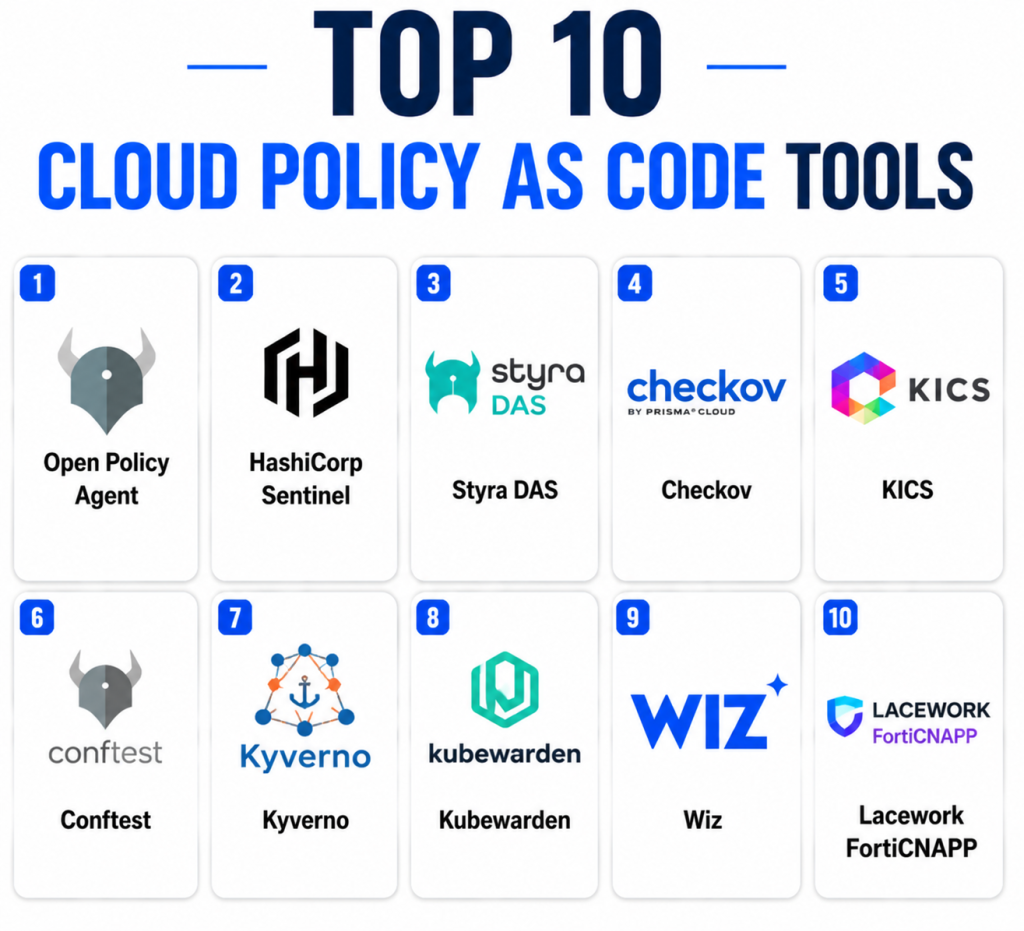
Top 10 Cloud Policy as Code Tools
#1 — Open Policy Agent
Short description: Open Policy Agent, often called OPA, is a general-purpose open-source policy engine used to define and enforce policies across cloud-native environments. It is widely used for Kubernetes admission control, microservices authorization, CI/CD checks, API authorization, and infrastructure governance. OPA uses the Rego policy language, which gives teams strong flexibility for complex rule logic. It is especially useful for platform engineering and security teams that want vendor-neutral policy enforcement. OPA is not a complete commercial governance platform by itself, but it provides a powerful policy foundation. It is best for technical teams comfortable managing open-source policy infrastructure.
Key Features
- General-purpose policy engine
- Rego policy language
- Kubernetes admission control support
- CI/CD and API policy enforcement
- Vendor-neutral architecture
- Strong cloud-native adoption
- Flexible integration model
Pros
- Highly flexible and widely adopted.
- Strong fit for Kubernetes and platform engineering.
- Open-source and vendor-neutral.
Cons
- Rego can have a learning curve.
- Requires internal expertise for production operations.
- Not a full managed governance platform by default.
Platforms / Deployment
- Linux
- Kubernetes
- Self-hosted
- Cloud
- Hybrid
Security & Compliance
- Security depends on deployment configuration
- RBAC depends on integration environment
- Audit logs depend on implementation
- Compliance details: Not publicly stated
Integrations & Ecosystem
OPA has a broad cloud-native ecosystem and is often embedded into other platforms, CI/CD workflows, Kubernetes tooling, and authorization systems.
- Kubernetes
- Terraform workflows
- CI/CD pipelines
- API gateways
- Service mesh environments
- Custom applications
Support & Community
OPA has strong open-source community support, technical documentation, and broad ecosystem adoption. Enterprise support depends on vendors, partners, or internal platform teams.
#2 — HashiCorp Sentinel
Short description: HashiCorp Sentinel is a Policy as Code framework designed to enforce governance rules across HashiCorp workflows, especially Terraform and related infrastructure automation processes. It helps organizations define rules for security, compliance, cost, tagging, resource limits, and operational standards before infrastructure is provisioned. Sentinel is especially useful for teams using Terraform Cloud or Terraform Enterprise. It allows organizations to create policy checks that prevent unsafe or non-compliant infrastructure changes. The tool is best for enterprises standardizing Infrastructure as Code through HashiCorp platforms. It is less ideal for teams not using the HashiCorp ecosystem.
Key Features
- Policy as Code for Terraform workflows
- Pre-deployment governance checks
- Rule-based compliance enforcement
- Cost and tagging guardrails
- Integration with Terraform runs
- Fine-grained policy controls
- Enterprise governance workflows
Pros
- Strong fit for Terraform-heavy organizations.
- Helps prevent non-compliant infrastructure changes before deployment.
- Useful for regulated and enterprise cloud programs.
Cons
- Best value is within HashiCorp ecosystem.
- Less suitable for teams not using Terraform Cloud or Enterprise.
- Policy language and governance setup require learning.
Platforms / Deployment
- Web
- Cloud
- Self-hosted
- Hybrid
Security & Compliance
- SSO/SAML
- RBAC
- Audit logs
- Encryption
- Compliance details: Varies / N/A
Integrations & Ecosystem
Sentinel is strongest inside the HashiCorp ecosystem and works closely with Terraform-based infrastructure workflows.
- Terraform Cloud
- Terraform Enterprise
- Version control systems
- CI/CD pipelines
- Cloud providers
- Enterprise governance workflows
Support & Community
HashiCorp provides documentation, enterprise support options, and professional services. Community strength is strong among Terraform and infrastructure automation teams.
#3 — Styra DAS
Short description: Styra Declarative Authorization Service is a commercial policy management platform built around Open Policy Agent. It helps teams manage, distribute, test, monitor, and govern OPA policies at scale. Styra is useful for organizations that like OPA but need enterprise workflows, visibility, policy lifecycle management, and support. It can be used for Kubernetes admission control, microservices authorization, cloud-native governance, and platform security. The platform helps reduce the operational burden of managing OPA manually. It is best for enterprises that want OPA-based policy enforcement with a managed control plane and governance features.
Key Features
- Enterprise OPA policy management
- Kubernetes admission control
- Policy testing and validation
- Centralized policy distribution
- Decision logging
- Policy lifecycle workflows
- Compliance and governance support
Pros
- Strong for scaling OPA in enterprise environments.
- Provides management layer above open-source OPA.
- Useful for Kubernetes and platform security teams.
Cons
- May be more than small teams need.
- Requires understanding of OPA and policy design.
- Pricing details vary / N/A.
Platforms / Deployment
- Web
- Kubernetes
- Cloud
- Hybrid
Security & Compliance
- SSO/SAML
- RBAC
- Audit logs
- Encryption
- Compliance details: Varies / N/A
Integrations & Ecosystem
Styra integrates with OPA and cloud-native environments where policy decisions need to be managed centrally.
- Open Policy Agent
- Kubernetes
- CI/CD workflows
- Git-based policy repositories
- Cloud-native platforms
- Security and compliance workflows
Support & Community
Styra provides enterprise support, documentation, onboarding, and OPA-focused expertise. Community strength benefits from the broader OPA ecosystem.
#4 — Checkov
Short description: Checkov is an open-source Infrastructure as Code scanning tool used to detect misconfigurations, security risks, and compliance issues before cloud resources are deployed. It supports Terraform, Kubernetes, CloudFormation, Helm, Dockerfile, and other configuration formats. Checkov is popular among DevOps, cloud security, and platform engineering teams that want shift-left scanning in CI/CD pipelines. It includes built-in policies and also supports custom policy creation. The tool is especially useful for teams that want developer-friendly IaC scanning without heavy platform setup. It is often used as part of broader cloud security and DevSecOps workflows.
Key Features
- IaC security scanning
- Terraform and Kubernetes support
- Built-in policy library
- Custom policy support
- CI/CD integration
- Misconfiguration detection
- Developer-friendly feedback
Pros
- Easy to adopt in DevSecOps workflows.
- Good support for common IaC formats.
- Open-source option available.
Cons
- Primarily focused on pre-deployment scanning.
- Enterprise management may require commercial tooling.
- Large policy sets need careful tuning to avoid noise.
Platforms / Deployment
- Linux
- macOS
- Windows
- Cloud
- Self-hosted
- Hybrid
Security & Compliance
- Security depends on deployment model
- RBAC and audit logs vary by commercial or self-managed usage
- Compliance details: Varies / N/A
Integrations & Ecosystem
Checkov works well with developer workflows and cloud security pipelines.
- GitHub
- GitLab
- Bitbucket
- Jenkins
- Terraform
- Kubernetes
- CI/CD pipelines
Support & Community
Checkov has strong open-source usage and documentation. Commercial support may be available through related platforms, while community support is strong among DevSecOps teams.
#5 — KICS
Short description: KICS, short for Keeping Infrastructure as Code Secure, is an open-source IaC scanning tool designed to detect security vulnerabilities, compliance gaps, and misconfigurations in infrastructure definitions. It supports multiple IaC formats and helps teams shift security checks earlier in development. KICS is useful for developers, DevOps teams, and security engineers who want to validate cloud infrastructure code before deployment. It provides predefined queries and can be used in CI/CD pipelines. The tool is especially attractive to teams that prefer open-source scanning. It is best for organizations looking for a lightweight, code-first policy scanning approach.
Key Features
- IaC security scanning
- Multi-format configuration support
- Predefined security queries
- CI/CD pipeline integration
- Misconfiguration detection
- Open-source model
- Custom query support
Pros
- Open-source and developer-friendly.
- Good for early-stage IaC security checks.
- Works well in automation pipelines.
Cons
- Enterprise governance features may be limited.
- Requires tuning for large environments.
- Support depends on community or vendor resources.
Platforms / Deployment
- Linux
- macOS
- Windows
- Self-hosted
- Cloud
- Hybrid
Security & Compliance
- Security depends on deployment configuration
- RBAC and audit logs depend on implementation
- Compliance details: Not publicly stated
Integrations & Ecosystem
KICS fits well into CI/CD and developer workflows where IaC needs to be checked before deployment.
- Git repositories
- CI/CD pipelines
- Terraform workflows
- Kubernetes manifests
- CloudFormation templates
- DevSecOps automation
Support & Community
KICS has open-source documentation and community support. Enterprise support depends on vendor or internal team adoption.
#6 — Conftest
Short description: Conftest is an open-source tool that uses Open Policy Agent and Rego to test configuration files. It allows teams to write policies for Kubernetes manifests, Terraform plans, Docker configurations, YAML files, JSON files, and other structured configuration formats. Conftest is popular with technical teams that want lightweight Policy as Code checks in local development or CI/CD workflows. It is not a full enterprise governance platform, but it is highly useful for validating configuration before deployment. The tool gives teams flexibility to apply OPA-style policies across many file types. It is best for engineering teams that want simple, scriptable policy checks.
Key Features
- Configuration policy testing
- OPA and Rego support
- Terraform plan validation
- Kubernetes manifest checks
- CI/CD-friendly command-line workflow
- Support for JSON, YAML, HCL, and other formats
- Lightweight developer adoption
Pros
- Simple and flexible.
- Useful for local and pipeline-based checks.
- Strong fit for OPA users.
Cons
- Requires Rego knowledge.
- Not a managed enterprise platform.
- Reporting and governance features are limited.
Platforms / Deployment
- Linux
- macOS
- Windows
- Self-hosted
- Hybrid
Security & Compliance
- Security depends on deployment configuration
- Compliance details: Not publicly stated
Integrations & Ecosystem
Conftest integrates easily into scripts, repositories, and CI/CD pipelines.
- Git repositories
- CI/CD pipelines
- Terraform
- Kubernetes
- Docker configuration files
- OPA/Rego policy workflows
Support & Community
Conftest has open-source documentation and community support. It is best supported by technical teams comfortable with command-line tools and Rego policies.
#7 — Kyverno
Short description: Kyverno is a Kubernetes-native Policy as Code tool that allows teams to validate, mutate, generate, and enforce policies inside Kubernetes clusters. Unlike tools that require a separate policy language, Kyverno policies are written as Kubernetes resources, making them familiar to Kubernetes administrators. It is useful for enforcing security, compliance, image validation, namespace standards, resource limits, and configuration rules. Kyverno is especially popular among Kubernetes platform teams that want admission control without learning Rego. It can help enforce guardrails across clusters in a cloud-native way. It is best for Kubernetes-heavy organizations seeking practical policy enforcement.
Key Features
- Kubernetes-native policy engine
- Admission control policies
- Validate, mutate, and generate rules
- Image verification support
- Resource and namespace governance
- Policy reports
- GitOps-friendly workflows
Pros
- Easy for Kubernetes teams to understand.
- No separate policy language required.
- Strong fit for cluster governance.
Cons
- Focused mainly on Kubernetes use cases.
- Not a complete multi-cloud policy platform.
- Large policy libraries need governance to avoid complexity.
Platforms / Deployment
- Kubernetes
- Cloud
- Self-hosted
- Hybrid
Security & Compliance
- RBAC depends on Kubernetes configuration
- Audit logs depend on cluster setup
- Encryption depends on environment
- Compliance details: Not publicly stated
Integrations & Ecosystem
Kyverno fits naturally into Kubernetes and GitOps workflows.
- Kubernetes
- GitOps tools
- Helm
- CI/CD pipelines
- Container registries
- Policy reporting tools
Support & Community
Kyverno has strong cloud-native community adoption and documentation. Enterprise support depends on vendors, partners, or internal platform teams.
#8 — Kubewarden
Short description: Kubewarden is a Kubernetes policy engine that allows teams to write and run policies using WebAssembly-based modules. It is designed for Kubernetes admission control and gives teams flexibility in policy language choices. Kubewarden can help enforce security, compliance, image, workload, and configuration policies across Kubernetes clusters. It is useful for platform teams that want Kubernetes-native governance with a modular policy model. The WebAssembly approach makes it attractive for teams that want flexibility beyond one policy language. It is best for technical Kubernetes teams exploring modern policy enforcement patterns.
Key Features
- Kubernetes admission control
- WebAssembly-based policies
- Flexible policy authoring model
- Policy validation and enforcement
- Cluster governance support
- Container and workload rules
- Cloud-native architecture
Pros
- Flexible policy language approach.
- Strong Kubernetes-native use case.
- Useful for advanced platform engineering teams.
Cons
- Smaller ecosystem than OPA or Kyverno.
- Requires technical maturity.
- Not a broad cloud governance platform by itself.
Platforms / Deployment
- Kubernetes
- Cloud
- Self-hosted
- Hybrid
Security & Compliance
- RBAC depends on Kubernetes configuration
- Audit logs depend on deployment
- Compliance details: Not publicly stated
Integrations & Ecosystem
Kubewarden integrates with Kubernetes admission control and cloud-native platform workflows.
- Kubernetes
- Container registries
- CI/CD workflows
- GitOps pipelines
- Policy repositories
- Cloud-native security workflows
Support & Community
Kubewarden has documentation and a growing open-source community. Enterprise support may depend on vendor involvement or internal team expertise.
#9 — Wiz
Short description: Wiz is a cloud security platform that includes cloud posture management, vulnerability visibility, identity risk insights, Kubernetes security, and cloud compliance workflows. While it is not only a Policy as Code tool, it helps organizations define and enforce cloud security posture expectations across complex cloud environments. Wiz is useful for security teams that need visibility into cloud risks, misconfigurations, exposure paths, and compliance gaps. Its policy and compliance capabilities help teams monitor and prioritize cloud control violations. It is best for organizations seeking broader cloud security visibility rather than only pipeline-level policy checks. Wiz can complement IaC and Kubernetes policy tools.
Key Features
- Cloud security posture management
- Misconfiguration detection
- Kubernetes and container visibility
- Compliance monitoring
- Risk prioritization
- Cloud identity risk insights
- Security graph-based context
Pros
- Strong cloud security visibility.
- Useful for prioritizing real risk.
- Good fit for cloud security teams.
Cons
- Not a pure open-source Policy as Code tool.
- May be more expensive than developer-only scanners.
- Best suited for broader cloud security programs.
Platforms / Deployment
- Web
- Cloud
Security & Compliance
- SSO/SAML
- RBAC
- Audit logs
- Encryption
- Compliance details: Varies / N/A
Integrations & Ecosystem
Wiz integrates with cloud providers, security workflows, and operational tools to support cloud risk management.
- AWS
- Microsoft Azure
- Google Cloud
- Kubernetes
- SIEM tools
- Ticketing and workflow systems
Support & Community
Wiz provides enterprise support, documentation, onboarding, and security-focused guidance. Community strength is high among cloud security and CNAPP buyers.
#10 — Lacework FortiCNAPP
Short description: Lacework FortiCNAPP is a cloud-native application protection platform that helps organizations identify cloud misconfigurations, workload risks, compliance gaps, vulnerabilities, and security issues across cloud environments. While it is broader than Policy as Code, it supports policy-driven cloud security and compliance monitoring. Security teams can use it to detect violations and prioritize remediation across cloud accounts, Kubernetes, workloads, and applications. It is suitable for organizations that want cloud posture, workload protection, and compliance visibility in one platform. It can work alongside IaC scanners and Kubernetes admission tools. It is best for enterprises needing broader CNAPP-style governance rather than only code-level policy checks.
Key Features
- Cloud security posture management
- Compliance monitoring
- Vulnerability visibility
- Workload and container security
- Cloud misconfiguration detection
- Risk prioritization
- Security analytics
Pros
- Broad cloud-native security coverage.
- Useful for compliance and posture management.
- Helps prioritize cloud security risks.
Cons
- Not a dedicated developer-first Policy as Code tool.
- May require tuning for large cloud environments.
- Best value comes from broader CNAPP adoption.
Platforms / Deployment
- Web
- Cloud
Security & Compliance
- SSO/SAML
- RBAC
- Audit logs
- Encryption
- Compliance details: Varies / N/A
Integrations & Ecosystem
Lacework FortiCNAPP integrates with cloud providers, DevOps workflows, and security operations tools.
- AWS
- Microsoft Azure
- Google Cloud
- Kubernetes
- SIEM tools
- Ticketing systems
Support & Community
Enterprise support, onboarding, and documentation are available. Community strength is stronger among cloud security and CNAPP users than open-source policy communities.
Comparison Table
| Tool Name | Best For | Platform(s) Supported | Deployment | Standout Feature | Public Rating |
|---|---|---|---|---|---|
| Open Policy Agent | Vendor-neutral policy engine | Linux, Kubernetes | Self-hosted/Hybrid | Flexible Rego-based policy enforcement | N/A |
| HashiCorp Sentinel | Terraform governance | Web | Cloud/Self-hosted/Hybrid | Terraform policy enforcement | N/A |
| Styra DAS | Enterprise OPA management | Web, Kubernetes | Cloud/Hybrid | Managed OPA policy lifecycle | N/A |
| Checkov | IaC security scanning | Windows, macOS, Linux | Cloud/Self-hosted/Hybrid | Developer-friendly IaC scanning | N/A |
| KICS | Open-source IaC scanning | Windows, macOS, Linux | Self-hosted/Hybrid | Multi-format IaC security checks | N/A |
| Conftest | Lightweight config testing | Windows, macOS, Linux | Self-hosted/Hybrid | OPA-based config validation | N/A |
| Kyverno | Kubernetes policy enforcement | Kubernetes | Cloud/Self-hosted/Hybrid | Kubernetes-native policy rules | N/A |
| Kubewarden | Advanced Kubernetes policy | Kubernetes | Cloud/Self-hosted/Hybrid | WebAssembly-based policies | N/A |
| Wiz | Cloud security governance | Web | Cloud | Risk-based cloud posture insights | N/A |
| Lacework FortiCNAPP | CNAPP policy monitoring | Web | Cloud | Cloud posture and compliance visibility | N/A |
Evaluation & Scoring of Cloud Policy as Code Tools
| Tool Name | Core (25%) | Ease (15%) | Integrations (15%) | Security (10%) | Performance (10%) | Support (10%) | Value (15%) | Weighted Total (0–10) |
| Open Policy Agent | 9.3 | 7.4 | 9.2 | 8.5 | 9.0 | 8.5 | 9.5 | 8.8 |
| HashiCorp Sentinel | 8.8 | 8.0 | 8.7 | 8.8 | 8.7 | 8.6 | 8.0 | 8.5 |
| Styra DAS | 9.0 | 8.2 | 8.8 | 8.9 | 8.8 | 8.7 | 8.0 | 8.6 |
| Checkov | 8.7 | 8.5 | 8.8 | 8.4 | 8.6 | 8.2 | 9.0 | 8.6 |
| KICS | 8.2 | 8.2 | 8.2 | 8.0 | 8.3 | 7.8 | 9.0 | 8.3 |
| Conftest | 8.0 | 7.8 | 8.5 | 7.8 | 8.5 | 7.8 | 9.2 | 8.2 |
| Kyverno | 8.8 | 8.8 | 8.5 | 8.5 | 8.7 | 8.2 | 9.0 | 8.7 |
| Kubewarden | 8.0 | 7.5 | 7.8 | 8.0 | 8.3 | 7.5 | 8.8 | 8.0 |
| Wiz | 8.7 | 8.7 | 8.8 | 9.2 | 9.0 | 8.8 | 7.8 | 8.7 |
| Lacework FortiCNAPP | 8.5 | 8.2 | 8.5 | 9.0 | 8.8 | 8.5 | 7.8 | 8.5 |
These scores are comparative and should be adjusted based on your use case. A Kubernetes-first platform team may rate Kyverno, OPA, or Kubewarden higher than a cloud security team would. A Terraform-heavy enterprise may prefer Sentinel or Checkov. A security operations team may value Wiz or Lacework FortiCNAPP because they provide broader cloud risk context. Always test tools in your real CI/CD, cloud, and Kubernetes workflows before final selection.
Which Cloud Policy as Code Tool Is Right for You?
Solo / Freelancer
Solo users and freelancers usually do not need an enterprise policy platform. Checkov, KICS, Conftest, or Open Policy Agent can be good starting points because they are developer-friendly and can run locally or in simple pipelines. If Kubernetes is your main environment, Kyverno is easier to start with than more complex policy engines.
SMB
SMBs should prioritize simplicity, fast deployment, and low operational burden. Checkov, KICS, Kyverno, and Conftest can provide strong policy checks without enterprise complexity. If the SMB already uses Terraform Cloud, Sentinel may also be practical. Teams with limited security staff should avoid overly complex policy frameworks unless they have strong DevOps support.
Mid-Market
Mid-market organizations often need CI/CD integration, policy libraries, Kubernetes controls, cloud posture visibility, and better reporting. Checkov, OPA, Kyverno, Styra DAS, and Wiz can be strong choices depending on operating model. If compliance workflows are important, broader CNAPP tools may complement developer-first scanners.
Enterprise
Enterprises usually need scalable governance, auditability, identity controls, policy lifecycle management, compliance reporting, and multi-cloud support. Styra DAS, HashiCorp Sentinel, Open Policy Agent, Wiz, Lacework FortiCNAPP, and Checkov are strong candidates. The best choice depends on whether the organization is Terraform-led, Kubernetes-led, CNAPP-led, or platform-engineering-led.
Budget vs Premium
Budget-conscious teams can start with OPA, Checkov, KICS, Conftest, Kyverno, or OpenCost-style open-source governance patterns. Premium buyers should evaluate Styra DAS, HashiCorp Sentinel, Wiz, and Lacework FortiCNAPP for enterprise management, reporting, support, and governance workflows. Premium tools are easier to justify when audit requirements and multi-team scale increase.
Feature Depth vs Ease of Use
OPA and Conftest are powerful but require Rego knowledge. Kyverno is easier for Kubernetes teams because policies look like Kubernetes resources. Checkov and KICS are easier for IaC scanning. Wiz and Lacework FortiCNAPP are easier for security visibility but are not pure Policy as Code tools. Teams should match policy depth with operational skill.
Integrations & Scalability
Teams should evaluate integration with GitHub, GitLab, Bitbucket, Jenkins, Terraform, Kubernetes, Helm, CI/CD platforms, cloud providers, SIEM, ticketing tools, and GitOps workflows. Scalability depends on how policies are versioned, tested, reviewed, rolled out, and monitored. Policy sprawl can become a problem without governance.
Security & Compliance Needs
Regulated organizations should prioritize audit logs, RBAC, SSO, policy history, compliance mapping, exception workflows, and reporting. Developer-first scanners are valuable, but enterprises often need a broader governance layer. Security teams should also check how sensitive cloud, repository, and deployment data is accessed and stored.
Frequently Asked Questions
1- What is Cloud Policy as Code?
Cloud Policy as Code means writing security, compliance, cost, and operational rules as code so they can be tested and enforced automatically. It helps teams prevent mistakes before they reach production.
2- How is Policy as Code different from Infrastructure as Code?
Infrastructure as Code defines what infrastructure should be created. Policy as Code defines what rules that infrastructure must follow, such as approved regions, required tags, encryption settings, and access controls.
3- Why do companies need Policy as Code?
Companies need Policy as Code because cloud environments change too quickly for manual reviews. Automated policy checks help reduce misconfigurations, compliance gaps, and risky deployments.
4- Which tools are best for Terraform governance?
HashiCorp Sentinel, Checkov, OPA, and Conftest are commonly used in Terraform governance workflows. The best choice depends on whether you need enterprise enforcement, open-source scanning, or lightweight validation.
5- Which tools are best for Kubernetes policy enforcement?
Kyverno, Open Policy Agent, Styra DAS, and Kubewarden are strong choices for Kubernetes policy enforcement. Kyverno is often easier for Kubernetes teams, while OPA is more flexible across use cases.
6- Are open-source Policy as Code tools enough?
Open-source tools can be enough for technical teams with strong DevOps maturity. Enterprises may need commercial platforms for centralized reporting, policy lifecycle management, support, auditability, and governance workflows.
7- What are common mistakes when adopting Policy as Code?
Common mistakes include writing too many policies too quickly, creating noisy alerts, ignoring developer experience, failing to test policies, and not defining exception workflows. Good policy programs start small and mature gradually.
8- Can Policy as Code help with compliance?
Yes, Policy as Code can help automate compliance checks for cloud configurations, access controls, encryption, tagging, logging, and approved resource standards. However, final compliance responsibility still requires governance and audit review.
9- How long does implementation take?
A basic scanner can be added to a CI/CD pipeline quickly. A mature enterprise policy program may take longer because teams must define standards, ownership, policy review workflows, exception handling, and reporting.
10- Do these tools replace cloud security platforms?
Not always. Policy as Code tools help enforce rules early and consistently, while cloud security platforms provide broader visibility, runtime monitoring, risk prioritization, and compliance dashboards. Many organizations use both.
Conclusion
Cloud Policy as Code Tools help organizations automate governance across cloud, Infrastructure as Code, Kubernetes, CI/CD, and security workflows. The best option depends on your architecture, team maturity, compliance requirements, and preferred policy model. Open Policy Agent, Conftest, Kyverno, Kubewarden, KICS, and Checkov are strong choices for technical teams that want flexible and developer-friendly enforcement. HashiCorp Sentinel is strong for Terraform-heavy enterprises. Styra DAS helps organizations scale OPA with enterprise management. Wiz and Lacework FortiCNAPP provide broader cloud security and compliance visibility that can complement policy enforcement. is to shortlist two or three tools, test them in real pipelines and clusters, validate developer experience, review security controls, and build a policy rollout plan that supports both speed and governance.
