Introduction
Enterprise Content Connectors for RAG (Retrieval-Augmented Generation) are integration layers that securely connect large language model applications to enterprise data sources such as Google Drive, SharePoint, Confluence, Slack, Salesforce, databases, and internal document systems. Instead of manually moving or duplicating data, these connectors continuously ingest, sync, and normalize enterprise content so it can be indexed into vector databases or semantic search systems.
In modern AI architectures, RAG systems are only as good as the data they can access. Enterprise content connectors ensure that AI systems retrieve fresh, permission-aware, and contextually accurate information. They also handle critical challenges like authentication, access control, data synchronization, incremental updates, and structured/unstructured data transformation.
These tools are essential for enterprise copilots, AI knowledge assistants, customer support automation, legal discovery systems, HR assistants, and internal search engines.
Evaluation Criteria for Buyers
When selecting enterprise content connectors for RAG, consider:
- Source system coverage (SaaS + on-prem)
- Real-time vs batch synchronization
- Permission-aware data ingestion
- Incremental sync and change tracking
- Data normalization and cleaning
- Integration with vector databases
- RAG pipeline compatibility
- Security and compliance controls
- API flexibility and extensibility
- Scalability for enterprise workloads
- Observability and sync monitoring
- Ease of deployment and maintenance
Best for: Enterprises building RAG-based copilots, AI assistants, semantic search platforms, and knowledge management systems.
Not ideal for: Simple applications without enterprise data sources or systems that do not require continuous data synchronization.
What’s Changed in Enterprise Content Connectors for RAG
- Shift from static ingestion to real-time sync pipelines
- Native permission-aware RAG ingestion (ACL propagation into embeddings)
- Deep integration with vector databases and hybrid search systems
- Automatic data chunking during ingestion
- Multi-source federated retrieval (cross-app search)
- LLM-powered data normalization and cleaning
- Event-driven ingestion architectures
- Built-in RAG evaluation and freshness tracking
- Stronger enterprise governance and audit logging
- Support for multimodal enterprise content (audio, video, images, docs)
- Zero-copy ingestion pipelines reducing data duplication
- Embedded security layers for sensitive enterprise data
Quick Buyer Checklist
- Supports major enterprise SaaS systems (Google, Microsoft, Salesforce, etc.)
- Maintains access control (ACL-aware ingestion)
- Provides real-time or near real-time syncing
- Integrates with vector databases (Pinecone, Weaviate, etc.)
- Supports structured + unstructured content
- Offers incremental updates and change tracking
- Provides secure authentication (OAuth, SAML, API keys)
- Enables audit logs and observability
- Supports RAG-ready output formatting
- Handles large-scale enterprise data ingestion
- Allows custom connector development
- Minimizes vendor lock-in risk
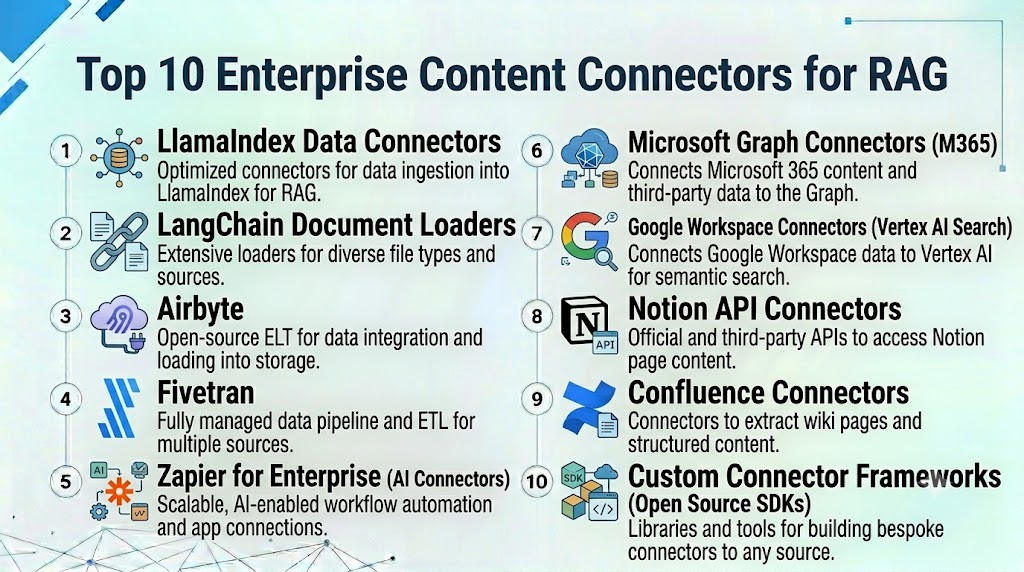
Top 10 Enterprise Content Connectors for RAG
1- LlamaIndex Data Connectors
One-line verdict: Best developer-first framework for building RAG-ready enterprise data connectors.
Short description:
LlamaIndex provides a flexible connector ecosystem that integrates with enterprise systems, APIs, and file sources to build RAG-ready pipelines.
Standout Capabilities
- Wide connector ecosystem (Drive, Slack, Notion, etc.)
- Structured ingestion pipelines
- Metadata preservation
- Incremental indexing support
- RAG-native design
- Custom connector support
- Vector database integration
AI-Specific Depth
- Model support: Multi-LLM compatible
- RAG integration: Native-first architecture
- Evaluation: Built-in evaluation modules
- Guardrails: Basic pipeline constraints
- Observability: Tracing and ingestion logs
Pros
- Highly flexible
- Strong developer ecosystem
- RAG-optimized design
Cons
- Requires engineering effort
- Not a plug-and-play enterprise tool
- Connector quality varies
Deployment & Platforms
- Python library
- Cloud or self-hosted
Integrations & Ecosystem
Works with vector databases, LLM APIs, and enterprise SaaS connectors.
Pricing Model
Open-source.
Best-Fit Scenarios
- Custom RAG systems
- AI copilots
- Enterprise ingestion pipelines
2- LangChain Document Loaders
One-line verdict: Best ecosystem-driven connector framework for LLM applications.
Short description:
LangChain provides a large set of document loaders for ingesting data from enterprise systems into RAG pipelines.
Standout Capabilities
- Enterprise SaaS connectors
- File system loaders
- API-based ingestion
- Streaming ingestion support
- Metadata extraction
- Chunking integration
- Vector DB compatibility
AI-Specific Depth
- Model support: Multi-model compatible
- RAG integration: Core functionality
- Evaluation: External tools required
- Guardrails: Pipeline-level controls
- Observability: LangSmith integration
Pros
- Huge ecosystem support
- Easy integration
- Strong community adoption
Cons
- Not enterprise-managed
- Requires orchestration layer
- Can become complex
Deployment & Platforms
- Python/JS library
- Cloud/local
Integrations & Ecosystem
Works with vector stores, APIs, and LLM providers.
Pricing Model
Open-source core.
Best-Fit Scenarios
- RAG pipelines
- AI applications
- Developer workflows
3- Airbyte
One-line verdict: Best enterprise ETL-style connector platform extended for RAG pipelines.
Short description:
Airbyte provides a connector-based ingestion platform that integrates enterprise SaaS systems and databases into AI pipelines.
Standout Capabilities
- 300+ data connectors
- Incremental sync
- Change data capture (CDC)
- API-based extensibility
- Pipeline scheduling
- Data normalization
- Open-source core
AI-Specific Depth
- Model support: External AI systems
- RAG integration: Indirect via pipelines
- Evaluation: Not publicly stated
- Guardrails: Pipeline controls
- Observability: Sync monitoring
Pros
- Strong connector ecosystem
- Enterprise-ready ingestion
- Scalable architecture
Cons
- Not AI-native
- Requires transformation layer for RAG
- Setup complexity
Deployment & Platforms
- Cloud
- Self-hosted
- Hybrid
Integrations & Ecosystem
Integrates with warehouses, APIs, and AI pipelines.
Pricing Model
Open-source + enterprise cloud tiers.
Best-Fit Scenarios
- Enterprise data ingestion
- SaaS data syncing
- RAG pipeline feeding
4- Fivetran
One-line verdict: Best fully managed enterprise connector platform for structured data ingestion.
Short description:
Fivetran automates data synchronization from enterprise systems into centralized data stores used for AI and analytics.
Standout Capabilities
- Fully managed connectors
- Automatic schema management
- Incremental updates
- High reliability ingestion
- Enterprise SaaS coverage
- Data normalization
- Cloud data warehouse sync
AI-Specific Depth
- Model support: External AI systems
- RAG integration: Via downstream pipelines
- Evaluation: Not available
- Guardrails: Enterprise controls
- Observability: Pipeline monitoring
Pros
- Zero-maintenance ingestion
- High reliability
- Enterprise-grade
Cons
- Expensive at scale
- Limited customization
- Not RAG-native
Deployment & Platforms
- Cloud only
Integrations & Ecosystem
Integrates with Snowflake, BigQuery, Databricks, and warehouses.
Pricing Model
Usage-based enterprise pricing.
Best-Fit Scenarios
- Enterprise data pipelines
- Warehouse-centric AI systems
- Structured ingestion workflows
5- Zapier for Enterprise (AI Connectors)
One-line verdict: Best lightweight automation-based connector system for SaaS-to-RAG pipelines.
Short description:
Zapier enables automation-based integration between enterprise SaaS tools and AI systems.
Standout Capabilities
- SaaS app integrations
- Workflow automation
- Event-driven triggers
- API-based connectors
- Lightweight ingestion flows
- No-code pipeline setup
- Rapid prototyping
AI-Specific Depth
- Model support: External AI systems
- RAG integration: Indirect
- Evaluation: Not available
- Guardrails: Basic workflow controls
- Observability: Task logs
Pros
- Easy to use
- Fast setup
- Huge SaaS coverage
Cons
- Not designed for large-scale ingestion
- Limited governance
- Not RAG-optimized
Deployment & Platforms
- Cloud only
Best-Fit Scenarios
- Small AI workflows
- SaaS automation
- Prototype RAG ingestion
6- Microsoft Graph Connectors (M365)
One-line verdict: Best enterprise-native connector ecosystem for Microsoft-based organizations.
Short description:
Microsoft Graph Connectors integrate enterprise content from Microsoft 365 and third-party systems into Microsoft Search and AI systems.
Standout Capabilities
- SharePoint, Teams, Outlook integration
- Enterprise search ingestion
- Security trimming (ACL-aware)
- Graph API ecosystem
- Real-time indexing
- Compliance controls
- Hybrid data sources
AI-Specific Depth
- Model support: Microsoft AI ecosystem
- RAG integration: Strong within Azure stack
- Evaluation: Not publicly stated
- Guardrails: Strong enterprise policies
- Observability: Microsoft monitoring tools
Pros
- Deep Microsoft integration
- Strong security model
- Enterprise scalability
Cons
- Microsoft lock-in
- Limited external flexibility
- Complex configuration
Deployment & Platforms
- Cloud (Microsoft ecosystem)
Best-Fit Scenarios
- Enterprise Microsoft environments
- Internal search systems
- AI copilots in M365
7- Google Workspace Connectors (Vertex AI Search)
One-line verdict: Best for Google-native enterprise data ingestion for AI search.
Short description:
Google Workspace connectors integrate Drive, Gmail, and Docs into Vertex AI Search for RAG applications.
Standout Capabilities
- Google Drive ingestion
- Gmail data indexing
- Docs and Sheets parsing
- Enterprise search integration
- Real-time updates
- AI-powered ranking
- Secure access controls
AI-Specific Depth
- Model support: Google AI ecosystem
- RAG integration: Native in Vertex AI
- Evaluation: Not publicly stated
- Guardrails: Google IAM policies
- Observability: Cloud logging
Pros
- Strong AI integration
- Scalable infrastructure
- Managed service
Cons
- Google ecosystem lock-in
- Limited customization
- Enterprise pricing complexity
Deployment & Platforms
- Cloud only (GCP)
Best-Fit Scenarios
- Google Workspace enterprises
- AI search systems
- Knowledge assistants
8- Notion API Connectors
One-line verdict: Best lightweight knowledge base connector for AI-powered documentation systems.
Short description:
Notion connectors allow ingestion of structured workspace content into RAG systems.
Standout Capabilities
- API-based content extraction
- Page hierarchy support
- Rich text parsing
- Metadata extraction
- Workspace synchronization
- Lightweight integration
- Developer-friendly APIs
AI-Specific Depth
- Model support: External AI systems
- RAG integration: Common use case
- Evaluation: Not available
- Guardrails: Workspace permissions
- Observability: API logs
Pros
- Easy integration
- Clean structured content
- Popular among startups
Cons
- Limited enterprise governance
- Rate limits
- Not designed for large-scale ingestion
Deployment & Platforms
- Cloud API
Best-Fit Scenarios
- Startup knowledge bases
- AI documentation assistants
- Internal copilots
9- Confluence Connectors
One-line verdict: Best enterprise documentation ingestion connector for knowledge-heavy organizations.
Short description:
Confluence connectors enable structured ingestion of enterprise documentation into AI systems.
Standout Capabilities
- Page hierarchy ingestion
- Rich text extraction
- Permissions-aware access
- Metadata preservation
- Version tracking
- API-based sync
- Enterprise collaboration support
AI-Specific Depth
- Model support: External AI systems
- RAG integration: Strong use case
- Evaluation: Not publicly stated
- Guardrails: ACL-based restrictions
- Observability: Sync monitoring
Pros
- Strong enterprise documentation source
- Reliable structure extraction
- Permission-aware ingestion
Cons
- Atlassian ecosystem dependency
- Limited customization
- Requires setup for scaling
Deployment & Platforms
- Cloud + enterprise Atlassian
Best-Fit Scenarios
- Enterprise knowledge systems
- Internal AI assistants
- Documentation RAG pipelines
10- Custom Connector Frameworks (Open Source SDKs)
One-line verdict: Best for organizations needing fully customized enterprise ingestion pipelines.
Short description:
Custom connector frameworks allow teams to build tailored ingestion pipelines for proprietary systems and complex enterprise architectures.
Standout Capabilities
- Fully customizable connectors
- API-based ingestion
- Multi-source integration
- Event-driven architecture
- Flexible data transformations
- RAG pipeline compatibility
- Deep system integration
AI-Specific Depth
- Model support: Any LLM system
- RAG integration: Fully customizable
- Evaluation: External tooling required
- Guardrails: Custom implementation
- Observability: Developer-defined
Pros
- Maximum flexibility
- No vendor lock-in
- Highly scalable design
Cons
- Requires engineering effort
- Maintenance overhead
- Longer development cycles
Deployment & Platforms
- Self-hosted
- Cloud-native builds
Best-Fit Scenarios
- Complex enterprise ecosystems
- Proprietary data systems
- Large-scale AI platforms
Comparison Table
| Tool | Best For | Deployment | Model Flexibility | Strength | Watch-Out | Public Rating |
|---|---|---|---|---|---|---|
| LlamaIndex | RAG pipelines | Library | High | Flexibility | Engineering effort | N/A |
| LangChain | LLM workflows | Library | High | Ecosystem | Complexity | N/A |
| Airbyte | Data ingestion | Hybrid | High | Connectors | Not AI-native | N/A |
| Fivetran | Enterprise ETL | Cloud | Medium | Reliability | Cost | N/A |
| Zapier | Automation | Cloud | Medium | Simplicity | Not scalable | N/A |
| Microsoft Graph | M365 ingestion | Cloud | High | Enterprise integration | Lock-in | N/A |
| Google Workspace | GCP ingestion | Cloud | High | AI integration | Lock-in | N/A |
| Notion | Knowledge base | Cloud | Medium | Simplicity | Limited scale | N/A |
| Confluence | Enterprise docs | Cloud | High | Structured docs | Atlassian lock-in | N/A |
| Custom SDKs | Enterprise builds | Hybrid | High | Flexibility | Engineering cost | N/A |
Scoring & Evaluation
| Tool | Core | Reliability | Guardrails | Integrations | Ease | Performance | Security | Support | Weighted Total |
|---|---|---|---|---|---|---|---|---|---|
| LlamaIndex | 9 | 9 | 8 | 10 | 9 | 8 | 7 | 8 | 8.6 |
| LangChain | 9 | 8 | 7 | 10 | 9 | 8 | 7 | 8 | 8.3 |
| Airbyte | 8 | 8 | 8 | 9 | 8 | 8 | 8 | 8 | 8.1 |
| Fivetran | 9 | 9 | 9 | 9 | 8 | 9 | 10 | 9 | 8.9 |
| Zapier | 7 | 7 | 6 | 8 | 10 | 7 | 7 | 7 | 7.3 |
| Microsoft Graph | 9 | 9 | 9 | 9 | 8 | 9 | 10 | 9 | 9.0 |
| Google Workspace | 9 | 9 | 8 | 9 | 8 | 9 | 9 | 8 | 8.8 |
| Notion | 8 | 8 | 7 | 8 | 10 | 7 | 8 | 7 | 7.8 |
| Confluence | 9 | 9 | 9 | 9 | 8 | 8 | 9 | 9 | 8.8 |
| Custom SDKs | 10 | 8 | 7 | 10 | 6 | 9 | 8 | 7 | 8.3 |
Conclusion
Enterprise Content Connectors for RAG are a foundational layer in modern AI systems, enabling organizations to bring real-time, permission-aware, and structured enterprise knowledge into LLM-powered applications. As AI moves toward agentic workflows and GraphRAG architectures, connectors are becoming more intelligent, secure, and deeply integrated with enterprise ecosystems.
