Introduction
Ontology Management Tools for AI help organizations define, structure, and govern domain knowledge in a machine-readable format. An ontology is essentially a formal representation of concepts, entities, and relationships within a domain—such as healthcare, finance, retail, or enterprise knowledge systems. In AI systems, ontologies act as the “semantic backbone” that allows machines to understand meaning, enforce consistency, and reason over structured knowledge.
In modern AI architectures, especially those involving Retrieval-Augmented Generation (RAG), knowledge graphs, and agent-based systems, ontologies ensure that models don’t just retrieve information but understand it in a structured, explainable way. They reduce ambiguity, improve data interoperability, and enable more accurate reasoning across enterprise systems.
Real-world use cases include enterprise knowledge modeling, AI assistants, healthcare diagnosis systems, financial compliance systems, fraud detection, semantic search, data integration pipelines, and intelligent automation workflows.
Evaluation Criteria for Buyers
When evaluating ontology management tools, consider:
- Ontology modeling capabilities (OWL, RDF support)
- Ease of schema and taxonomy design
- Reasoning and inference support
- Integration with AI/LLM systems
- Knowledge graph compatibility
- Collaboration features for domain experts
- Version control and lifecycle management
- Scalability for enterprise knowledge bases
- Interoperability with data pipelines
- Governance and validation controls
- API and automation support
- Visualization and debugging tools
Best for: AI teams, knowledge engineers, data architects, enterprise AI platforms, semantic search systems, and organizations building knowledge graphs or AI reasoning systems.
Not ideal for: Simple databases, non-semantic applications, or teams that do not require structured knowledge modeling.
What’s Changed in Ontology Management Tools
- Deep integration with LLM-powered ontology generation
- Automated ontology extraction from unstructured data
- GraphRAG-driven ontology enrichment workflows
- Multimodal ontology modeling (text, image, video entities)
- AI-assisted schema design and validation
- Real-time ontology evolution in production systems
- Stronger alignment with knowledge graphs and vector systems
- Improved ontology versioning and lifecycle governance
- Built-in reasoning engines for AI applications
- Low-code/no-code ontology builders for enterprises
- Increased interoperability with semantic web standards
- Enterprise-grade auditability and compliance tracking
Quick Buyer Checklist
- Supports OWL, RDF, or equivalent semantic standards
- Provides reasoning or inference capabilities
- Allows collaborative ontology modeling
- Integrates with knowledge graphs or vector databases
- Supports AI/LLM pipelines (RAG, GraphRAG)
- Offers version control and audit trails
- Provides visualization tools for relationships
- Supports API-driven ontology management
- Enables validation and constraint checking
- Handles large-scale domain models
- Supports modular ontology design
- Minimizes vendor lock-in risk
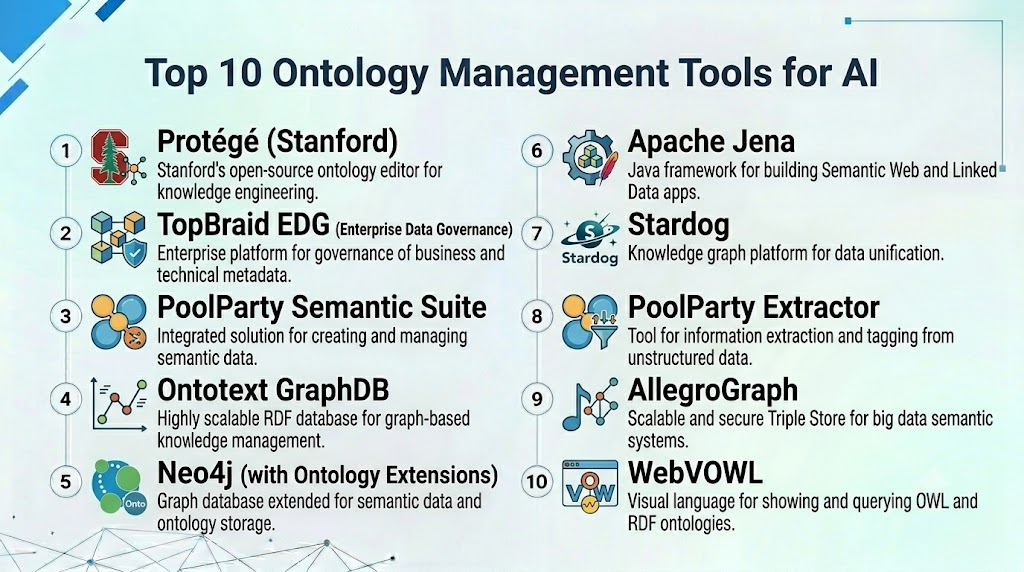
Top 10 Ontology Management Tools for AI
1- Protégé (Stanford)
One-line verdict: Best open-source ontology editor for semantic modeling and AI knowledge design.
Short description:
Protégé is the most widely used ontology development tool, providing a powerful environment for creating, editing, and managing OWL-based ontologies used in AI and semantic systems.
Standout Capabilities
- OWL ontology modeling
- RDF schema support
- Reasoning engine integration
- Plugin ecosystem
- Class and property management
- Semantic validation tools
- Knowledge visualization
AI-Specific Depth
- Model support: Not model-based; ontology-driven
- RAG integration: Indirect via export to graph systems
- Evaluation: Logical consistency checking
- Guardrails: Schema constraints and validation rules
- Observability: Ontology debugging and reasoning logs
Pros
- Free and open-source
- Strong academic and enterprise adoption
- Highly extensible
Cons
- UI feels technical for beginners
- Requires ontology expertise
- Limited native AI integration
Deployment & Platforms
- Desktop (Windows/macOS/Linux)
- Plugin-based extensions
Integrations & Ecosystem
Supports RDF stores, graph databases, and semantic web tools via export formats and plugins.
Pricing Model
Free and open-source.
Best-Fit Scenarios
- Academic ontology design
- Enterprise knowledge modeling
- Semantic web applications
2- TopBraid EDG
One-line verdict: Best enterprise-grade ontology and knowledge graph governance platform.
Short description:
TopBraid EDG provides enterprise ontology lifecycle management with strong governance, collaboration, and data integration features for large organizations.
Standout Capabilities
- Enterprise ontology governance
- Knowledge graph integration
- Data catalog alignment
- Business glossary management
- Collaboration workflows
- Validation and rule enforcement
- Semantic data modeling
AI-Specific Depth
- Model support: LLM-assisted features (varies)
- RAG integration: Strong GraphRAG compatibility
- Evaluation: Schema validation + consistency checks
- Guardrails: Strong policy enforcement
- Observability: Governance dashboards
Pros
- Enterprise governance focus
- Strong collaboration tools
- Scales to large organizations
Cons
- Enterprise pricing
- Complex onboarding
- Requires training
Deployment & Platforms
- Cloud
- On-premise
- Hybrid
Integrations & Ecosystem
Integrates with data catalogs, knowledge graphs, BI systems, and semantic web tools.
Pricing Model
Enterprise licensing (not publicly stated).
Best-Fit Scenarios
- Large enterprise ontology governance
- Regulatory knowledge systems
- AI knowledge infrastructure
3- PoolParty Semantic Suite
One-line verdict: Best semantic AI platform for taxonomy and ontology management.
Short description:
PoolParty combines ontology management, taxonomy building, and semantic enrichment for enterprise AI and knowledge systems.
Standout Capabilities
- Taxonomy and ontology management
- Semantic enrichment
- Entity extraction tools
- Knowledge graph integration
- Text mining capabilities
- Auto-classification
- Linked data support
AI-Specific Depth
- Model support: NLP + semantic enrichment
- RAG integration: Strong support via knowledge graphs
- Evaluation: Semantic validation tools
- Guardrails: Controlled vocabularies
- Observability: Semantic analytics dashboards
Pros
- Strong semantic processing
- Good automation features
- Enterprise-ready
Cons
- Steep learning curve
- Enterprise pricing
- UI complexity
Deployment & Platforms
- Cloud
- On-premise
Best-Fit Scenarios
- Enterprise taxonomy systems
- Semantic search platforms
- AI content classification
4- Ontotext GraphDB
One-line verdict: Best RDF-based ontology and semantic knowledge graph platform.
Short description:
GraphDB is a semantic graph database designed for ontology-driven knowledge systems using RDF and OWL standards.
Standout Capabilities
- RDF triple store
- OWL reasoning engine
- SPARQL query support
- Ontology alignment tools
- Semantic inference
- Knowledge graph integration
- High-performance indexing
AI-Specific Depth
- Model support: External LLM integration
- RAG integration: Strong GraphRAG support
- Evaluation: Logical consistency checking
- Guardrails: Ontology constraints
- Observability: Query analytics
Pros
- Strong semantic reasoning
- Standards-based architecture
- Enterprise scalability
Cons
- Requires ontology expertise
- Complex configuration
- Less beginner-friendly
Deployment & Platforms
- Cloud
- On-premise
Best-Fit Scenarios
- Semantic AI systems
- Knowledge graphs
- Research-driven AI
5- Neo4j (with Ontology Extensions)
One-line verdict: Best graph-based ontology modeling integrated with enterprise knowledge graphs.
Short description:
Neo4j supports ontology-like modeling through labeled property graphs, enabling flexible semantic knowledge representation.
Standout Capabilities
- Graph-based ontology modeling
- Cypher query language
- Graph analytics
- Knowledge graph integration
- Real-time updates
- Visualization tools
- AI ecosystem compatibility
AI-Specific Depth
- Model support: LLM + embedding integration
- RAG integration: Strong GraphRAG support
- Evaluation: Graph validation tools
- Guardrails: Access control + schema rules
- Observability: Query monitoring
Pros
- Flexible modeling
- Strong ecosystem
- Widely adopted
Cons
- Not pure ontology (RDF-based)
- Requires graph expertise
- Licensing complexity
Deployment & Platforms
- Cloud
- Self-hosted
- Hybrid
Best-Fit Scenarios
- AI knowledge graphs
- Enterprise semantic systems
- Recommendation engines
6- Apache Jena
One-line verdict: Best open-source framework for RDF ontology development.
Short description:
Apache Jena is a Java-based framework for building semantic web and ontology-driven applications.
Standout Capabilities
- RDF data model support
- SPARQL query engine
- OWL reasoning support
- Semantic web integration
- Modular architecture
- Triple store capabilities
- Ontology APIs
Pros
- Fully open-source
- Strong standards compliance
- Flexible architecture
Cons
- Requires development expertise
- Limited UI tools
- Performance tuning needed
Deployment & Platforms
- Self-hosted
- Cloud via infrastructure
Best-Fit Scenarios
- Research systems
- Semantic web applications
- Custom ontology pipelines
7- Stardog
One-line verdict: Best enterprise semantic platform for ontology-driven AI systems.
Short description:
Stardog provides ontology management, knowledge graphs, and reasoning capabilities for enterprise AI applications.
Standout Capabilities
- Ontology management
- Knowledge graph reasoning
- Data virtualization
- Semantic integration
- Graph federation
- Enterprise governance
- AI-ready knowledge layer
Pros
- Strong reasoning engine
- Enterprise capabilities
- Semantic flexibility
Cons
- Complex setup
- Enterprise pricing
- Requires domain expertise
Deployment & Platforms
- Cloud
- On-premise
- Hybrid
Best-Fit Scenarios
- Enterprise semantic AI
- Knowledge-driven applications
- Compliance systems
8- PoolParty Extractor
One-line verdict: Best NLP-powered ontology extraction tool.
Short description:
PoolParty Extractor focuses on automatically building ontologies from unstructured text using NLP and semantic enrichment.
Standout Capabilities
- Automatic entity extraction
- Semantic classification
- Ontology enrichment
- Text mining engine
- Knowledge graph integration
- Taxonomy generation
- AI-assisted modeling
Pros
- Reduces manual effort
- Strong NLP capabilities
- Enterprise integration
Cons
- Requires fine-tuning
- Enterprise licensing
- Limited customization
Deployment & Platforms
- Cloud
- On-premise
Best-Fit Scenarios
- Automated ontology creation
- Content classification systems
- Enterprise knowledge pipelines
9- AllegroGraph
One-line verdict: Best high-performance semantic graph database with ontology support.
Short description:
AllegroGraph is a semantic graph database designed for RDF-based ontology systems and large-scale reasoning.
Standout Capabilities
- RDF triple store
- Advanced reasoning engine
- Geo-spatial support
- Semantic querying
- High-performance storage
- Knowledge graph integration
- AI-ready architecture
Pros
- High performance
- Strong reasoning
- Scalable architecture
Cons
- Complex configuration
- Enterprise-focused pricing
- Steep learning curve
Deployment & Platforms
- Cloud
- On-premise
Best-Fit Scenarios
- Enterprise semantic systems
- AI reasoning engines
- Knowledge-intensive applications
10- WebVOWL
One-line verdict: Best ontology visualization tool for understanding semantic structures.
Short description:
WebVOWL is a web-based ontology visualization tool that helps users explore and understand ontology structures visually.
Standout Capabilities
- Ontology visualization
- OWL support
- Interactive graphs
- Schema exploration
- Web-based interface
- Lightweight design
- Educational tools
Pros
- Easy visualization
- Lightweight tool
- Free to use
Cons
- Not a full ontology platform
- Limited editing features
- Visualization-only focus
Deployment & Platforms
- Web-based
Best-Fit Scenarios
- Ontology visualization
- Education and training
- Schema exploration
Comparison Table
| Tool | Best For | Deployment | Model Flexibility | Strength | Watch-Out | Public Rating |
|---|---|---|---|---|---|---|
| Protégé | Ontology design | Desktop | High | Open-source standard | Technical UI | N/A |
| TopBraid EDG | Enterprise governance | Hybrid | High | Governance | Complexity | N/A |
| PoolParty | Semantic AI | Hybrid | High | Automation | Enterprise cost | N/A |
| GraphDB | RDF systems | Hybrid | High | Reasoning | Complexity | N/A |
| Neo4j | Knowledge graphs | Hybrid | High | Ecosystem | Not pure ontology | N/A |
| Apache Jena | Developers | Self-hosted | High | Flexibility | Dev-heavy | N/A |
| Stardog | Enterprise semantics | Hybrid | High | Reasoning | Cost | N/A |
| PoolParty Extractor | NLP ontology creation | Hybrid | Medium | Automation | Fine-tuning needed | N/A |
| AllegroGraph | Semantic databases | Hybrid | High | Performance | Complexity | N/A |
| WebVOWL | Visualization | Web | Low | Simplicity | Limited scope | N/A |
Scoring & Evaluation
| Tool | Core | Reliability | Guardrails | Integrations | Ease | Performance | Security | Support | Weighted Total |
|---|---|---|---|---|---|---|---|---|---|
| Protégé | 9 | 8 | 7 | 8 | 8 | 7 | 7 | 8 | 7.9 |
| TopBraid EDG | 10 | 9 | 10 | 9 | 7 | 8 | 10 | 9 | 9.1 |
| PoolParty | 9 | 9 | 9 | 9 | 7 | 8 | 9 | 9 | 8.8 |
| GraphDB | 9 | 8 | 8 | 8 | 6 | 9 | 8 | 8 | 8.1 |
| Neo4j | 9 | 9 | 8 | 10 | 8 | 9 | 9 | 9 | 8.8 |
| Apache Jena | 8 | 8 | 7 | 8 | 6 | 8 | 8 | 7 | 7.6 |
| Stardog | 9 | 9 | 9 | 9 | 7 | 8 | 9 | 8 | 8.7 |
| PoolParty Extractor | 8 | 8 | 7 | 8 | 7 | 8 | 8 | 8 | 8.0 |
| AllegroGraph | 9 | 9 | 8 | 8 | 6 | 9 | 8 | 8 | 8.2 |
| WebVOWL | 7 | 6 | 5 | 7 | 10 | 6 | 6 | 7 | 6.8 |
Conclusion
Ontology Management Tools for AI are becoming a critical layer in modern intelligent systems, especially as organizations adopt knowledge graphs, GraphRAG architectures, and LLM-powered reasoning systems. These tools help structure domain knowledge, improve AI explainability, and ensure consistency across complex enterprise datasets.
No single tool fits all scenarios. Protégé and Apache Jena excel in open-source and research environments, while TopBraid EDG, Stardog, and PoolParty dominate enterprise semantic governance. Neo4j and GraphDB provide strong hybrid graph-ontology capabilities for AI-driven applications.
