Introduction
Policy as Code tools help organizations define, manage, enforce, and automate governance, security, compliance, and operational policies using code instead of manual processes. Rather than relying on spreadsheets, documentation, or human reviews, Policy as Code enables teams to codify rules that automatically validate infrastructure, applications, Kubernetes environments, cloud resources, and deployment pipelines.
As organizations continue adopting cloud-native architectures, Infrastructure as Code, DevOps, GitOps, and multi-cloud environments, policy enforcement has become increasingly complex. Policy as Code tools provide a scalable way to maintain security, compliance, and operational consistency without slowing development teams.
Real-world use cases include:
- Cloud security governance
- Kubernetes admission control
- Infrastructure compliance validation
- CI/CD security enforcement
- Regulatory compliance automation
What buyers should evaluate:
- Policy language flexibility
- Cloud and Kubernetes support
- Infrastructure as Code integration
- CI/CD compatibility
- Scalability
- Compliance reporting
- Auditability
- Developer experience
- Ecosystem maturity
- Enterprise governance capabilities
Best for: DevOps teams, Platform Engineering teams, Security Operations teams, Cloud Architects, Compliance teams, regulated industries, enterprises adopting Infrastructure as Code, and organizations implementing Zero Trust governance.
Not ideal for: Very small organizations with minimal cloud infrastructure, teams managing only a few servers manually, or businesses without automation initiatives where traditional configuration management may be sufficient.
Key Trends in Policy as Code Tools
- AI-assisted policy creation and policy optimization are becoming mainstream.
- Shift-left security continues driving policy validation earlier in CI/CD pipelines.
- Kubernetes governance remains a primary adoption driver.
- Multi-cloud compliance frameworks are becoming standard requirements.
- GitOps integration is increasingly expected by platform teams.
- Real-time policy remediation is replacing simple policy detection.
- Cloud-native security platforms are embedding Policy as Code engines.
- Open-source policy ecosystems continue expanding rapidly.
- Platform engineering teams are standardizing policy libraries across business units.
- Regulatory frameworks increasingly require automated compliance evidence collection.
How We Selected These Tools (Methodology)
Our evaluation considered:
- Market adoption and community momentum
- Enterprise deployment maturity
- Breadth of policy enforcement capabilities
- Kubernetes and cloud-native support
- Infrastructure as Code integration depth
- Security and compliance functionality
- Ecosystem strength and extensibility
- Suitability across enterprise, mid-market, and developer-focused environments
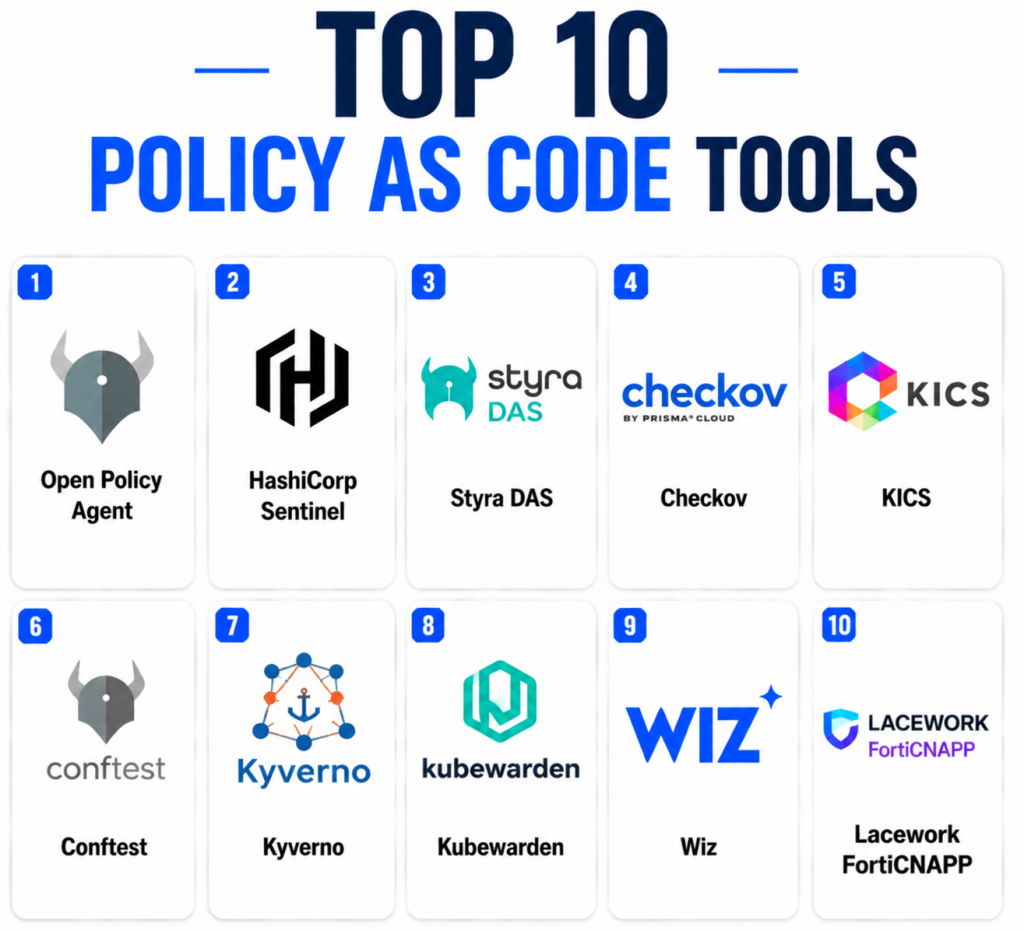
Top 10 Policy as Code Tools
1- Open Policy Agent
Short description:
Open Policy Agent, commonly known as OPA, is the most widely adopted open-source Policy as Code framework. It enables organizations to decouple policy decisions from applications and infrastructure. OPA is extensively used across Kubernetes, cloud infrastructure, APIs, CI/CD pipelines, and platform engineering initiatives. Its flexible Rego language supports complex policy logic while remaining highly portable. Many commercial security products also build upon OPA technology. It is suitable for organizations seeking maximum flexibility and vendor neutrality.
Key Features
- Rego policy language
- Kubernetes policy enforcement
- API authorization policies
- Infrastructure validation
- Cloud governance automation
- CI/CD integration
- Extensive ecosystem support
Pros
- Highly flexible
- Strong open-source community
- Vendor-neutral architecture
Cons
- Learning curve for Rego
- Requires policy engineering expertise
- Advanced policies can become complex
Platforms / Deployment
- Linux / Windows / macOS
- Cloud / Self-hosted / Hybrid
Security & Compliance
- RBAC integration
- Audit capabilities
- Encryption support depends on deployment
- Compliance controls configurable
Integrations & Ecosystem
OPA has one of the largest ecosystems in the Policy as Code market.
- Kubernetes
- Terraform
- GitHub Actions
- Jenkins
- Istio
- Envoy
Support & Community
Strong open-source community, extensive documentation, enterprise support available through ecosystem vendors.
2- HashiCorp Sentinel
Short description:
Sentinel is HashiCorp’s policy framework integrated into Terraform Enterprise and other HashiCorp products. It allows organizations to enforce governance and compliance policies during infrastructure provisioning. Sentinel is particularly attractive for enterprises heavily invested in Terraform workflows. The platform focuses on policy enforcement before infrastructure deployment, helping reduce compliance violations and configuration drift. It offers centralized governance with infrastructure automation.
Key Features
- Terraform policy enforcement
- Governance automation
- Policy testing framework
- Fine-grained access controls
- Policy simulation
- Compliance validation
Pros
- Native Terraform integration
- Enterprise governance focus
- Mature policy lifecycle controls
Cons
- Strongly tied to HashiCorp ecosystem
- Less flexible outside Terraform
- Enterprise licensing requirements
Platforms / Deployment
- Cloud / Hybrid
Security & Compliance
- Audit logging
- RBAC
- Policy governance controls
Integrations & Ecosystem
Strong integration with HashiCorp platforms.
- Terraform
- Vault
- HCP
- Infrastructure workflows
Support & Community
Enterprise-grade support and documentation.
3- Styra DAS
Short description:
Styra DAS extends OPA capabilities with enterprise governance, policy lifecycle management, visualization, and operational tooling. It provides a centralized platform for managing policies across cloud-native environments. Enterprises use Styra DAS to standardize governance across Kubernetes, cloud resources, APIs, and applications. The platform simplifies policy adoption while maintaining OPA compatibility.
Key Features
- OPA-based governance
- Policy lifecycle management
- Compliance reporting
- Centralized policy management
- Kubernetes governance
- Policy analytics
Pros
- Enterprise-friendly OPA management
- Strong governance features
- Centralized visibility
Cons
- Commercial licensing
- Additional operational layer
- Best value at enterprise scale
Platforms / Deployment
- Cloud / Hybrid
Security & Compliance
- Audit logging
- RBAC
- Enterprise governance controls
Integrations & Ecosystem
- Kubernetes
- AWS
- Azure
- Google Cloud
- Terraform
- CI/CD tools
Support & Community
Strong enterprise support with professional services.
4- Checkov
Short description:
Checkov focuses on Infrastructure as Code security scanning and policy enforcement. Developed for cloud security validation, it helps identify misconfigurations before deployment. Checkov supports Terraform, Kubernetes manifests, CloudFormation, Helm charts, and other infrastructure definitions. Security teams frequently use Checkov as part of shift-left security programs.
Key Features
- Infrastructure scanning
- Misconfiguration detection
- Compliance validation
- CI/CD integration
- Multi-cloud coverage
- Policy customization
Pros
- Developer-friendly
- Strong IaC coverage
- Fast scanning
Cons
- Primarily security-focused
- Less suitable for broader governance
- Complex policies may require customization
Platforms / Deployment
- Cloud / Self-hosted
Security & Compliance
- Compliance frameworks support
- Security scanning
- Audit reporting
Integrations & Ecosystem
- Terraform
- Kubernetes
- GitHub
- GitLab
- Jenkins
Support & Community
Large open-source user community and commercial backing.
5- KICS
Short description:
KICS stands for Keeping Infrastructure as Code Secure. It is an open-source static analysis tool focused on identifying security and compliance issues in infrastructure definitions. KICS supports multiple IaC frameworks and provides extensive built-in policy checks. Organizations use it to automate cloud security validation within development workflows.
Key Features
- IaC scanning
- Security policies
- Compliance checks
- Multi-framework support
- Custom query creation
- Pipeline integration
Pros
- Open source
- Broad IaC support
- Easy adoption
Cons
- Limited enterprise governance features
- Focused on scanning
- Smaller ecosystem than OPA
Platforms / Deployment
- Cloud / Self-hosted
Security & Compliance
- Security scanning
- Compliance validation
Integrations & Ecosystem
- Terraform
- Kubernetes
- GitHub Actions
- GitLab CI
Support & Community
Growing open-source community.
6- Conftest
Short description:
Conftest leverages OPA policies to test configuration files before deployment. It enables developers to validate infrastructure definitions, Kubernetes manifests, and configuration files directly within CI/CD pipelines. Organizations adopting GitOps frequently use Conftest as an early-stage validation mechanism.
Key Features
- OPA integration
- Configuration validation
- CI/CD testing
- Kubernetes support
- Infrastructure validation
- Policy reuse
Pros
- Lightweight deployment
- Reuses OPA policies
- Easy CI/CD integration
Cons
- Limited governance dashboarding
- Requires OPA knowledge
- No centralized management
Platforms / Deployment
- Cloud / Self-hosted
Security & Compliance
- Policy enforcement
- Configuration validation
Integrations & Ecosystem
- Kubernetes
- Terraform
- GitHub
- GitLab
- Jenkins
Support & Community
Strong community support due to OPA adoption.
7- Kyverno
Short description:
Kyverno is a Kubernetes-native policy engine designed specifically for Kubernetes governance. Unlike OPA’s Rego language, Kyverno policies are written using familiar YAML syntax. This makes it highly attractive to Kubernetes administrators and platform teams seeking easier policy management.
Key Features
- Kubernetes-native policies
- Admission control
- Policy mutation
- Policy generation
- Compliance auditing
- YAML-based policies
Pros
- Kubernetes-friendly
- Easier learning curve
- Strong cloud-native adoption
Cons
- Kubernetes-focused
- Less suitable outside Kubernetes
- Advanced use cases may require additional tooling
Platforms / Deployment
- Kubernetes
- Cloud / Self-hosted
Security & Compliance
- Admission controls
- Audit reporting
- Compliance validation
Integrations & Ecosystem
- Kubernetes
- GitOps platforms
- Cloud-native ecosystem
Support & Community
Large CNCF community support.
8- Kubewarden
Short description:
Kubewarden provides Kubernetes policy enforcement using WebAssembly. It enables developers to create policies in multiple programming languages while maintaining strong performance. Organizations seeking flexible policy development often consider Kubewarden an alternative to traditional admission controllers.
Key Features
- WebAssembly policies
- Kubernetes governance
- Multi-language support
- Admission control
- Policy marketplace
- Performance optimization
Pros
- Flexible development model
- High performance
- Modern architecture
Cons
- Smaller ecosystem
- Kubernetes-specific
- Less enterprise adoption
Platforms / Deployment
- Kubernetes
- Cloud / Self-hosted
Security & Compliance
- Policy auditing
- Admission controls
Integrations & Ecosystem
- Kubernetes
- GitOps workflows
- CNCF ecosystem
Support & Community
Growing community and active development.
9- Wiz
Short description:
Wiz includes Policy as Code capabilities within its cloud security platform. Security teams can define and enforce governance controls across cloud environments. Wiz combines posture management, risk prioritization, and policy automation within a unified platform.
Key Features
- Cloud governance
- Risk prioritization
- Compliance monitoring
- Policy automation
- Multi-cloud visibility
- Security posture management
Pros
- Unified security platform
- Strong cloud visibility
- Enterprise scalability
Cons
- Commercial solution
- Security-centric focus
- Less flexible than dedicated policy engines
Platforms / Deployment
- Cloud
Security & Compliance
- RBAC
- Audit logging
- Compliance monitoring
Integrations & Ecosystem
- AWS
- Azure
- Google Cloud
- DevOps platforms
Support & Community
Strong enterprise support and onboarding services.
10- Lacework FortiCNAPP
Short description:
Lacework FortiCNAPP incorporates policy automation within its cloud-native application protection platform. Organizations use it to monitor cloud resources, enforce compliance requirements, and automate security governance. The platform combines visibility, compliance management, and policy enforcement capabilities.
Key Features
- Cloud governance
- Compliance monitoring
- Security automation
- Risk detection
- Multi-cloud support
- Policy management
Pros
- Unified security operations
- Multi-cloud visibility
- Compliance-focused
Cons
- Enterprise-oriented pricing
- Security-first design
- Less open customization
Platforms / Deployment
- Cloud
Security & Compliance
- Audit logging
- RBAC
- Compliance reporting
Integrations & Ecosystem
- AWS
- Azure
- Google Cloud
- CI/CD platforms
Support & Community
Enterprise support programs and documentation resources.
Comparison Table
| Tool Name | Best For | Platform(s) Supported | Deployment | Standout Feature | Public Rating |
|---|---|---|---|---|---|
| Open Policy Agent | Enterprise Governance | Multi-platform | Cloud/Self-hosted | Rego Policy Engine | N/A |
| Sentinel | Terraform Governance | Cloud Infrastructure | Cloud | Native Terraform Enforcement | N/A |
| Styra DAS | Enterprise Policy Management | Multi-platform | Hybrid | OPA Lifecycle Management | N/A |
| Checkov | IaC Security | Multi-platform | Cloud/Self-hosted | Security Scanning | N/A |
| KICS | Open Source Compliance | Multi-platform | Self-hosted | IaC Analysis | N/A |
| Conftest | Configuration Validation | Multi-platform | Self-hosted | OPA Testing Framework | N/A |
| Kyverno | Kubernetes Governance | Kubernetes | Self-hosted | YAML Policies | N/A |
| Kubewarden | Kubernetes Flexibility | Kubernetes | Self-hosted | WebAssembly Policies | N/A |
| Wiz | Cloud Governance | Multi-cloud | Cloud | Unified CNAPP | N/A |
| Lacework FortiCNAPP | Security Governance | Multi-cloud | Cloud | Compliance Automation | N/A |
Evaluation & Scoring of Policy as Code Tools
| Tool | Core | Ease | Integrations | Security | Performance | Support | Value | Weighted Total |
|---|---|---|---|---|---|---|---|---|
| OPA | 10 | 7 | 10 | 9 | 9 | 9 | 9 | 9.1 |
| Sentinel | 8 | 8 | 8 | 9 | 8 | 9 | 7 | 8.1 |
| Styra DAS | 9 | 8 | 9 | 9 | 8 | 9 | 7 | 8.5 |
| Checkov | 8 | 8 | 8 | 8 | 8 | 8 | 9 | 8.2 |
| KICS | 7 | 8 | 7 | 8 | 8 | 7 | 9 | 7.8 |
| Conftest | 8 | 8 | 8 | 8 | 8 | 8 | 9 | 8.1 |
| Kyverno | 9 | 9 | 8 | 8 | 8 | 8 | 9 | 8.6 |
| Kubewarden | 8 | 7 | 7 | 8 | 9 | 7 | 8 | 7.8 |
| Wiz | 9 | 9 | 9 | 9 | 9 | 9 | 7 | 8.8 |
| Lacework FortiCNAPP | 8 | 8 | 8 | 9 | 8 | 8 | 7 | 8.0 |
These scores are comparative rather than absolute. Organizations should prioritize criteria that align with their operational requirements. Kubernetes-focused teams may value Kyverno more highly, while cloud governance teams may prioritize Wiz. OPA remains the most versatile platform overall, but enterprise buyers often choose commercial solutions for governance, reporting, and support capabilities.
Which Policy as Code Tool Is Right for You?
Solo / Freelancer
Open-source options such as OPA, Conftest, Checkov, and KICS provide strong capabilities without licensing costs.
SMB
Kyverno, Checkov, and Conftest offer strong security and governance capabilities with manageable operational complexity.
Mid-Market
Styra DAS and Kyverno provide a balance between enterprise governance and operational simplicity.
Enterprise
OPA, Styra DAS, Wiz, and Sentinel are strong choices for large-scale governance, compliance, and cloud operations.
Budget vs Premium
Budget-conscious organizations should consider OPA, Kyverno, Conftest, Checkov, and KICS. Premium buyers may prefer Wiz, Styra DAS, Sentinel, or Lacework.
Feature Depth vs Ease of Use
Kyverno offers easier policy authoring, while OPA provides deeper customization and flexibility.
Integrations & Scalability
OPA, Wiz, and Styra DAS provide the broadest integration ecosystems and enterprise scalability.
Security & Compliance Needs
Regulated industries often benefit from Styra DAS, Sentinel, Wiz, and Lacework due to governance reporting and compliance-focused capabilities.
Frequently Asked Questions
1- What is Policy as Code?
Policy as Code is the practice of defining governance, security, compliance, and operational rules in machine-readable code. These policies are automatically enforced across infrastructure, applications, and deployment pipelines.
2- Why is Policy as Code important?
It helps organizations automate governance, reduce human error, improve compliance, and maintain consistent security standards across complex cloud environments.
3- Is Policy as Code only for Kubernetes?
No. While Kubernetes is a major use case, Policy as Code can also govern cloud resources, APIs, Infrastructure as Code, CI/CD pipelines, and application access controls.
4- What is the difference between OPA and Kyverno?
OPA provides a flexible policy framework using Rego, while Kyverno focuses specifically on Kubernetes and uses YAML-based policies that are easier for Kubernetes administrators to understand.
5- Are open-source tools sufficient for enterprise use?
Many enterprises successfully use OPA, Kyverno, Checkov, and Conftest. However, commercial platforms often provide governance dashboards, support, and compliance reporting.
6- Can Policy as Code help with compliance audits?
Yes. Automated policy enforcement helps organizations generate evidence, maintain controls, and demonstrate compliance more effectively during audits.
7- How difficult is implementation?
Complexity varies by tool. Kyverno and Checkov are generally easier to adopt, while OPA may require more expertise because of its policy language.
8- What common mistakes should organizations avoid?
Common mistakes include writing overly complex policies, lacking policy testing processes, ignoring developer experience, and failing to align policies with business goals.
9- Can these tools integrate with CI/CD pipelines?
Yes. Most modern Policy as Code platforms integrate with GitHub Actions, GitLab CI, Jenkins, Azure DevOps, and other CI/CD systems.
10- What should be evaluated before selecting a tool?
Organizations should assess policy flexibility, integration support, scalability, compliance requirements, deployment models, governance features, and operational complexity.
Conclusion
Policy as Code has become a foundational capability for modern cloud, DevOps, Kubernetes, and platform engineering initiatives. As infrastructure complexity continues growing, organizations need automated governance mechanisms that scale across teams, environments, and compliance frameworks. Open Policy Agent remains the most flexible and widely adopted solution, while Kyverno offers exceptional Kubernetes-native simplicity. Enterprises requiring governance, reporting, and operational visibility often gravitate toward Styra DAS, Wiz, Sentinel, or Lacework. The right choice ultimately depends on your infrastructure strategy, compliance obligations, internal expertise, and operational scale. Before making a decision, shortlist two or three candidates, run a proof of concept, validate integration requirements, and confirm that policy management aligns with your long-term cloud governance objectives.
