Introduction
Privacy-preserving analytics tools help organizations collect, analyze, and derive insights from data while minimizing exposure of personally identifiable information and sensitive user data. These platforms use techniques such as differential privacy, federated analytics, secure multiparty computation, anonymization, pseudonymization, and privacy-enhancing technologies to enable data-driven decision-making without compromising privacy.
As privacy regulations become stricter and third-party cookies continue to disappear, organizations increasingly need analytics solutions that balance business intelligence with user trust. Modern privacy-preserving analytics platforms allow companies to measure performance, understand customer behavior, and optimize products while maintaining compliance with regulations and internal governance requirements.
Real-world use cases include:
- Customer behavior analytics without exposing personal information.
- Healthcare research using protected patient datasets.
- Financial fraud detection while protecting customer privacy.
- Cross-organization analytics and collaboration.
- Marketing measurement in a cookieless environment.
What buyers should evaluate:
- Privacy technologies and methodologies.
- Data collection capabilities.
- Regulatory compliance support.
- Deployment flexibility.
- Integration ecosystem.
- Scalability and performance.
- Reporting and visualization features.
- Security controls and governance.
- AI and machine learning support.
- Total cost of ownership.
Best for: Enterprises, healthcare organizations, financial institutions, government agencies, SaaS providers, privacy-focused startups, data science teams, compliance leaders, and organizations operating under strict privacy regulations.
Not ideal for: Small organizations with minimal analytics requirements, businesses relying solely on traditional analytics workflows, or teams without regulatory or privacy-driven business requirements.
Key Trends in Privacy-Preserving Analytics Tools
- AI-powered privacy risk detection and automated governance workflows.
- Increased adoption of differential privacy techniques for data sharing.
- Growth of federated analytics and federated machine learning.
- Expansion of privacy-enhancing technologies in cloud environments.
- Greater emphasis on first-party data strategies.
- Real-time privacy compliance monitoring and reporting.
- Integration of analytics platforms with data clean rooms.
- Hybrid deployment models supporting regulated industries.
- Automated anonymization and synthetic data generation.
- Increased demand for privacy-safe marketing measurement.
How We Selected These Tools (Methodology)
The tools in this list were evaluated based on:
- Market adoption and industry recognition.
- Breadth of privacy-preserving capabilities.
- Analytics and reporting functionality.
- Security architecture and governance features.
- Scalability across enterprise environments.
- Integration ecosystem and APIs.
- Deployment flexibility and cloud support.
- Suitability for organizations of varying sizes.
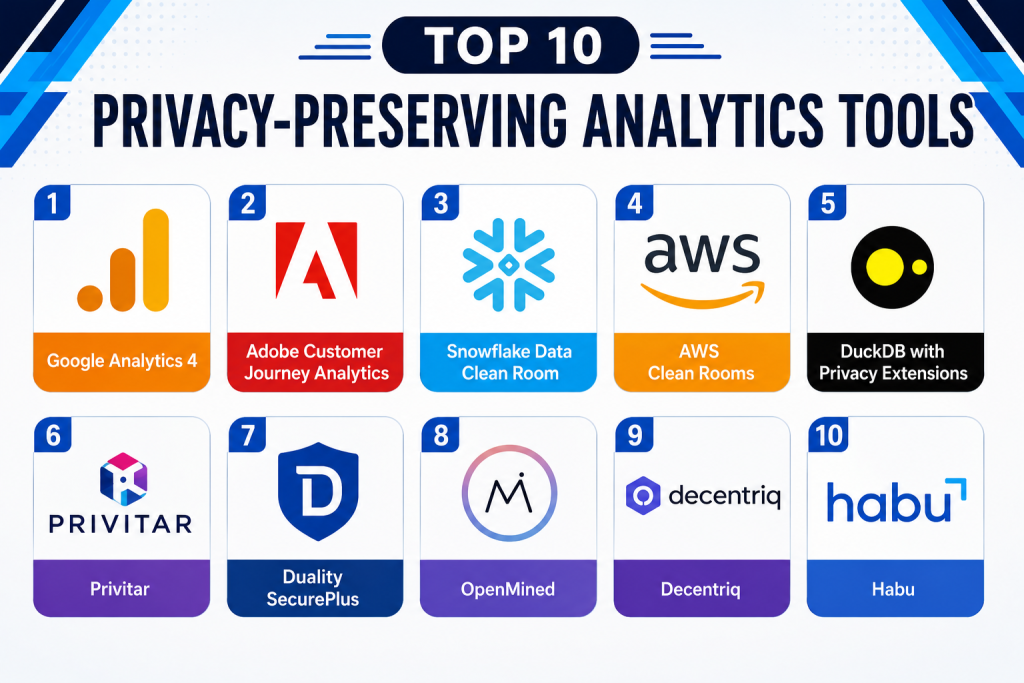
Top 10 Privacy-Preserving Analytics Tools
1- Google Analytics 4
Short description:
Google Analytics 4 represents Google’s modern analytics platform with privacy-centric measurement capabilities. It supports event-based tracking, consent-aware data collection, and machine learning-driven insights. Organizations transitioning from traditional cookie-based analytics often consider GA4 due to its broad ecosystem and privacy-focused evolution. It is widely used by businesses of all sizes seeking digital analytics capabilities while adapting to changing privacy expectations. Its extensive reporting capabilities and integration ecosystem make it a common starting point for privacy-conscious analytics initiatives.
Key Features
- Event-based analytics architecture.
- Consent mode support.
- Machine learning insights.
- Cross-platform measurement.
- Audience analysis.
- Predictive analytics.
- Custom reporting.
Pros
- Extensive ecosystem.
- Strong reporting capabilities.
- Broad market adoption.
Cons
- Learning curve for advanced users.
- Limited customization in some scenarios.
- Enterprise governance may require additional tools.
Platforms / Deployment
- Web
- Cloud
Security & Compliance
- Encryption
- RBAC
- GDPR support features
- MFA through Google accounts
Integrations & Ecosystem
GA4 integrates extensively with marketing, advertising, cloud, and business intelligence ecosystems.
- Google Ads
- BigQuery
- Looker
- Firebase
- Google Cloud APIs
Support & Community
Large global community, extensive documentation, training resources, and enterprise support options.
2- Adobe Customer Journey Analytics
Short description:
Adobe Customer Journey Analytics enables organizations to analyze customer interactions while maintaining governance controls across large-scale digital environments. It combines customer journey mapping, analytics, and privacy-focused data management capabilities. Enterprises often use it to unify customer insights across multiple channels. The platform is particularly valuable for organizations seeking advanced analytics with strong governance and segmentation features. Its integration within the Adobe ecosystem enhances enterprise adoption.
Key Features
- Cross-channel analytics.
- Customer journey visualization.
- Advanced segmentation.
- Real-time analytics.
- Data governance tools.
- AI-powered insights.
- Enterprise reporting.
Pros
- Powerful enterprise capabilities.
- Deep analytics functionality.
- Strong visualization tools.
Cons
- Higher cost.
- Complex implementation.
- Requires skilled administrators.
Platforms / Deployment
- Web
- Cloud
Security & Compliance
- SSO/SAML
- MFA
- Audit logs
- RBAC
Integrations & Ecosystem
Works closely with Adobe Experience Cloud and enterprise data platforms.
- Adobe Experience Platform
- CRM systems
- Data warehouses
- APIs
- Marketing platforms
Support & Community
Strong enterprise support and extensive documentation.
3- Snowflake Data Clean Room
Short description:
Snowflake Data Clean Room provides privacy-safe collaboration capabilities for organizations that need to share and analyze sensitive datasets without exposing raw data. It is commonly used for advertising measurement, customer insights, and collaborative analytics. Organizations can derive joint insights while maintaining strict data access controls. Its cloud-native architecture makes it attractive for enterprises pursuing modern data-sharing initiatives.
Key Features
- Secure data collaboration.
- Data clean room architecture.
- Controlled query execution.
- Privacy-safe sharing.
- Governance controls.
- Cloud-native scalability.
- Analytics support.
Pros
- Strong privacy controls.
- Enterprise scalability.
- Flexible data collaboration.
Cons
- Requires Snowflake expertise.
- Complex setup.
- Costs can scale with usage.
Platforms / Deployment
- Cloud
Security & Compliance
- Encryption
- RBAC
- Audit logs
- Governance controls
Integrations & Ecosystem
Built within the Snowflake ecosystem and connected data platforms.
- Data warehouses
- BI platforms
- APIs
- Cloud platforms
- Marketing systems
Support & Community
Strong enterprise support and growing user community.
4- AWS Clean Rooms
Short description:
AWS Clean Rooms allows organizations to collaborate on datasets while preserving privacy and maintaining control over sensitive information. It helps businesses generate insights from combined datasets without revealing underlying records. The service is increasingly used in advertising, healthcare, and financial services environments. Organizations seeking cloud-native privacy collaboration often consider AWS Clean Rooms as part of broader AWS strategies.
Key Features
- Privacy-safe collaboration.
- Query controls.
- AWS-native integration.
- Security management.
- Analytics support.
- Controlled access policies.
- Scalable architecture.
Pros
- Strong cloud integration.
- Enterprise-grade security.
- Flexible collaboration.
Cons
- AWS expertise required.
- Complex governance setup.
- Cost management considerations.
Platforms / Deployment
- Cloud
Security & Compliance
- Encryption
- IAM integration
- Audit logging
- Access controls
Integrations & Ecosystem
Integrated across AWS analytics and storage services.
- Amazon S3
- Redshift
- Athena
- Lake Formation
- AWS Identity Services
Support & Community
Strong AWS documentation and enterprise support.
5- DuckDB with Privacy Extensions
Short description:
DuckDB is a high-performance analytical database increasingly adopted for privacy-sensitive analytics workloads. Combined with privacy-preserving frameworks and extensions, it enables secure local analytics without requiring large cloud infrastructures. Organizations favor it for embedded analytics and research use cases. It offers flexibility for developers seeking privacy-focused analytical environments.
Key Features
- Embedded analytics.
- Fast query processing.
- Local execution.
- Open-source architecture.
- Data portability.
- Flexible integration.
- Lightweight deployment.
Pros
- High performance.
- Open-source flexibility.
- Cost-effective.
Cons
- Requires technical expertise.
- Limited enterprise features.
- Smaller ecosystem.
Platforms / Deployment
- Windows
- macOS
- Linux
- Self-hosted
Security & Compliance
- Depends on implementation
- Not publicly stated
Integrations & Ecosystem
Popular among developers and data engineers.
- Python
- R
- Data science tools
- SQL interfaces
- Analytics frameworks
Support & Community
Growing open-source community and active development.
6- Privitar
Short description:
Privitar specializes in privacy-enhancing technologies that help organizations safely use sensitive data. The platform focuses on data minimization, anonymization, and governance while enabling analytics and innovation. Enterprises in regulated industries often leverage Privitar for compliance-driven analytics programs. Its privacy engineering capabilities distinguish it within the market.
Key Features
- Data anonymization.
- Privacy controls.
- Governance management.
- Data access policies.
- Risk assessment.
- Data sharing controls.
- Analytics enablement.
Pros
- Strong privacy focus.
- Enterprise governance.
- Regulatory support.
Cons
- Enterprise-oriented pricing.
- Specialized expertise required.
- Complex deployments.
Platforms / Deployment
- Cloud
- Hybrid
Security & Compliance
- Encryption
- RBAC
- Audit logging
Integrations & Ecosystem
Designed to work alongside enterprise data ecosystems.
- Data lakes
- Warehouses
- Analytics tools
- APIs
- Governance platforms
Support & Community
Strong enterprise support programs.
7- Duality SecurePlus
Short description:
Duality SecurePlus focuses on privacy-enhancing technologies including homomorphic encryption and secure analytics. Organizations can process sensitive information while reducing exposure risks. It is commonly considered by industries requiring advanced cryptographic protections. The platform addresses complex privacy requirements while supporting analytics workloads.
Key Features
- Homomorphic encryption.
- Secure analytics.
- Privacy-enhancing technologies.
- Data collaboration.
- Governance controls.
- Security policies.
- Compliance support.
Pros
- Advanced cryptography.
- Strong privacy guarantees.
- Enterprise security focus.
Cons
- Specialized technology.
- Complex implementation.
- Higher learning curve.
Platforms / Deployment
- Cloud
- Hybrid
Security & Compliance
- Encryption
- Access controls
- Governance features
Integrations & Ecosystem
Supports enterprise data environments and secure collaboration workflows.
- APIs
- Data platforms
- Analytics systems
- Cloud services
Support & Community
Enterprise support focused on regulated industries.
8- OpenMined
Short description:
OpenMined is an open-source ecosystem supporting privacy-preserving machine learning and analytics. It promotes federated learning, secure computation, and privacy-enhancing technologies. Researchers, developers, and organizations exploring privacy-first AI initiatives frequently use OpenMined frameworks. It offers flexibility and innovation opportunities in privacy-focused analytics.
Key Features
- Federated learning.
- Secure computation.
- Privacy-preserving AI.
- Open-source frameworks.
- Research support.
- Distributed analytics.
- Community-driven development.
Pros
- Open-source innovation.
- Strong privacy focus.
- Active research ecosystem.
Cons
- Technical complexity.
- Requires development expertise.
- Limited enterprise tooling.
Platforms / Deployment
- Windows
- macOS
- Linux
- Self-hosted
Security & Compliance
- Privacy-enhancing technologies
- Not publicly stated
Integrations & Ecosystem
Developer-focused ecosystem supporting AI and analytics projects.
- Python
- ML frameworks
- Research tools
- APIs
Support & Community
Strong open-source community and academic participation.
9- Decentriq
Short description:
Decentriq provides secure data clean room technology for privacy-sensitive analytics and collaboration. Organizations use it to analyze shared datasets without exposing raw information. It is popular in marketing, media, and regulated sectors seeking privacy-compliant data sharing. The platform emphasizes secure collaboration and governance.
Key Features
- Data clean rooms.
- Privacy-safe analytics.
- Secure collaboration.
- Governance controls.
- Access management.
- Query restrictions.
- Compliance support.
Pros
- Strong privacy controls.
- Clean room specialization.
- Collaboration features.
Cons
- Niche focus.
- Enterprise-oriented adoption.
- Requires governance planning.
Platforms / Deployment
- Cloud
Security & Compliance
- Encryption
- Access controls
- Governance features
Integrations & Ecosystem
Supports modern data collaboration workflows.
- Cloud platforms
- Data warehouses
- APIs
- Analytics systems
Support & Community
Enterprise support and implementation assistance.
10- Habu
Short description:
Habu is a data clean room platform designed for privacy-first analytics and collaboration. It enables organizations to generate insights across multiple datasets without compromising privacy. Marketing, advertising, and enterprise analytics teams frequently use Habu for secure data partnerships. The platform focuses on interoperability and privacy-safe measurement.
Key Features
- Data clean rooms.
- Privacy-safe collaboration.
- Identity resolution support.
- Governance controls.
- Analytics workflows.
- Data partnerships.
- Measurement capabilities.
Pros
- Strong collaboration tools.
- Modern architecture.
- Privacy-centric design.
Cons
- Enterprise-focused.
- Specialized use cases.
- Learning curve.
Platforms / Deployment
- Cloud
Security & Compliance
- Encryption
- Governance controls
- Access management
Integrations & Ecosystem
Built for cross-platform data collaboration.
- Data warehouses
- Cloud platforms
- Marketing systems
- APIs
Support & Community
Enterprise onboarding and implementation support.
Comparison Table
| Tool Name | Best For | Platform(s) Supported | Deployment | Standout Feature | Public Rating |
|---|---|---|---|---|---|
| Google Analytics 4 | Digital Analytics | Web | Cloud | Consent-Aware Analytics | N/A |
| Adobe Customer Journey Analytics | Enterprise Analytics | Web | Cloud | Customer Journey Analysis | N/A |
| Snowflake Data Clean Room | Data Collaboration | Web | Cloud | Secure Data Sharing | N/A |
| AWS Clean Rooms | Cloud Collaboration | Web | Cloud | Privacy-Safe Queries | N/A |
| DuckDB | Embedded Analytics | Windows, macOS, Linux | Self-hosted | Local Analytics Engine | N/A |
| Privitar | Privacy Engineering | Web | Cloud, Hybrid | Data Anonymization | N/A |
| Duality SecurePlus | Secure Analytics | Web | Cloud, Hybrid | Homomorphic Encryption | N/A |
| OpenMined | Privacy-Preserving AI | Windows, macOS, Linux | Self-hosted | Federated Learning | N/A |
| Decentriq | Data Clean Rooms | Web | Cloud | Secure Collaboration | N/A |
| Habu | Marketing Analytics | Web | Cloud | Privacy-First Measurement | N/A |
Evaluation & Scoring of Privacy-Preserving Analytics Tools
| Tool | Core | Ease | Integrations | Security | Performance | Support | Value | Weighted Total |
|---|---|---|---|---|---|---|---|---|
| Google Analytics 4 | 9 | 8 | 10 | 8 | 9 | 9 | 10 | 9.0 |
| Adobe Customer Journey Analytics | 10 | 7 | 9 | 9 | 9 | 9 | 7 | 8.7 |
| Snowflake Data Clean Room | 9 | 8 | 9 | 9 | 9 | 8 | 8 | 8.7 |
| AWS Clean Rooms | 9 | 7 | 9 | 9 | 9 | 8 | 8 | 8.5 |
| DuckDB | 8 | 8 | 7 | 7 | 10 | 8 | 10 | 8.3 |
| Privitar | 9 | 7 | 8 | 10 | 8 | 8 | 7 | 8.2 |
| Duality SecurePlus | 8 | 6 | 7 | 10 | 8 | 7 | 7 | 7.7 |
| OpenMined | 8 | 6 | 7 | 9 | 8 | 8 | 10 | 8.0 |
| Decentriq | 8 | 8 | 8 | 9 | 8 | 8 | 7 | 8.0 |
| Habu | 8 | 8 | 8 | 8 | 8 | 8 | 7 | 7.9 |
These scores are comparative rather than absolute. Organizations should prioritize criteria aligned with their business goals, compliance obligations, and technical capabilities. A tool with a lower overall score may still be the best fit for a specialized use case. Enterprises often prioritize governance and security, while smaller organizations may focus on usability and value.
Which Privacy-Preserving Analytics Tool Is Right for You?
Solo / Freelancer
Google Analytics 4 and DuckDB are often the most practical choices. They offer strong analytical capabilities with manageable costs and relatively straightforward implementation.
SMB
Google Analytics 4, DuckDB, and Snowflake Data Clean Room provide a balance of functionality, scalability, and privacy-focused capabilities suitable for growing organizations.
Mid-Market
Adobe Customer Journey Analytics, Snowflake Data Clean Room, and AWS Clean Rooms provide stronger governance, reporting, and integration capabilities.
Enterprise
Adobe Customer Journey Analytics, Privitar, AWS Clean Rooms, Snowflake Data Clean Room, and Duality SecurePlus offer advanced governance, privacy controls, and scalability.
Budget vs Premium
Budget-conscious organizations should evaluate DuckDB, OpenMined, and Google Analytics 4. Premium buyers may benefit more from Adobe, Privitar, or Duality solutions.
Feature Depth vs Ease of Use
Google Analytics 4 emphasizes accessibility, while Adobe and Privitar deliver deeper enterprise functionality with increased complexity.
Integrations & Scalability
Snowflake, AWS, Adobe, and Google provide extensive ecosystems that support large-scale deployments and enterprise integrations.
Security & Compliance Needs
Organizations operating under strict regulations should evaluate Privitar, Duality SecurePlus, AWS Clean Rooms, and Decentriq due to their strong privacy-focused architectures.
Frequently Asked Questions
1. What are privacy-preserving analytics tools?
These tools enable organizations to analyze data while minimizing exposure of personal information. They use technologies such as anonymization, differential privacy, encryption, and federated analytics to balance insights with privacy protection.
2. Why are these tools becoming more important?
Privacy regulations continue to evolve, and customers increasingly expect responsible data handling. Organizations must derive business value from data while maintaining trust and compliance.
3. Are privacy-preserving analytics tools only for large enterprises?
No. While enterprises often have the most complex requirements, many SMBs and startups are adopting privacy-first analytics to prepare for future compliance needs and customer expectations.
4. What is a data clean room?
A data clean room is a secure environment where multiple parties can analyze combined datasets without directly sharing raw data. This enables collaboration while maintaining privacy controls.
5. How do these tools help with compliance?
Many platforms support governance, auditing, access controls, encryption, and privacy-enhancing technologies that help organizations meet regulatory requirements and internal policies.
6. Can privacy-preserving analytics replace traditional analytics?
In many cases they can complement rather than completely replace traditional analytics. Organizations often adopt hybrid approaches depending on business requirements and privacy risks.
7. Are these tools suitable for AI and machine learning projects?
Yes. Many platforms support privacy-preserving AI techniques such as federated learning, secure computation, and privacy-enhanced model training.
8. What is the biggest implementation challenge?
Organizations often struggle with governance planning, integration complexity, and balancing privacy controls with analytical flexibility. Careful planning is essential.
9. How should organizations evaluate vendors?
Focus on privacy capabilities, deployment flexibility, security controls, scalability, integration support, and alignment with regulatory obligations and business objectives.
10. What is the best way to start?
Begin with a privacy assessment, identify sensitive datasets, define governance requirements, shortlist appropriate tools, and conduct a controlled pilot before large-scale deployment.
Conclusion
Privacy-preserving analytics has moved from a niche requirement to a strategic capability for modern organizations. As regulations tighten and customer expectations evolve, businesses need analytics platforms that deliver meaningful insights without compromising privacy. Solutions such as Google Analytics 4, Adobe Customer Journey Analytics, Snowflake Data Clean Room, AWS Clean Rooms, Privitar, and emerging privacy-enhancing technology platforms each address different requirements across enterprise, mid-market, and specialized environments. There is no universal winner because priorities vary widely between industries, data sensitivity levels, compliance obligations, and technical maturity. The most effective approach is to shortlist two or three platforms that align with your privacy strategy, conduct a pilot project, validate integrations and security controls, and then scale deployment based on measurable business outcomes.
