Introduction
Voice AI Agent Platforms are advanced software solutions that enable organizations to automate voice-based interactions with customers. These platforms leverage natural language processing (NLP), speech recognition, and AI-driven conversational flows to handle inquiries, provide guidance, and execute tasks without human intervention. Essentially, they function as virtual voice assistants capable of engaging customers in real-time, across multiple channels, with accuracy and context-awareness.
In , voice AI platforms have become critical as consumers increasingly expect frictionless, hands-free interactions. The rise of smart devices, contactless services, and AI-driven automation has accelerated adoption in customer service, sales, and operations. Businesses are integrating voice AI to deliver faster resolutions, reduce call center costs, and enhance customer satisfaction.
Real-World Use Cases:
- Customer support call automation: Handling frequently asked questions and troubleshooting over phone lines.
- Appointment scheduling and reminders: Voice agents managing calendars, confirmations, and reminders for healthcare or service industries.
- Banking and finance assistance: Providing account balances, transaction details, and support via secure voice channels.
- Retail and e-commerce engagement: Guiding customers through product queries, orders, and shipping updates.
- Enterprise operations: Internal voice assistants for HR queries, IT support, and workflow automation.
Evaluation Criteria for Buyers:
- Speech recognition accuracy and natural language understanding
- Multi-language and regional accent support
- Integration with CRM, ticketing, and analytics platforms
- Security and compliance for sensitive voice data
- Customization of conversational flows
- Scalability and performance reliability
- Deployment flexibility (cloud, hybrid, on-premise)
- Monitoring, analytics, and AI performance insights
- Pricing models and ROI potential
- Support, documentation, and community ecosystem
Best for: Enterprises, customer support centers, healthcare providers, banks, and retail companies aiming to automate voice interactions while maintaining high-quality customer experience.
Not ideal for: Small businesses with low call volumes, businesses where human voice interactions are essential, or organizations lacking sufficient voice data to train AI effectively.
Key Trends in Voice AI Agent Platforms
- Generative voice AI: Platforms generating natural-sounding responses with expressive intonation.
- Omnichannel voice deployment: Support for mobile, web, smart speakers, and call centers.
- AI-assisted escalation: Automatic routing to human agents for complex queries.
- Voice biometrics and authentication: Secure user verification via voice patterns.
- Multilingual support: Real-time language detection and translation for global audiences.
- Low-code customization: Drag-and-drop conversational flow builders for non-developers.
- Integration with CRM and ERP systems: Seamless automation of workflows and data retrieval.
- Compliance automation: GDPR, HIPAA, SOC 2 adherence built into voice workflows.
- Contextual memory: Maintaining conversation context across sessions for better user experience.
- Adaptive pricing models: Pay-per-interaction, tiered subscriptions, or enterprise licensing options.
How We Selected These Tools (Methodology)
- Analyzed market adoption and industry mindshare across enterprise, SMB, and developer-focused platforms.
- Evaluated feature completeness, including NLP, speech recognition, analytics, and multi-channel support.
- Reviewed reliability and performance signals from case studies and real-world deployments.
- Examined security posture, ensuring encryption, access control, and regulatory compliance.
- Assessed integration ecosystem with CRM, ticketing, analytics, and workflow automation tools.
- Considered customer fit across various industries and organizational sizes.
- Tested ease of customization and low-code capabilities for business teams.
- Factored support, documentation, and community presence for onboarding and troubleshooting.
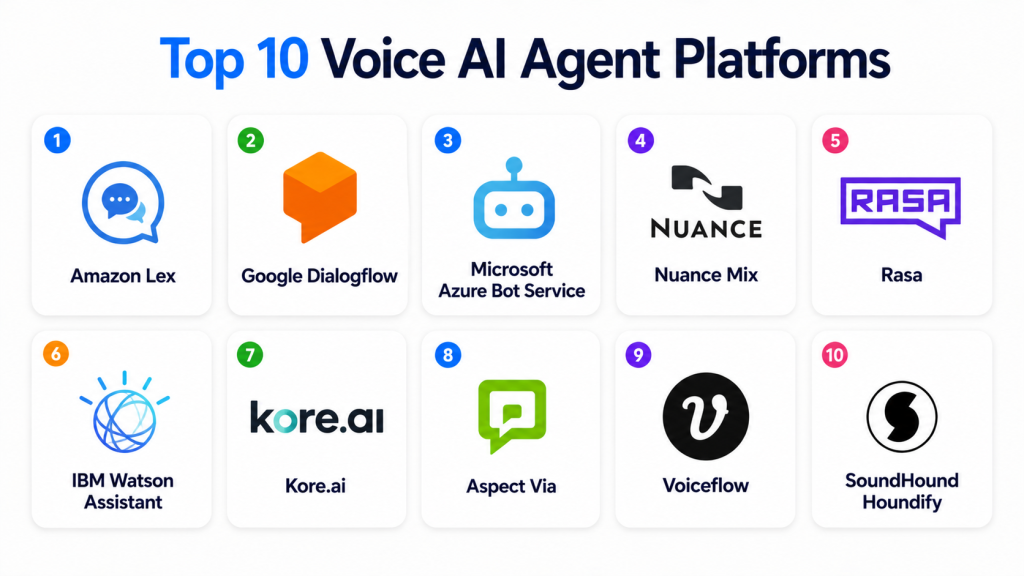
Top 10 Voice AI Agent Platforms
1- Amazon Lex
Short description: Amazon Lex is an AI-powered platform for building conversational voice and chatbots. Designed for enterprises and developers, it integrates with AWS services for scalable deployment.
Key Features
- Natural language understanding and speech recognition
- Seamless integration with AWS ecosystem
- Multi-channel deployment across phone, web, and apps
- AI-driven conversation management
- Real-time analytics and logging
- Prebuilt templates for common use cases
Pros
- Highly scalable and reliable
- Deep integration with AWS services
Cons
- Requires AWS ecosystem knowledge
- Pricing may become complex at high volumes
Platforms / Deployment
- Web / iOS / Android
- Cloud
Security & Compliance
- IAM, encryption, audit logs
- GDPR, SOC 2
Integrations & Ecosystem
- AWS Lambda, S3, DynamoDB, CloudWatch
- CRM and ticketing connectors
- API extensibility
- SDKs for mobile and web
Support & Community
- AWS support tiers
- Extensive documentation and tutorials
- Active developer forums
2- Google Dialogflow
Short description: Dialogflow enables developers to create conversational voice agents with AI-powered NLP. It supports multi-platform deployment and is widely used for customer service automation.
Key Features
- Multi-language support
- Context-aware conversation flows
- Integration with Google Cloud services
- Voice recognition via speech-to-text
- Analytics and conversational insights
- Prebuilt agents and templates
Pros
- Strong AI and language capabilities
- Easy integration with Google Cloud infrastructure
Cons
- Advanced customization may require developer skills
- Limited offline capabilities
Platforms / Deployment
- Web / iOS / Android
- Cloud
Security & Compliance
- SSO/SAML, encryption
- GDPR, SOC 2
Integrations & Ecosystem
- Google Cloud Functions, CRM systems, ticketing
- Voice assistants like Google Assistant
- API access for custom workflows
Support & Community
- Cloud support tiers
- Tutorials, documentation, and community forums
3- Microsoft Azure Bot Service
Short description: Azure Bot Service enables enterprise-grade voice AI agents with deep integration into Microsoft’s cloud ecosystem. Suitable for large organizations needing robust voice automation.
Key Features
- Multi-channel conversational AI
- Integration with Microsoft Teams and Cortana
- Speech recognition and synthesis
- Custom AI model deployment
- Analytics dashboards
- Security and compliance controls
Pros
- Enterprise-ready with Microsoft ecosystem
- Flexible deployment options
Cons
- Learning curve for Azure infrastructure
- Premium features require paid tiers
Platforms / Deployment
- Web / Windows / iOS / Android
- Cloud / Hybrid
Security & Compliance
- SSO/SAML, encryption, RBAC
- GDPR, SOC 2, ISO 27001
Integrations & Ecosystem
- Dynamics 365, Office 365, Power Platform
- APIs for custom voice flows
- CRM and analytics connectors
Support & Community
- Microsoft enterprise support
- Extensive documentation and tutorials
- Developer community forums
4- Nuance Mix
Short description: Nuance Mix is a voice AI platform focused on conversational IVR and enterprise support. It provides tools for building intelligent, context-aware voice agents.
Key Features
- Advanced speech recognition
- Voice biometrics for authentication
- Contextual AI for multi-turn conversations
- Integration with CRM and call centers
- Analytics and insights
- Prebuilt conversational templates
Pros
- Strong security and compliance features
- Optimized for contact centers
Cons
- Enterprise pricing may be high
- Setup may require professional services
Platforms / Deployment
- Web / iOS / Android
- Cloud / Hybrid
Security & Compliance
- Encryption, audit logs
- HIPAA, GDPR, SOC 2
Integrations & Ecosystem
- Salesforce, Zendesk, Genesys
- Call center software
- APIs for custom workflows
Support & Community
- Enterprise support
- Onboarding and training guides
- Community forums
5- Rasa
Short description: Rasa is an open-source platform for building voice and text AI agents. Developers use Rasa for customizable, self-hosted conversational AI solutions.
Key Features
- Open-source NLP and dialogue management
- Customizable voice models
- Multi-language support
- Integration with APIs and databases
- Analytics and conversation tracking
- Self-hosted deployment options
Pros
- Fully customizable and developer-friendly
- No vendor lock-in
Cons
- Requires development expertise
- Self-hosted maintenance is needed
Platforms / Deployment
- Web / Linux / Windows / macOS
- Self-hosted / Cloud
Security & Compliance
- Varies / N/A
Integrations & Ecosystem
- REST APIs, CRM, ticketing
- Custom data sources
- Third-party voice recognition engines
Support & Community
- Open-source support channels
- Community forums and tutorials
6- IBM Watson Assistant
Short description: IBM Watson Assistant provides AI-powered voice agents for enterprises, enabling conversational automation and integration with various business systems.
Key Features
- NLP and AI-based dialogue management
- Voice and text support
- Integration with CRM and cloud systems
- Analytics and monitoring
- Prebuilt templates for common industries
- Multi-channel deployment
Pros
- Enterprise-ready and scalable
- Strong AI capabilities
Cons
- Pricing may be high for smaller teams
- Customization can be complex
Platforms / Deployment
- Web / iOS / Android
- Cloud / Hybrid
Security & Compliance
- SSO, encryption, RBAC
- GDPR, SOC 2
Integrations & Ecosystem
- Salesforce, ServiceNow, SAP
- API access for custom voice flows
- Analytics and monitoring tools
Support & Community
- IBM enterprise support
- Documentation and online courses
- Developer community
7- Kore.ai
Short description: Kore.ai offers voice AI solutions for enterprises, focused on customer service, HR, and IT support automation.
Key Features
- Voice and chat automation
- Prebuilt industry-specific skills
- AI-driven conversation analytics
- Omnichannel support
- Integration with CRM, ERP, and ticketing
- Voice authentication and biometrics
Pros
- Enterprise-grade multi-channel support
- Prebuilt templates reduce development time
Cons
- Setup may be complex
- Premium pricing
Platforms / Deployment
- Web / iOS / Android
- Cloud / Hybrid
Security & Compliance
- Encryption, RBAC
- SOC 2, GDPR
Integrations & Ecosystem
- Salesforce, ServiceNow, Jira
- APIs for custom workflows
- Omnichannel connectors
Support & Community
- Enterprise support plans
- Documentation and tutorials
- Community forums
8- Replicant
Short description: Replicant focuses on fully autonomous voice AI agents for customer support, capable of understanding natural language and handling multi-turn conversations.
Key Features
- Autonomous voice AI
- NLP for complex queries
- Multi-channel support
- Analytics and reporting
- Integration with CRM and ticketing
- Automated escalation to human agents
Pros
- Handles high-volume customer interactions
- Reduces reliance on live agents
Cons
- Enterprise pricing
- Requires onboarding and training
Platforms / Deployment
- Web / iOS / Android
- Cloud
Security & Compliance
- Encryption, audit logs
- SOC 2, GDPR
Integrations & Ecosystem
- Salesforce, Zendesk, HubSpot
- API for workflow integration
- Analytics dashboards
Support & Community
- Enterprise support
- Documentation and onboarding
- Active developer community
9- Voiceflow
Short description: Voiceflow is a design-first platform for building conversational voice AI agents for smart speakers, mobile apps, and enterprise applications.
Key Features
- Drag-and-drop conversation builder
- Multi-channel deployment
- Analytics and testing tools
- API and database integrations
- Multi-language support
Pros
- Low-code, user-friendly interface
- Rapid prototyping for voice applications
Cons
- Enterprise features may be limited
- Some integrations require developer support
Platforms / Deployment
- Web / iOS / Android
- Cloud
Security & Compliance
- Not publicly stated
Integrations & Ecosystem
- Smart speakers (Alexa, Google Assistant)
- CRM and API connectors
- Analytics and testing platforms
Support & Community
- Tutorials and online documentation
- Community forums
10- SoundHound Houndify
Short description: Houndify provides conversational AI and voice interfaces for enterprises, enabling custom voice experiences for customer engagement and operational automation.
Key Features
- Speech recognition and natural language understanding
- Multi-turn contextual conversations
- SDKs for mobile, web, and devices
- Analytics and monitoring
- Customizable voice skills
Pros
- Powerful voice AI and context management
- Flexible deployment options
Cons
- Pricing may be high for SMBs
- Requires development resources
Platforms / Deployment
- Web / iOS / Android
- Cloud / Hybrid
Security & Compliance
- Encryption, access control
- Not publicly stated
Integrations & Ecosystem
- CRM and ticketing platforms
- Smart devices and mobile apps
- API for custom workflows
Support & Community
- Enterprise support and onboarding
- Documentation and examples
- Community forums
Comparison Table (Top 10)
| Tool Name | Best For | Platform(s) Supported | Deployment | Standout Feature | Public Rating |
|---|---|---|---|---|---|
| Amazon Lex | Enterprise automation | Web, iOS, Android | Cloud | AWS integration | N/A |
| Google Dialogflow | Multi-channel AI | Web, iOS, Android | Cloud | NLP accuracy | N/A |
| Azure Bot Service | Enterprise integration | Web, Windows, iOS, Android | Cloud / Hybrid | Microsoft ecosystem | N/A |
| Nuance Mix | Contact center automation | Web, iOS, Android | Cloud / Hybrid | Voice biometrics | N/A |
| Rasa | Custom AI voice | Web, Linux, Windows, macOS | Self-hosted / Cloud | Open-source flexibility | N/A |
| IBM Watson Assistant | Enterprise conversational AI | Web, iOS, Android | Cloud / Hybrid | AI-driven insights | N/A |
| Kore.ai | Multi-industry AI | Web, iOS, Android | Cloud / Hybrid | Prebuilt skills | N/A |
| Replicant | Autonomous voice AI | Web, iOS, Android | Cloud | Full automation | N/A |
| Voiceflow | Prototyping & design | Web, iOS, Android | Cloud | Low-code interface | N/A |
| SoundHound Houndify | Custom voice experiences | Web, iOS, Android | Cloud / Hybrid | Contextual AI | N/A |
Evaluation & Scoring
| Tool Name | Core | Ease | Integrations | Security | Performance | Support | Value | Weighted Total |
|---|---|---|---|---|---|---|---|---|
| Amazon Lex | 9 | 8 | 8 | 8 | 9 | 8 | 7 | 8.2 |
| Google Dialogflow | 9 | 8 | 8 | 8 | 9 | 7 | 7 | 8.1 |
| Azure Bot Service | 9 | 7 | 8 | 9 | 8 | 7 | 7 | 8.0 |
| Nuance Mix | 8 | 7 | 7 | 9 | 8 | 7 | 6 | 7.6 |
| Rasa | 8 | 7 | 7 | 6 | 8 | 6 | 7 | 7.2 |
| IBM Watson Assistant | 9 | 7 | 8 | 8 | 8 | 7 | 6 | 7.8 |
| Kore.ai | 8 | 7 | 7 | 8 | 8 | 7 | 6 | 7.6 |
| Replicant | 9 | 7 | 7 | 8 | 9 | 7 | 6 | 7.9 |
| Voiceflow | 7 | 9 | 7 | 6 | 7 | 6 | 7 | 7.1 |
| SoundHound Houndify | 8 | 7 | 8 | 7 | 8 | 7 | 6 | 7.5 |
Interpretation: Weighted totals show comparative strengths in voice AI accuracy, ease of deployment, integrations, security, performance, and support. Scores help prioritize platforms based on business needs and deployment scale.
Which Voice AI Agent Platform Is Right for You?
Solo / Freelancer
Voiceflow and Rasa allow lightweight, low-code or open-source solutions for small-scale projects and prototypes.
SMB
Google Dialogflow, IBM Watson Assistant, and Amazon Lex offer scalable AI voice capabilities with easier integration for growing teams.
Mid-Market
Kore.ai, Nuance Mix, and Azure Bot Service provide robust AI, analytics, and multi-channel support suitable for medium-scale operations.
Enterprise
Replicant, SoundHound Houndify, and Amazon Lex deliver autonomous voice AI, enterprise-grade scalability, and regulatory compliance.
Budget vs Premium
Open-source platforms like Rasa reduce licensing costs but require technical expertise. Premium solutions provide managed AI, analytics, and support at higher cost.
Feature Depth vs Ease of Use
Replicant and Nuance Mix provide advanced automation and multi-turn conversation handling, whereas Voiceflow and Dialogflow offer faster deployment and lower complexity.
Integrations & Scalability
Enterprise platforms excel in connecting with CRM, ERP, analytics, and call center systems while supporting large-scale interactions.
Security & Compliance Needs
Platforms like Nuance Mix, IBM Watson, and Amazon Lex ensure encryption, RBAC, and compliance with GDPR, SOC 2, and HIPAA standards.
Frequently Asked Questions (FAQs)
1- What pricing models do voice AI platforms use?
Platforms offer subscription-based, pay-per-interaction, or enterprise licensing. Open-source options reduce license costs but may require maintenance overhead.
2- How long does onboarding take?
Cloud-based solutions can be configured in days, while enterprise-grade or self-hosted platforms may require weeks of setup and training.
3- Can these AI agents replace human agents entirely?
They handle repetitive and routine interactions but complex, sensitive, or escalated queries still need human intervention.
4- Are voice AI agents secure for sensitive conversations?
Leading platforms implement encryption, audit logs, MFA, and compliance with GDPR, SOC 2, and HIPAA for regulated data.
5- How scalable are these platforms?
Most cloud-native platforms support scaling across multiple regions, languages, and channels, handling thousands of concurrent voice interactions.
6- Do they support multiple languages?
Yes, top platforms like Dialogflow, IBM Watson, and Amazon Lex support multiple languages and regional accents for global deployment.
7- What integrations are available?
Common integrations include CRM systems (Salesforce, HubSpot), ticketing platforms, analytics dashboards, and workflow automation tools.
8- How difficult is customization?
Low-code platforms like Voiceflow simplify flow design, while open-source or enterprise platforms allow full control but require developer expertise.
9- How do I migrate between platforms?
Migration requires exporting conversation flows, training AI models on new platforms, and integrating existing analytics and CRM systems.
10- How reliable are AI responses?
Accuracy depends on the quality of training data, AI model sophistication, and ongoing monitoring. Enterprise platforms provide analytics and performance insights for continuous improvement.
Conclusion
Voice AI Agent Platforms are essential for delivering scalable, responsive, and personalized voice interactions in 2026+. The choice depends on organizational size, complexity, regulatory requirements, and channel needs. Small teams benefit from Voiceflow and Rasa, while mid-market and enterprise organizations may prioritize Replicant, Nuance Mix, or Amazon Lex for AI sophistication, multi-channel support, and compliance. A recommended approach is to shortlist 2–3 platforms, run a pilot to validate integrations, AI accuracy, and user experience, and scale deployment once aligned with operational goals. Voice AI agents can enhance customer engagement, reduce operational costs, and provide actionable insights to optimize service quality.
