Introduction
The world of IT operations is changing very fast. Keeping up with thousands of logs and alerts is no longer possible for humans alone. This is where the Certified AIOps Professional comes into play. It is a specialized program designed to help engineers use artificial intelligence and machine learning to manage complex systems. This guide is written for those who want to understand how to move from traditional monitoring to intelligent automation.
Whether you are working in DevOps, site reliability engineering, or platform engineering, this certification helps you stay ahead of the curve. Companies now look for professionals who can reduce noise and predict system failures before they happen. By reading this guide, you will learn about the different levels of training available at AIOpsSchool and how they can help you make better choices for your career growth. We will look at why this skill matters today and how it fits into the global job market.
What is the Certified AIOps Professional?
The Certified AIOps Professional is a program that teaches you how to apply AI and ML to IT operations. It is not just about learning theories or reading books. Instead, it focuses on real-world scenarios where systems generate massive amounts of data. The goal is to teach you how to use tools that can automatically find the root cause of a problem.
This certification exists because modern enterprise environments are too big to manage manually. It aligns perfectly with how modern engineering teams work today. It moves away from reactive fixes and focuses on proactive system health. By following this path, you learn how to build workflows that are smarter, faster, and much more reliable in a production setting.
Who Should Pursue Certified AIOps Professional?
This path is ideal for anyone who is already working with servers, cloud platforms, or software code. Specifically, DevOps engineers and Site Reliability Engineers will find it very useful. If you are a cloud architect or a data professional, learning these skills will help you manage infrastructure more effectively. Security experts can also benefit by using these techniques to spot threats faster.
It is suitable for both beginners who are starting their tech journey and experienced managers who lead large teams. In the global market, especially in India, there is a huge demand for people who can handle automated systems. Managers need this knowledge to make better decisions about which tools to buy. Engineers need it to reduce the time they spend on repetitive, manual tasks.
Why Certified AIOps Professional is Valuable and Beyond
The demand for intelligent operations is growing every single day. As companies move more services to the cloud, the complexity increases. Traditional tools cannot keep up with this growth. Having this certification ensures that your skills remain relevant even if specific software tools change over time. It teaches you the core principles of using data to drive operations.
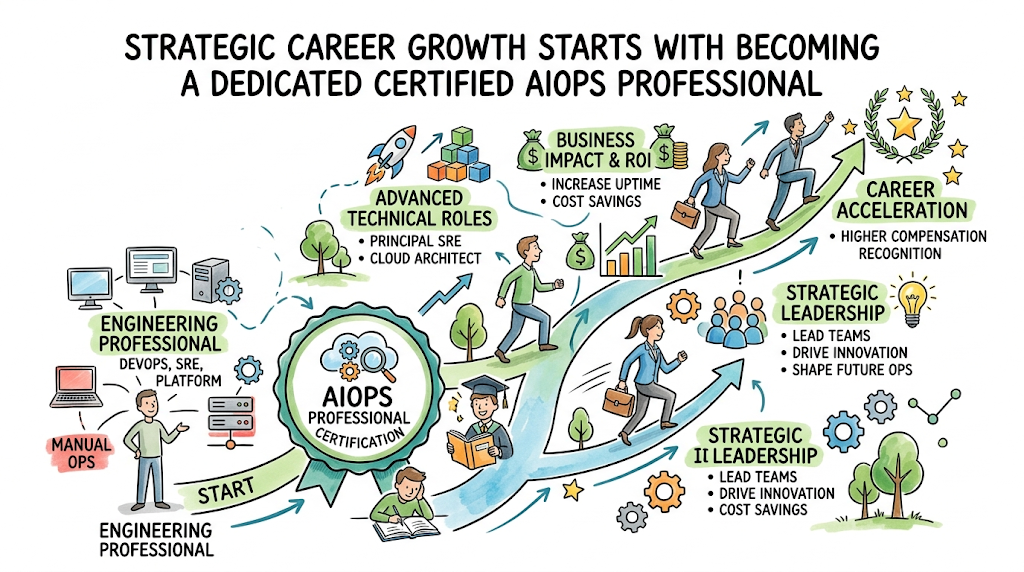
Investing your time in this program offers a high return on investment for your career. It proves to employers that you can handle the scale of modern enterprise systems. Longevity in the tech field depends on your ability to adapt. By mastering these skills, you move from being a general engineer to a specialist who can solve high-level problems that others might miss.
Certified AIOps Professional Certification Overview
This program is delivered through the Certified AIOps Professional training and is hosted on the aiopsschool.com website. The certification is structured into different levels to help you grow step by step. It uses a practical assessment approach, meaning you have to show that you can actually do the work. It is not just a multiple-choice exam; it involves working on real environments.
The ownership of the program ensures that the curriculum is always updated with the latest industry practices. Each level is designed to build on the previous one, ensuring a smooth learning curve. The structure is practical, focusing on the tools and techniques that are used by top tech companies around the world. It provides a clear roadmap for anyone looking to master the art of intelligent operations.
Certified AIOps Professional Certification Tracks & Levels
The program is divided into three main levels: Foundation, Professional, and Advanced. The Foundation level is for those who are new to the concept and want to understand the basics of data and automation. The Professional level dives deeper into specific tools and how to integrate them into existing DevOps or SRE workflows. This is where most working engineers spend their time.
The Advanced level is for those who want to lead teams or design complex systems from scratch. There are also specialization tracks available. You can choose to focus on how this applies to FinOps for cost savings or DevSecOps for better security. These tracks allow you to align your learning with your specific job role or the direction you want your career to go.
Complete Certified AIOps Professional Certification Table
| Track | Level | Who it’s for | Prerequisites | Skills Covered | Recommended Order |
| Core AIOps | Foundation | Beginners and Junior Engineers | Basic Linux and Cloud Knowledge | Data Collection, Basic Automation | First |
| Engineering | Professional | DevOps and SRE Professionals | 2+ Years in IT Ops | Pattern Recognition, Tool Integration | Second |
| Architecture | Advanced | Tech Leads and Architects | Deep DevOps Experience | System Design, Strategy, Scaling | Third |
| Financial | FinOps | Cloud Cost Managers | Financial and Cloud Basics | Cost Prediction, Resource Optimization | Optional |
| Security | DevSecOps | Security Engineers | Security Fundamentals | Threat Detection, Auto-remediation | Optional |
Detailed Guide for Each Certified AIOps Professional Certification
Certified AIOps Professional – Foundation
What it is
This level validates your basic understanding of how artificial intelligence can be applied to IT tasks. It confirms that you know how to gather data from different sources and understand the basic flow of an automated system.
Who should take it
It is perfect for junior engineers, students, or managers who want to understand the terminology. If you are new to the world of automation, this is the right starting point for you.
Skills you’ll gain
- Understanding the difference between traditional monitoring and intelligent operations.
- Learning how to collect logs and metrics from cloud environments.
- Identifying common patterns in system data.
- Basic knowledge of automation scripts.
Real-world projects you should be able to do
- Setting up a basic dashboard that collects data from multiple servers.
- Creating a simple alert system that filters out unnecessary noise.
Preparation plan
- 7–14 days: Focus on learning the core terms and the overall workflow.
- 30 days: Practice setting up basic monitoring tools on a local machine or cloud trial.
- 60 days: Review case studies of how companies have used these tools to save time.
Common mistakes
- Trying to learn complex machine learning math instead of focusing on operational use.
- Skipping the basics of how servers and logs work.
Best next certification after this
- Same-track option: Professional Level.
- Cross-track option: Cloud Practitioner.
- Leadership option: Team Lead Fundamentals.
Certified AIOps Professional – Professional
What it is
This certification validates your ability to implement and manage intelligent systems in a production environment. It shows you can integrate various tools to create a self-healing infrastructure.
Who should take it
Experienced DevOps engineers, SREs, and system administrators should take this. It is for those who are responsible for keeping systems running 24/7 and want to make their jobs easier.
Skills you’ll gain
- Advanced integration of AI tools into CI/CD pipelines.
- Building predictive models to find failures before they happen.
- Managing large-scale data lakes for IT operations.
- Automating the response to common system incidents.
Real-world projects you should be able to do
- Designing a system that automatically scales based on predicted traffic.
- Implementing an incident management tool that groups related alerts together.
Preparation plan
- 7–14 days: Deep dive into specific tool integrations and APIs.
- 30 days: Build a lab environment to test automated remediation scripts.
- 60 days: Fine-tune models using real-world datasets to reduce false positives.
Common mistakes
- Relying too much on the tools without understanding the underlying data.
- Not testing automated fixes in a safe, non-production environment first.
Best next certification after this
- Same-track option: Advanced / Master Level.
- Cross-track option: DevSecOps Professional.
- Leadership option: Project Management Professional.
Choose Your Learning Path
DevOps Path
This path focuses on making the software delivery process smarter. You will learn how to use AI to test code faster and find bugs before the software is even released. It is about speed and quality. Engineers on this path work closely with developers to ensure that the entire pipeline is automated and intelligent.
DevSecOps Path
In this path, the focus is on safety. You learn how to use intelligent tools to scan for security vulnerabilities in real-time. Instead of waiting for a manual audit, the system constantly checks for threats. If a problem is found, the system can automatically block the threat or alert the team immediately.
SRE Path
Site Reliability Engineering is all about uptime and performance. This path teaches you how to use data to meet service level objectives. You will learn how to automate the manual work that takes up so much time. The goal is to build a system that can fix itself when things go wrong.
AIOps Path
This is the core path for those who want to be specialists in intelligent operations. It covers the full spectrum of data collection, analysis, and action. You will become an expert in managing the brain of the IT infrastructure. It is ideal for those who want to work on large-scale enterprise systems.
MLOps Path
This path is for those who want to manage the lifecycle of machine learning models. It is a mix of data science and operations. You will learn how to deploy models, monitor their performance, and update them as needed. It ensures that the AI itself is running smoothly and providing accurate results.
DataOps Path
Data is the fuel for AI. This path focuses on the quality and flow of that data. You will learn how to build pipelines that clean and move data from one place to another reliably. It ensures that the information being used by the AI is correct and arrives on time.
FinOps Path
Cloud costs can get out of control very quickly. This path teaches you how to use AI to predict and manage spending. You will learn how to identify wasted resources and optimize your cloud budget. It is a high-value skill for companies looking to save money while maintaining performance.
Role → Recommended Certifications
| Role | Recommended Certifications |
| DevOps Engineer | Professional Level + DevSecOps Track |
| SRE | Professional Level + SRE Track |
| Platform Engineer | Advanced Level + Core AIOps |
| Cloud Engineer | Foundation Level + Professional Level |
| Security Engineer | Foundation Level + DevSecOps Track |
| Data Engineer | Foundation Level + DataOps Track |
| FinOps Practitioner | Foundation Level + FinOps Track |
| Engineering Manager | Foundation Level + Leadership Track |
Next Certifications to Take After Certified AIOps Professional
Same Track Progression
Once you finish the professional level, you should look toward becoming a Master or Architect in this field. This involves learning how to design these systems for massive global companies. Deep specialization means you understand the very specific nuances of different AI models and how they interact with various types of hardware and software.
Cross-Track Expansion
If you have mastered the core operations, it is a great idea to expand into security or data. Broadening your skills makes you more valuable because you can speak multiple technical languages. For example, an operations expert who understands data pipelines is much more useful to a company than someone who only knows how to fix a server.
Leadership & Management Track
For those who want to move away from daily coding and fixing, the leadership track is the way to go. This involves learning how to manage people, budgets, and long-term strategy. You will use your technical background to guide teams and make big decisions about the future of the company’s technology.
Training & Certification Support Providers for Certified AIOps Professional
DevOpsSchool
DevOpsSchool is a leading provider of technical training with a strong focus on hands-on learning. They offer a wide range of courses that cover everything from basic Linux to advanced cloud architecture. Their instructors are industry experts who bring real-world experience into the classroom. The community is very active, providing students with plenty of support and networking opportunities. It is a great place for professionals who want to gain practical skills that they can use immediately in their jobs.
Cotocus
Cotocus is known for its specialized training programs that cater to the needs of modern enterprises. They provide deep dives into specific technologies like Kubernetes, Terraform, and AI-driven operations. Their training style is very direct and efficient, making it a good choice for busy professionals. They focus on the latest trends and ensure that their curriculum is always up to date. Many engineers choose them for their clear explanations and practical approach to complex topics.
Scmgalaxy
Scmgalaxy has been a trusted name in the software configuration management and DevOps community for many years. They offer a wealth of free resources, tutorials, and blogs that help engineers stay informed. Their certification programs are well-regarded and focus on the technical details that matter most in a professional setting. They have a large community of learners and experts who share knowledge and help each other grow. It is a solid choice for anyone looking for reliable technical guidance.
BestDevOps
BestDevOps focuses on providing high-quality training that is accessible to everyone. They break down difficult concepts into simple, easy-to-understand lessons. This makes them a great choice for beginners or those who are moving into a new area of technology. Their courses are structured logically, taking you from the basics to more advanced topics. They emphasize the best practices that are used by top-tier engineering teams, ensuring you learn the right way from the start.
devsecopsschool.com
This provider focuses specifically on the intersection of development, security, and operations. In a world where security threats are always growing, their training is more important than ever. They teach you how to bake security into every step of the software lifecycle. Their courses are practical and cover a wide range of security tools and techniques. If you want to become a specialist in keeping systems safe and secure, this is the place to go.
sreschool.com
Site Reliability Engineering is a specific discipline, and this provider is dedicated to teaching it correctly. They focus on concepts like error budgets, monitoring, and incident response. Their training helps you understand how to balance the need for speed with the need for stability. The instructors have extensive experience in managing large-scale systems, providing students with insights that you can’t find in a textbook. It is ideal for those who want to master system reliability.
As the primary host for the Certified AIOps Professional program, this site is the go-to resource for intelligent operations. They offer specialized tracks that cover everything from data collection to predictive analytics. Their curriculum is designed to meet the needs of the modern enterprise. They provide a clear roadmap for anyone looking to transition into a career focused on AI and machine learning for IT. The support and resources provided here are top-notch and highly focused.
dataopsschool.com
Data is at the heart of everything we do in modern tech, and this provider focuses on how to manage it. They teach the principles of DataOps, which is about making data delivery faster and more reliable. You will learn about data pipelines, quality control, and how to work with big data sets. This is a crucial skill for anyone working with AI or analytics. Their training is practical and helps you understand the technical challenges of moving data at scale.
finopsschool.com
Managing cloud costs is a major challenge for many companies, and this provider offers the solution. They focus on the financial side of cloud operations, teaching you how to optimize spending. You will learn how to read cloud bills, identify waste, and predict future costs. Their training is essential for managers and engineers who want to show the business value of their technical work. It is a unique and highly valuable specialization in today’s market.
Frequently Asked Questions (General)
- What is the main goal of this certification?
The primary goal is to teach you how to use artificial intelligence and machine learning to automate and improve IT operations.
- How long does it take to get certified?
It depends on your experience level, but most people can complete the foundation level in about a month and the professional level in two to three months.
- Are there any prerequisites for the foundation level?
There are no strict prerequisites, but having a basic understanding of Linux and how the cloud works will be very helpful.
- Is this certification recognized globally?
Yes, the skills taught in this program are used by companies all over the world, making it a valuable credential no matter where you work.
- Does this program involve coding?
Yes, you will need to use some basic scripting and understand how to work with APIs to integrate different tools.
- How is the exam conducted?
The assessment is practical and hands-on, requiring you to complete tasks in a real-world lab environment.
- Will this help me get a higher salary?
Specializing in a high-demand area like AI-driven operations often leads to better job opportunities and higher pay.
- Can a manager benefit from this training?
Absolutely. Managers need to understand these concepts to lead their teams and choose the right tools for their organization.
- What is the difference between DevOps and AIOps?
DevOps is a culture and set of practices for software delivery, while AIOps is the use of AI to enhance and automate those operations.
- Do I need to be a data scientist to learn this?
No, you do not need a deep background in math or data science. The focus is on using existing AI tools for operational tasks.
- How often is the curriculum updated?
The content is reviewed regularly to ensure it reflects the latest tools and industry practices.
- Is there community support available?
Yes, most providers have active communities where you can ask questions and share knowledge with other students.
FAQs on Certified AIOps Professional
- Why is data quality important in this program?
Data is the foundation of AI. If the information going into the system is wrong, the results will be wrong too. This program teaches you how to ensure your logs and metrics are accurate and clean before you use them.
- How does this help with alert fatigue?
Alert fatigue happens when engineers get too many notifications and start ignoring them. This certification teaches you how to use AI to group related alerts together so you only see what really matters.
- Can these techniques be used on-premises or only in the cloud?
While much of the focus is on the cloud, the principles can be applied to any IT environment, including traditional on-premises servers.
- What kind of tools will I learn to use?
You will learn about a variety of tools used for monitoring, log aggregation, and automated incident response.
- Does the program cover machine learning models?
It covers how to use and manage models specifically for IT operations, such as predicting when a disk will be full.
- Is this useful for small companies?
Yes, even small teams can benefit from automation to save time and reduce errors, though the benefits are most visible at scale.
- How does this impact incident response times?
By automating the identification of problems, teams can respond much faster, often fixing issues before users even notice.
- What is the focus of the advanced level?
The advanced level focuses on architecture and strategy, helping you design large systems and lead technical organizations.
Final Thoughts
As someone who has seen the industry evolve over two decades, I can tell you that the shift toward intelligent automation is real. We are moving away from a world where we fix things when they break. Instead, we are building systems that tell us they are about to break. This change requires a new set of skills.
If you are looking to future-proof your career, this path is a very smart choice. It is not about chasing a trend; it is about learning a more efficient way to work. The time you spend learning these concepts will pay off by making you a more effective and valuable engineer. It is a journey worth taking for anyone serious about a career in modern IT operations.
