Introduction
The tech world is changing fast and moving toward automation driven by artificial intelligence. A Certified AIOps Architect is a professional who knows how to use AI and machine learning to improve IT operations and solve complex system issues automatically. This guide is written for engineers and managers who want to understand how to move from traditional monitoring to intelligent observability. If you are looking to advance your career in DevOps, cloud-native environments, or platform engineering, this guide helps you make better career decisions. By reading this, you will learn how to choose the right learning path for your professional growth at Aiopsschool.
What is the Certified AIOps Architect?
The Certified AIOps Architect represents the highest level of expertise in applying artificial intelligence to IT operations. It exists because modern systems have become too complex for humans to manage using old manual methods. This program is not just about learning theory or reading books; it focuses heavily on real-world production environments. It teaches you how to handle massive amounts of data from logs and metrics to predict failures before they happen. This aligns perfectly with modern enterprise practices where speed and reliability are the top priorities for any engineering workflow.
Who Should Pursue Certified AIOps Architect?
This certification is ideal for various technical roles including DevOps engineers, Site Reliability Engineers, and cloud architects. It is also highly beneficial for security professionals and data engineers who want to see how AI can secure and optimize infrastructure. Even beginners who have a basic understanding of IT can start here to build a future-proof career. For experienced engineers and managers, it provides the strategic knowledge needed to lead digital transformation projects. Whether you are working in India or anywhere else globally, these skills are in high demand across all major tech hubs.
Why Certified AIOps Architect is Valuable and Beyond
The demand for AIOps professionals is growing because companies are collecting more data than ever before. Traditional tools cannot keep up with this growth, but AI-driven systems can effectively manage the scale. This certification ensures longevity in your career by teaching you how to build systems that learn and adapt. Even as specific software tools change, the core principles of AI-driven operations will remain relevant for decades. It is a smart return on your time because it moves you away from repetitive manual tasks and toward high-value architectural work.
Certified AIOps Architect Certification Overview
The program is delivered via the official Certified AIOps Architect training portal and is hosted on Aiopsschool. It is designed to be a comprehensive journey that includes practical assessments and hands-on lab work. Instead of just a simple multiple-choice exam, the focus is on showing that you can actually build and manage AIOps pipelines. The certification ownership is held by industry experts who understand what enterprises need today. The structure is broken down into logical phases that take you from the basics of data collection to the advanced implementation of machine learning models for infrastructure.
Certified AIOps Architect Certification Tracks & Levels
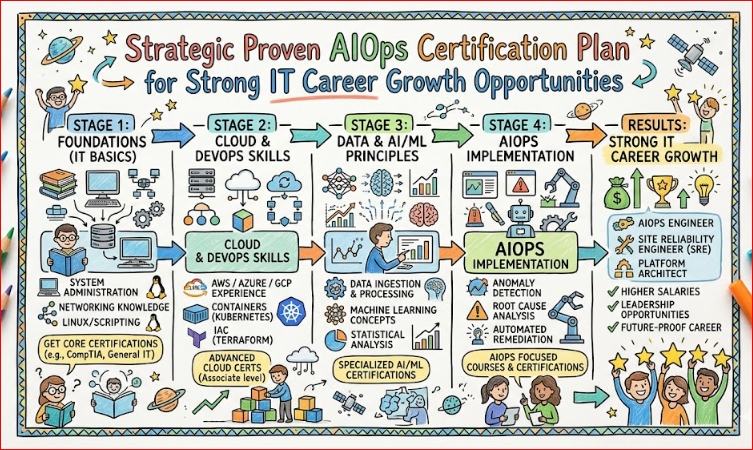
The certification is divided into three main levels: foundation, professional, and advanced. The foundation level focuses on the basic concepts of observability and data science for operations. The professional level dives deep into implementing specific AIOps tools and integrating them with DevOps and SRE workflows. Finally, the advanced level is for those who want to design entire enterprise-grade AIOps strategies, including FinOps and security. These levels are designed to match your career progression, helping you move from an individual contributor to a lead architect or manager.
Complete Certified AIOps Architect Certification Table
| Track | Level | Who it’s for | Prerequisites | Skills Covered | Recommended Order |
| AIOps Foundation | Entry | Junior Engineers | Basic IT knowledge | Data logs, metrics, AI basics | First |
| AIOps Professional | Mid | DevOps/SRE | 2 years experience | Anomaly detection, automation | Second |
| AIOps Architect | Expert | Senior Leads | 5 years experience | Strategy, AI modeling, scaling | Third |
Detailed Guide for Each Certified AIOps Architect Certification
Certified AIOps Architect – Foundation Level
What it is
This level validates your understanding of the core concepts of AI in IT operations. It ensures you know the difference between traditional monitoring and modern AIOps.
Who should take it
It is suitable for junior engineers, students, or managers who need to understand the terminology and basic workflows of AIOps.
Skills you’ll gain
- Understanding of telemetry data types.
- Basic knowledge of machine learning in IT.
- Ability to identify use cases for AIOps.
Real-world projects you should be able to do
- Setting up a basic centralized logging system.
- Creating a dashboard that shows system health using basic AI alerts.
Preparation plan
- 7-14 days: Focus on vocabulary and core concepts.
- 30 days: Complete all foundational video modules.
- 60 days: Review case studies of successful AIOps implementations.
Common mistakes
- Ignoring the data cleaning process.
- Thinking AIOps is only about automation without intelligence.
Best next certification after this
Include:
- Same-track option: AIOps Professional
- Cross-track option: SRE Foundation
- Leadership option: IT Management Essentials
Certified AIOps Architect – Professional Level
What it is
This validates your ability to implement AIOps tools in a production environment. It proves you can integrate AI models with existing DevOps pipelines.
Who should take it
Intermediate DevOps and SRE professionals who are responsible for maintaining system uptime and performance.
Skills you’ll gain
- Implementing anomaly detection models.
- Automating incident response with AI.
- Integrating AIOps with CI/CD tools.
Real-world projects you should be able to do
- Building an automated root cause analysis pipeline.
- Developing a predictive scaling system for cloud resources.
Preparation plan
- 7-14 days: Deep dive into specific AIOps tools and frameworks.
- 30 days: Hands-on labs focusing on data integration.
- 60 days: Running a pilot AIOps project in a staging environment.
Common mistakes
- Using too many complex models for simple problems.
- Not monitoring the performance of the AI models themselves.
Best next certification after this
Include:
- Same-track option: AIOps Architect (Advanced)
- Cross-track option: DevSecOps Professional
- Leadership option: Technical Lead Certification
Certified AIOps Architect – Advanced Level
What it is
This is the highest level that proves you can design and lead an enterprise-wide AIOps strategy. It focuses on architecture and long-term business value.
Who should take it
Senior architects, principal engineers, and CTOs who need to transform how their organization handles IT operations.
Skills you’ll gain
- Designing scalable AIOps architectures.
- Managing the cost and ROI of AI operations.
- Leading cross-functional teams for AI adoption.
Real-world projects you should be able to do
- Creating a multi-year AIOps roadmap for a large company.
- Designing a self-healing infrastructure that reduces downtime by 90 percent.
Preparation plan
- 7-14 days: Studying enterprise architecture patterns.
- 30 days: Practicing high-level design and strategy sessions.
- 60 days: Mentoring others and preparing a capstone architectural project.
Common mistakes
- Focusing only on tech and ignoring the culture of the team.
- Failing to align AIOps goals with business objectives.
Best next certification after this
Include:
- Same-track option: Specialized ML for Ops
- Cross-track option: Cloud Security Architect
- Leadership option: Digital Transformation Leadership
Choose Your Learning Path
DevOps Path
In this path, you focus on how AI can make the software delivery life cycle faster. You learn to use AI to find bugs in code before it is deployed. It helps in making the deployment process smoother by predicting which changes might cause a system crash. This is great for those who want to build highly efficient delivery pipelines that require minimal human intervention.
DevSecOps Path
This path combines security with AI operations to create a proactive defense system. You will learn how to use AI to detect unusual patterns that might indicate a security breach. It focuses on automating security audits and response across the infrastructure. This is essential for engineers who want to ensure that speed does not come at the cost of safety.
SRE Path
The SRE path is all about reliability and uptime. You use AIOps to manage service level objectives and reduce the manual work often referred to as toil. It teaches you how to build systems that can automatically fix themselves when they detect a problem. This is the best path for those who enjoy solving complex infrastructure puzzles and maintaining global scale systems.
AIOps Path
This path is a deep dive into the specific world of artificial intelligence for IT. You focus on the data science side of things, like training models to understand system behavior. You learn how to manage the full life cycle of an AIOps solution from data ingestion to automated action. It is perfect for those who want to be specialists in this specific new field.
MLOps Path
MLOps focuses on the operational side of machine learning models. You learn how to deploy, monitor, and manage AI models in production just like you would with software. It bridges the gap between data scientists and operations teams. This is a high-growth area for anyone interested in the technical side of managing machine learning at scale.
DataOps Path
DataOps is about managing the data pipelines that fuel AI and business analytics. You learn how to ensure that data is high quality, accessible, and secure. This path focuses on the automation of data delivery and integration. It is ideal for professionals who want to work at the intersection of big data and operations to support AI initiatives.
FinOps Path
The FinOps path teaches you how to use AI to manage and optimize cloud costs. You learn how to predict spending and find ways to save money without hurting performance. It focuses on the financial accountability of cloud engineering. This is a very important skill for managers and lead architects in large organizations that spend millions on cloud.
Role → Recommended Certified AIOps Architect Certifications
| Role | Recommended Certifications |
| DevOps Engineer | AIOps Foundation, Professional |
| SRE | AIOps Professional, Architect |
| Platform Engineer | AIOps Professional, Architect |
| Cloud Engineer | AIOps Foundation, Professional |
| Security Engineer | AIOps Professional (Security Track) |
| Data Engineer | AIOps Professional (Data Track) |
| FinOps Practitioner | AIOps Professional (FinOps Track) |
| Engineering Manager | AIOps Foundation, Architect |
Next Certifications to Take After Certified AIOps Architect
Same Track Progression
Once you complete the architect level, you should look for niche specializations. This could include deep learning for infrastructure or advanced natural language processing for log analysis. Staying in this track means you want to be the top expert in your company for everything related to AI operations. It allows you to stay focused and become a thought leader in the space while staying updated with AI trends.
Cross-Track Expansion
If you want to broaden your skills, consider moving into related fields like DevSecOps or specialized Cloud Architecture. Learning how AIOps fits into security or data management makes you a more versatile professional. This is a good choice if you want to work in smaller companies where you need to wear many hats. It helps you understand the bigger picture of how IT works and connects different departments.
Leadership & Management Track
For those who want to move away from coding and into leading teams, the management track is the way to go. You can pursue certifications in digital transformation or IT leadership. These programs teach you how to manage budgets, people, and long-term strategy. Your background as an AIOps architect will give you the technical respect needed to lead engineering teams effectively toward modern automated goals.
Training & Certification Support Providers for Certified AIOps Architect
DevOpsSchool
This provider offers extensive training for various technical certifications with a focus on hands-on learning. They have a long history of helping professionals upgrade their skills through interactive sessions and real-world lab environments. Their curriculum is designed to meet the needs of the current job market, ensuring that students learn the most relevant tools. Many engineers choose them for their structured approach and experienced instructors who come from top tech companies. They provide excellent support for those looking to master the complexities of modern engineering workflows and automated systems.
Cotocus
Cotocus is known for providing high-quality consulting and training services in the DevOps and AIOps space. They focus on delivering customized learning experiences that help organizations and individuals achieve their technical goals. Their trainers are industry veterans who bring years of practical experience to the classroom. They emphasize the importance of understanding the reasoning behind the technology, not just the technical steps. This makes them a great choice for professionals who want a deep, conceptual understanding of their field. Their support system helps students through every step of the certification journey.
Scmgalaxy
Scmgalaxy is a popular community and training platform that provides a wealth of resources for software configuration management. They offer a wide range of tutorials, articles, and training programs that cover everything from basic tools to advanced architectural patterns. The platform is built on the idea of knowledge sharing, making it a great place for continuous learning. Their certification support is highly regarded because it includes practical insights from a global community of experts. It is an excellent resource for anyone looking to stay updated on the latest trends in the industry.
BestDevOps
BestDevOps focuses on providing clear and concise training for engineers who want to advance their careers quickly. They offer specialized courses that target the most in-demand skills in the DevOps and cloud sectors. Their teaching method is straightforward and avoids unnecessary jargon, making complex topics easier to understand. They provide plenty of practice exams and project work to ensure that students are fully prepared for their tests. Many working professionals prefer them because their courses are designed to fit into a busy schedule without compromising on quality.
devsecopsschool.com
This platform is dedicated entirely to the intersection of development, security, and operations. They provide specialized training that teaches engineers how to build security into every stage of the software life cycle. Their courses are very practical, focusing on the tools and processes needed to create secure and resilient systems. They offer a variety of certification programs that are recognized by major employers worldwide. For anyone looking to specialize in security within an AIOps or DevOps context, this is one of the best places to start your learning.
sreschool.com
sreschool.com focuses on the principles and practices of Site Reliability Engineering. They provide in-depth training on how to create scalable and highly reliable software systems. Their curriculum covers essential topics like monitoring, incident response, and capacity planning. They emphasize the use of automation to reduce manual work and improve system performance. The platform offers a range of certifications that help engineers prove their expertise in maintaining enterprise-grade infrastructure. It is a top choice for those who want to focus on the reliability side of IT operations.
aiopsschool.com is the primary destination for professionals looking to master artificial intelligence in IT operations. They offer specialized tracks that cover everything from the foundation to the advanced architect level. Their training is built around real-world scenarios, ensuring that students can apply what they learn immediately in their jobs. They provide a supportive environment with access to mentors and a community of like-minded professionals. As the host of the Certified AIOps Architect program, they are the go-to source for the most up-to-date and relevant AIOps education.
dataopsschool.com
This provider specializes in the emerging field of DataOps, helping professionals manage the complex data needs of modern AI systems. Their courses focus on building efficient data pipelines and ensuring data quality across the organization. They teach students how to use automation to streamline data delivery and integration. Their certification programs are designed to validate the skills needed to support data-driven decision-making and AI applications. For engineers who want to focus on the data side of the operations world, this school offers the most targeted and effective training available.
finopsschool.com
finopsschool.com focuses on the financial management of cloud resources. They provide training that helps engineers and managers understand and control their cloud spending. Their courses cover topics like cost allocation, forecasting, and optimization using AI-driven tools. They offer certifications that prove your ability to manage cloud budgets while maintaining high performance. This is an essential skill set in today’s cloud-first world, where costs can easily spiral out of control. Many leaders choose this school to help their teams become more financially responsible and efficient.
Frequently Asked Questions (General)
- Is the Certified AIOps Architect exam difficult?
The exam is challenging because it requires a mix of theoretical knowledge and practical skills. It is designed to ensure that only those who truly understand the material can pass. However, with the right preparation and hands-on experience, it is definitely achievable for most dedicated professionals.
- How much time is needed to prepare for the exam?
Most people spend between one to three months preparing, depending on their technical background. If you already have experience in DevOps or SRE, you might move faster. It is important to not rush the process and to spend plenty of time on the practical labs.
- What are the prerequisites for this certification?
While there are no strict requirements, having a basic understanding of Linux, cloud computing, and DevOps is highly recommended. For the higher levels, a few years of industry experience will make the concepts much easier to grasp.
- What is the return on investment for this program?
The ROI is very high because AIOps is a specialized and high-demand field. Certified professionals often see significant salary increases and better job opportunities. It also saves you time in the long run by teaching you how to automate your daily tasks.
- Is a data science background required to pass?
No, you do not need to be a data scientist. While you will learn some basic data science concepts, the focus is on how to use AI tools as an engineer. You will learn to apply models, not necessarily build them from scratch using complex math.
- Can the exam be taken online?
Yes, the certification process is designed to be accessible globally, and online options are typically available. This allows you to learn and get certified from the comfort of your home or office without traveling.
- Is this certification recognized by major companies?
Yes, enterprises are looking for people who can help them manage their growing infrastructure using AI. Holding a certification from a specialized provider like Aiopsschool carries a lot of weight in the industry.
- How long is the certification valid?
Most technical certifications are valid for two to three years. After that, you may need to take a refresher course or a new exam to stay updated with the latest technological changes in the AI field.
- Does the program include hands-on labs?
Yes, practical labs are a core part of the learning experience. You will get to work with real tools and data to solve problems that you would encounter in a real job.
- What happens if the exam is not passed on the first attempt?
If you do not pass on your first try, most programs allow you to retake the exam after a short waiting period. Use the time to review the areas where you struggled and try again.
- Are there any study groups available for candidates?
Yes, many students join online communities or local meetups to study together. This is a great way to share knowledge and stay motivated throughout your preparation period.
- Will this help in moving into a management role?
Absolutely. Understanding how to implement and scale AIOps is a key skill for modern technical leaders. It shows that you can think strategically about the future of the organization and cost management.
FAQs on Certified AIOps Architect
- What specific AI models are covered in the training?
You will focus on models used for anomaly detection, pattern recognition, and predictive analytics. These are the most common models used in IT operations to find issues and predict future needs.
- How does AIOps differ from traditional monitoring methods?
Monitoring tells you that something is broken right now. AIOps uses data to tell you why it broke and can often predict that it will break before it actually happens.
- Is training provided for specific tools like ELK or Splunk?
Yes, the program covers how to integrate AIOps concepts with popular industry tools. You will learn how to make these tools smarter using AI plugins and custom models.
- Is this certification relevant for engineers in small companies?
While large enterprises benefit the most, small companies also need AIOps to stay lean. It allows a small team to manage a large infrastructure without needing to hire dozens of people.
- How much coding is involved in the certification training?
There is some coding involved, mostly in scripting and using APIs to connect different tools. You do not need to be a software developer, but being comfortable with Python or Bash is very helpful.
- Can specialization be done for a specific cloud provider?
The principles you learn are cloud-agnostic, meaning they work on any platform. However, the labs often use major cloud providers so you can see how it works in a real environment.
- Does the course cover the ethics of AI in IT operations?
Yes, it is important to understand how to use AI responsibly. The course touches on topics like data privacy and ensuring that AI decisions are transparent and fair to the users.
- What is the most important skill gained from this program?
The most important skill is the ability to look at IT operations through the lens of data and intelligence. You will stop being a reactive firefighter and start being a proactive architect.
Final Thoughts
As a mentor who has seen many trends come and go, I can tell you that AIOps is not just a buzzword. It is the natural evolution of how we manage technology. Systems are getting bigger and faster, and we need smarter ways to keep them running. Getting certified as an AIOps Architect is a solid investment in your future. It moves you away from the stressful world of manual troubleshooting and into a role where you design intelligent, self-healing systems. If you are willing to put in the work to learn these new skills, you will find yourself in high demand for years to come. It is not about chasing a certificate; it is about gaining the knowledge to lead in a world driven by artificial intelligence. If you are ready to take that next step, this is the right path to follow.
