Introduction
Transaction Monitoring (AML) Systems are specialized platforms designed to continuously monitor financial transactions for suspicious activity, detect potential money laundering, and ensure compliance with regulatory obligations. These systems enable banks, fintechs, and corporations to proactively manage risk and comply with anti-money laundering (AML) regulations.
In and beyond, the complexity of global financial transactions and heightened regulatory scrutiny make AML transaction monitoring critical. Advanced tools provide real-time analytics, automated alerts, and AI-driven anomaly detection to prevent financial crimes.
Real-World Use Cases:
- Detecting suspicious transactions and unusual patterns in real time.
- Monitoring cross-border payments for compliance with international AML regulations.
- Generating alerts and managing case investigations for compliance teams.
- Automating regulatory reporting and audit trails.
- Integrating with core banking and payment systems to improve operational efficiency.
Buyer Evaluation Criteria:
- Real-time monitoring and alerting
- Integration with core banking and transaction platforms
- AI and machine learning anomaly detection
- Workflow automation for case management
- Multi-jurisdiction regulatory coverage
- Reporting and audit trail capabilities
- Scalability for high transaction volumes
- User experience and dashboard analytics
- Security and compliance features
Best for: Compliance officers, AML teams, banks, fintech companies, and multinational corporations.
Not ideal for: Small organizations with minimal regulatory oversight or limited transaction volume where manual monitoring may suffice.
Key Trends in Transaction Monitoring (AML) Systems
- AI-driven anomaly detection to identify suspicious transactions faster.
- Continuous, real-time transaction monitoring across global markets.
- Automated workflow for alert escalation and investigation.
- Integration with trade finance, payment, and core banking systems.
- Multi-jurisdiction and multi-currency compliance coverage.
- Cloud-based deployment for scalable monitoring and reporting.
- Advanced dashboards and analytics for compliance teams.
- Low-code/no-code configuration for custom monitoring rules.
- Subscription and usage-based pricing models.
- Strong cybersecurity, encryption, and access control standards.
How We Selected These Tools (Methodology)
- Evaluated market adoption and reputation in banking and fintech sectors.
- Reviewed feature completeness including real-time monitoring, case management, and reporting.
- Analyzed reliability and performance signals from production environments.
- Assessed security posture including encryption, audit logs, and access control.
- Considered integration capabilities with core banking, payment, and AML systems.
- Evaluated suitability for various organization sizes and transaction volumes.
- Checked support, onboarding, and training availability.
- Prioritized tools balancing compliance depth with usability.
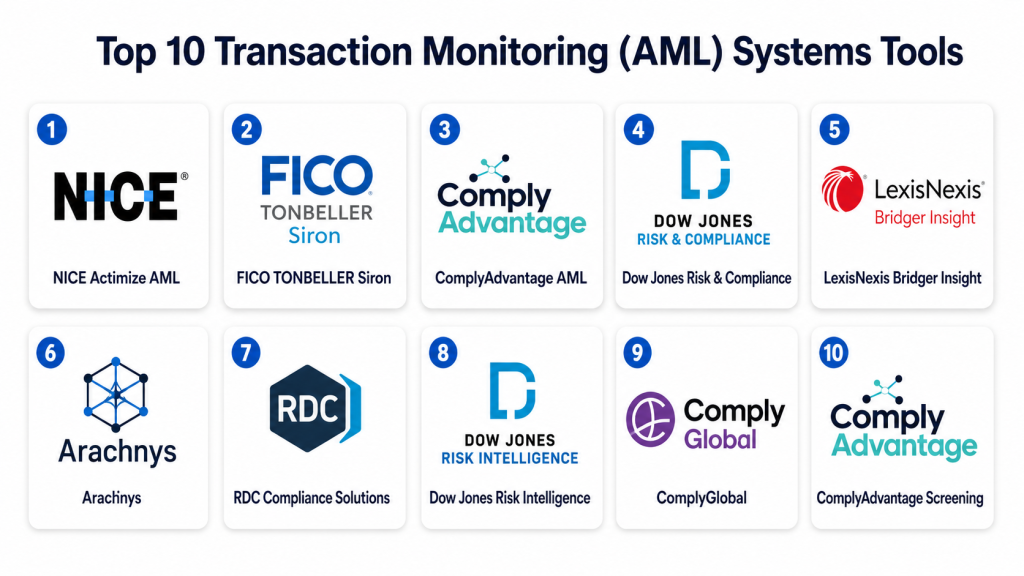
Top 10 Transaction Monitoring (AML) Systems Tools
#1 — NICE Actimize AML
Short description: NICE Actimize provides enterprise-grade transaction monitoring with real-time AML alerts and case management for banks and financial institutions.
Key Features
- Real-time transaction monitoring
- AI-driven anomaly detection
- Automated alert generation
- Case management and workflow automation
- Multi-jurisdiction compliance
- Advanced reporting dashboards
Pros
- Broad coverage for global AML regulations
- Strong analytics and reporting
Cons
- High implementation complexity
- Premium pricing
Platforms / Deployment
- Web / Windows
- Cloud / Hybrid
Security & Compliance
- SSO, MFA, encryption, audit logs
- SOC 2, ISO 27001
Integrations & Ecosystem
- Core banking and payment systems
- OMS and AML platforms
- API for custom workflows
- Regulatory reporting integration
Support & Community
- Enterprise support tiers
- Documentation and onboarding
- Active compliance community
#2 — FICO TONBELLER Siron
Short description: FICO TONBELLER Siron monitors financial transactions to detect money laundering risks and ensures regulatory compliance across multiple jurisdictions.
Key Features
- Multi-jurisdiction AML screening
- Real-time transaction monitoring
- Automated alert and case management
- Risk scoring and analytics
- Regulatory reporting dashboards
Pros
- Flexible workflow automation
- Comprehensive compliance coverage
Cons
- Complex deployment
- Higher cost
Platforms / Deployment
- Web / Windows
- Cloud / Hybrid
Security & Compliance
- Encryption, audit logs
- Not publicly stated
Integrations & Ecosystem
- Core banking systems
- Payment processing platforms
- AML case management
- API connectivity
Support & Community
- Enterprise support
- Documentation and training
- Varies
#3 — ComplyAdvantage AML
Short description: ComplyAdvantage offers AI-driven transaction monitoring and risk detection for banks, fintechs, and financial institutions to ensure AML compliance.
Key Features
- Real-time transaction monitoring
- AI-based anomaly detection
- Automated alerts and case management
- Integration with payment and banking systems
- Risk scoring and compliance reporting
Pros
- Advanced AI reduces false positives
- Real-time alerting
Cons
- Requires careful rule tuning
- Integration complexity
Platforms / Deployment
- Web
- Cloud
Security & Compliance
- SSO, encryption, audit logs
- Not publicly stated
Integrations & Ecosystem
- Core banking and payment systems
- AML platforms
- API integration for workflow automation
Support & Community
- Documentation and onboarding
- Enterprise support
- Active compliance community
#4 — Dow Jones Risk & Compliance
Short description: Dow Jones Risk & Compliance provides transaction monitoring with sanctions, AML, and PEP screening to detect suspicious financial activity.
Key Features
- Real-time and batch monitoring
- Sanctions and PEP screening
- Alert generation and workflow automation
- Multi-jurisdiction coverage
- Regulatory reporting
Pros
- High-quality global data
- Advanced analytics
Cons
- Complex configuration
- Costly for SMBs
Platforms / Deployment
- Web / Windows
- Cloud / Hybrid
Security & Compliance
- Encryption, audit logs
- Not publicly stated
Integrations & Ecosystem
- Payment and transaction systems
- AML case management tools
- API connectivity
Support & Community
- Enterprise support tiers
- Documentation and training
- Varies
#5 — LexisNexis Bridger Insight
Short description: Bridger Insight screens transactions and entities against sanctions and AML databases, helping financial institutions manage compliance risk effectively.
Key Features
- Batch and real-time screening
- Multi-jurisdiction sanctions coverage
- Automated alert management
- Risk scoring and reporting
- Workflow automation for investigations
Pros
- User-friendly interface
- Broad global coverage
Cons
- Limited advanced analytics
- Premium pricing
Platforms / Deployment
- Web / Windows
- Cloud / Hybrid
Security & Compliance
- SSO, encryption, audit logs
- Not publicly stated
Integrations & Ecosystem
- Core banking and payment systems
- AML and risk management platforms
- API integration
Support & Community
- Documentation and training
- Enterprise support tiers
- Varies
#6 — Arachnys
Short description: Arachnys provides real-time transaction monitoring, AML screening, and AI-powered due diligence for banks and corporates.
Key Features
- AI-enhanced anomaly detection
- Real-time transaction monitoring
- Automated alerts and workflow
- Multi-jurisdiction compliance
- Reporting and audit trails
Pros
- Advanced AI reduces false positives
- Broad sanctions and AML coverage
Cons
- Cost may be high for SMBs
- Configuration required
Platforms / Deployment
- Web
- Cloud
Security & Compliance
- SSO, encryption, audit logs
- Not publicly stated
Integrations & Ecosystem
- Core banking and payment systems
- AML and risk platforms
- API integration
Support & Community
- Documentation and onboarding
- Enterprise support
- Active compliance community
#7 — RDC Compliance Solutions
Short description: RDC Compliance Solutions monitors transactions, screens against sanctions and PEPs, and automates AML compliance workflows for enterprises.
Key Features
- Real-time and batch transaction monitoring
- Automated alerts and case management
- Multi-jurisdictional compliance
- Risk scoring dashboards
- Integration with banking and payment platforms
Pros
- Broad coverage
- Efficient workflow automation
Cons
- Implementation complexity
- Premium cost
Platforms / Deployment
- Web
- Cloud
Security & Compliance
- Encryption, audit logs
- Not publicly stated
Integrations & Ecosystem
- Core banking and AML platforms
- Payment system integration
- API access
Support & Community
- Enterprise support
- Documentation and onboarding
- Varies
#8 — Dow Jones Risk Intelligence
Short description: Dow Jones Risk Intelligence provides transaction monitoring and screening for sanctions, AML, and adverse media alerts for global financial institutions.
Key Features
- Real-time transaction monitoring
- Sanctions and PEP screening
- Automated alert workflow
- Multi-jurisdiction coverage
- Reporting dashboards
Pros
- High-quality data
- Automated workflows
Cons
- Limited AI features
- Costly for smaller firms
Platforms / Deployment
- Web
- Cloud
Security & Compliance
- Encryption, audit logs
- Not publicly stated
Integrations & Ecosystem
- Banking and transaction systems
- AML and risk management platforms
- API integration
Support & Community
- Documentation
- Enterprise support tiers
- Varies
#9 — ComplyGlobal
Short description: ComplyGlobal offers AML transaction monitoring, PEP and sanctions screening, and real-time alerts for financial institutions and corporates.
Key Features
- Multi-jurisdiction sanctions and AML coverage
- Real-time monitoring and alerts
- Workflow automation for investigations
- Reporting and audit trails
- API for integrations
Pros
- Real-time monitoring
- Configurable alerts
Cons
- Smaller user base
- Limited advanced analytics
Platforms / Deployment
- Web
- Cloud
Security & Compliance
- Encryption, audit logs
- Not publicly stated
Integrations & Ecosystem
- Core banking systems
- Payment and AML platforms
- API integration
Support & Community
- Enterprise support
- Documentation and training
- Varies
#10 — ComplyAdvantage Screening
Short description: ComplyAdvantage Screening offers AI-powered transaction monitoring, AML screening, and automated alerts for financial institutions.
Key Features
- Real-time transaction monitoring
- AI-driven anomaly detection
- Automated alerts and workflow
- Multi-jurisdiction sanctions and PEP screening
- Reporting dashboards
Pros
- Advanced AI reduces false positives
- Broad AML coverage
Cons
- Integration complexity
- Cost for small firms
Platforms / Deployment
- Web
- Cloud
Security & Compliance
- SSO, encryption, audit logs
- Not publicly stated
Integrations & Ecosystem
- Core banking and AML platforms
- Payment system integration
- API access
Support & Community
- Enterprise support
- Documentation and training
- Varies
Comparison Table (Top 10)
| Tool Name | Best For | Platform(s) Supported | Deployment | Standout Feature | Public Rating |
|---|---|---|---|---|---|
| NICE Actimize AML | Large banks, financial institutions | Web/Windows | Cloud/Hybrid | AI-driven AML alerts | N/A |
| FICO TONBELLER Siron | Multi-jurisdiction banks | Web/Windows | Cloud/Hybrid | Workflow automation | N/A |
| ComplyAdvantage AML | Fintechs, banks | Web | Cloud | AI-powered risk detection | N/A |
| Dow Jones Risk & Compliance | Investment firms | Web/Windows | Cloud/Hybrid | Real-time monitoring | N/A |
| LexisNexis Bridger Insight | Financial institutions | Web/Windows | Cloud/Hybrid | Batch & real-time screening | N/A |
| Arachnys | Banks, corporates | Web | Cloud | AI-enhanced due diligence | N/A |
| RDC Compliance Solutions | Corporates, banks | Web | Cloud | Workflow automation | N/A |
| Dow Jones Risk Intelligence | Enterprises | Web | Cloud | Adverse media & AML | N/A |
| ComplyGlobal | Banks, mid-market | Web | Cloud | Real-time configurable alerts | N/A |
| ComplyAdvantage Screening | Financial institutions | Web | Cloud | AI-powered monitoring | N/A |
Evaluation & Scoring of Transaction Monitoring Tools
| Tool Name | Core | Ease | Integrations | Security | Performance | Support | Value | Weighted Total |
|---|---|---|---|---|---|---|---|---|
| NICE Actimize AML | 9 | 7 | 8 | 8 | 9 | 8 | 7 | 8.3 |
| FICO TONBELLER Siron | 8 | 6 | 7 | 7 | 8 | 6 | 6 | 7.1 |
| ComplyAdvantage AML | 8 | 8 | 7 | 7 | 8 | 7 | 6 | 7.5 |
| Dow Jones Risk & Compliance | 8 | 7 | 8 | 7 | 8 | 7 | 6 | 7.6 |
| LexisNexis Bridger Insight | 8 | 7 | 7 | 7 | 8 | 6 | 6 | 7.2 |
| Arachnys | 8 | 7 | 7 | 7 | 8 | 7 | 6 | 7.4 |
| RDC Compliance Solutions | 8 | 6 | 7 | 7 | 8 | 6 | 6 | 7.2 |
| Dow Jones Risk Intelligence | 8 | 7 | 7 | 7 | 8 | 6 | 6 | 7.1 |
| ComplyGlobal | 7 | 6 | 7 | 7 | 7 | 6 | 6 | 6.8 |
| ComplyAdvantage Screening | 8 | 7 | 7 | 7 | 8 | 6 | 6 | 7.2 |
Interpretation: Weighted totals allow firms to compare platforms based on core AML functionality, ease of use, integrations, security, performance, support, and value. Higher scores indicate stronger overall capabilities.
Which Transaction Monitoring Tool Is Right for You?
Solo / Freelancer
Smaller operations may rely on ComplyAdvantage or Arachnys for ease of use and affordability.
SMB
Mid-sized firms handling moderate transaction volumes benefit from LexisNexis or Dow Jones Risk & Compliance for automated screening.
Mid-Market
Banks and investment firms with significant volume can consider NICE Actimize or FICO TONBELLER for enterprise-grade capabilities.
Enterprise
Large multinational institutions should prioritize NICE Actimize, RDC Compliance Solutions, or Dow Jones Risk Intelligence for advanced AML monitoring and workflow automation.
Budget vs Premium
Budget-conscious firms may choose Arachnys or ComplyAdvantage. Premium solutions like NICE Actimize and FICO TONBELLER provide enterprise capabilities and compliance depth.
Feature Depth vs Ease of Use
Actimize balances depth with usability; Arachnys emphasizes simplicity; FICO TONBELLER provides robust analytics at a steeper learning curve.
Integrations & Scalability
Organizations needing integration with payment and banking systems and multi-jurisdiction coverage should prioritize Actimize or Dow Jones Risk Intelligence.
Security & Compliance Needs
Organizations requiring strong audit, encryption, and regulatory adherence should focus on tools with SSO, MFA, audit logs, and certifications like SOC 2 or ISO 27001.
Frequently Asked Questions
1 — What is a Transaction Monitoring (AML) System?
Transaction Monitoring Systems monitor financial transactions to detect suspicious activity, ensure AML compliance, and prevent financial crimes.
2 — How much do these systems cost?
Costs vary depending on transaction volume, firm size, features, and licensing models. Enterprise solutions are premium-priced.
3 — How long is onboarding?
Onboarding can take several weeks to months depending on system complexity, integrations, and rule configuration.
4 — Can these systems integrate with my banking or payment platforms?
Yes, most tools provide APIs, connectors, and native integration with banking, payment, and AML platforms.
5 — How secure are these platforms?
Top platforms use encryption, SSO, MFA, and audit logging. Enterprise-grade tools may comply with SOC 2 or ISO 27001.
6 — Do these tools support multi-jurisdiction AML compliance?
Yes, leading platforms cover multiple countries and regulatory frameworks for global compliance.
7 — Are these systems suitable for small firms?
Some tools like ComplyAdvantage or Arachnys are suitable for SMBs. Enterprise solutions may be complex and costly for smaller organizations.
8 — How do these systems reduce regulatory risk?
They provide automated alerts, workflow management, reporting, and audit trails, reducing manual errors and compliance gaps.
9 — Are cloud deployments safe for AML monitoring?
Cloud-based tools are secure when providers implement encryption, access controls, and compliance certifications.
10 — Can I switch AML vendors easily?
Switching requires careful planning to migrate rules, transaction data, alerts, and integrations to minimize disruption.
Conclusion
Transaction Monitoring (AML) Systems are essential for preventing financial crimes, maintaining regulatory compliance, and managing operational risk. The “best” system depends on transaction volume, jurisdictional coverage, integration requirements, and budget. Firms should shortlist platforms, conduct pilot tests, and validate workflow efficiency, alert accuracy, and reporting capabilities before full deployment. Evaluating usability, AI capabilities, scalability, and support ensures effective and long-term AML compliance.
