Introduction
Healthcare Electronic Medical Record (EMR) systems are digital platforms designed to capture, manage, and store patient clinical information including history, diagnoses, medications, and treatment plans.
They streamline clinical documentation, improve coordination of care, and automate standard workflows for physicians, nurses, and administrative staff.
Modern EMR systems also integrate with laboratory, imaging, and pharmacy systems while supporting regulatory compliance and quality reporting.
Choosing the right EMR system enhances clinical efficiency, reduces documentation errors, and supports patient engagement.
Real‑world use cases:
- Recording patient vitals, histories, and progress notes
- Managing clinical orders, medications, and referrals
- Integrating with labs, imaging, and decision support tools
- Enabling patient portal access for test results and messaging
- Supporting quality metrics, reporting, and population health
Key buyer evaluation criteria:
- Clinical documentation and order entry
- Interoperability and FHIR/HL7 standards
- Patient engagement and portal features
- Lab, radiology, and pharmacy integration
- Billing and claims support
- Analytics and quality reporting
- Mobile access and telehealth integration
- Cloud vs on‑premises deployment
- Security & HIPAA compliance
Best for: Clinics, hospitals, ambulatory practices, specialty practices, and multi‑site healthcare networks.
Not ideal for: Organizations requiring only minimal recordkeeping or basic billing without clinical workflows.
Key Trends in Healthcare EMR Systems
- Cloud‑native EMRs for scalable multi‑site deployment
- Telehealth and mobile patient engagement integration
- AI‑assisted documentation and clinical decision support
- Interoperability via FHIR, HL7, and open APIs
- Enhanced security with encryption, role‑based access, and MFA
- Real‑time analytics and population health reporting
- Integrated workflow automation and order sets
- Modular specialty‑focused solutions
- Patient self‑scheduling and engagement tools
- Flexible SaaS subscription and hybrid deployment options
How We Selected These Tools (Methodology)
- Feature completeness across clinical, administrative, and engagement needs
- Ease of use and clinician adoption
- Interoperability and standards compliance
- Integration with labs, imaging, and third‑party apps
- Deployment flexibility (Cloud, On‑premises, Hybrid)
- Security and HIPAA compliance posture
- Analytics, reporting, and quality measure support
- Vendor support, documentation, and training availability
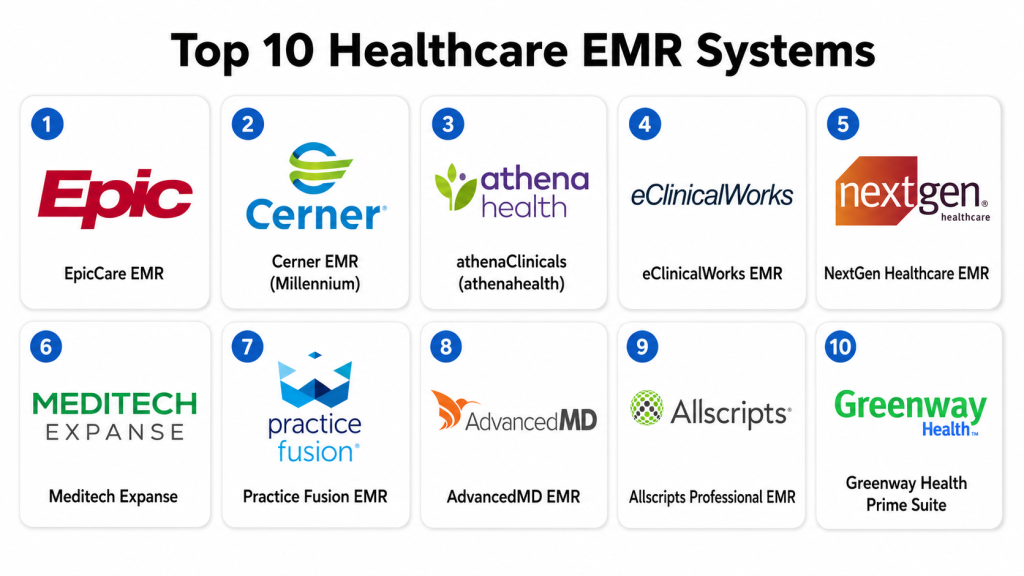
Top 10 Healthcare EMR Systems
#1 — EpicCare EMR
Short description:
EpicCare is a comprehensive EMR widely used by large hospitals and health systems.
Supports robust clinical documentation and multi‑specialty workflows.
Provides telehealth, patient portal, and population health modules.
Ideal for enterprise healthcare environments.
Key Features
- Clinical documentation and order entry
- Mobile and telehealth support
- Lab, radiology, and pharmacy integration
- Interoperability (FHIR/HL7)
- Analytics and quality reporting
Pros
- Scalable for large networks
- Strong interoperability and data sharing
- Extensive clinical feature set
Cons
- Higher implementation cost
- Complexity requires significant training
Platforms / Deployment
- Web / Windows / iOS
- Cloud / On‑premises
Security & Compliance
- Encryption, audit logs, RBAC
- HIPAA, HITECH compliance
Integrations & Ecosystem
- APIs for FHIR and HL7
- Marketplace of third‑party add‑ons
- Telehealth and billing connectors
Support & Community
- Comprehensive vendor training
- Large user community
- Dedicated support resources
#2 — Cerner EMR (Millennium)
Short description:
Cerner Millennium EMR supports clinical documentation, order entry, and patient tracking.
Offers interoperability, data analytics, and decision support tools.
Suitable for mid‑to‑large healthcare organizations.
Provides patient portal and telehealth integration.
Key Features
- Clinical workflows and CPOE
- Patient portal and engagement tools
- Interoperability standards support
- Data analytics and dashboards
- Lab/imaging/pharmacy integration
Pros
- Strong integration capabilities
- Cloud and hybrid deployment
- Comprehensive analytics
Cons
- Can be costly for smaller practices
- Customization complexity
Platforms / Deployment
- Web / Windows
- Cloud / On‑premises
Security & Compliance
- Encryption, SSO/MFA
- HIPAA compliance
Integrations & Ecosystem
- FHIR/HL7 support
- Third‑party application integration
Support & Community
- Vendor support and knowledge base
- Active user forums
#3 — athenaClinicals (athenahealth)
Short description:
athenaClinicals from athenahealth is a cloud‑based EMR solution.
Supports documentation, patient engagement, and billing workflows.
Designed for ambulatory and specialty practices.
Includes analytics and interoperability features.
Key Features
- Cloud EMR and practice management
- Patient portal and telehealth
- Billing and claims integration
- FHIR support and APIs
- Quality reporting tools
Pros
- Quick cloud deployment
- Strong patient engagement
- Cost‑effective for smaller practices
Cons
- Less configurable than enterprise EMRs
- Internet connectivity required
Platforms / Deployment
- Web / iOS
- Cloud
Security & Compliance
- Encryption, audit trails
- HIPAA compliant
Integrations & Ecosystem
- FHIR APIs
- Telehealth and labs/pharmacy integration
Support & Community
- Vendor support
- Documentation and tutorials
#4 — eClinicalWorks EMR
Short description:
eClinicalWorks is a cloud‑centric EMR with clinical and billing integration.
Supports documentation, patient engagement, and telehealth.
Ideal for ambulatory and mid‑sized practices.
Includes analytics and interoperability support.
Key Features
- Clinical documentation and CPOE
- Patient portal and engagement
- Integrated billing and claims
- Lab/radiology/pharmacy connectivity
- Reporting dashboards
Pros
- Cloud‑native and scalable
- Good patient engagement features
- Cost‑effective
Cons
- Training may be needed for advanced modules
- Smaller ecosystem than enterprise vendors
Platforms / Deployment
- Web / iOS
- Cloud
Security & Compliance
- Encryption, access control
- HIPAA compliant
Integrations & Ecosystem
- FHIR/HL7 interfaces
- Third‑party app connectors
Support & Community
- Vendor training and support
- Documentation
#5 — NextGen Healthcare EMR
Short description:
NextGen Healthcare EMR offers ambulatory EMR and practice management.
Supports documentation, orders, and patient engagement.
Includes reporting and analytics.
Ideal for small to mid‑sized clinics.
Key Features
- CPOE and clinical documentation
- Patient portal and telehealth
- Scheduling and billing
- Reporting & analytics
Pros
- User‑friendly interface
- Flexible for clinics and multi‑provider practices
- Cloud or on‑premises options
Cons
- Implementation complexity
- Some advanced features charged separately
Platforms / Deployment
- Web / Windows / iOS
- Cloud / On‑premises
Security & Compliance
- Encryption, user roles
- HIPAA compliant
Integrations & Ecosystem
- FHIR/HL7 support
- Third‑party integrations
Support & Community
- Vendor support
- Documentation and training
#6 — Meditech Expanse
Short description:
Meditech Expanse is an EMR for hospitals and health systems.
Provides clinical documentation and patient engagement.
Supports telehealth and mobile workflows.
Ideal for medium to large health systems.
Key Features
- Clinical documentation & CPOE
- Patient portal and mobile access
- Integration with labs, radiology, pharmacy
- Data analytics and reporting
Pros
- Mobile‑friendly and scalable
- Comprehensive clinical modules
- Cloud or on‑premises
Cons
- Premium pricing
- Training required
Platforms / Deployment
- Web / iOS / Windows
- Cloud / On‑premises
Security & Compliance
- Encryption & audit trails
- HIPAA & HITECH compliant
Integrations & Ecosystem
- FHIR/HL7 interfaces
- Third‑party app support
Support & Community
- Vendor support and documentation
#7 — Practice Fusion EMR
Short description:
Practice Fusion EMR is a cloud‑based system for small practices and clinics.
Supports documentation, scheduling, and patient engagement.
Ideal for independent practices.
Affordable and easy to deploy.
Key Features
- Cloud EMR with scheduling
- Patient portal and telehealth
- Lab and imaging integration
- Reporting and analytics
Pros
- Affordable entry‑level EMR
- Easy to deploy
- Cloud‑native
Cons
- Limited advanced clinical modules
- Customization is minimal
Platforms / Deployment
- Web / iOS
- Cloud
Security & Compliance
- Encryption & access control
- HIPAA compliant
Integrations & Ecosystem
- FHIR/HL7 support
- Lab/imaging interfaces
Support & Community
- Vendor support
- Tutorials
#8 — AdvancedMD EMR
Short description:
AdvancedMD EMR provides cloud‑based clinical documentation and practice management.
Supports telehealth, scheduling, and analytics.
Ideal for multi‑provider clinics.
Offers patient engagement tools.
Key Features
- Clinical documentation & CPOE
- Patient portal & telehealth
- Scheduling and billing
- Analytics dashboards
Pros
- Cloud‑native with modern UI
- Comprehensive practice workflows
- Scalable
Cons
- Subscription cost
- Some advanced features are add‑ons
Platforms / Deployment
- Web / iOS
- Cloud
Security & Compliance
- Encryption & access logs
- HIPAA compliant
Integrations & Ecosystem
- FHIR/HL7 compatibility
- Third‑party apps
Support & Community
- Vendor support
- Documentation
#9 — Allscripts Professional EMR
Short description:
Allscripts Professional EMR supports clinical documentation and patient care workflows.
Provides lab, imaging, and pharmacy integration.
Ideal for outpatient practices and clinics.
Includes analytics modules.
Key Features
- CPOE and documentation
- Patient portal & telehealth
- Lab, imaging, pharmacy interfaces
- Reporting and decision support
Pros
- Established clinical platform
- Flexible deployment
- Scalable for practices
Cons
- Requires training
- Premium pricing
Platforms / Deployment
- Web / Windows / iOS
- Cloud / On‑premises
Security & Compliance
- Encryption & audit logs
- HIPAA compliant
Integrations & Ecosystem
- FHIR/HL7 interfaces
- Third‑party add‑ons
Support & Community
- Vendor support
- Forums
#10 — Greenway Health Prime Suite
Short description:
Greenway Prime Suite EMR provides clinical documentation and practice management.
Supports telehealth, lab integration, and patient engagement.
Designed for ambulatory practices.
Includes analytics and reporting.
Key Features
- Clinical workflows & CPOE
- Patient portal & telehealth
- Lab/imaging/pharmacy integration
- Analytics dashboards
Pros
- Comprehensive ambulatory features
- Patient engagement tools
- Cloud or on‑premises
Cons
- Implementation complexity
- Subscription cost
Platforms / Deployment
- Web / iOS / Windows
- Cloud / On‑premises
Security & Compliance
- Encryption & access control
- HIPAA compliant
Integrations & Ecosystem
- FHIR/HL7 support
- Third‑party APIs
Support & Community
- Vendor support
- Documentation
Comparison Table (Top 10)
| Tool Name | Best For | Platform(s) | Deployment | Standout Feature | Public Rating |
|---|---|---|---|---|---|
| EpicCare EMR | Large hospitals | Web/iOS/Windows | Cloud/On‑prem | Enterprise scalability | N/A |
| Cerner EMR | Health systems | Web/Windows/iOS | Cloud/On‑prem | Integrated analytics | N/A |
| athenaClinicals | Ambulatory practices | Web/iOS | Cloud | Cloud EHR & billing | N/A |
| eClinicalWorks | Mid‑sized clinics | Web/iOS | Cloud | Patient engagement | N/A |
| NextGen Healthcare | Clinics | Web/Windows/iOS | Cloud/On‑prem | User‑friendly and flexible | N/A |
| Meditech Expanse | Health systems | Web/iOS/Windows | Cloud/On‑prem | Mobile and cloud access | N/A |
| Practice Fusion EMR | Small practices | Web/iOS | Cloud | Affordable entry EMR | N/A |
| AdvancedMD EMR | Multi‑provider clinics | Web/iOS | Cloud | Practice management | N/A |
| Allscripts Professional EMR | Outpatient practices | Web/Windows/iOS | Cloud/On‑prem | Established clinical workflows | N/A |
| Greenway Prime Suite | Ambulatory clinics | Web/iOS/Windows | Cloud/On‑prem | Analytics & engagement | N/A |
Evaluation & Scoring
| Tool | Core (25%) | Ease (15%) | Integrations (15%) | Security (10%) | Performance (10%) | Support (10%) | Value (15%) | Weighted Total |
|---|---|---|---|---|---|---|---|---|
| EpicCare | 10 | 7 | 8 | 8 | 9 | 8 | 6 | 8.3 |
| Cerner EMR | 9 | 7 | 8 | 8 | 8 | 7 | 6 | 7.8 |
| athenaClinicals | 8 | 9 | 7 | 7 | 7 | 7 | 8 | 7.8 |
| eClinicalWorks | 8 | 8 | 7 | 7 | 7 | 7 | 7 | 7.5 |
| NextGen Healthcare | 8 | 8 | 7 | 7 | 7 | 7 | 7 | 7.4 |
| Meditech Expanse | 9 | 7 | 8 | 8 | 8 | 7 | 6 | 7.7 |
| Practice Fusion EMR | 7 | 9 | 7 | 6 | 7 | 7 | 8 | 7.4 |
| AdvancedMD EMR | 8 | 8 | 7 | 7 | 7 | 7 | 7 | 7.4 |
| Allscripts Professional EMR | 8 | 7 | 7 | 7 | 8 | 7 | 6 | 7.3 |
| Greenway Prime Suite | 8 | 7 | 7 | 7 | 7 | 7 | 6 | 7.2 |
Decision Guide
Large Hospitals & Health Systems
EpicCare and Cerner EMR provide comprehensive clinical documentation, interoperability, and analytics.
Ambulatory & Multi‑Provider Clinics
athenaClinicals, eClinicalWorks, and NextGen Healthcare deliver scalable cloud EHRs with strong patient engagement.
Small Practices
Practice Fusion EMR offers an affordable, cloud-native EMR with essential clinical workflows.
Specialty & Outpatient Practices
Allscripts Professional and Greenway Prime Suite offer flexible modules tailored for outpatient workflows.
Cloud vs On‑Premises
Cloud solutions like athenaClinicals and Practice Fusion reduce infrastructure overhead; enterprise EMRs retain on‑premises options.
Frequently Asked Questions (FAQs)
1. What’s the cost model for EMR systems?
Most EMRs use subscription or licensing fees; cloud deployments typically involve recurring SaaS pricing.
2. Are EMRs HIPAA compliant?
Top EMR systems include encryption, access control, auditing, and other HIPAA compliance features.
3. Do EMRs work with labs and imaging?
Yes, major EMRs support HL7/FHIR interfaces for laboratory, radiology, and pharmacy integration.
4. Do EMRs include patient portals?
Most include portals for messaging, results, scheduling, and telehealth.
5. Can multiple clinics share an EMR?
Enterprise EMRs support centralized data across multi‑site practices for seamless workflows.
6. How long does implementation take?
Implementation ranges from weeks (cloud EMR) to months (enterprise EMR) depending on scale.
7. Are mobile apps supported?
Yes, many platforms offer mobile access for clinicians and patients.
8. Do EMRs handle billing?
Integrated billing and claims support is included in many systems like athenaClinicals and NextGen.
9. Is training required?
Yes, vendor training is critical to support adoption and productivity.
10. Can EMRs integrate with third‑party tools?
Most offer APIs and FHIR interfaces to integrate with telehealth, analytics, and other healthcare apps.
Conclusion
Choosing the right Healthcare EMR depends on practice size, clinical workflows, and growth plans. Large hospitals benefit from robust, interoperable platforms like EpicCare and Cerner EMR with analytics and multi‑site support. Cloud‑native solutions like athenaClinicals and Practice Fusion provide cost‑effective, fast deployment options for smaller practices or clinics. Integrated documentation, scheduling, lab/imaging interfaces, and analytics should be prioritized to ensure clinical efficiency and quality care. Always pilot workflows, validate interoperability requirements, and factor training and support when selecting an EMR.
