Introduction
Remote Patient Monitoring (RPM) platforms are digital health systems that collect health data from patients outside clinical settings—often in their homes—and transmit it securely to clinicians for ongoing monitoring and intervention.
RPM devices and software help healthcare teams track vitals such as blood pressure, glucose levels, oxygen saturation, weight changes, and symptom reports in near‑real‑time.
These platforms improve chronic disease management, support post‑acute care follow‑up, reduce hospital readmissions, and enhance patient engagement outside traditional visits.
Choosing the right RPM solution can increase care access, optimize clinician workflows, and improve patient outcomes while supporting reimbursement and compliance.
Real‑world use cases:
- Monitoring chronic conditions like diabetes, hypertension, COPD
- Post‑surgical recovery tracking and fall detection
- Maternal and prenatal remote care monitoring
- Elderly patient wellness checks and medication adherence tracking
- COVID‑19 home monitoring and early deterioration alerts
Key buyer evaluation criteria:
- Device ecosystem and data capture reliability
- Integration with EHR/EMR systems
- Alerting and clinical escalation workflows
- Patient and clinician mobile app experience
- Security, encryption, and HIPAA compliance
- Analytics and longitudinal trend reporting
- Scalability across patient populations
- Billing and reimbursement support
- Remote onboarding and support
Best for: Healthcare systems, ambulatory care practices, chronic care management programs, telehealth providers, and post‑acute care teams.
Not ideal for: Practices without structured clinical monitoring workflows or where patient engagement is minimal.
Key Trends in Remote Patient Monitoring Platforms
- Cloud‑based architectures enabling scalable deployment and remote access
- Multi‑device monitoring for blood pressure, glucose, weight, ECG, SpO₂, and wearable sensors
- AI/ML‑assisted alerts and risk stratification to prioritize clinician response
- Integration with EHR/EMR using FHIR/HL7 standards for seamless clinical workflows
- Mobile first and patient‑centric app design with reminders and education
- Interoperability with telehealth and care coordination tools
- Analytics dashboards for population health and quality insights
- Automated billing and reimbursement workflows for RPM CPT codes
- Security controls including MFA, encryption at rest and transit
- Device management and remote troubleshooting capabilities
How We Selected These Tools (Methodology)
- Market adoption by healthcare systems and payers
- Feature completeness: data collection, alerts, analytics, patient UX
- Reliability of device connectivity and data integrity
- Integration with EHR/EMR and clinical systems
- Support for clinician workflows and alerting
- Security, compliance, and data protection posture
- Scalability and performance across patient groups
- Support resources, documentation, and onboarding
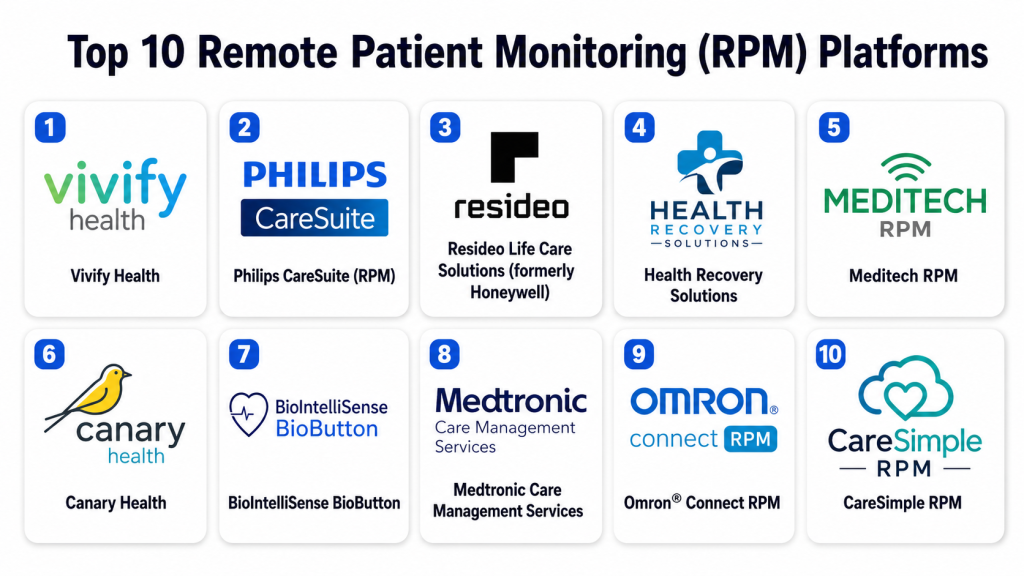
Top 10 Remote Patient Monitoring (RPM) Platforms
#1 — Vivify Health
Short description:
Vivify Health offers a comprehensive RPM platform with automated care plans and device connectivity.
Supports multi‑modal monitoring including vitals and patient‑reported data.
Includes configurable alerts and clinical workflow integration.
Ideal for health systems and chronic care programs.
Key Features
- Connected device support for BP, glucose, pulse ox
- Automated care journeys and questionnaires
- EHR integration via APIs and standards
- Alerts, clinical escalation, and care pathways
Pros
- Mature platform with robust clinical logic
- Strong customization for care plans
- Scales across conditions and patient segments
Cons
- Premium pricing tier
- Setup requires clinical workflow design
Platforms / Deployment
- Web / iOS / Android
- Cloud
Security & Compliance
- Encryption in transit/at rest
- HIPAA compliant; audit logging
- Role‑based access
Integrations & Ecosystem
- FHIR/HL7‑based EHR connections
- APIs for telehealth and messaging
- Device vendor partner integrations
Support & Community
- Implementation support
- Documentation and onboarding
- Clinical content libraries
#2 — Philips CareSuite (RPM)
Short description:
Philips CareSuite provides a remote monitoring platform with device and wearable integrations.
Tracks vital signs, mobile sensor metrics, and condition‑specific monitoring.
Includes clinical dashboards and alerts.
Ideal for large healthcare systems and chronic disease management.
Key Features
- Multi‑sensor device support
- Real‑time dashboarding and alerts
- Analytics and trend reporting
- Multidisciplinary care team views
Pros
- Enterprise scalability
- Strong device ecosystem
- Analytics tools
Cons
- Cost can be high for smaller clinics
- Longer onboarding time
Platforms / Deployment
- Web / Mobile
- Cloud
Security & Compliance
- Encryption, MFA
- HIPAA & regulatory compliance
Integrations & Ecosystem
- EHR/EMR integrations
- APIs for data sharing
- Device manufacturer support
Support & Community
- Vendor support
- Training modules
#3 — Resideo Life Care Solutions (formerly Honeywell)
Short description:
Life Care Solutions offers an RPM platform with remote monitoring and alerting.
Supports vitals, motion, activity, and sensor data aggregation.
Focuses on senior care and chronic condition monitoring.
Ideal for long‑term care and aging populations.
Key Features
- Home sensor integrations
- Vital sign monitoring
- Alert notifications
- Care coordination tools
Pros
- Strong support for aging patient use cases
- Sensor and device diversity
- Good alerting workflow
Cons
- Smaller EHR integration ecosystem
- Analytics features can be limited
Platforms / Deployment
- Web / Mobile
- Cloud
Security & Compliance
- Encryption
- HIPAA compliant
Integrations & Ecosystem
- APIs
- Device partner integrations
Support & Community
- Vendor assistance
- Documentation
#4 — Health Recovery Solutions
Short description:
Health Recovery Solutions (HRS) is a care engagement and RPM platform tracking vitals and PROs.
Includes video, surveys, and condition‑specific protocols.
Suitable for post‑discharge monitoring and chronic care.
Ideal for practices seeking patient‑centered engagement.
Key Features
- Device connectivity (BP, glucose, scale)
- Surveys and self‑report instruments
- Secure messaging and video
- Alerting and clinician workflows
Pros
- Strong patient engagement features
- Supports multiple conditions
- Easy mobile interface
Cons
- Analytics relatively basic
- Some workflows require design support
Platforms / Deployment
- Web / iOS / Android
- Cloud
Security & Compliance
- Encryption
- HIPAA compliant
Integrations & Ecosystem
- API support
- Integrates with EHR/EMR
Support & Community
- Onboarding support
- Guides and documentation
#5 — Meditech RPM
Short description:
Meditech’s RPM extends its hospital and EMR suite to remote monitoring.
Supports device data, alerts, and longitudinal tracking.
Fully integrated in Meditech workflows.
Ideal for existing Meditech customers.
Key Features
- Native EMR integration
- Device data ingestion
- Alerts and notifications
- Patient engagement portal
Pros
- Seamless clinical workflow integration
- Single record view
- Familiar interface for existing users
Cons
- Less standalone flexibility
- Smaller third‑party ecosystem
Platforms / Deployment
- Web / Mobile
- Cloud / On‑premises
Security & Compliance
- Encryption, RBAC
- HIPAA compliant
Integrations & Ecosystem
- EHR native
- APIs
Support & Community
- Vendor training
- Documentation
#6 — Canary Health
Short description:
Canary Health offers behavior‑based engagement and remote tracking for chronic disease.
Focuses on coaching, education, and habit development alongside biometric monitoring.
Ideal for long‑term chronic care and population health teams.
Key Features
- Coaching and behavior change content
- Tracking dashboards
- Condition‑specific pathways
- Integration with device data
Pros
- Strong patient education
- Good for wellness and management
- Population focus
Cons
- Limited core device coverage
- Analytics less advanced
Platforms / Deployment
- Web / Mobile
- Cloud
Security & Compliance
- Encryption
- HIPAA compliant
Integrations & Ecosystem
- API available
- Some EHR integrations
Support & Community
- Support resources
- Training
#7 — BioIntelliSense BioButton
Short description:
BioButton by BioIntelliSense is a wearable‑enabled RPM platform that continuously captures biometrics.
Monitors vitals, activity, and physiological changes.
Includes clinical dashboards and alerts.
Ideal for high‑risk patient cohorts and remote surveillance.
Key Features
- Continuous wearable data capture
- Vitals and activity tracking
- Alerts and trend visualizations
- Remote dashboard
Pros
- Continuous data yields granular insights
- Wearable‑first design
- Portable and patient‑centered
Cons
- Hardware procurement required
- May be overkill for simple workflows
Platforms / Deployment
- Web / Mobile
- Cloud
Security & Compliance
- Encryption, MFA
- HIPAA compliant
Integrations & Ecosystem
- API support
- EHR connectivity optional
Support & Community
- Training and support
- Documentation
#8 — Medtronic Care Management Services
Short description:
Medtronic’s RPM platform focuses on chronic condition monitoring, especially diabetes and cardiac patients.
Includes device data integration, alerts, and clinician workflows.
Ideal for condition‑specific RPM programs.
Key Features
- Device outcome data
- Alerts and clinical workflows
- Condition‑specific tools
- Analytics dashboards
Pros
- Strong condition focus
- Device fidelity
- Supports structured programs
Cons
- Tied to Medtronic device ecosystem
- Higher cost
Platforms / Deployment
- Web / Mobile
- Cloud
Security & Compliance
- Encryption
- HIPAA compliant
Integrations & Ecosystem
- Device ecosystem
- APIs
Support & Community
- Vendor support
#9 — Omron® Connect RPM
Short description:
Omron® Connect combines Omron health devices with RPM platforms for home monitoring.
Focuses on BP, pulse, and heart health.
Includes patient app and clinician data views.
Ideal for hypertension programs.
Key Features
- BP and vitals capture
- Patient app with trends
- Data sharing capabilities
- Alerts
Pros
- Strong device brand
- Easy patient setup
- Focused clinical use case
Cons
- Narrow device scope
- Integration complexity varies
Platforms / Deployment
- Web / Mobile
- Cloud
Security & Compliance
- Encryption
- HIPAA compliant
Integrations & Ecosystem
- API support
- EHR connectivity optional
Support & Community
- Vendor support
#10 — CareSimple RPM
Short description:
CareSimple provides device‑agnostic RPM workflows with alerts, patient apps, and clinical dashboards.
Supports multi‑device data capture and care pathways.
Ideal for clinics seeking flexible RPM integration.
Key Features
- Device‑agnostic support
- Alerts and dashboards
- Patient app with education
- API integration
Pros
- Flexible device support
- Good UX
- Scales across conditions
Cons
- Smaller ecosystem than enterprise vendors
- Feature growth continuing
Platforms / Deployment
- Web / Mobile
- Cloud
Security & Compliance
- Encryption
- HIPAA compliant
Integrations & Ecosystem
- EHR API support
Support & Community
- Documentation
- Vendor support
Comparison Table (Top 10)
| Tool Name | Best For | Platform(s) | Deployment | Standout Feature | Public Rating |
|---|---|---|---|---|---|
| Vivify Health | Enterprise RPM & care journeys | Web/Mobile | Cloud | Care path automation | N/A |
| Philips CareSuite | Large health systems | Web/Mobile | Cloud | Device ecosystem & analytics | N/A |
| Life Care Solutions | Senior care | Web/Mobile | Cloud | Home sensor integration | N/A |
| Health Recovery Solutions | Post‑acute monitoring | Web/Mobile | Cloud | Engagement + vitals | N/A |
| Meditech RPM | Existing Meditech users | Web/Mobile | Cloud/On‑prem | EMR‑native RPM | N/A |
| Canary Health | Chronic care & coaching | Web/Mobile | Cloud | Education & pathways | N/A |
| BioButton (BioIntelliSense) | Continuous wearable RPM | Web/Mobile | Cloud | Continuous vital capture | N/A |
| Medtronic Care Management | Condition‑specific RPM | Web/Mobile | Cloud | Device‑focused data | N/A |
| Omron® Connect | Hypertension programs | Web/Mobile | Cloud | Strong BP device support | N/A |
| CareSimple RPM | Flexible multi‑device RPM | Web/Mobile | Cloud | Device‑agnostic | N/A |
Evaluation & Scoring
| Tool | Core (25%) | Ease (15%) | Integrations (15%) | Security (10%) | Performance (10%) | Support (10%) | Value (15%) | Weighted Total |
|---|---|---|---|---|---|---|---|---|
| Vivify Health | 10 | 8 | 9 | 8 | 9 | 8 | 6 | 8.6 |
| Philips CareSuite | 9 | 7 | 9 | 8 | 8 | 7 | 6 | 8.0 |
| Life Care Solutions | 8 | 8 | 7 | 8 | 7 | 7 | 7 | 7.7 |
| Health Recovery Solutions | 8 | 9 | 7 | 8 | 8 | 8 | 7 | 8.1 |
| Meditech RPM | 8 | 7 | 8 | 8 | 8 | 7 | 6 | 7.7 |
| Canary Health | 7 | 9 | 6 | 8 | 7 | 7 | 7 | 7.5 |
| BioButton | 9 | 8 | 7 | 8 | 9 | 7 | 6 | 8.0 |
| Medtronic | 8 | 7 | 7 | 8 | 8 | 7 | 6 | 7.7 |
| Omron Connect | 7 | 9 | 6 | 8 | 7 | 7 | 7 | 7.4 |
| CareSimple RPM | 8 | 8 | 7 | 8 | 8 | 7 | 7 | 7.8 |
Decision Guide
Large Health Systems & Enterprise RPM
Vivify Health and Philips CareSuite provide full feature sets with care journey automation and device ecosystems.
Chronic Care & Patient Engagement
Health Recovery Solutions, Canary Health, and CareSimple RPM deliver strong engagement and longitudinal tracking.
Wearable & Continuous Monitoring
BioButton excels for continuous physiological data capture for high‑risk cohorts.
Condition‑Focused Monitoring
Medtronic Care Management and Omron Connect suit diabetes, cardiac, or hypertension programs.
EMR‑Native Workflow Integration
Meditech RPM works best for existing Meditech EMR customers seeking seamless integration.
Frequently Asked Questions (FAQs)
1. What device types do RPM platforms support?
Most support blood pressure cuffs, glucose meters, SpO₂ monitors, scales, and wearables; broader ecosystems include motion and home sensors.
2. Do RPM systems require special hardware?
Some require manufacturer‑linked devices; others are device‑agnostic supporting standard Bluetooth or cellular devices.
3. How does RPM integration with EHRs work?
RPM platforms use FHIR/HL7 APIs or native connectors to send data and alerts directly into clinical charts.
4. Are these platforms HIPAA compliant?
Yes, top RPM tools enforce encryption, secure access, auditing, and HIPAA compliance standards.
5. Can RPM improve chronic disease outcomes?
RPM enables early detection of trends and supports proactive care, which can improve outcomes for chronic conditions.
6. Do these platforms support telehealth?
Many platforms integrate or link with telehealth systems to enable virtual clinical visits.
7. Is analytics included?
Yes, dashboards and trend reporting help clinicians monitor populations and individual patients over time.
8. Can RPM support billing and reimbursement?
Leading solutions assist with tracking and reporting data required for RPM CPT code reimbursement.
9. Are mobile apps available for patients?
Most platforms offer mobile apps for iOS/Android alongside web access.
10. Do they require onboarding and training?
Yes, clinical workflow design and staff training are recommended to optimize RPM deployment.
Conclusion
Selecting the right Remote Patient Monitoring platform depends on clinical goals, patient population, and interoperability needs. Large health systems benefit from comprehensive solutions like Vivify Health and Philips CareSuite with enterprise‑grade analytics and device ecosystems. Platforms like Health Recovery Solutions and Canary Health strengthen engagement and long‑term chronic care management. Wearable‑centric platforms like BioButton suit high‑risk, continuous monitoring use cases, while device‑agnostic solutions like CareSimple RPM offer flexibility for multi‑device support. Ensuring strong EHR/EMR integration, reliable data capture, and secure patient access can help practices enhance care delivery, reduce readmissions, and improve patient satisfaction.
