Introduction
Radiology Information Systems (RIS) are specialized healthcare software designed to manage the operational, clinical, and administrative workflows of radiology departments.
RIS platforms handle scheduling, patient tracking, exam reporting, worklist management, and billing communication, ensuring smooth coordination of imaging services and clinical teams.
They often integrate tightly with PACS (Picture Archiving and Communication Systems) and EMRs/EHRs to enable seamless information flow and reduce administrative bottlenecks.
Choosing the right RIS enhances workflow efficiency, improves report turnaround, supports compliance, and strengthens collaboration between radiologists, technologists, and referring clinicians.
Real‑world use cases:
- Scheduling radiology exams and managing appointment calendars
- Tracking patient exams and modalities through completion
- Generating structured radiology reports and templates
- Communicating results to referring providers and EMRs
- Managing billing, coding, and revenue cycle touchpoints
Key buyer evaluation criteria:
- Scheduling and modality worklist management
- Reporting tools and structured templates
- Integration with PACS and EMR/EHR systems
- Billing and coding support (CPT/ICD)
- Patient tracking and status notifications
- Analytics, dashboards, and performance reporting
- Security, access control, and auditing
- Scalability for single or multi‑site radiology departments
- Mobile and web‑based clinician access
Best for: Radiology departments, imaging centers, multi‑specialty clinics, and hospitals requiring streamlined imaging workflows.
Not ideal for: Small clinics without formal imaging services or standalone basic imaging workflows only.
Key Trends in Radiology Information Systems
- Tight EMR/EHR & PACS interoperability using DICOM, HL7, and FHIR
- Structured reporting with templates and voice recognition support
- Cloud‑native RIS options reducing infrastructure needs
- Role‑based workflow orchestration and automated worklists
- Analytics dashboards for performance, turnaround, and utilization
- AI‑assisted decision support and report enrichment
- Mobile and web access for on‑the‑go scheduling and reporting
- Revenue cycle integration including coding and billing workflows
- Patient self‑scheduling and reminders
- Secure messaging and clinician communication tools
How We Selected These Tools (Methodology)
- Adoption in radiology departments and imaging centers
- Breadth of core RIS functionality and workflow completeness
- Integration quality with PACS, EMR/EHR, and modality systems
- Reporting tools, templates, and documentation capabilities
- Cloud, hybrid, and on‑premises deployment options
- Security posture, access control, and compliance safeguards
- Support, training, and community resources
- Scalability and multi‑site coordination potential
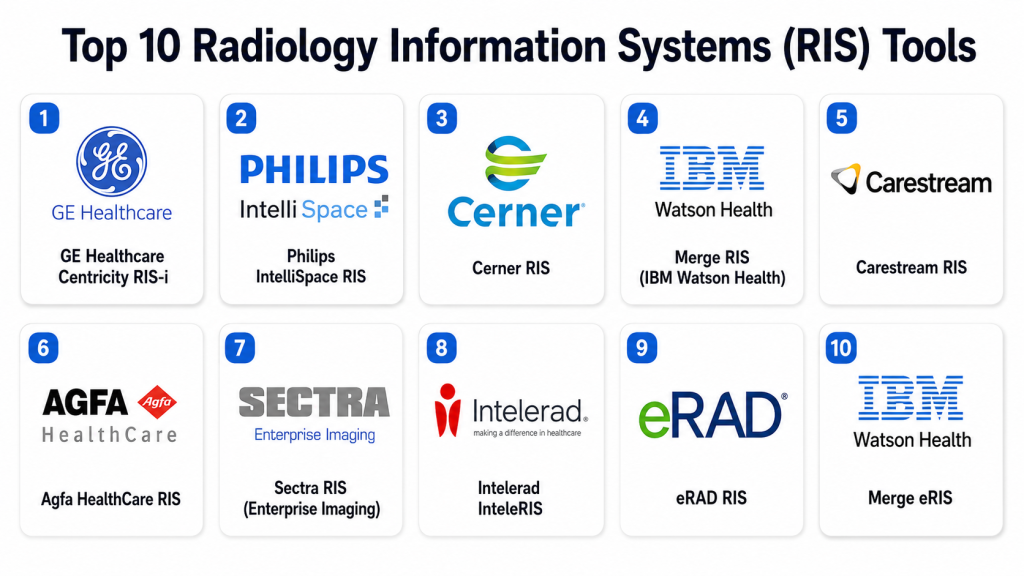
Top 10 Radiology Information Systems (RIS) Tools
#1 — GE Healthcare Centricity RIS‑i
Short description:
Centricity RIS‑i is an enterprise RIS designed for radiology and imaging workflows.
Supports patient scheduling, exam tracking, and structured reporting.
Integrates tightly with PACS and EMR for seamless clinical data flow.
Ideal for large hospitals and multi‑site imaging operations.
Key Features
- Scheduling and modality worklists
- Structured reporting templates
- EMR and PACS integration
- Billing/CPT/ICD linkage
Pros
- Strong enterprise workflow support
- Excellent modality coordination
- Integrated billing features
Cons
- Complex implementation
- Premium licensing cost
Platforms / Deployment
- Web / Desktop
- Cloud / On‑premises
Security & Compliance
- Encryption, audit logs
- HIPAA compliant
Integrations & Ecosystem
- DICOM/HL7/FHIR interfaces
- PACS and EMR connectors
- APIs for workflow extensions
Support & Community
- Vendor support
- Training and documentation
#2 — Philips IntelliSpace RIS
Short description:
IntelliSpace RIS is a modern radiology workflow platform supporting scheduling, reporting, and analytics.
Designed for collaboration across departments.
Includes structured reporting and customizable templates.
Ideal for health systems and imaging departments.
Key Features
- Patient and exam scheduling
- Structured radiology reporting
- Performance dashboards
- EMR/PACS connectivity
Pros
- Modern UI with dashboards
- Good analytics and reporting
- Flexible templates
Cons
- Training needed for advanced features
- Higher total cost
Platforms / Deployment
- Web / Desktop
- Cloud / On‑premises
Security & Compliance
- Encryption, access control
- HIPAA compliant
Integrations & Ecosystem
- EMR/FHIR/HL7
- PACS integration
Support & Community
- Vendor documentation
- Support services
#3 — Cerner RIS
Short description:
Cerner RIS supports radiology operations within the broader Cerner EMR ecosystem.
Offers appointment scheduling, reporting, and modality tracking.
Supports dashboards and clinical communication.
Ideal for organizations already using Cerner Millennium.
Key Features
- Modality worklist and scheduling
- Structured report generation
- Clinician communication tools
- Integration with EMR and billing
Pros
- Deep EMR integration
- Rich scheduling tools
- Common clinical workflows
Cons
- Best experienced within Cerner EMR
- Customization complexity
Platforms / Deployment
- Web / Desktop
- Cloud / On‑premises
Security & Compliance
- Encryption
- HIPAA compliant
Integrations & Ecosystem
- HL7/FHIR connectors
- PACS support
Support & Community
- Cerner support
- Documentation
#4 — Merge RIS (IBM Watson Health)
Short description:
Merge RIS is an enterprise radiology information platform with structured reporting and workflow automation.
Supports scheduling, patient tracking, and analytics.
Closely ties with Merge PACS and IBM Watson analytics.
Ideal for hospitals and imaging centers.
Key Features
- Scheduling and patient management
- Structured reporting
- Analytics and utilization reporting
- EMR and PACS connectivity
Pros
- Strong enterprise features
- Analytics capabilities
- Good reporting tools
Cons
- Older interface than some competitors
- Premium pricing
Platforms / Deployment
- Web / Desktop
- Cloud / On‑premises
Security & Compliance
- Encryption, audit logs
- HIPAA compliant
Integrations & Ecosystem
- HL7, DICOM
- PACS interfaces
Support & Community
- Vendor documentation
- Training
#5 — Carestream RIS
Short description:
Carestream RIS provides core radiology workflows for scheduling, reporting, and modality tracking.
Strong support for multi‑site and imaging center coordination.
Includes worklists, reporting templates, and dashboarding.
Ideal for mid‑sized hospitals and imaging groups.
Key Features
- Scheduling and exam tracking
- Templates and reporting tools
- Dashboards
- PACS and EMR interfaces
Pros
- Affordable mid‑range option
- Integration with Carestream PACS
- Reliable workflows
Cons
- UI less modern
- Analytics depth limited
Platforms / Deployment
- Web / Desktop
- Cloud / On‑premises
Security & Compliance
- Encryption
- HIPAA compliant
Integrations & Ecosystem
- DICOM, HL7
- EMR/PACS links
Support & Community
- Vendor support
- Guides
#6 — Agfa HealthCare RIS
Short description:
Agfa RIS delivers scheduling, reporting, and patient tracking with tele‑radiology support.
Works alongside Agfa Enterprise Imaging and PACS.
Supports structured reporting and workflow automation.
Ideal for imaging centers and hospitals.
Key Features
- Modality scheduling
- Structured reporting
- Worklist management
- Tele‑radiology workflows
Pros
- Good tele‑radiology coordination
- Flexible deployment
- Strong PACS synergy
Cons
- Custom setup required
- UI learning curve
Platforms / Deployment
- Web / Desktop
- Cloud / On‑premises
Security & Compliance
- Encryption, audit logs
- HIPAA compliant
Integrations & Ecosystem
- DICOM/HL7
- PACS/EMR connectors
Support & Community
- Vendor documentation
- Support
#7 — Sectra RIS (Enterprise Imaging)
Short description:
Sectra RIS supports efficient radiology workflows with scheduling, tracking, and report generation.
Focuses on collaboration, modality coordination, and multi‑site operations.
Works with Sectra PACS and enterprise imaging.
Ideal for large departments.
Key Features
- Scheduling and exam tracking
- Structured reporting
- Multi‑site workflow support
- Dashboards
Pros
- Excellent enterprise workflows
- Strong performance
- Good tele‑radiology features
Cons
- Higher total cost
- Requires training
Platforms / Deployment
- Web / Desktop
- Cloud / Hybrid
Security & Compliance
- Encryption
- HIPAA compliant
Integrations & Ecosystem
- DICOM/HL7
- PACS/EMR integration
Support & Community
- Vendor support
#8 — Intelerad InteleRIS
Short description:
InteleRIS offers flexible radiology scheduling, reporting, and patient management tools.
Supports multi‑site operations and integration with IntelePACS.
Includes dashboards and workflow orchestration.
Ideal for imaging groups and hospitals.
Key Features
- Scheduling & modality worklists
- Structured reporting
- Multi‑site access
- EMR and PACS connectivity
Pros
- Flexible deployment
- Strong integrations
- Good performance
Cons
- User interface may feel complex
- Support can vary
Platforms / Deployment
- Web / Desktop
- Cloud / On‑premises
Security & Compliance
- Encryption
- HIPAA compliant
Integrations & Ecosystem
- DICOM, HL7, FHIR
- PACS/EMR links
Support & Community
- Documentation
#9 — eRAD RIS
Short description:
eRAD RIS provides radiology scheduling, reporting, and tracking with integration to imaging workflows.
Includes business intelligence and utilization dashboards.
Ideal for outpatient imaging centers.
Key Features
- Scheduling and worklists
- Business intelligence dashboards
- Reporting tools
- PACS and EMR integration
Pros
- Good analytics focus
- Flexible use
- Solid reporting
Cons
- Smaller ecosystem
- Premium modules cost extra
Platforms / Deployment
- Web / Desktop
- Cloud / On‑premises
Security & Compliance
- Encryption
- HIPAA compliant
Integrations & Ecosystem
- DICOM/HL7
- EMR/PACS connectors
Support & Community
- Support resources
- Documentation
#10 — Merge eRIS
Short description:
Merge eRIS provides clinician‑focused radiology workflows with scheduling, reporting, and tracking.
Designed to work with Merge PACS and enterprise imaging.
Includes structured reporting and performance metrics.
Ideal for radiology departments seeking integrated workflows.
Key Features
- Scheduling and tracking
- Structured reporting
- Dashboards and analytics
- EMR support
Pros
- Integrates well with Merge PACS
- Strong reporting templates
- Good performance
Cons
- Older UI
- Premium price
Platforms / Deployment
- Web / Desktop
- Cloud / On‑premises
Security & Compliance
- Encryption
- HIPAA compliant
Integrations & Ecosystem
- DICOM/HL7
- PACS/EMR connections
Support & Community
- Vendor support
- Documentation
Comparison Table (Top 10)
| Tool Name | Best For | Platform(s) | Deployment | Standout Feature | Public Rating |
|---|---|---|---|---|---|
| Centricity RIS‑i | Large hospitals | Web/Desktop | Cloud/On‑prem | Enterprise scheduling & reporting | N/A |
| IntelliSpace RIS | Health systems | Web/Desktop | Cloud/On‑prem | Modern UI & analytics | N/A |
| Cerner RIS | EMR‑centric radiology | Web/Desktop | Cloud/On‑prem | Deep EMR integration | N/A |
| Merge RIS | Enterprise imaging | Web/Desktop | Cloud/On‑prem | Analytics and workflow | N/A |
| Carestream RIS | Mid‑sized imaging | Web/Desktop | Cloud/On‑prem | Reliable workflows | N/A |
| Agfa RIS | Imaging centers | Web/Desktop | Cloud/On‑prem | Tele‑radiology workflows | N/A |
| Sectra RIS | Enterprise radiology | Web/Desktop | Cloud/Hybrid | Multi‑site workflows | N/A |
| InteleRIS | Imaging groups | Web/Desktop | Cloud/On‑prem | Flexible deployment | N/A |
| eRAD RIS | Outpatient centers | Web/Desktop | Cloud/On‑prem | BI dashboards | N/A |
| Merge eRIS | Department workflows | Web/Desktop | Cloud/On‑prem | Structured reporting | N/A |
Evaluation & Scoring
| Tool | Core (25%) | Ease (15%) | Integrations (15%) | Security (10%) | Performance (10%) | Support (10%) | Value (15%) | Weighted Total |
|---|---|---|---|---|---|---|---|---|
| Centricity RIS‑i | 10 | 7 | 9 | 8 | 9 | 8 | 6 | 8.5 |
| IntelliSpace RIS | 9 | 8 | 8 | 8 | 8 | 7 | 6 | 7.9 |
| Cerner RIS | 9 | 7 | 9 | 8 | 8 | 7 | 6 | 7.8 |
| Merge RIS | 8 | 7 | 8 | 8 | 8 | 7 | 6 | 7.6 |
| Carestream RIS | 8 | 8 | 7 | 8 | 7 | 7 | 7 | 7.7 |
| Agfa RIS | 8 | 7 | 8 | 8 | 7 | 7 | 6 | 7.6 |
| Sectra RIS | 9 | 7 | 8 | 8 | 8 | 7 | 6 | 7.8 |
| InteleRIS | 8 | 7 | 8 | 8 | 8 | 7 | 6 | 7.6 |
| eRAD RIS | 7 | 8 | 7 | 8 | 7 | 7 | 7 | 7.5 |
| Merge eRIS | 7 | 7 | 8 | 8 | 8 | 7 | 6 | 7.4 |
Decision Guide
Enterprise Radiology & Multi‑Site
Centricity RIS‑i, IntelliSpace RIS, and Sectra RIS provide robust scheduling, reporting, and analytics for complex imaging operations.
EMR‑Centric Workflows
Cerner RIS and Merge RIS integrate deeply with EMR systems to streamline documentation and clinician collaboration.
Imaging Centers & Departments
Carestream RIS and Agfa RIS offer reliable, cost‑effective tools with strong modality and workflow support.
Outpatient Imaging Tasks
eRAD RIS and InteleRIS provide useful BI dashboards and flexible deployment for outpatient and multi‑clinic scenarios.
Structured Reporting Focus
Merge eRIS excels with structured templates and performance reporting for departmental workflows.
Frequently Asked Questions (FAQs)
1. What’s the core purpose of RIS?
RIS manages radiology workflows including scheduling, tracking exams, reporting, and integration with imaging and clinical systems.
2. Do RIS platforms integrate with PACS?
Yes — integration with PACS via DICOM and workflow connectors ensures synchronized imaging and reporting.
3. Are RIS systems HIPAA compliant?
Top RIS tools use encryption, audit logging, and access controls to meet HIPAA and healthcare security standards.
4. Can RIS support multi‑site operations?
Yes — enterprise RIS like Centricity and Sectra support robust multi‑site coordination and sharing.
5. Do RIS platforms include analytics?
Many include dashboards and BI tools for turnaround times, utilization, and departmental performance.
6. Are mobile access and web clients available?
Yes — modern RIS platforms offer web interfaces and mobile access for scheduling and reporting.
7. Do RIS systems help with billing?
Most integrate billing, CPT/ICD coding, and revenue workflows into radiology operations.
8. Is structured reporting supported?
Yes — structured templates and voice recognition support are common for consistent radiology reports.
9. Can RIS communicate with EMRs?
RIS systems integrate with EMRs using HL7/FHIR standards to share orders, results, and patient data.
10. Is training required?
Implementation and training are recommended to ensure workflow adoption and full utilization of RIS features.
Conclusion
Choosing the right Radiology Information System (RIS) depends on department size, imaging volume, and integration needs. Large radiology departments and enterprise imaging operations benefit from Centricity RIS‑i, IntelliSpace RIS, and Sectra RIS with strong workflows and analytics. Facilities already using specific EMRs gain value from Cerner RIS and Merge RIS for native integration. Mid‑sized imaging teams and outpatient centers find reliable performance and flexible deployment with Carestream RIS and Agfa RIS, while InteleRIS and eRAD RIS excel in BI dashboards and outpatient workflows. Prioritizing interoperability, workflow orchestration, and structured reporting ensures optimized operational efficiency in radiology services.
