Introduction
Prospecting automation tools are software platforms that automate the process of finding, qualifying, and engaging potential customers. Instead of manually researching leads, crafting repetitive outreach, and juggling disparate tools, prospecting automation systems streamline workflows by combining data discovery, list building, outreach sequencing, and engagement tracking into repeatable processes. In plain English, these tools make it easier for sales and marketing teams to identify the right prospects, contact them efficiently, and measure the impact of their efforts without requiring manual effort at every step.
In the sales landscape, effective prospecting is more challenging and more critical than ever. Buyers are empowered with more information, competition is higher for attention and budget, and teams are tasked with doing more with fewer resources. Modern automation helps standardize outreach, surface high‑value prospects, and reduce time spent on repetitive tasks like data entry, email sequencing, and follow‑ups. AI‑enhanced features help rank leads, predict engagement likelihood, and personalize interactions at scale.
Real-World Use Cases:
- Automated lead list building: Pulling targeted contact lists based on ICP (Ideal Customer Profile) attributes.
- Sequenced outreach automation: Scheduling multi‑touch email, call, and social campaigns with smart follow‑ups.
- Lead qualification workflows: Automatically scoring or routing prospects based on responses or behavior.
- Sales rep productivity augmentation: Reducing manual tasks to focus on high‑value conversations.
- Integration‑backed engagement tracking: Syncing prospect activity with CRM and analytics for measurement.
What Buyers Should Evaluate:
- Data quality and enrichment sources
- Automation capability (email, calls, social)
- Sequencing flexibility and multi‑touch logic
- AI personalization and insight features
- CRM and ecosystem integrations
- Analytics and reporting depth
- Security and compliance posture
- Scalability for team size and volume
- Ease of use and time to value
- Support, community, and documentation
Best for: B2B sales teams, SDR/BDR teams, growth and revenue operations, and any organization seeking to scale outreach with reduced manual effort.
Not ideal for: Very small teams with limited outreach needs or organizations that rely exclusively on inbound leads without leveraging outbound workflows.
Key Trends in Prospecting Automation Tools
- AI‑driven personalization at scale: Platforms increasingly use AI to craft personalized messaging based on intent, profile data, and engagement history.
- Intent and behavior signals: Prospecting tools integrate intent signals (e.g., content consumption, search behavior) to rank and prioritize outreach.
- Sales and marketing alignment workflows: Shared pipelines and aligned workflows between marketing and sales teams reduce handoff friction and improve conversion rates.
- Omnichannel prospecting automation: Tools now automate outreach across email, voice, video, SMS, and social channels in a coordinated cadence.
- CRM‑native automation: Deep synchronization with CRM systems ensures enriched data flows and reduces duplication or stale records.
- Predictive scoring and analytics: Predictive models help prioritize leads and forecast which prospects are most likely to convert.
- Automated compliance and consent tracking: Respect for privacy regulations means systems automatically manage opt‑outs, consent flags, and compliance metadata.
- Playable engagement triggers: Real‑time triggers based on website visits, email interactions, or link clicks initiate automated follow‑up sequences.
- Aligning content with stage‑based outreach: Automated prospecting tools increasingly tie messaging sequences to funnel stages and ICP criteria.
- Flexible pricing and modular capabilities: Vendors offer modular stacks where users pay for just the features they use (data, automation, analytics, integrations).
How We Selected These Tools (Methodology)
- Evaluated market adoption and mindshare among sales and revenue teams.
- Assessed feature completeness, including data, sequences, personalization, and analytics.
- Considered reliability and performance signals such as uptime, processing speed, and handling large volumes.
- Examined security posture signals, including encryption, compliance, access controls, and consent management.
- Reviewed integration ecosystem with CRM, engagement, and data enrichment tools.
- Tested ease of use and onboarding experience, including API and SDK options where relevant.
- Analyzed customer fit across segments (SMB, mid‑market, enterprise) and workflow complexity.
- Prioritized 2026 relevance, including AI features, intent integrations, and privacy‑aware design.
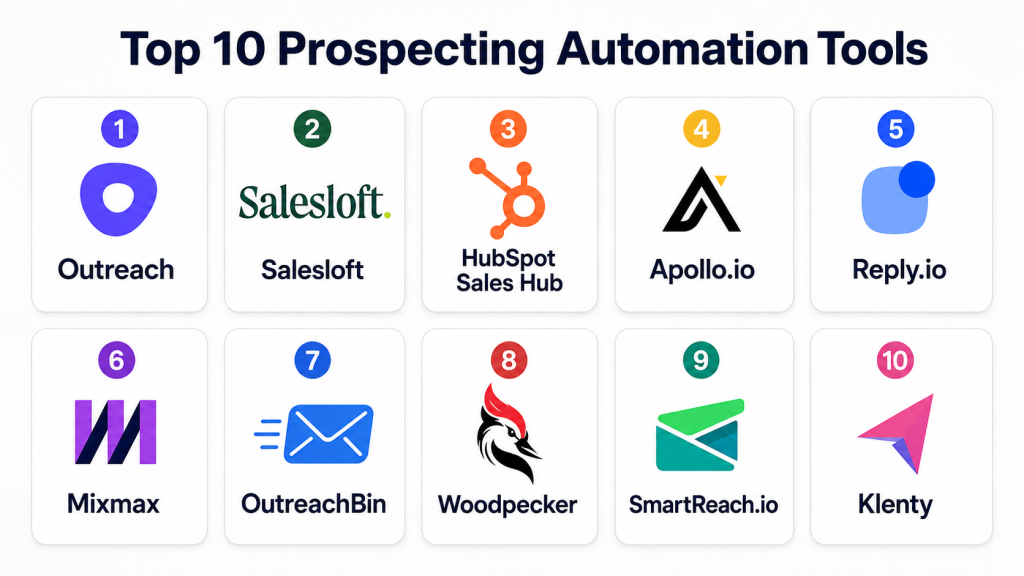
Top 10 Prospecting Automation Tools
#1 — Outreach
Short description: Outreach is a leading sales engagement and prospecting automation tool used by revenue teams to streamline multi‑touch outreach across email, calls, and workflows. Targeted at mid‑market and enterprise organizations, Outreach automates sequences, prioritizes high‑value prospects, and provides actionable engagement insights.
Key Features
- Multi‑channel sequencing (email, call, SMS)
- Predictive engagement analytics
- AI‑assisted messaging recommendations
- Real‑time sales activity dashboards
- CRM syncing and data enrichment tooling
- Scheduled tasks and workflow automation
Pros
- Excellent for structured outbound prospecting at scale
- Strong analytics and insights for pipeline optimization
Cons
- Premium pricing may be a barrier for small teams
- Requires dedicated training for advanced workflows
Platforms / Deployment
- Web / iOS / Android
- Cloud
Security & Compliance
- SSO/SAML, encryption, RBAC
- Not publicly stated for certifications
Integrations & Ecosystem
Outreach integrates with CRM and sales engagement systems to automate contact enrichment and sequence execution.
- Salesforce
- HubSpot
- Microsoft Dynamics
- Email and calendar systems
Support & Community
Outreach offers tiered support, documentation, onboarding resources, and a growing user community.
#2 — Salesloft
Short description: Salesloft is a popular sales engagement and automation platform focused on enabling SDR teams to automate prospecting flows, measure engagement, and improve sales execution efficiency. It helps teams manage sequences, personalize content, and optimize cadence performance.
Key Features
- Outbound sequencing and automation
- Engagement tracking and analytics
- Personalized messaging tools
- Dialer and voicemail automation
- CRM sync and enrichment
- AI‑powered insights
Pros
- Balanced feature set that fits many mid‑market teams
- Good integration ecosystem
Cons
- Some advanced analytics are add‑on features
- Messaging personalization can require upfront setup
Platforms / Deployment
- Web / iOS / Android
- Cloud
Security & Compliance
- Encryption, permission controls
- Not publicly stated for certifications
Integrations & Ecosystem
Salesloft integrates with CRM, marketing automation, engagement, and data enrichment systems.
- Salesforce
- Microsoft Dynamics
- HubSpot
- Engagement platforms
Support & Community
Comprehensive documentation, training programs, and support tiers with community engagement.
#3 — HubSpot Sales Hub
Short description: HubSpot Sales Hub provides prospecting automation capabilities embedded within a broader CRM and sales platform. It is especially suitable for SMB and mid‑market teams seeking an integrated solution with contact enrichment, email sequences, task automation, and pipeline management. HubSpot’s user‑friendly interface makes it accessible to teams with limited operations resources.
Key Features
- Email sequencing and automation
- Contact and company enrichment
- Task queues and reminders
- Engagement analytics
- CRM‑native prospect tracking
- Meeting scheduling automation
Pros
- Easy adoption for teams already using HubSpot CRM
- Unified view with marketing and service data
Cons
- Some automation depth may lag compared to specialist tools
- Advanced features may require paid tiers
Platforms / Deployment
- Web / iOS / Android
- Cloud
Security & Compliance
- Role permissions, encryption
- Not publicly stated for certifications
Integrations & Ecosystem
HubSpot Sales Hub connects smoothly with marketing, service, and analytics tools.
- HubSpot CRM
- Marketing automation
- Chat and conversational tools
- Analytics and reporting
Support & Community
HubSpot provides extensive documentation, academy training, and community forums.
#4 — Apollo.io
Short description: Apollo.io is a unified growth platform that combines contact discovery with prospecting automation. It enables teams to discover targeted lists, enrich contact and account data, and automate sequences directly within one system. Apollo’s blend of discovery and outreach makes it useful for both small teams and scaling sales operations.
Key Features
- Contact and company discovery
- Lead enrichment and scoring
- Automated email and call sequences
- CRM sync and data routing
- Analytics and performance dashboards
- Custom workflow automation
Pros
- Combines discovery and outreach in one platform
- Good for lean teams seeking unified functionality
Cons
- Depth of advanced sequences may require additional tools
- Data quality may vary by region and vertical
Platforms / Deployment
- Web / iOS / Android
- Cloud
Security & Compliance
- API key protections and encryption
- Not publicly stated for certifications
Integrations & Ecosystem
Apollo integrates with CRM and engagement systems for pipeline tracking and data sync.
- Salesforce
- HubSpot
- Outreach tools
- Analytics systems
Support & Community
Documentation, onboarding, and customer support available with community engagement resources.
#5 — Reply.io
Short description: Reply.io automates outbound outreach workflows across email, voice, social, and SMS channels. It is known for its flexible sequencing engine, personalization options, and integration ecosystem that connects prospecting automation with CRM, sales intelligence, and analytics.
Key Features
- Multi‑channel outreach (email, calls, SMS, LinkedIn)
- Automated sequence scheduling
- Template and personalization engine
- Analytics and performance tracking
- CRM sync and enrichment
- A/B testing workflow
Pros
- Flexible multi‑channel sequencing
- Strong personalization features
Cons
- May require operations setup for best results
- Voice features may not be as deep as dedicated dialers
Platforms / Deployment
- Web / iOS / Android
- Cloud
Security & Compliance
- Data encryption and access controls
- Not publicly stated for certifications
Integrations & Ecosystem
Reply.io integrates with CRM, marketing, and sales engagement platforms.
- Salesforce
- HubSpot
- Outreach and dialer tools
Support & Community
Documentation, community forums, and customer support channels.
#6 — Mixmax
Short description: Mixmax focuses on email‑centric prospecting automation, providing sequencing, tracking, and engagement insights directly within the inbox. It’s a popular choice for teams that rely heavily on email outreach and want lightweight automation without leaving their email environment.
Key Features
- Email sequences and automation
- Engagement tracking and analytics
- Calendar scheduling tools
- Real‑time notifications and nudges
- Template management
- CRM integration
Pros
- Highly intuitive for email workflows
- Real‑time engagement signals
Cons
- Not as strong for multi‑channel prospecting
- Sequence complexity is lower than full sales engagement platforms
Platforms / Deployment
- Web / iOS / Android
- Cloud
Security & Compliance
- Encryption and permission layers
- Not publicly stated for certifications
Integrations & Ecosystem
Mixmax integrates with major email providers and CRM systems.
- Gmail and Outlook
- Salesforce
- Engagement tools
Support & Community
Documentation and onboarding resources; active community discussion.
#7 — OutreachBin
Short description: OutreachBin is a lightweight prospecting automation tool that helps teams automate email sequences, follow‑ups, and tracking without the complexity of larger platforms. It targets small sales teams and startups that need affordable, easy‑to‑use outreach automation with solid reporting.
Key Features
- Email sequence automation
- Follow‑up and retry logic
- Open and reply tracking
- Template library
- Performance dashboards
- Exportable engagement data
Pros
- Easy to adopt for small teams
- Simplified interface with essential automation
Cons
- Limited multi‑channel support
- Fewer integrations than enterprise platforms
Platforms / Deployment
- Web
- Cloud
Security & Compliance
- Standard data encryption
- Not publicly stated for certifications
Integrations & Ecosystem
Basic CRM and email integrations streamline data routing.
- Gmail
- Outlook
- CRM sync workflows
Support & Community
Documentation and customer support are available; community presence is smaller.
#8 — Woodpecker
Short description: Woodpecker automates cold email outreach and follow‑ups with a focus on personalization and deliverability. It is often used by small teams and startups that need simple, reliable email prospecting without extensive overhead.
Key Features
- Cold email campaign automation
- Follow‑up sequences
- Personalization tokens
- Deliverability tools
- Analytics and reporting
- CRM integration
Pros
- Focused on email deliverability and personalization
- Easy setup
Cons
- Limited to email workflows
- Not ideal for large, multi‑channel sequences
Platforms / Deployment
- Web
- Cloud
Security & Compliance
- Basic encryption and permissions
- Not publicly stated for certifications
Integrations & Ecosystem
Integrates with CRM and contact tools.
- HubSpot
- Salesforce
- Email platforms
Support & Community
Documentation and support channels.
#9 — SmartReach.io
Short description: SmartReach.io is a prospecting automation and outreach tool that provides multi‑channel sequencing with support for email, calls, and SMS. It is positioned as a scalable yet affordable option for teams that want flexible outreach logic and strong reporting.
Key Features
- Email, call, and SMS sequencing
- Advanced human‑like sending patterns
- Open and reply tracking
- Domain warmup tools
- CRM sync
- Analytics dashboards
Pros
- Affordable and flexible multi‑channel workflows
- Strong deliverability tooling
Cons
- Some advanced analytics require manual interpretation
- Less mature than enterprise suites
Platforms / Deployment
- Web
- Cloud
Security & Compliance
- Encryption and permission controls
- Not publicly stated for certifications
Integrations & Ecosystem
SmartReach.io syncs with CRM and engagement platforms.
- Salesforce
- HubSpot
- Engagement tools
Support & Community
Documentation, onboarding guides, and support teams.
#10 — Klenty
Short description: Klenty is a sales engagement and prospecting automation tool that helps teams create personalized outreach across email and calls, automate sequences, and track engagement with robust reporting. It is suitable for SMB and mid‑market teams seeking powerful automation without enterprise complexity.
Key Features
- Automated email and call sequences
- Engagement tracking and analytics
- Template and personalization library
- CRM sync and enrichment
- Task automation and alerts
- AI‑powered responses and follow‑ups
Pros
- Strong balance of automation and ease of use
- Designed for growth teams
Cons
- Some advanced enterprise features are missing
- Analytics depth varies by plan
Platforms / Deployment
- Web / iOS / Android
- Cloud
Security & Compliance
- Encryption and access controls
- Not publicly stated for certifications
Integrations & Ecosystem
Klenty integrates with CRM, engagement, and automation systems.
- Salesforce
- HubSpot
- Outreach and dialer tools
Support & Community
Documentation, onboarding, and support resources.
Comparison Table (Top 10)
| Tool Name | Best For | Platform(s) Supported | Deployment | Standout Feature | Public Rating |
|---|---|---|---|---|---|
| Outreach | Enterprise outbound automation | Web, iOS, Android | Cloud | Predictive analytics | N/A |
| Salesloft | SDR teams and sequences | Web, iOS, Android | Cloud | Multi‑channel sequencing | N/A |
| HubSpot Sales Hub | CRM‑native prospecting | Web, iOS, Android | Cloud | Integrated sales and CRM | N/A |
| Apollo.io | Unified discovery + outreach | Web, iOS, Android | Cloud | Discovery + engagement | N/A |
| Reply.io | Multi‑channel outreach | Web, iOS, Android | Cloud | Flexible sequences | N/A |
| Mixmax | Email‑centric outreach | Web, iOS, Android | Cloud | Inbox‑centric automation | N/A |
| OutreachBin | Small team automation | Web | Cloud | Simplified outreach | N/A |
| Woodpecker | Email outreach | Web | Cloud | Deliverability focus | N/A |
| SmartReach.io | Affordable multi‑channel | Web | Cloud | Domain warmup tools | N/A |
| Klenty | SMB/Mid‑market outreach | Web, iOS, Android | Cloud | Task automation | N/A |
Evaluation & Scoring of Prospecting Automation Tools
| Tool Name | Core Features (25%) | Ease (15%) | Integrations (15%) | Security (10%) | Performance (10%) | Support (10%) | Value (15%) | Weighted Total |
|---|---|---|---|---|---|---|---|---|
| Outreach | 9 | 7 | 8 | 8 | 9 | 8 | 7 | 8.2 |
| Salesloft | 8 | 8 | 8 | 7 | 8 | 7 | 7 | 7.8 |
| HubSpot Sales Hub | 8 | 9 | 9 | 8 | 8 | 8 | 8 | 8.4 |
| Apollo.io | 8 | 8 | 8 | 7 | 8 | 7 | 7 | 7.8 |
| Reply.io | 8 | 8 | 8 | 7 | 8 | 7 | 7 | 7.8 |
| Mixmax | 7 | 9 | 7 | 7 | 7 | 8 | 8 | 7.8 |
| OutreachBin | 6 | 9 | 7 | 7 | 7 | 7 | 8 | 7.5 |
| Woodpecker | 6 | 9 | 7 | 7 | 7 | 8 | 8 | 7.6 |
| SmartReach.io | 7 | 8 | 8 | 7 | 8 | 7 | 8 | 7.9 |
| Klenty | 8 | 8 | 8 | 7 | 8 | 7 | 7 | 7.9 |
Interpretation: Weighted scores compare tools across essential criteria — core automation features, ease of use, ecosystem integration, security, performance, support, and value. Higher totals suggest a better balance of capabilities and usability for a broader range of teams. Choose tools that best align with your team’s size, outreach complexity, and integration needs.
Which Prospecting Automation Tool Is Right for You?
Solo / Freelancer
Smaller teams or individual contributors benefit from lightweight, easy‑to‑adopt tools like HubSpot Sales Hub, Mixmax, or Woodpecker that support quick email outreach without heavy operations overhead.
SMB
Growing SMB teams should consider platforms like SmartReach.io, Reply.io, or Klenty, which balance automation capabilities with ease of use and scalable sequences.
Mid‑Market
Teams with higher volume and complex engagement needs will benefit from Salesloft, Apollo.io, or HubSpot Sales Hub due to deeper sequencing and analytics.
Enterprise
Enterprises with more sophisticated revenue operations should prioritize Outreach for structured automation, strong analytics, and workflow governance across large teams.
Budget vs Premium
Budget‑leaning teams can start with Mixmax, Woodpecker, or OutreachBin. Premium tools like Outreach and Salesloft deliver advanced analytics and personalization at a higher investment.
Feature Depth vs Ease of Use
Tools like Outreach and Salesloft offer deep workflows but require training. HubSpot Sales Hub and Mixmax provide ease of use without sacrificing essential automation.
Integrations & Scalability
For teams with CRM, enrichment, and analytics stacks, HubSpot Sales Hub, Outreach, and Apollo.io provide scalable integration patterns. Enterprises should evaluate API options and data sync reliability.
Security & Compliance Needs
Verify role permissions, encryption, audit logs, SSO, and consent features during procurement. When certification details are unclear, treat them as “Not publicly stated” and request vendor documentation.
Frequently Asked Questions (FAQs)
1‑ How do pricing models work for prospecting automation tools?
Most tools use subscription pricing based on users, send limits, sequence logic, and analytics features. Volume and feature tiers affect overall cost.
2‑ How quickly can these tools be deployed?
Basic sequences and email outreach can be configured in days. Complex multi‑channel cadences may take weeks with CRM integration and policy setup.
3‑ Can these tools automate social outreach?
Some tools support LinkedIn and social touches through integrations, while others focus primarily on email and voice.
4‑ Are these platforms secure?
Top tools offer encryption at rest and in transit, role permissions, and dashboard access controls. Confirm security requirements especially for regulated industries.
5‑ What integrations matter most?
CRM, calendar, email provider, marketing automation, analytics, and data enrichment integrations are essential for seamless prospecting workflows.
6‑ How do I measure prospecting success?
Measure opens, replies, conversion rates, sequence velocity, pipeline influence, and revenue impact.
7‑ Do these tools require clean CRM data?
Yes — clean, deduplicated CRM records significantly improve automation accuracy and engagement insights.
8‑ Can these tools help with inbound and outbound?
Many support outbound sequences; tools like HubSpot Sales Hub can also nurture inbound contacts through automated workflows.
9‑ How do AI features improve prospecting?
AI helps recommend optimal sequences, personalize messages, predict engagement likelihood, and suggest next best actions.
10‑ Can I use these tools without a CRM?
Some tools work standalone, but integration with a CRM ensures context, tracking, and measurement across the revenue lifecycle.
Conclusion
Prospecting automation tools help teams scale outreach, qualify leads faster, and focus effort on high‑impact conversations. The right tool depends on your team’s size, existing tech stack, desired automation depth, and budget. HubSpot Sales Hub is strong for CRM‑native workflows, Outreach and Salesloft dominate structured outbound automation at scale, and tools like Apollo.io, Reply.io, and SmartReach.io offer balanced multi‑channel automation for growth teams. For lightweight email‑centric workflows, Mixmax and Woodpecker deliver fast time to value. Spend time defining your ideal workflow, integration needs, and measurement criteria before piloting tools. Shortlist 2–3 platforms, run pilot tests, validate synchronization and compliance features, and scale once the tool consistently improves conversion efficiency and revenue outcomes.
