Introduction
Data enrichment APIs are programmatic services that enhance raw data — such as email addresses, names, company domains, or phone numbers — by appending additional contextual information like firmographic, demographic, technographic, behavioral, intent, or location attributes. Instead of relying on manual research or static datasets, companies use enrichment APIs to automatically improve data quality, provide deeper insights, and drive smarter decisions across marketing, sales, analytics, personalization, and operational workflows.
In the evolving data landscape of, organizations face increasing demand for real‑time insights, privacy‑aware profiling, and integrated data streams across systems. Modern data enrichment APIs help teams maintain accurate customer records, automate lead and account intelligence, reduce manual entry, and support compliance with data governance standards. Whether for CRM syncs, customer segmentation, predictive scoring, or personalized experiences, enrichment APIs serve as building blocks for smarter data‑driven operations.
Real‑World Use Cases:
- CRM auto‑enrichment: Populating missing fields (company size, industry, location) for sales or support workflows.
- Lead scoring and prioritization: Enhancing lead and account records with intent signals to guide follow‑ups.
- Personalized experiences: Tailoring content or offers based on enriched profile attributes.
- Fraud detection and validation: Using enrichment to verify identities and detect anomalies.
- Analytics and segmentation: Boosting segmentation precision across campaigns and analytics models.
Best for: Developers, data engineers, revenue operations teams, analytics practitioners, and product owners building personalized, compliant, and real‑time data workflows.
Not ideal for: Organizations with limited technical resources, or teams without systems that can meaningfully act on enriched data (e.g., tiny in‑house CRMs).
Key Trends in Data Enrichment APIs
- AI‑driven attribute inference: Predictive models that infer missing fields with confidence scores rather than lookup tables alone.
- Behavioral and intent signals: Enrichment that includes real‑time interest data from cross‑channel signals.
- Privacy‑first design: Consent‑aware APIs supporting legal compliance like GDPR and CCPA by design.
- Semantic identity resolution: Matching fragmented identity signals across devices and channels.
- API performance and SLAs: Real‑time, low‑latency enrichment for streaming and synchronous application use cases.
- SDK libraries and auto‑integration: Native SDKs for Python, JavaScript, Java, and mobile ecosystems to reduce implementation burden.
- Cross‑domain enrichment: Linking individual, company, and transaction data to enable richer profiles.
- Custom attribute pipelines: Allowing users to train or define custom enrichment models.
- Serverless and edge enrichment: Distributed enrichment close to application endpoints to improve responsiveness.
- Transparent quality metrics: Confidence scores, data provenance, and feedback loops to improve reliability.
How We Selected These Tools (Methodology)
- Reviewed market adoption and developer mindshare, including usage in real production systems.
- Evaluated feature completeness, including attribute breadth, real‑time performance, and SDK support.
- Assessed data accuracy and freshness signals and quality control approaches.
- Considered security and privacy features, such as encryption, consent support, and compliance workflows.
- Analyzed integration ecosystems including SDKs, API docs, client libraries, and tooling.
- Tested ease of use and developer experience through documentation, sample code, and authentication methods.
- Measured scalability, SLAs, and uptime commitments where publicly known.
- Considered support and community resources including forums, tutorials, and response quality.
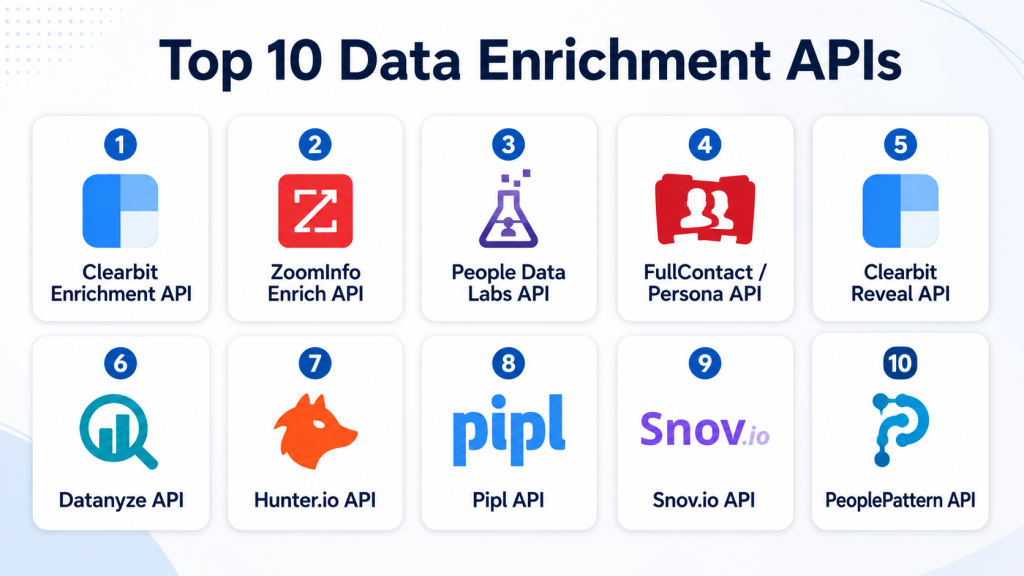
Top 10 Data Enrichment APIs
#1 — Clearbit Enrichment API
Short description: Clearbit provides a real‑time data enrichment API that takes minimal input (like email address or domain) and returns detailed business and contact attributes. It’s widely used for CRM enrichment, lead qualification, personalization, and segmentation workflows. The API is designed to be easy to integrate and developer‑friendly.
Key Features
- Real‑time enrichment with API endpoints
- Business and contact firmographics
- Location and website insights
- Technographic data
- Role and seniority inference
- Cached responses for performance
Pros
- Simple API design with accessible SDKs
- Fast lookup suitable for pipeline enrichment
Cons
- Data coverage may be more limited than larger enterprise databases
- Historical or intent data can be sparse
Platforms / Deployment
- Cloud (API)
Security & Compliance
- API key authentication and TLS encryption
- Not publicly stated for specific certifications
Integrations & Ecosystem
Clearbit has native connectors and SDKs that accelerate integration and is often used with CRM systems, marketing automation, and routing logic.
- CRM systems
- Web forms and chat flows
- Marketing automation platforms
- Custom applications
Support & Community
Clearbit offers documentation, sample code, and developer support; community engagement varies with plan.
#2 — ZoomInfo Enrich API
Short description: ZoomInfo’s enrichment API delivers business profiles, contact details, and intelligence signals back to applications. It draws from ZoomInfo’s extensive B2B database, offering deep context for sales, marketing, and analytics systems seeking high‑quality enrichment at scale.
Key Features
- B2B contact and company enrichment
- Role and technographic data
- Intent signals (when included)
- Industry and firmographic attributes
- Confidence and match scores
- Sync with systems like CRM and analytics
Pros
- Broad enterprise‑grade dataset
- Deep B2B context for revenue operations
Cons
- Cost and complexity may challenge smaller teams
- API calls often need governance and quotas
Platforms / Deployment
- Cloud (API)
Security & Compliance
- Encryption and access control
- Not publicly stated for specific certifications
Integrations & Ecosystem
ZoomInfo Enrich APIs integrate with CRM systems, data warehouses, and analytics pipelines to automate enrichment and improve data quality.
- Salesforce
- HubSpot
- Marketing automation systems
- Data warehouses
Support & Community
Enterprise support and documentation are available; larger account management resources are common.
#3 — People Data Labs API
Short description: People Data Labs provides a comprehensive API with contact, company, demographic, and identity resolution data. The API supports custom attribute queries and flexible enrichment models, making it suitable for enterprise and developer workflows that need detailed identity insights.
Key Features
- Contact, company, and demographic enrichment
- Identity graph capabilities
- Custom attribute query support
- Real‑time lookup and batch mode
- Data normalization and deduplication
- Bulk enrichment options
Pros
- Rich attribute set with flexible API
- Good for identity resolution workflows
Cons
- Requires clear governance and API key management
- Some advanced features require deeper implementation effort
Platforms / Deployment
- API (Cloud)
Security & Compliance
- Standard API security and encryption
- Not publicly stated for certifications
Integrations & Ecosystem
People Data Labs APIs are designed for developer usage and are commonly implemented inside CRMs, analytics flows, and custom applications.
- Backend enrichment pipelines
- CRM sync processes
- BI tools
- Custom dashboards
Support & Community
Developer documentation and API guides support implementation; community engagement varies.
#4 — FullContact / Persona API
Short description: FullContact, now integrated with Persona, provides identity resolution and enrichment APIs that unify scattered identifiers and enhance records with persona attributes. It’s especially useful for identity resolution use cases in personalization, customer 360 platforms, and profile unification tasks.
Key Features
- Identity resolution across email, phone, social
- Contact and entity enrichment
- Profile consolidation
- Normalization layers
- Consent‑aware design
Pros
- Strong identity unification features
- Useful for personalization and profile stitching
Cons
- Not as deep on firmographics as some B2B providers
- Requires identity schema design in consuming systems
Platforms / Deployment
- API (Cloud)
Security & Compliance
- Privacy‑aware design with consent handling
- Not publicly stated for specific certifications
Integrations & Ecosystem
FullContact APIs are used in systems that require customer identity resolution, personalization platforms, and CRM augmentation workflows.
Support & Community
Documentation and support are available; implementation guides assist developers.
#5 — Clearbit Reveal API
Short description: Complementing the traditional Clearbit Enrichment API, the Reveal API turns anonymous traffic (e.g., website visitors) into company insights by mapping IP or cookie signals to firmographic data. This is useful for lead capture pipelines that start with anonymous interest and want to trigger personalized experiences or routing.
Key Features
- Anonymous visitor to company enrichment
- Firmographic attributes based on IP signals
- Trigger signals for personalization
- Batch and real‑time endpoints
Pros
- Converts anonymous signals into actionable account data
- Useful for personalization and ABM workflows
Cons
- Firmographic inference may vary in accuracy
- Not suited for individual contact data enrichment
Platforms / Deployment
- API (Cloud)
Security & Compliance
- Standard API security protocols
- Not publicly stated for certifications
Integrations & Ecosystem
Often used with web personalization platforms, CRM, and ABM orchestration tools.
Support & Community
Documentation and usage examples available.
#6 — Datanyze API
Short description: Datanyze API focuses on technographic enrichment — revealing technology stacks and platform usage for companies. It enables developers to incorporate technology profile data into platforms for segmentation, targeting, and product‑market insights.
Key Features
- Technology stack and usage signals
- Company profiles and firmographics
- Segmentation by technology adoption
- API access for real‑time enrichment
Pros
- Valuable for technographic segmentation
- Supports product marketing and competitive insights
Cons
- Technographic focus may be narrower than full‑stack enrichment needs
- Best used as a complement to other APIs
Platforms / Deployment
- API (Cloud)
Security & Compliance
- Standard API protections
- Not publicly stated
Integrations & Ecosystem
Used in CRM, analytics, and product‑market fit tools where technology usage insights matter.
Support & Community
Developer documentation and support guides available.
#7 — Hunter.io API
Short description: Hunter.io provides a simple API for email address discovery and verification, often used in enrichment pipelines that require verified email addresses before further enrichment or outreach. It is widely used in sales and marketing tech stacks.
Key Features
- Email discovery by domain
- Email verification and deliverability scoring
- Bulk lookup endpoints
- Real‑time API
Pros
- Strong focus on email accuracy and validation
- Simple and fast API
Cons
- Limited beyond email attributes
- Requires additional enrichment layers for deeper context
Platforms / Deployment
- API (Cloud)
Security & Compliance
- Encryption and API key access controls
- Not publicly stated for certifications
Integrations & Ecosystem
Often integrated into CRM, workflow automation, and outreach tools to verify and enrich contact data.
Support & Community
Documentation and support tiers are available; straightforward examples help developers onboard.
#8 — Pipl API
Short description: Pipl API provides identity and contact enrichment with global identity data, aiding in verification, fraud detection, and profiling use cases. It helps connect email, phone, and social signals to entity profiles for deeper understanding in compliance‑aware systems.
Key Features
- Identity resolution and contact enrichment
- Global coverage with demographic signals
- Verification and confidence scoring
Pros
- Good for identity verification and fraud workflows
- Broad global data coverage
Cons
- Pricing may reflect high‑value use cases
- Not focused specifically on B2B firmographics
Platforms / Deployment
- API (Cloud)
Security & Compliance
- Privacy controls and encryption
- Not publicly stated
Integrations & Ecosystem
Deployed in fraud systems, identity orchestration platforms, and CRM workflows.
Support & Community
Documentation and specialized support available.
#9 — Snov.io API
Short description: Snov.io offers API endpoints for email discovery, domain enrichment, and lead qualification signals. It is often used as part of sales automation and enrichment pipelines to verify contact data and enrich lead profiles before outreach.
Key Features
- Email finder and domain search
- Email verification
- Bulk enrichment
- Lead qualification signals
Pros
- Versatile for sales outreach enrichment
- Bulk processing supported
Cons
- Limited deep firmographic/intent data
- Best when paired with additional sources
Platforms / Deployment
- API (Cloud)
Security & Compliance
- API key security and encryption
- Not publicly stated
Integrations & Ecosystem
Used in CRM and automation workflows to boost contact data and reduce invalid leads.
Support & Community
Documentation and support resources available.
#10 — PeoplePattern API
Short description: PeoplePattern provides profile enrichment with attributes like demographics, interests, and lifestyle signals. While often focused on B2C contexts, it can be useful for certain segmentation and personalization use cases where deeper persona attributes matter.
Key Features
- Demographic and persona enrichment
- Contextual interest signals
- API access for custom workflows
Pros
- Useful for personalization and audience insights
- Provides layered profile attributes
Cons
- Less B2B‑focused than other providers
- Attribute relevance varies by context
Platforms / Deployment
- API (Cloud)
Security & Compliance
- Standard protections and access controls
- Not publicly stated
Integrations & Ecosystem
PeoplePattern can be woven into marketing stacks, analytics platforms, and personalization engines.
Support & Community
Documentation and developer support are provided.
Comparison Table (Top 10)
| Tool Name | Best For | Platform(s) Supported | Deployment | Standout Feature | Public Rating |
|---|---|---|---|---|---|
| Clearbit Enrichment API | Real‑time enrichment | API | Cloud | Easy realtime lookup | N/A |
| ZoomInfo Enrich API | B2B enterprise enrichment | API | Cloud | Broad, deep B2B dataset | N/A |
| People Data Labs API | Identity & demographic | API | Cloud | Identity resolution and coverage | N/A |
| FullContact / Persona API | Identity resolution | API | Cloud | Unified persona profiles | N/A |
| Clearbit Reveal API | Anonymous visitor to profile | API | Cloud | Anonymous enrichment | N/A |
| Datanyze API | Technographics | API | Cloud | Technology stack insights | N/A |
| Hunter.io API | Email discovery & validation | API | Cloud | Email verification | N/A |
| Pipl API | Identity verification | API | Cloud | Broad global identity signals | N/A |
| Snov.io API | Sales enrichment | API | Cloud | Bulk email and domain search | N/A |
| PeoplePattern API | Persona enrichment | API | Cloud | Demographics & interests | N/A |
Evaluation & Scoring
| Tool Name | Core Features (25%) | Ease (15%) | Integrations (15%) | Security (10%) | Performance (10%) | Support (10%) | Value (15%) | Weighted Total |
|---|---|---|---|---|---|---|---|---|
| Clearbit | 8 | 8 | 8 | 7 | 8 | 7 | 8 | 7.9 |
| ZoomInfo | 9 | 7 | 9 | 8 | 9 | 8 | 7 | 8.3 |
| People Data Labs | 8 | 7 | 8 | 7 | 8 | 7 | 7 | 7.6 |
| FullContact | 7 | 8 | 7 | 8 | 7 | 7 | 7 | 7.3 |
| Clearbit Reveal | 7 | 8 | 8 | 7 | 8 | 7 | 7 | 7.5 |
| Datanyze | 7 | 8 | 7 | 7 | 7 | 7 | 7 | 7.2 |
| Hunter.io | 7 | 9 | 7 | 7 | 7 | 8 | 8 | 7.6 |
| Pipl | 8 | 7 | 7 | 7 | 8 | 7 | 7 | 7.5 |
| Snov.io | 7 | 8 | 7 | 7 | 7 | 7 | 7 | 7.3 |
| PeoplePattern | 7 | 8 | 7 | 7 | 7 | 7 | 7 | 7.3 |
Scores reflect relative strengths in core data enrichment capabilities, ease of use, depth of integrations, security posture, performance, support resources, and value propositions. Higher totals suggest a well‑rounded API suitable for integration into modern data‑driven systems.
Which Data Enrichment API Is Right for You?
Solo / Freelancer
If you are building lightweight workflows or simple enrichment tasks, Clearbit and Hunter.io API provide easy‑to‑implement, real‑time lookup and verification.
SMB
Clearbit, ZoomInfo Enrich API, or Snov.io API strike a balance between depth and ease. They integrate well with CRMs, form capture systems, and automation workflows.
Mid‑Market
People Data Labs API, ZoomInfo Enrich API, or FullContact / Persona API provide broad coverage, identity resolution, and stronger context attributes for segmentation and scoring.
Enterprise
Enterprise teams should prioritize ZoomInfo Enrich API for deep B2B context, People Data Labs for identity resolution, and Clearbit Reveal API for persona insights at scale. Ensure API performance and compliance features meet internal governance standards.
Budget vs Premium
Budget projects and small teams benefit from Hunter.io and Snov.io for basic enrichment and email verification. Premium enrichment with deep firmographics and intent signals is best supported by ZoomInfo, People Data Labs, and Clearbit.
Feature Depth vs Ease of Use
For depth, ZoomInfo and People Data Labs provide extensive attribute sets. For quick adoption and lightweight implementation, Clearbit and Hunter.io stand out.
Integrations & Scalability
If your ecosystem spans CRM, marketing automation, and analytics, choose APIs with strong SDK and connector ecosystems. ZoomInfo, Clearbit, and People Data Labs fit well with scalable multi‑system pipelines.
Security & Compliance Needs
For regulated environments, verify encryption, audit controls, consent handling, and compliance features during procurement. When certification details are unclear, treat them as “Not publicly stated” and request vendor documentation.
Frequently Asked Questions (FAQs)
1– What pricing models do data enrichment APIs use?
Most enrichment APIs use tiered subscription plans with charges based on API calls, attribute depth, and enterprise support features. Volume discounts often apply for high‑use cases.
2– How fast are enrichment API responses?
Many APIs deliver near real‑time HTTP responses suitable for synchronous workflows such as form submission or CRM sync. Latency can vary by endpoint and payload size.
3– What is the difference between batch and real‑time enrichment?
Real‑time enrichment APIs return data immediately upon request, while batch processes handle large volumes asynchronously and are suitable for bulk backfills.
4– Are enrichment APIs compliant with privacy laws?
Many vendors support privacy and consent features, but buyers should explicitly verify GDPR, CCPA, and other regional requirements during evaluation.
5– How do I integrate an enrichment API into my tech stack?
APIs typically provide REST endpoints, SDKs, and webhook integration options, allowing integration with backend systems, form handlers, CRMs, and analytics pipelines.
6– Can enrichment APIs improve lead scoring?
Yes — enriched fields like firmographics, technographics, intent signals, and behavioral attributes can feed models that assign more accurate lead scores.
7– Do enrichment APIs help with personalization?
Enriched attributes enable personalization by supplying deeper context on users — such as industry, role, interests, or past behavior — which can drive targeted experiences.
8– How do I avoid accuracy or duplicate issues?
Many APIs include normalization and deduplication features, but combining enrichment with data governance and match logic in your CRM improves overall quality.
9– What attributes can enrichment APIs return?
Common attributes include company size, industry, role, email validity, technographic signals, location, social profiles, and intent signals.
10– Do enrichment APIs handle global data?
Many platforms provide global coverage, but data availability may vary by region. Verify global scope during evaluation.
Conclusion
Data enrichment APIs empower modern data‑driven teams to transform raw records into meaningful insights that accelerate pipeline growth, improve personalization, and support analytics. The choice of API depends on attribute needs, integration depth, performance expectations, and budget. ZoomInfo Enrich API, Clearbit, and People Data Labs API stand out for broad coverage, deep attribute sets, and integration friendliness. Tools like Hunter.io and Snov.io are ideal for quick email discovery and verification, while identity specialists like FullContact support unified profile goals. For specialized technographic needs, Datanyze brings unique insights. To choose the right API, shortlist 2–3 that align with your workflows, test performance and data quality in real scenarios, verify compliance requirements, and scale adoption based on measured operational impact.
