Introduction
Newsletter platforms are software solutions that help organizations, marketers, and creators build, distribute, and track email newsletters. These platforms enable users to capture subscriber lists, design professional-looking emails, schedule automated campaigns, and measure engagement through metrics like open rates, click-throughs, and subscriber growth. In plain English, they make it easy to stay connected with your audience consistently and professionally.
In , newsletters remain a vital channel for engagement, brand awareness, and revenue generation. With increasing competition for attention, high-quality content and automation capabilities are critical to maintain relevance. Modern platforms also incorporate AI for personalization, analytics for audience insights, and integrations with CRM, e-commerce, and marketing tools to streamline operations.
Real-World Use Cases:
- Marketing campaigns: Regular newsletters to educate, convert, and retain customers.
- Content distribution: Bloggers, publishers, and creators sharing updates with subscribers.
- Event promotion: Automated invites and reminders for webinars, launches, or virtual events.
- Lead nurturing: Segmented emails to move prospects down the funnel.
- Customer engagement: Product updates, loyalty programs, and announcements.
What Buyers Should Evaluate:
- Ease of email design and template availability
- Automation and scheduling capabilities
- Personalization options (AI-powered or dynamic content)
- Subscriber management and segmentation
- Analytics, reporting, and A/B testing
- Integration with CRM, e-commerce, and social platforms
- Deliverability and spam compliance
- Data privacy and compliance (GDPR, CCPA)
- Pricing models (subscriber count, email volume)
- Support and community resources
Best for: Marketing teams, publishers, SaaS companies, e-commerce businesses, and creators looking to engage audiences via email.
Not ideal for: Organizations without a digital audience or where alternative channels (social, in-app notifications) suffice for communication.
Key Trends in Newsletter Platforms
- AI-driven personalization: Platforms dynamically tailor content for individual subscribers using AI.
- Advanced segmentation: Tools support behavioral, demographic, and engagement-based audience groups.
- Automated workflows: Triggered campaigns based on actions, anniversaries, or user events.
- Cross-channel integration: Email sequences integrated with social media, push notifications, and in-app messaging.
- Analytics and predictive insights: AI-driven recommendations for optimal send times, subject lines, and content.
- Deliverability improvements: Enhanced spam filtering and authentication (SPF, DKIM, DMARC) to improve inbox placement.
- Interactive and rich media content: Incorporating GIFs, videos, polls, and surveys to increase engagement.
- Compliance and privacy by design: GDPR, CCPA, and opt-in/opt-out management built into the platform.
- Multi-brand and multi-language support: For global companies and publishers managing diverse audiences.
- Subscription management automation: Simplified sign-ups, preference centers, and easy unsubscribes.
How We Selected These Tools (Methodology)
- Evaluated market adoption among SMB, mid-market, and enterprise users.
- Assessed feature completeness, including templates, automation, segmentation, and analytics.
- Reviewed email deliverability and compliance practices.
- Examined integration capabilities with CRM, CMS, e-commerce, and social platforms.
- Tested ease of use and onboarding process.
- Analyzed scalability for large subscriber bases and high-volume sends.
- Reviewed support and community strength: documentation, tutorials, and user forums.
- Prioritized 2026 relevance: AI-powered personalization, automation, and analytics.
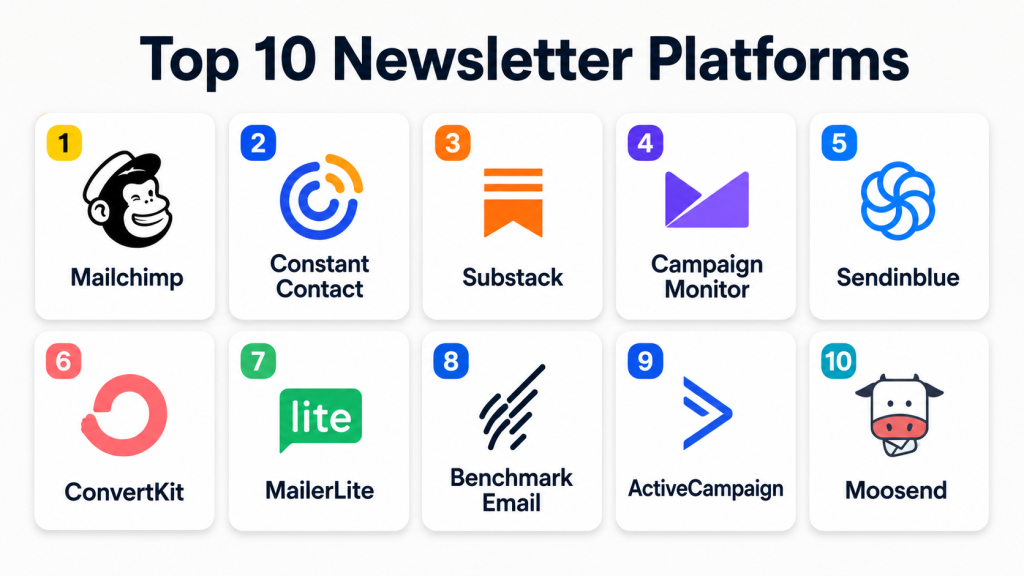
Top 10 Newsletter Platforms
#1 — Mailchimp
Short description: Mailchimp is a leading newsletter and email marketing platform suitable for SMBs and mid-market companies. It offers drag-and-drop design, automation, analytics, and multi-channel campaigns.
Key Features
- Drag-and-drop email builder
- Automated sequences and triggered campaigns
- Audience segmentation
- A/B testing
- Analytics dashboards and reports
- CRM and e-commerce integrations
Pros
- User-friendly interface and templates
- Extensive automation and analytics capabilities
Cons
- Can become expensive as subscriber count grows
- Some advanced features require higher-tier plans
Platforms / Deployment
- Web / iOS / Android
- Cloud
Security & Compliance
- Encryption, role-based access
- Not publicly stated for certifications
Integrations & Ecosystem
Integrates with CRM, e-commerce, social media, and analytics tools.
- Shopify
- Salesforce
- WordPress
- Instagram/Facebook
Support & Community
Documentation, knowledge base, and email support; active community forums.
#2 — Constant Contact
Short description: Constant Contact offers email newsletter tools with robust automation, templates, and reporting, targeting SMBs and event-focused businesses.
Key Features
- Customizable templates and drag-and-drop builder
- Automated welcome and follow-up emails
- List segmentation and tagging
- Engagement analytics
- Event and RSVP management
Pros
- Easy to set up for SMBs
- Strong email templates and design tools
Cons
- Limited advanced automation compared to competitors
- Analytics less comprehensive than enterprise tools
Platforms / Deployment
- Web / iOS / Android
- Cloud
Security & Compliance
- Standard encryption
- Not publicly stated for certifications
Integrations & Ecosystem
- CRM and e-commerce tools
- Social media integrations
- Event platforms
Support & Community
Phone, chat, and knowledge base support.
#3 — Substack
Short description: Substack is a newsletter platform focused on creators and publishers, offering simple content distribution, subscription management, and monetization options.
Key Features
- Content publishing and distribution
- Paid subscription management
- Subscriber analytics
- Simple editor for email newsletters
- Audience growth insights
Pros
- Monetization options for paid newsletters
- Simple and lightweight for creators
Cons
- Limited automation features
- Fewer integrations for enterprise workflows
Platforms / Deployment
- Web / Mobile (iOS/Android)
- Cloud
Security & Compliance
- Standard platform security
- Not publicly stated for certifications
Integrations & Ecosystem
- Payment platforms for subscriptions
- Limited CRM or marketing integrations
Support & Community
Documentation, community resources, and email support.
#4 — Campaign Monitor
Short description: Campaign Monitor is a robust newsletter platform known for professional templates, automation, and analytics suitable for marketing teams.
Key Features
- Drag-and-drop email builder
- Automated workflows
- Dynamic content personalization
- A/B testing
- Analytics and reporting dashboards
Pros
- Professional design templates
- Strong reporting and automation
Cons
- Can be pricey for large subscriber lists
- Some features require technical setup
Platforms / Deployment
- Web / iOS / Android
- Cloud
Security & Compliance
- Encryption and access control
- Not publicly stated for certifications
Integrations & Ecosystem
- CRM, e-commerce, CMS, analytics tools
Support & Community
Documentation, tutorials, and email support.
#5 — Sendinblue
Short description: Sendinblue combines email marketing, SMS, and transactional email capabilities with automation workflows, targeting SMBs and mid-market businesses.
Key Features
- Email and SMS campaigns
- Marketing automation sequences
- Transactional email support
- Contact segmentation
- Analytics and engagement reports
Pros
- Multi-channel campaigns
- Scalable automation workflows
Cons
- Email design templates less flexible than some competitors
- Learning curve for advanced automation
Platforms / Deployment
- Web / iOS / Android
- Cloud
Security & Compliance
- Standard encryption, GDPR support
- Not publicly stated for certifications
Integrations & Ecosystem
- CRM and e-commerce systems
- CMS and analytics platforms
Support & Community
Documentation, chat support, and tutorials.
#6 — ConvertKit
Short description: ConvertKit is creator-focused, offering email automation and newsletter tools for small businesses, bloggers, and influencers, emphasizing audience segmentation and monetization.
Key Features
- Automated sequences and funnels
- Subscriber tagging and segmentation
- Landing page and form builder
- Analytics dashboards
- Monetization and subscription management
Pros
- Excellent for creators and small businesses
- Simple automation interface
Cons
- Less suitable for enterprise-scale workflows
- Limited templates compared to competitors
Platforms / Deployment
- Web / iOS / Android
- Cloud
Security & Compliance
- Standard encryption and role management
- Not publicly stated for certifications
Integrations & Ecosystem
- Payment systems for subscriptions
- Landing pages and form integrations
Support & Community
Email support, webinars, and community forums.
#7 — MailerLite
Short description: MailerLite provides a simple newsletter platform with automation, landing pages, and analytics, targeted at small and mid-market businesses seeking affordability and ease of use.
Key Features
- Drag-and-drop editor
- Automation and workflows
- Subscriber segmentation
- Landing pages and popups
- Analytics dashboards
Pros
- Cost-effective for small businesses
- Simple and intuitive interface
Cons
- Advanced automation limited
- Less robust reporting than enterprise platforms
Platforms / Deployment
- Web / iOS / Android
- Cloud
Security & Compliance
- Encryption and access controls
- GDPR-ready
Integrations & Ecosystem
- E-commerce, CMS, CRM integrations
Support & Community
Knowledge base, email support, and community forums.
#8 — Benchmark Email
Short description: Benchmark Email provides easy-to-use email marketing and newsletter automation tools, suitable for SMBs and marketing teams with basic automation needs.
Key Features
- Drag-and-drop editor
- Automation and workflows
- Subscriber segmentation
- A/B testing
- Analytics reports
Pros
- Easy to use and quick to set up
- Affordable for small businesses
Cons
- Advanced features limited
- Less robust integration ecosystem
Platforms / Deployment
- Web / iOS / Android
- Cloud
Security & Compliance
- Encryption and role-based access
- Not publicly stated
Integrations & Ecosystem
- CRM and e-commerce systems
- Landing page integrations
Support & Community
Documentation and support via email and chat.
#9 — ActiveCampaign
Short description: ActiveCampaign combines newsletter capabilities with marketing automation, CRM, and sales workflows, suitable for SMBs and mid-market teams seeking integrated automation.
Key Features
- Email newsletters and automation
- CRM and sales automation
- Segmentation and personalization
- Analytics dashboards
- Multi-channel messaging (email, SMS)
Pros
- Combines marketing and CRM workflows
- Strong automation features
Cons
- Learning curve for advanced automation
- Pricing scales with contacts and features
Platforms / Deployment
- Web / iOS / Android
- Cloud
Security & Compliance
- Standard encryption, access control
- Not publicly stated for certifications
Integrations & Ecosystem
- CRM, e-commerce, and analytics platforms
Support & Community
Documentation, webinars, and support tiers.
#10 — Moosend
Short description: Moosend is an email marketing platform providing newsletter creation, automation, and reporting, designed for SMBs seeking affordability and simplicity.
Key Features
- Drag-and-drop editor
- Automated campaigns and triggers
- Segmentation and personalization
- Analytics and reporting
- Template library
Pros
- Affordable for small teams
- Easy-to-use interface
Cons
- Limited advanced automation
- Less integration flexibility
Platforms / Deployment
- Web / iOS / Android
- Cloud
Security & Compliance
- Encryption and role management
- GDPR compliance
Integrations & Ecosystem
- CRM and e-commerce integration support
Support & Community
Documentation and email support.
Comparison Table (Top 10)
| Tool Name | Best For | Platform(s) Supported | Deployment | Standout Feature | Public Rating |
|---|---|---|---|---|---|
| Mailchimp | SMB, marketers | Web, iOS, Android | Cloud | Drag-and-drop builder & automation | N/A |
| Constant Contact | Event-based SMBs | Web, iOS, Android | Cloud | Event management & email templates | N/A |
| Substack | Creators & publishers | Web, Mobile | Cloud | Paid subscriptions & content distribution | N/A |
| Campaign Monitor | Marketing teams | Web, iOS, Android | Cloud | Professional templates & analytics | N/A |
| Sendinblue | SMB & mid-market | Web, iOS, Android | Cloud | Multi-channel campaigns | N/A |
| ConvertKit | Creators & bloggers | Web, iOS, Android | Cloud | Audience segmentation & automation | N/A |
| MailerLite | Small businesses | Web, iOS, Android | Cloud | Affordable & simple automation | N/A |
| Benchmark Email | SMBs | Web, iOS, Android | Cloud | Easy setup & templates | N/A |
| ActiveCampaign | SMB & mid-market | Web, iOS, Android | Cloud | CRM + automation integration | N/A |
| Moosend | SMB | Web, iOS, Android | Cloud | Cost-effective automation | N/A |
Evaluation & Scoring of Newsletter Platforms
| Tool Name | Core Features | Ease | Integrations | Security | Performance | Support | Value | Weighted Total |
|---|---|---|---|---|---|---|---|---|
| Mailchimp | 9 | 8 | 9 | 8 | 9 | 8 | 8 | 8.4 |
| Constant Contact | 8 | 9 | 8 | 7 | 8 | 8 | 8 | 8.0 |
| Substack | 7 | 9 | 6 | 7 | 8 | 7 | 7 | 7.3 |
| Campaign Monitor | 8 | 8 | 8 | 7 | 8 | 8 | 8 | 7.9 |
| Sendinblue | 8 | 8 | 8 | 8 | 8 | 8 | 8 | 8.0 |
| ConvertKit | 8 | 9 | 7 | 7 | 8 | 8 | 8 | 7.9 |
| MailerLite | 7 | 9 | 7 | 7 | 8 | 7 | 8 | 7.7 |
| Benchmark Email | 7 | 9 | 7 | 7 | 7 | 7 | 7 | 7.5 |
| ActiveCampaign | 9 | 8 | 8 | 8 | 8 | 8 | 8 | 8.2 |
| Moosend | 7 | 9 | 7 | 7 | 8 | 7 | 8 | 7.7 |
Which Newsletter Platform Is Right for You?
Solo / Freelancer
- Substack, MailerLite, or Moosend provide simple, affordable platforms for creators or individual newsletters.
SMB
- Mailchimp, Sendinblue, or ConvertKit offer automation, personalization, and reporting without overwhelming small teams.
Mid-Market
- ActiveCampaign, Campaign Monitor, and HubSpot Email Tools provide segmentation, multi-channel automation, and analytics for growing organizations.
Enterprise
- Mailchimp (enterprise tiers), ActiveCampaign, and Sendinblue enterprise editions provide scalability, advanced reporting, and integration ecosystems for large-scale newsletters.
Budget vs Premium
- Budget: Moosend, MailerLite, Benchmark Email
- Premium: Mailchimp, ActiveCampaign, Campaign Monitor
Feature Depth vs Ease of Use
- Depth: ActiveCampaign, Campaign Monitor
- Ease: MailerLite, Moosend, Substack
Integrations & Scalability
- Enterprises should choose platforms with deep integrations into CRM, e-commerce, and analytics stacks.
Security & Compliance Needs
- Platforms supporting encryption, GDPR, CCPA, and subscription management are essential for compliance and data privacy.
Frequently Asked Questions (FAQs)
1– What pricing models do newsletter platforms use?
Most platforms charge based on subscriber count, number of emails sent, and features included. Enterprise plans may include advanced automation or analytics.
2– Can I automate my newsletters?
Yes — most platforms support multi-step automation for welcome sequences, drip campaigns, and triggered emails.
3– Are newsletters compliant with GDPR?
Leading platforms provide tools for opt-in, consent management, and data privacy compliance.
4– Can I track engagement metrics?
Yes — open rates, click-through rates, bounce rates, unsubscribes, and conversions are commonly tracked.
5– Do platforms support A/B testing?
Most top platforms provide A/B testing for subject lines, content, and send times.
6– Can I personalize newsletters for each subscriber?
Yes — dynamic content, personalization tokens, and AI-based recommendations are common features.
7– Are these platforms mobile-friendly?
Yes — most platforms provide responsive templates and mobile apps for management.
8– Can I integrate with my CRM or e-commerce tools?
Yes — integrations allow syncing of contacts, events, and analytics across systems.
9– Do these platforms support paid subscriptions?
Substack and ConvertKit support paid newsletters, while others offer subscription integrations through e-commerce or third-party platforms.
10– Is technical expertise required?
Many platforms are low-code or drag-and-drop, though advanced automation or API integrations may require technical knowledge.
Conclusion
Newsletter platforms empower businesses, marketers, and creators to build, automate, and optimize email communication with their audiences. Small teams may prioritize ease-of-use and affordability, favoring platforms like Moosend, MailerLite, or Substack. Mid-market and enterprise organizations benefit from robust automation, personalization, and analytics offered by Mailchimp, ActiveCampaign, or Campaign Monitor. To choose the right platform, shortlist 2–3 tools aligned with your subscriber base, workflow complexity, and integration needs, run pilot campaigns to evaluate performance, verify deliverability and compliance, and scale once results demonstrate improved engagement and conversion
