Introduction
AI-Based Code Review Tools use artificial intelligence to analyze source code, identify bugs, detect security vulnerabilities, suggest improvements, and help development teams maintain better code quality. These tools enhance traditional code review processes by providing automated feedback during development workflows, reducing manual review effort, and improving software reliability. AI-powered reviews can analyze coding patterns, detect potential issues, recommend optimizations, and support developers before code reaches production environments. Real-world use cases include automated pull request reviews, security vulnerability detection, coding standard enforcement, bug prevention, technical debt management, and improving developer productivity. Buyers should evaluate code analysis accuracy, programming language support, IDE and repository integrations, security capabilities, customization options, and enterprise scalability.
Best for
Software development teams, DevOps organizations, enterprises, and engineering groups looking to improve code quality and accelerate review workflows.
Not ideal for
Teams requiring completely human-free code approval processes or organizations with highly restricted environments where external AI services cannot be used.
Key Trends
- Increased adoption of AI-powered pull request reviews
- Automated vulnerability detection and remediation suggestions
- Integration with Git platforms and CI/CD pipelines
- AI-assisted code quality improvement
- Support for multiple programming languages
- Real-time developer feedback inside IDEs
- Enterprise focus on secure code analysis
- Automated documentation and testing suggestions
- Integration with DevSecOps workflows
- AI-based technical debt management
Methodology
- Selected tools based on code review capabilities, developer adoption, and security features
- Evaluated AI analysis quality, integrations, automation, scalability, and usability
- Considered solutions for individual developers, startups, and enterprises
- Prioritized tools supporting Git workflows and CI/CD environments
- Reviewed customization, compliance, and enterprise deployment options
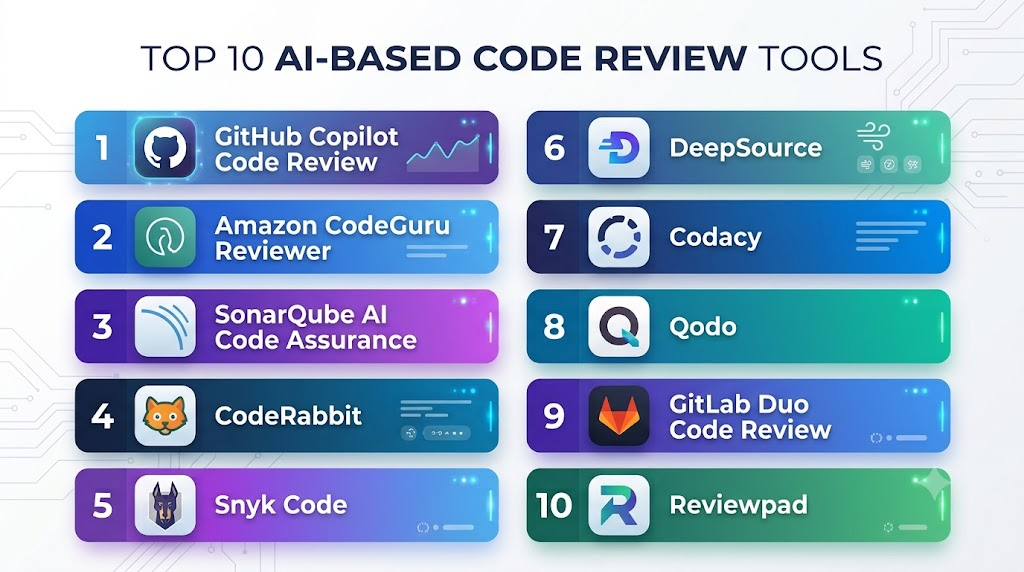
Top 10 AI-Based Code Review Tools
1- GitHub Copilot Code Review
Verdict: AI-powered code review integrated into modern development workflows.
Short Description: GitHub Copilot Code Review helps developers analyze pull requests, identify issues, and receive AI-generated suggestions directly within GitHub workflows.
Key Features:
- AI-powered pull request analysis
- Code improvement suggestions
- Bug identification
- Security-focused recommendations
- GitHub workflow integration
Pros:
- Excellent GitHub integration
- Easy developer adoption
Cons:
- Requires human validation
- Best experience within GitHub ecosystem
Deployment: Cloud-based
Security & Compliance: Enterprise security controls
Integrations & Ecosystem: GitHub, IDEs, development workflows
Support & Community: Large developer community
Pricing Model: Subscription-based
Best-Fit Scenarios: Development teams using GitHub
2- Amazon CodeGuru Reviewer
Verdict: AI-powered automated code review for AWS environments.
Short Description: Amazon CodeGuru Reviewer analyzes applications to identify bugs, performance issues, and coding best practices using machine learning.
Key Features:
- Automated code analysis
- Security issue detection
- Performance recommendations
- Repository integration
- AWS workflow support
Pros:
- Strong AWS integration
- Performance analysis capabilities
Cons:
- Best suited for AWS users
- Limited ecosystem outside AWS
Deployment: Cloud-based
Security & Compliance: AWS security standards
Integrations & Ecosystem: AWS services, Git repositories
Support & Community: AWS support ecosystem
Pricing Model: Usage-based
Best-Fit Scenarios: AWS application teams
3- SonarQube AI Code Assurance
Verdict: Enterprise code quality platform enhanced with AI capabilities.
Short Description: SonarQube provides automated code analysis, quality checks, security detection, and AI-assisted development insights.
Key Features:
- Code quality analysis
- Security vulnerability detection
- Code smell identification
- Quality gates
- CI/CD integration
Pros:
- Strong enterprise adoption
- Comprehensive code analysis
Cons:
- Requires configuration
- Advanced features may require paid plans
Deployment: Cloud and on-premises
Security & Compliance: Enterprise security controls
Integrations & Ecosystem: CI/CD tools, Git platforms
Support & Community: Large developer community
Pricing Model: Subscription-based
Best-Fit Scenarios: Enterprise DevSecOps teams
4- CodeRabbit
Verdict: AI-powered pull request reviewer for development teams.
Short Description: CodeRabbit provides automated code reviews by analyzing pull requests and generating contextual feedback for developers.
Key Features:
- Pull request reviews
- Code explanations
- Bug detection
- Review summaries
- Git integration
Pros:
- Easy setup
- Developer-friendly feedback
Cons:
- AI suggestions require validation
- Limited enterprise customization
Deployment: Cloud-based
Security & Compliance: Security controls vary by plan
Integrations & Ecosystem: GitHub, GitLab
Support & Community: Developer support
Pricing Model: Subscription-based
Best-Fit Scenarios: Startups and engineering teams
5- Snyk Code
Verdict: AI-assisted secure code review focused on vulnerabilities.
Short Description: Snyk Code uses AI-powered analysis to identify security vulnerabilities and provide remediation guidance during development.
Key Features:
- Security vulnerability scanning
- Developer feedback
- Real-time analysis
- Code fixes suggestions
- CI/CD integration
Pros:
- Strong security focus
- Developer-friendly workflow
Cons:
- Primarily security-focused
- Enterprise features require higher plans
Deployment: Cloud-based
Security & Compliance: Security-focused platform
Integrations & Ecosystem: Git platforms, CI/CD tools
Support & Community: Security community
Pricing Model: Subscription-based
Best-Fit Scenarios: Secure software development teams
6- DeepSource
Verdict: Automated AI-assisted code quality improvement platform.
Short Description: DeepSource analyzes code repositories to identify bugs, anti-patterns, and maintainability issues.
Key Features:
- Static analysis
- Bug detection
- Code quality checks
- Automated fixes
- Repository integration
Pros:
- Developer-friendly automation
- Supports multiple languages
Cons:
- Smaller ecosystem
- Requires configuration tuning
Deployment: Cloud-based
Security & Compliance: Enterprise controls
Integrations & Ecosystem: Git platforms, CI/CD tools
Support & Community: Developer community
Pricing Model: Subscription-based
Best-Fit Scenarios: Engineering teams improving code quality
7- Codacy
Verdict: Automated code quality and security review platform.
Short Description: Codacy provides automated code analysis, quality monitoring, and security insights across development pipelines.
Key Features:
- Static code analysis
- Security scanning
- Quality tracking
- Coding standards enforcement
- Team dashboards
Pros:
- Strong reporting features
- Multi-language support
Cons:
- Setup complexity
- Advanced features require paid plans
Deployment: Cloud and enterprise
Security & Compliance: Enterprise security options
Integrations & Ecosystem: GitHub, GitLab, CI/CD platforms
Support & Community: Documentation and support
Pricing Model: Subscription-based
Best-Fit Scenarios: Teams managing code quality standards
8- Qodo
Verdict: AI-powered code quality and testing assistant.
Short Description: Qodo helps developers review code, generate tests, and improve software reliability through AI-based analysis.
Key Features:
- AI code review
- Test generation
- Code understanding
- Review automation
- Developer workflow integration
Pros:
- Strong testing capabilities
- AI-native workflow
Cons:
- Emerging ecosystem
- Enterprise adoption still growing
Deployment: Cloud-based
Security & Compliance: Enterprise security options
Integrations & Ecosystem: IDEs and Git workflows
Support & Community: Developer community
Pricing Model: Subscription-based
Best-Fit Scenarios: Teams focused on testing and quality
9- GitLab Duo Code Review
Verdict: AI-powered review assistance inside GitLab workflows.
Short Description: GitLab Duo provides AI capabilities for reviewing code, improving merge requests, and assisting developers throughout the software lifecycle.
Key Features:
- Merge request assistance
- Code explanations
- Review suggestions
- Development workflow integration
- Security support
Pros:
- Native GitLab integration
- Full DevOps lifecycle support
Cons:
- Best for GitLab users
- Feature availability depends on plan
Deployment: Cloud and enterprise
Security & Compliance: Enterprise security controls
Integrations & Ecosystem: GitLab DevOps platform
Support & Community: GitLab community
Pricing Model: Subscription-based
Best-Fit Scenarios: GitLab-based organizations
10- Reviewpad
Verdict: Automated AI-assisted pull request workflow management.
Short Description: Reviewpad helps teams automate code review processes using AI-based rules, workflows, and development insights.
Key Features:
- Automated pull request reviews
- Review workflows
- Code quality rules
- Team collaboration
- Git integration
Pros:
- Flexible automation
- Developer workflow focus
Cons:
- Smaller ecosystem
- Requires workflow configuration
Deployment: Cloud-based
Security & Compliance: Depends on implementation
Integrations & Ecosystem: GitHub workflows
Support & Community: Developer support
Pricing Model: Subscription-based
Best-Fit Scenarios: Teams automating review processes
Comparison Table
| Platform | AI Review | Security Analysis | Git Integration | Automation | Best Use |
|---|---|---|---|---|---|
| GitHub Copilot Code Review | High | Medium | Excellent | High | GitHub teams |
| Amazon CodeGuru Reviewer | High | High | High | High | AWS applications |
| SonarQube | High | Very High | High | High | Enterprise DevSecOps |
| CodeRabbit | High | Medium | Excellent | High | PR reviews |
| Snyk Code | High | Very High | High | High | Secure coding |
| DeepSource | High | High | High | Medium | Code quality |
| Codacy | Medium | High | High | High | Quality management |
| Qodo | High | Medium | High | High | Testing workflows |
| GitLab Duo | High | Medium | Excellent | High | GitLab teams |
| Reviewpad | Medium | Medium | High | High | Review automation |
Evaluation & Scoring Table
| Platform | Code Analysis 25% | Security 15% | Integrations 15% | Automation 15% | Ease 10% | Scalability 10% | Value 10% | Total |
|---|---|---|---|---|---|---|---|---|
| GitHub Copilot Code Review | 25 | 13 | 15 | 15 | 10 | 10 | 9 | 97 |
| Amazon CodeGuru Reviewer | 23 | 15 | 14 | 14 | 9 | 10 | 9 | 94 |
| SonarQube | 25 | 15 | 14 | 14 | 8 | 10 | 9 | 95 |
| CodeRabbit | 23 | 12 | 15 | 14 | 10 | 9 | 9 | 92 |
| Snyk Code | 24 | 15 | 14 | 14 | 9 | 10 | 9 | 95 |
| DeepSource | 22 | 13 | 14 | 13 | 9 | 9 | 9 | 89 |
| Codacy | 22 | 14 | 14 | 14 | 8 | 10 | 9 | 91 |
| Qodo | 23 | 12 | 13 | 14 | 9 | 9 | 9 | 89 |
| GitLab Duo | 23 | 13 | 15 | 14 | 9 | 10 | 9 | 93 |
| Reviewpad | 21 | 11 | 13 | 14 | 9 | 8 | 9 | 85 |
Which AI-Based Code Review Tool Is Right for You?
- GitHub Teams: GitHub Copilot Code Review, CodeRabbit
- Enterprise DevSecOps: SonarQube, Snyk Code
- AWS Development Teams: Amazon CodeGuru Reviewer
- GitLab Organizations: GitLab Duo
- Security-Focused Teams: Snyk Code, SonarQube
- Testing-Focused Teams: Qodo
- Automated PR Workflows: Reviewpad, CodeRabbit
Common Mistakes
- Accepting AI suggestions without review
- Ignoring false positives
- Using tools without coding standards
- Not integrating reviews into CI/CD
- Overlooking security and privacy controls
Frequently Asked Questions
What are AI-based code review tools?
They are tools that use artificial intelligence to analyze code, detect issues, and provide automated review suggestions.
Can AI code review tools replace human reviewers?
No. They assist developers but still require human judgment for final decisions.
What issues can AI code review tools detect?
They can identify bugs, vulnerabilities, code quality problems, and maintainability issues.
Do AI code review tools support multiple programming languages?
Yes. Most support popular programming languages and development frameworks.
Are AI code review tools secure for enterprise use?
Many provide enterprise security features, privacy controls, and compliance options.
Can these tools integrate with Git platforms?
Yes. Most integrate with GitHub, GitLab, Bitbucket, and CI/CD workflows.
Can AI tools automatically fix code issues?
Some provide suggested fixes or automated changes, but developers should review them.
Do these tools help with security testing?
Yes. Many include vulnerability detection and secure coding recommendations.
Are AI code review tools useful for startups?
Yes. They help small teams improve quality without large review overhead.
Can AI reviews improve developer productivity?
Yes. They reduce repetitive review tasks and provide faster feedback.
Do AI code review tools work with CI/CD pipelines?
Most integrate with automated build and deployment workflows.
How should teams adopt AI code review tools?
Start with pilot projects, define review guidelines, and gradually expand usage.
Conclusion
AI-Based Code Review Tools are transforming software quality management by providing faster feedback, automated issue detection, and intelligent development recommendations. Platforms such as GitHub Copilot Code Review, SonarQube, Snyk Code, and Amazon CodeGuru Reviewer support different needs ranging from security analysis to enterprise code governance.
