Introduction
AI API Documentation Generators use artificial intelligence to automatically create, improve, and maintain technical documentation for APIs, software services, and developer platforms. These tools analyze API specifications, source code, endpoints, schemas, and developer workflows to generate clear documentation, examples, explanations, and reference materials. As organizations build more APIs and microservices, maintaining accurate documentation becomes increasingly challenging. AI-powered documentation tools help developers reduce manual writing effort, improve API discoverability, and keep documentation synchronized with changing codebases. Real-world use cases include generating API references, creating developer portals, documenting REST and GraphQL APIs, maintaining SDK documentation, improving onboarding experiences, and supporting enterprise API governance. Buyers should evaluate API specification support, automation capabilities, code integration, documentation quality, customization options, collaboration features, and scalability.
Best for
API development teams, software companies, developer platform teams, enterprises, and organizations managing large API ecosystems.
Not ideal for
Small projects with limited APIs or teams requiring fully manual documentation workflows without automation.
Key Trends
- Growth of AI-generated developer documentation
- Automated synchronization between code and documentation
- Increased adoption of API-first development
- AI-generated examples and explanations
- Integration with developer portals
- Support for REST, GraphQL, and event-driven APIs
- Automated documentation quality improvement
- Integration with CI/CD workflows
- Better developer onboarding experiences
- Enterprise API governance automation
Methodology
- Selected tools based on AI documentation capabilities and developer adoption
- Evaluated API support, automation, integrations, usability, and scalability
- Considered solutions for developers, API teams, and enterprises
- Prioritized tools supporting automated documentation workflows
- Reviewed customization, collaboration, and enterprise features
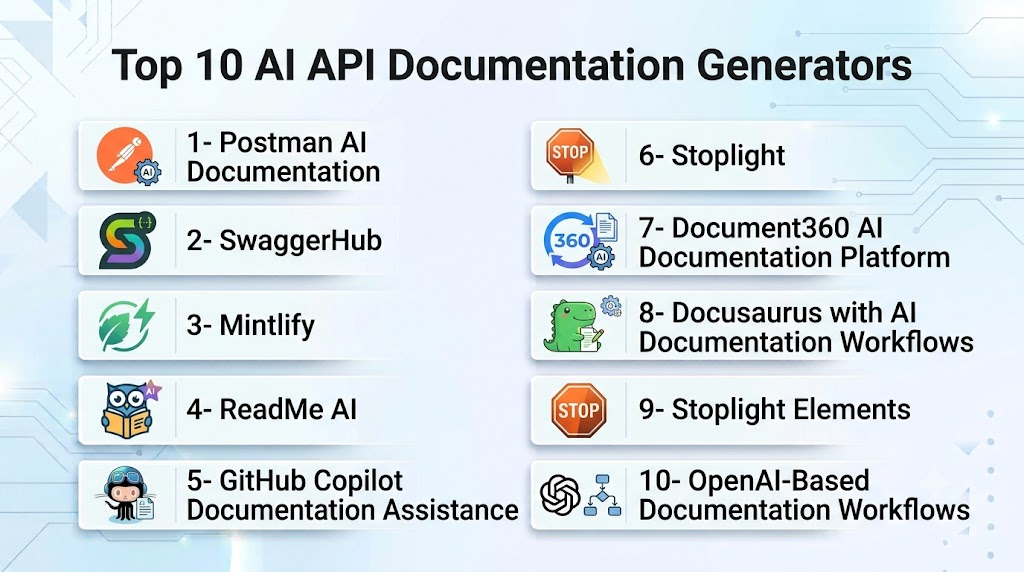
Top 10 AI API Documentation Generators
1- Postman AI Documentation
Verdict: Leading API documentation platform with AI-assisted capabilities.
Short Description: Postman helps teams create, organize, test, and document APIs while using AI features to improve API understanding and developer collaboration.
Key Features:
- Automated API documentation
- API collections
- Example generation
- API testing integration
- Developer collaboration
Pros:
- Strong API ecosystem
- Widely adopted by developers
Cons:
- Best for API-centric workflows
- Advanced features require paid plans
Deployment: Cloud and desktop
Security & Compliance: Enterprise security controls
Integrations & Ecosystem: API tools, CI/CD platforms, developer workflows
Support & Community: Large developer community
Pricing Model: Subscription-based
Best-Fit Scenarios: API development teams
2- SwaggerHub
Verdict: Enterprise API documentation and design platform.
Short Description: SwaggerHub helps organizations design, document, manage, and collaborate on APIs using OpenAPI standards.
Key Features:
- OpenAPI documentation
- API design workflows
- Documentation publishing
- API governance
- Collaboration tools
Pros:
- Strong API standard support
- Enterprise governance features
Cons:
- Requires API design knowledge
- Enterprise pricing
Deployment: Cloud and enterprise
Security & Compliance: Enterprise controls
Integrations & Ecosystem: OpenAPI tools, API gateways
Support & Community: Enterprise support
Pricing Model: Subscription-based
Best-Fit Scenarios: Enterprise API teams
3- Mintlify
Verdict: AI-powered developer documentation platform.
Short Description: Mintlify helps developers generate modern API documentation with AI-assisted explanations, formatting, and documentation management.
Key Features:
- AI documentation generation
- API reference creation
- Code examples
- Documentation hosting
- Developer-friendly design
Pros:
- Modern documentation experience
- Easy setup
Cons:
- Focused mainly on developer documentation
- Enterprise features vary
Deployment: Cloud-based
Security & Compliance: Security options available
Integrations & Ecosystem: Git repositories and developer workflows
Support & Community: Developer community
Pricing Model: Subscription-based
Best-Fit Scenarios: Developer platforms and startups
4- ReadMe AI
Verdict: AI-enhanced API documentation and developer portal solution.
Short Description: ReadMe helps companies create interactive API documentation, developer portals, and support experiences using automation and AI features.
Key Features:
- Interactive API docs
- Developer portals
- API references
- Documentation analytics
- Collaboration features
Pros:
- Strong developer experience
- Interactive documentation
Cons:
- Higher cost for advanced features
- Best for API companies
Deployment: Cloud-based
Security & Compliance: Enterprise security options
Integrations & Ecosystem: API platforms and developer tools
Support & Community: Customer support
Pricing Model: Subscription-based
Best-Fit Scenarios: API-first companies
5- GitHub Copilot Documentation Assistance
Verdict: AI coding assistant with documentation generation support.
Short Description: GitHub Copilot helps developers create API documentation by analyzing code, generating explanations, and producing documentation content.
Key Features:
- Code documentation generation
- API explanation
- Example creation
- Code understanding
- IDE integration
Pros:
- Strong developer workflow integration
- Supports multiple languages
Cons:
- Not a dedicated documentation platform
- Requires developer review
Deployment: IDE and cloud-based
Security & Compliance: Enterprise security controls
Integrations & Ecosystem: GitHub, IDEs, repositories
Support & Community: Large developer community
Pricing Model: Subscription-based
Best-Fit Scenarios: Developers documenting APIs during coding
6- Stoplight
Verdict: API design and documentation platform with automation capabilities.
Short Description: Stoplight helps teams design APIs, generate documentation, and manage API quality through collaborative workflows.
Key Features:
- API documentation
- OpenAPI support
- API governance
- Design collaboration
- Mock servers
Pros:
- Strong API lifecycle management
- Good collaboration features
Cons:
- Requires API maturity
- Enterprise-focused pricing
Deployment: Cloud-based
Security & Compliance: Enterprise controls
Integrations & Ecosystem: API tools and developer workflows
Support & Community: Enterprise support
Pricing Model: Subscription-based
Best-Fit Scenarios: API product teams
7- Document360 AI Documentation Platform
Verdict: AI-assisted knowledge base and technical documentation solution.
Short Description: Document360 helps organizations create, manage, and improve technical documentation using AI-powered writing assistance.
Key Features:
- AI writing assistance
- Knowledge base management
- Documentation organization
- Search capabilities
- Collaboration tools
Pros:
- Broad documentation support
- Easy content management
Cons:
- Not API-specific
- Requires API content structure
Deployment: Cloud-based
Security & Compliance: Enterprise security options
Integrations & Ecosystem: Knowledge management tools
Support & Community: Customer support
Pricing Model: Subscription-based
Best-Fit Scenarios: Organizations managing technical documentation
8- Docusaurus with AI Documentation Workflows
Verdict: Flexible open-source documentation framework enhanced with AI workflows.
Short Description: Docusaurus enables teams to build documentation websites while AI tools assist with content generation and maintenance.
Key Features:
- Documentation websites
- Markdown support
- Version management
- Developer workflows
- Custom AI integrations
Pros:
- Open-source flexibility
- Highly customizable
Cons:
- Requires technical setup
- AI features need additional tools
Deployment: Self-hosted and cloud
Security & Compliance: Depends on implementation
Integrations & Ecosystem: Git workflows and developer tools
Support & Community: Open-source community
Pricing Model: Free and customization-based
Best-Fit Scenarios: Developer teams needing flexibility
9- Stoplight Elements
Verdict: API documentation component toolkit.
Short Description: Stoplight Elements provides reusable components for creating interactive API documentation experiences.
Key Features:
- API reference components
- OpenAPI rendering
- Interactive documentation
- Custom documentation portals
- Developer experience tools
Pros:
- Flexible implementation
- Strong API support
Cons:
- Requires development effort
- Less automated than full platforms
Deployment: Developer environments
Security & Compliance: Depends on implementation
Integrations & Ecosystem: API development workflows
Support & Community: Developer community
Pricing Model: Tool dependent
Best-Fit Scenarios: Custom API documentation solutions
10- OpenAI-Based Documentation Workflows
Verdict: Flexible AI approach for automated API documentation creation.
Short Description: Large language model-based workflows help generate API references, examples, explanations, and developer documentation from code and specifications.
Key Features:
- Documentation generation
- API explanation
- Example creation
- Content automation
- Custom workflows
Pros:
- Highly flexible
- Supports custom requirements
Cons:
- Requires implementation effort
- Needs content validation
Deployment: API and custom environments
Security & Compliance: Depends on implementation
Integrations & Ecosystem: APIs, repositories, documentation systems
Support & Community: Developer ecosystem
Pricing Model: Usage-based
Best-Fit Scenarios: Custom documentation automation
Comparison Table
| Platform | AI Documentation | API Support | Automation | Developer Portal | Best Use |
|---|---|---|---|---|---|
| Postman | High | Very High | High | Medium | API teams |
| SwaggerHub | Medium | Very High | High | High | Enterprise APIs |
| Mintlify | Very High | High | High | High | Modern developer docs |
| ReadMe | High | Very High | High | Very High | API companies |
| GitHub Copilot | High | Medium | Medium | Medium | Developers |
| Stoplight | High | Very High | High | High | API lifecycle |
| Document360 | High | Medium | Medium | Medium | Technical documentation |
| Docusaurus | Medium | Medium | Medium | High | Custom docs |
| Stoplight Elements | Medium | High | Medium | High | Custom API portals |
| AI Workflows | Very High | High | High | Custom | Enterprise automation |
Evaluation & Scoring Table
| Platform | Documentation Quality 25% | API Support 15% | Automation 15% | Integrations 15% | AI Capability 10% | Ease 10% | Value 10% | Total |
|---|---|---|---|---|---|---|---|---|
| Postman | 24 | 15 | 14 | 15 | 9 | 10 | 9 | 96 |
| SwaggerHub | 23 | 15 | 14 | 14 | 8 | 9 | 9 | 92 |
| Mintlify | 25 | 14 | 15 | 13 | 10 | 10 | 9 | 96 |
| ReadMe | 24 | 15 | 14 | 14 | 9 | 9 | 8 | 93 |
| GitHub Copilot | 22 | 12 | 12 | 15 | 10 | 10 | 9 | 90 |
| Stoplight | 23 | 15 | 14 | 14 | 9 | 9 | 8 | 92 |
| Document360 | 22 | 11 | 12 | 12 | 9 | 10 | 9 | 85 |
| Docusaurus | 21 | 10 | 11 | 12 | 8 | 8 | 10 | 80 |
| Stoplight Elements | 21 | 13 | 11 | 13 | 8 | 9 | 9 | 84 |
| AI Workflows | 24 | 13 | 15 | 12 | 10 | 8 | 9 | 91 |
Which AI API Documentation Generator Is Right for You?
- API Development Teams: Postman, SwaggerHub
- Modern Developer Portals: Mintlify, ReadMe
- Enterprise API Governance: SwaggerHub, Stoplight
- Developers Needing Quick Documentation: GitHub Copilot
- Custom Documentation Platforms: Docusaurus, Stoplight Elements
- Automated AI Workflows: AI-based documentation solutions
Common Mistakes
- Publishing AI-generated documentation without review
- Ignoring API specification accuracy
- Not updating documentation with code changes
- Overlooking developer usability
- Failing to define documentation ownership
Frequently Asked Questions
What are AI API documentation generators?
They are tools that use artificial intelligence to create and maintain API documentation automatically.
How do AI documentation tools generate API docs?
They analyze API specifications, source code, endpoints, and examples to create documentation content.
Can AI tools document REST APIs?
Yes. Most support REST API documentation workflows.
Do these tools support OpenAPI specifications?
Many API documentation platforms support OpenAPI-based documentation.
Can AI generate API examples?
Yes. Many tools can create sample requests, responses, and usage examples.
Are AI-generated API documents accurate?
They improve efficiency but require developer validation.
Can documentation tools integrate with Git repositories?
Yes. Many connect with GitHub, GitLab, and development workflows.
Do AI documentation tools support GraphQL APIs?
Many modern platforms support GraphQL documentation capabilities.
Can enterprises use AI API documentation tools?
Yes. Enterprise solutions provide collaboration, governance, and security controls.
Do these tools improve developer onboarding?
Yes. Better documentation helps developers understand APIs faster.
Can AI update documentation automatically?
Many tools can synchronize documentation with API changes.
How should teams adopt AI documentation tools?
Start with important APIs, review generated content, and automate updates gradually.
Conclusion
AI API Documentation Generators are helping organizations create accurate, maintainable, and developer-friendly API documentation faster. Platforms such as Postman, SwaggerHub, Mintlify, and ReadMe provide different approaches for API teams, enterprises, and developer platforms.
