Introduction
AI DevOps ChatOps Assistants combine artificial intelligence, automation, and collaboration platforms to help DevOps teams manage infrastructure, deployments, incidents, monitoring, and operational workflows through conversational interfaces. These assistants allow engineers to interact with cloud environments, CI/CD pipelines, monitoring systems, and operational tools using natural language commands.
Traditional DevOps operations often require switching between multiple dashboards, command-line tools, and monitoring systems. AI-powered ChatOps assistants simplify these workflows by providing automated troubleshooting, incident analysis, deployment support, infrastructure guidance, and operational recommendations directly within team communication environments.
Real-world use cases:
- Incident detection and response assistance
- Deployment status monitoring
- Infrastructure troubleshooting
- Cloud resource management
- CI/CD pipeline support
- Log and alert analysis
- Automated operational workflows
- Developer support through conversational interfaces
Evaluation Criteria for Buyers:
- AI troubleshooting accuracy
- Integration with DevOps platforms
- Cloud and infrastructure support
- Automation capabilities
- Security and access controls
- Chat platform compatibility
- Incident management features
- Enterprise scalability
Best for
DevOps teams, SRE teams, cloud engineers, platform engineering groups, and enterprises managing complex infrastructure environments.
Not ideal for
Organizations requiring fully autonomous infrastructure management without human approval or teams with limited automation requirements.
Key Trends
- AI-powered incident response automation
- Natural language infrastructure management
- Integration with Slack and collaboration platforms
- Automated troubleshooting recommendations
- AI-assisted monitoring and alert analysis
- Cloud operations automation
- DevOps workflow optimization
- Faster incident resolution using AI insights
- Integration with observability platforms
- Enterprise adoption of AI operations assistants
Methodology
- Selected tools based on DevOps automation and ChatOps capabilities
- Evaluated integrations, AI assistance, incident management, security, and scalability
- Considered solutions for startups, enterprises, and cloud-native teams
- Prioritized tools supporting modern DevOps workflows
- Reviewed automation features, collaboration support, and operational efficiency
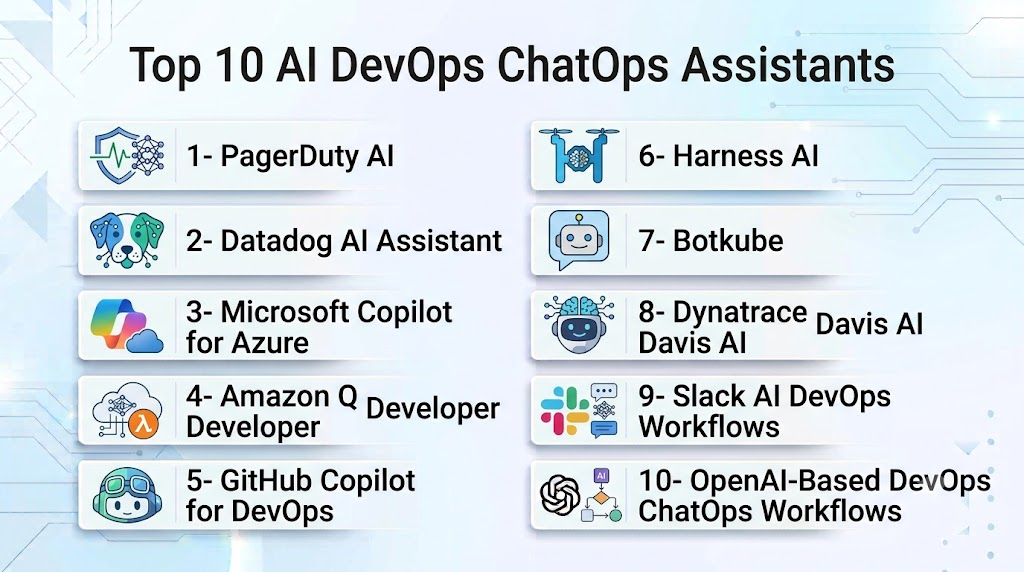
Top 10 AI DevOps ChatOps Assistants
1- PagerDuty AI
Verdict: Enterprise AI assistant for incident response and operations management.
Short Description: PagerDuty AI helps DevOps teams analyze incidents, summarize alerts, identify patterns, and improve response workflows through AI-powered operational assistance.
Key Features:
- Incident analysis
- Alert summarization
- Automated response workflows
- On-call assistance
- Operational insights
Pros:
- Strong incident management capabilities
- Enterprise-focused reliability
Cons:
- Higher enterprise cost
- Primarily focused on operations
Deployment: Cloud-based
Security & Compliance: Enterprise security controls
Integrations & Ecosystem: Monitoring tools, DevOps platforms, collaboration systems
Support & Community: Enterprise support
Pricing Model: Subscription-based
Best-Fit Scenarios: Enterprise incident management teams
2- Datadog AI Assistant
Verdict: AI-powered observability assistant for DevOps teams.
Short Description: Datadog AI Assistant helps engineers analyze logs, metrics, traces, and infrastructure data to troubleshoot application and system issues.
Key Features:
- Log analysis
- Monitoring assistance
- Incident investigation
- Performance insights
- Infrastructure analysis
Pros:
- Strong observability ecosystem
- Good enterprise scalability
Cons:
- Can become expensive
- Requires observability expertise
Deployment: Cloud-based
Security & Compliance: Enterprise security standards
Integrations & Ecosystem: Cloud platforms, monitoring tools, DevOps workflows
Support & Community: Enterprise support
Pricing Model: Usage-based
Best-Fit Scenarios: Large production environments
3- Microsoft Copilot for Azure
Verdict: AI assistant for managing Azure cloud operations.
Short Description: Microsoft Copilot for Azure helps engineers understand resources, troubleshoot issues, and optimize cloud operations using conversational AI.
Key Features:
- Cloud troubleshooting
- Resource analysis
- Deployment assistance
- Configuration guidance
- Azure optimization
Pros:
- Strong Azure integration
- Enterprise cloud support
Cons:
- Azure-focused
- Limited multi-cloud capability
Deployment: Cloud-based
Security & Compliance: Microsoft enterprise security
Integrations & Ecosystem: Azure services and DevOps tools
Support & Community: Microsoft ecosystem
Pricing Model: Subscription-based
Best-Fit Scenarios: Azure teams
4- Amazon Q Developer
Verdict: AI assistant for cloud development and DevOps workflows.
Short Description: Amazon Q Developer helps engineers troubleshoot applications, understand infrastructure, automate tasks, and improve AWS development workflows.
Key Features:
- Infrastructure assistance
- Cloud troubleshooting
- Code support
- AWS recommendations
- Developer productivity features
Pros:
- Strong AWS ecosystem
- Enterprise security capabilities
Cons:
- Best for AWS environments
- Limited outside AWS workflows
Deployment: Cloud-based
Security & Compliance: AWS enterprise security standards
Integrations & Ecosystem: AWS services, IDEs, cloud workflows
Support & Community: AWS ecosystem
Pricing Model: Subscription-based
Best-Fit Scenarios: AWS DevOps teams
5- GitHub Copilot for DevOps
Verdict: AI development assistant supporting operational workflows.
Short Description: GitHub Copilot helps DevOps teams create scripts, understand infrastructure code, troubleshoot issues, and automate repetitive tasks.
Key Features:
- Script generation
- Infrastructure code assistance
- Workflow automation
- Code explanation
- Developer support
Pros:
- Strong developer adoption
- Broad ecosystem support
Cons:
- Not a dedicated ChatOps platform
- Requires human validation
Deployment: Cloud and IDE-based
Security & Compliance: Enterprise security controls
Integrations & Ecosystem: GitHub, CI/CD tools, IDEs
Support & Community: Large developer community
Pricing Model: Subscription-based
Best-Fit Scenarios: DevOps automation support
6- Harness AI
Verdict: AI-powered DevOps automation assistant.
Short Description: Harness AI helps teams improve deployment workflows, automate delivery processes, and analyze software delivery operations.
Key Features:
- Deployment assistance
- CI/CD automation
- Release insights
- Pipeline analysis
- Developer workflows
Pros:
- Strong DevOps automation
- Enterprise delivery capabilities
Cons:
- Requires platform adoption
- Complex for small teams
Deployment: Cloud-based
Security & Compliance: Enterprise controls
Integrations & Ecosystem: CI/CD tools and cloud platforms
Support & Community: Enterprise support
Pricing Model: Subscription-based
Best-Fit Scenarios: Enterprise DevOps teams
7- Botkube
Verdict: ChatOps assistant designed for Kubernetes operations.
Short Description: Botkube enables teams to monitor, troubleshoot, and interact with Kubernetes environments through chat platforms.
Key Features:
- Kubernetes monitoring
- Chat-based commands
- Cluster notifications
- Troubleshooting assistance
- DevOps collaboration
Pros:
- Strong Kubernetes support
- Developer-friendly workflows
Cons:
- Kubernetes-focused
- Requires cluster knowledge
Deployment: Cloud and self-managed
Security & Compliance: Configurable security controls
Integrations & Ecosystem: Kubernetes, Slack, collaboration tools
Support & Community: Open-source community
Pricing Model: Subscription and open-source options
Best-Fit Scenarios: Kubernetes teams
8- Dynatrace Davis AI
Verdict: AI-driven operations assistant for enterprise observability.
Short Description: Dynatrace Davis AI analyzes application performance, infrastructure data, and operational events to provide automated insights.
Key Features:
- Root cause analysis
- Performance monitoring
- Incident insights
- Dependency analysis
- Automated recommendations
Pros:
- Advanced AI operations
- Enterprise scalability
Cons:
- Complex implementation
- Enterprise pricing
Deployment: Cloud and enterprise
Security & Compliance: Enterprise security controls
Integrations & Ecosystem: Cloud platforms, monitoring tools
Support & Community: Enterprise support
Pricing Model: Subscription-based
Best-Fit Scenarios: Large organizations
9- Slack AI DevOps Workflows
Verdict: Conversational collaboration layer for DevOps automation.
Short Description: Slack-based AI workflows help teams manage alerts, automate responses, summarize incidents, and coordinate operational tasks.
Key Features:
- AI conversations
- Workflow automation
- Incident communication
- Bot integrations
- Team collaboration
Pros:
- Easy team adoption
- Strong collaboration experience
Cons:
- Requires connected DevOps tools
- Limited standalone operations features
Deployment: Cloud-based
Security & Compliance: Enterprise collaboration security
Integrations & Ecosystem: DevOps tools and applications
Support & Community: Large user ecosystem
Pricing Model: Subscription-based
Best-Fit Scenarios: Collaborative DevOps teams
10- OpenAI-Based DevOps ChatOps Workflows
Verdict: Custom AI approach for automated DevOps assistance.
Short Description: AI-powered workflows can connect operational tools, monitoring systems, and infrastructure platforms to provide customized ChatOps automation.
Key Features:
- Natural language commands
- Incident analysis
- Automation workflows
- Tool integrations
- Custom assistants
Pros:
- Highly flexible
- Customizable for different environments
Cons:
- Requires engineering effort
- Needs security controls
Deployment: API and custom environments
Security & Compliance: Depends on implementation
Integrations & Ecosystem: APIs, DevOps platforms, cloud tools
Support & Community: Developer ecosystem
Pricing Model: Usage-based
Best-Fit Scenarios: Custom enterprise automation
Comparison Table
| Platform | Incident Response | Cloud Support | ChatOps | Automation | Best Use |
|---|---|---|---|---|---|
| PagerDuty AI | Very High | High | High | High | Incident management |
| Datadog AI | High | Very High | Medium | High | Observability |
| Microsoft Copilot Azure | High | Very High | Medium | High | Azure operations |
| Amazon Q Developer | High | Very High | Medium | High | AWS DevOps |
| GitHub Copilot | Medium | Medium | Low | High | Developer workflows |
| Harness AI | High | High | Medium | Very High | CI/CD automation |
| Botkube | High | High | Very High | High | Kubernetes ChatOps |
| Dynatrace Davis AI | Very High | High | Medium | High | Enterprise monitoring |
| Slack AI Workflows | Medium | Medium | Very High | Medium | Team collaboration |
| OpenAI Workflows | High | High | High | Very High | Custom automation |
Evaluation & Scoring Table
| Platform | AI Operations 25% | Integrations 15% | Automation 15% | ChatOps 15% | Security 10% | Ease 10% | Value 10% | Total |
|---|---|---|---|---|---|---|---|---|
| PagerDuty AI | 25 | 14 | 15 | 14 | 9 | 9 | 8 | 94 |
| Datadog AI | 24 | 15 | 14 | 12 | 9 | 9 | 8 | 91 |
| Microsoft Copilot Azure | 23 | 14 | 14 | 12 | 10 | 9 | 9 | 91 |
| Amazon Q Developer | 23 | 15 | 14 | 11 | 10 | 9 | 9 | 91 |
| GitHub Copilot | 21 | 14 | 13 | 10 | 9 | 10 | 9 | 86 |
| Harness AI | 23 | 14 | 15 | 11 | 9 | 8 | 8 | 88 |
| Botkube | 22 | 13 | 14 | 15 | 9 | 9 | 9 | 91 |
| Dynatrace Davis AI | 25 | 14 | 14 | 11 | 9 | 8 | 8 | 89 |
| Slack AI Workflows | 20 | 13 | 12 | 15 | 9 | 10 | 9 | 88 |
| OpenAI Workflows | 24 | 12 | 15 | 14 | 8 | 8 | 9 | 90 |
Which AI DevOps ChatOps Assistant Is Right for You?
- Incident Management Teams: PagerDuty AI, Dynatrace Davis AI
- AWS DevOps Teams: Amazon Q Developer
- Azure Operations: Microsoft Copilot for Azure
- Kubernetes Teams: Botkube
- CI/CD Automation: Harness AI
- Developer Productivity: GitHub Copilot
- Custom DevOps Automation: OpenAI-based workflows
Common Mistakes
- Giving AI unrestricted infrastructure access
- Automating critical changes without approval
- Ignoring security permissions
- Not validating AI recommendations
- Using AI without operational guidelines
Frequently Asked Questions
What are AI DevOps ChatOps assistants?
They are AI-powered tools that help DevOps teams manage operations, incidents, deployments, and infrastructure through conversational interfaces.
How do AI ChatOps assistants help DevOps teams?
They analyze issues, provide recommendations, automate workflows, and improve collaboration.
Can AI ChatOps assistants manage cloud infrastructure?
Some can assist with cloud operations, but critical changes usually require approval.
Do these tools integrate with Slack and collaboration platforms?
Many provide chat-based integrations for operational workflows.
Can AI assistants improve incident response?
Yes. They help summarize incidents, analyze alerts, and speed up troubleshooting.
Are AI DevOps assistants secure for enterprises?
Enterprise deployments require proper permissions, access controls, and security policies.
Can AI ChatOps tools automate deployments?
Some support deployment workflows and CI/CD automation.
Do these tools support Kubernetes environments?
Yes. Several tools provide Kubernetes monitoring and operational assistance.
Can startups use AI DevOps assistants?
Yes. They can help small teams automate operational tasks.
Do AI assistants replace DevOps engineers?
No. They support engineers by reducing repetitive operational work.
Can AI analyze logs and alerts?
Yes. Many observability-focused tools analyze operational data.
How should organizations adopt AI ChatOps tools?
Start with low-risk automation, validate results, and gradually expand usage.
Conclusion
AI DevOps ChatOps Assistants are transforming operational workflows by helping teams troubleshoot faster, automate repetitive tasks, and improve collaboration between developers and operations teams. Platforms such as PagerDuty AI, Datadog AI, Amazon Q Developer, and Botkube provide different approaches for incident response, cloud management, and DevOps automation.
