Introduction
AI Personalization Engines for CX use artificial intelligence, machine learning, customer data analysis, and predictive algorithms to deliver personalized customer experiences across digital channels. These platforms analyze customer behavior, preferences, interactions, purchase history, and engagement patterns to recommend relevant content, products, offers, and experiences.
Modern customers expect businesses to understand their needs and provide meaningful interactions. Traditional personalization methods often depend on predefined rules and limited customer segments. AI-powered personalization engines help organizations dynamically adapt experiences by predicting customer intent, identifying preferences, and delivering individualized journeys in real time.
These platforms are widely used in ecommerce, SaaS, banking, media, travel, retail, and customer experience teams to improve engagement, conversion rates, customer loyalty, and retention.
Real-world use cases:
- Personalized product recommendations
- Customer-specific content delivery
- Dynamic website experiences
- Personalized marketing campaigns
- AI-driven customer segmentation
- Next-best-action recommendations
- Personalized customer journeys
- Individualized offers and promotions
- Customer retention improvement
- Real-time experience optimization
Evaluation Criteria for Buyers:
- AI recommendation accuracy
- Customer behavior analysis
- Real-time personalization capability
- Data integration support
- Omnichannel experience management
- Customer segmentation features
- Analytics and reporting
- Security and privacy controls
Best for
Ecommerce businesses, SaaS companies, enterprises, marketing teams, customer experience teams, and organizations focused on improving customer engagement.
Not ideal for
Businesses with limited customer data or organizations that do not require personalized digital experiences.
Key Trends
- Generative AI-powered personalization
- Real-time customer experience optimization
- Predictive customer behavior analysis
- AI recommendation systems
- Hyper-personalized marketing
- Customer journey automation
- Omnichannel personalization
- AI-driven segmentation
- Personalized customer support experiences
- Privacy-focused personalization strategies
Methodology
- Selected platforms based on AI personalization capabilities
- Evaluated recommendation quality, automation, integrations, scalability, and analytics
- Considered solutions for ecommerce, enterprise, and digital businesses
- Prioritized platforms supporting multiple customer channels
- Reviewed security, customization, and usability features
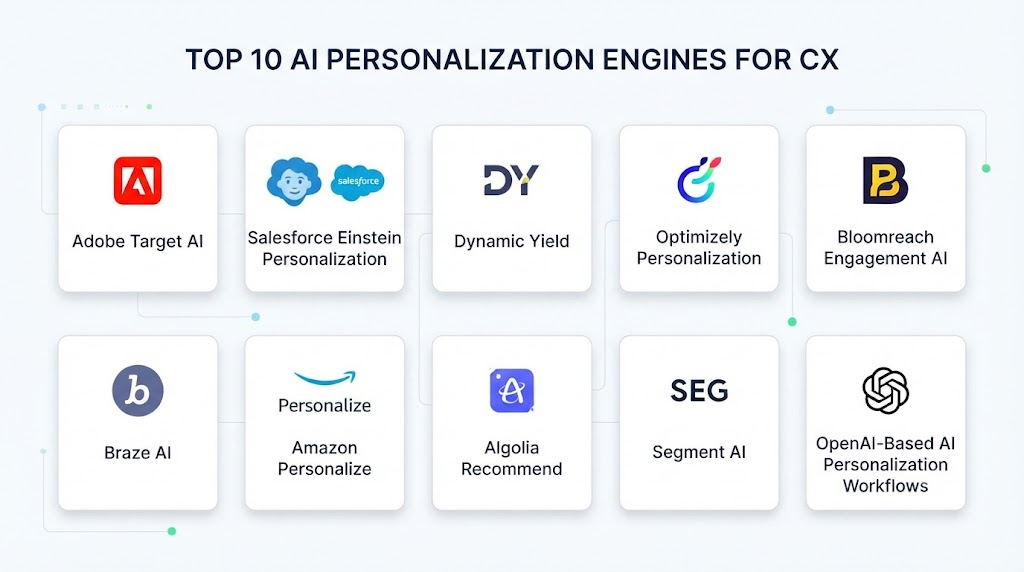
Top 10 AI Personalization Engines for CX
1. Adobe Target AI
Verdict: Enterprise AI personalization platform for optimizing digital customer experiences.
Short Description: Adobe Target AI helps organizations deliver personalized website experiences, recommendations, and customer journeys using AI-powered testing and optimization.
Key Features:
- AI personalization
- Recommendation engines
- Experience optimization
- Customer segmentation
- A/B testing
Pros:
- Strong enterprise capabilities
- Advanced optimization features
Cons:
- Requires Adobe ecosystem
- Complex implementation
Deployment: Cloud-based
Security & Compliance: Enterprise security controls
Integrations & Ecosystem: Adobe Experience Cloud and business platforms
Support & Community: Enterprise support
Pricing Model: Subscription-based
Best-Fit Scenarios: Enterprise digital experiences
2. Salesforce Einstein Personalization
Verdict: AI-powered personalization solution integrated with CRM data.
Short Description: Salesforce Einstein Personalization helps businesses create customized customer experiences using CRM data, customer behavior, and predictive insights.
Key Features:
- AI recommendations
- Customer segmentation
- Predictive insights
- Next-best-action suggestions
- CRM personalization
Pros:
- Strong CRM integration
- Enterprise scalability
Cons:
- Best within Salesforce ecosystem
- Requires configuration
Deployment: Cloud-based
Security & Compliance: Enterprise security controls
Integrations & Ecosystem: Salesforce platform and business applications
Support & Community: Enterprise support
Pricing Model: Subscription-based
Best-Fit Scenarios: CRM-driven enterprises
3. Dynamic Yield
Verdict: AI-powered personalization platform for digital customer experiences.
Short Description: Dynamic Yield helps businesses personalize websites, applications, and customer interactions using AI-driven recommendations and behavioral analysis.
Key Features:
- Product recommendations
- Experience personalization
- Customer segmentation
- Behavioral targeting
- Testing and optimization
Pros:
- Strong personalization capabilities
- Good ecommerce support
Cons:
- Requires data integration
- Enterprise-focused
Deployment: Cloud-based
Security & Compliance: Enterprise security options
Integrations & Ecosystem: Ecommerce and marketing platforms
Support & Community: Customer support
Pricing Model: Subscription-based
Best-Fit Scenarios: Retail and ecommerce businesses
4. Optimizely Personalization
Verdict: AI-driven experimentation and personalization platform.
Short Description: Optimizely helps organizations personalize digital experiences through AI recommendations, experimentation, and customer behavior analysis.
Key Features:
- AI personalization
- Experiment management
- Audience targeting
- Digital optimization
- Content recommendations
Pros:
- Strong experimentation tools
- Flexible personalization options
Cons:
- Requires optimization expertise
- Enterprise pricing
Deployment: Cloud-based
Security & Compliance: Enterprise controls
Integrations & Ecosystem: Marketing and digital platforms
Support & Community: Customer support
Pricing Model: Subscription-based
Best-Fit Scenarios: Digital experience teams
5. Bloomreach Engagement AI
Verdict: AI personalization platform for ecommerce and customer engagement.
Short Description: Bloomreach Engagement AI helps businesses personalize customer interactions using behavioral data, recommendations, and marketing automation.
Key Features:
- AI recommendations
- Customer segmentation
- Marketing personalization
- Customer journey automation
- Behavioral analytics
Pros:
- Strong ecommerce capabilities
- Good customer engagement workflows
Cons:
- Requires marketing data integration
- Learning curve for advanced features
Deployment: Cloud-based
Security & Compliance: Enterprise security controls
Integrations & Ecosystem: Ecommerce and marketing platforms
Support & Community: Customer support
Pricing Model: Subscription-based
Best-Fit Scenarios: Ecommerce businesses
6. Braze AI
Verdict: AI-powered customer engagement and personalization platform.
Short Description: Braze AI helps businesses deliver personalized messages, campaigns, and customer experiences across multiple communication channels.
Key Features:
- Customer segmentation
- Personalized campaigns
- AI recommendations
- Engagement analytics
- Cross-channel messaging
Pros:
- Strong customer engagement workflows
- Omnichannel support
Cons:
- Mainly focused on engagement
- Requires campaign strategy
Deployment: Cloud-based
Security & Compliance: Enterprise security options
Integrations & Ecosystem: Marketing and customer platforms
Support & Community: Enterprise support
Pricing Model: Subscription-based
Best-Fit Scenarios: Customer engagement teams
7. Amazon Personalize
Verdict: Machine learning-based personalization service for developers and enterprises.
Short Description: Amazon Personalize enables businesses to build recommendation systems using machine learning models and customer behavior data.
Key Features:
- Recommendation models
- Real-time personalization
- User behavior analysis
- Machine learning automation
- Developer APIs
Pros:
- Flexible AI capabilities
- Strong cloud integration
Cons:
- Requires technical expertise
- Implementation responsibility
Deployment: Cloud-based
Security & Compliance: Cloud security controls
Integrations & Ecosystem: AWS services and applications
Support & Community: Developer ecosystem
Pricing Model: Usage-based
Best-Fit Scenarios: Technical teams and enterprises
8. Algolia Recommend
Verdict: AI-powered search and recommendation personalization platform.
Short Description: Algolia Recommend helps businesses deliver personalized recommendations by analyzing user behavior and content interactions.
Key Features:
- AI recommendations
- Search personalization
- User behavior analysis
- Content recommendations
- API-based integration
Pros:
- Developer-friendly
- Fast implementation
Cons:
- Requires technical integration
- More focused on search experiences
Deployment: Cloud-based
Security & Compliance: Enterprise security options
Integrations & Ecosystem: Digital platforms and applications
Support & Community: Developer community
Pricing Model: Subscription-based
Best-Fit Scenarios: Digital products and ecommerce
9. Segment AI
Verdict: Customer data platform with AI-driven personalization capabilities.
Short Description: Segment AI helps organizations collect, unify, and analyze customer data to create personalized customer experiences.
Key Features:
- Customer data management
- Audience segmentation
- Data activation
- Personalization workflows
- Analytics integration
Pros:
- Strong customer data foundation
- Good integration ecosystem
Cons:
- Requires data strategy
- Personalization depends on connected tools
Deployment: Cloud-based
Security & Compliance: Enterprise security controls
Integrations & Ecosystem: Marketing, analytics, and CRM platforms
Support & Community: Customer support
Pricing Model: Subscription-based
Best-Fit Scenarios: Data-driven organizations
10. OpenAI-Based AI Personalization Workflows
Verdict: Custom AI approach for creating personalized customer experiences.
Short Description: AI-powered workflows can analyze customer behavior, preferences, conversations, and business data to generate personalized recommendations and experiences.
Key Features:
- Customer preference analysis
- Personalized recommendations
- AI content generation
- Customer insights
- Custom workflows
Pros:
- Highly customizable
- Supports different industries
Cons:
- Requires implementation effort
- Needs governance controls
Deployment: API and custom environments
Security & Compliance: Depends on implementation
Integrations & Ecosystem: CRM, ecommerce, analytics platforms
Support & Community: Developer ecosystem
Pricing Model: Usage-based
Best-Fit Scenarios: Custom enterprise solutions
Comparison Table
| Platform | AI Personalization | Recommendations | Customer Data | Integrations | Best Use |
|---|---|---|---|---|---|
| Adobe Target AI | Very High | Very High | High | Excellent | Enterprise CX |
| Salesforce Einstein Personalization | Very High | High | Very High | Excellent | CRM personalization |
| Dynamic Yield | Very High | Very High | High | High | Ecommerce |
| Optimizely Personalization | High | High | High | High | Digital experiences |
| Bloomreach Engagement AI | High | Very High | High | High | Ecommerce engagement |
| Braze AI | High | High | High | High | Customer engagement |
| Amazon Personalize | Very High | Very High | High | High | AI recommendations |
| Algolia Recommend | High | High | Medium | High | Search personalization |
| Segment AI | High | Medium | Very High | Excellent | Customer data |
| OpenAI Workflows | Very High | Custom | Custom | Custom | Custom solutions |
Evaluation & Scoring Table
| Platform | AI Accuracy 25% | Personalization 15% | Automation 15% | Integrations 15% | Security 10% | Ease 10% | Value 10% | Total |
|---|---|---|---|---|---|---|---|---|
| Adobe Target AI | 25 | 15 | 14 | 15 | 10 | 8 | 8 | 95 |
| Salesforce Einstein Personalization | 24 | 15 | 14 | 15 | 10 | 8 | 8 | 94 |
| Dynamic Yield | 25 | 15 | 14 | 13 | 9 | 9 | 9 | 94 |
| Optimizely Personalization | 23 | 14 | 13 | 14 | 9 | 9 | 9 | 91 |
| Bloomreach Engagement AI | 24 | 15 | 14 | 13 | 9 | 9 | 9 | 93 |
| Braze AI | 23 | 14 | 14 | 14 | 9 | 10 | 9 | 93 |
| Amazon Personalize | 25 | 15 | 13 | 14 | 10 | 8 | 9 | 94 |
| Algolia Recommend | 22 | 13 | 12 | 14 | 9 | 10 | 9 | 89 |
| Segment AI | 23 | 13 | 13 | 15 | 10 | 9 | 9 | 92 |
| OpenAI Workflows | 25 | 15 | 15 | 12 | 8 | 8 | 9 | 92 |
Which AI Personalization Engine for CX Is Right for You?
- Enterprise Digital Experiences: Adobe Target AI, Salesforce Einstein Personalization
- Ecommerce Personalization: Dynamic Yield, Bloomreach AI, Amazon Personalize
- Customer Engagement Campaigns: Braze AI
- Digital Product Experiences: Optimizely, Algolia Recommend
- Customer Data-Driven Personalization: Segment AI
- Custom AI Personalization Systems: OpenAI-based workflows
Common Mistakes
- Personalizing without enough customer data
- Ignoring privacy requirements
- Creating irrelevant recommendations
- Not testing personalization strategies
- Failing to monitor customer response
Frequently Asked Questions
What are AI personalization engines for CX?
They are AI-powered platforms that create customized customer experiences using behavior and preference data.
How do AI personalization tools work?
They analyze customer data and predict what content, products, or experiences are most relevant.
Can AI personalize customer journeys?
Yes. AI can adapt experiences across websites, apps, and communication channels.
Do personalization engines improve customer engagement?
Yes. Relevant experiences often improve interaction and satisfaction.
Which industries use AI personalization?
Ecommerce, SaaS, banking, media, travel, and retail commonly use these tools.
Can AI personalization work in real time?
Many platforms provide real-time recommendations and experience adjustments.
Do these tools integrate with CRM systems?
Most support CRM, marketing, analytics, and customer data integrations.
Are AI personalization engines secure?
Organizations should evaluate privacy controls and data protection practices.
Can small businesses use AI personalization tools?
Yes, depending on available customer data and business requirements.
Do AI personalization tools replace marketing teams?
No. They help teams create more effective customer experiences.
Can AI improve customer retention?
Yes. Personalized experiences can increase engagement and loyalty.
How should companies implement AI personalization?
Start with customer data collection, test personalization strategies, and expand gradually.
Conclusion
AI Personalization Engines for CX are helping businesses deliver more relevant, engaging, and customer-focused experiences. Platforms such as Adobe Target AI, Salesforce Einstein Personalization, Dynamic Yield, and Amazon Personalize enable organizations to understand customer preferences and optimize interactions across multiple channels.
