Introduction
AI Fraud/Abuse Detection for Support Tools are intelligent security solutions that help organizations identify, prevent, and respond to fraudulent activities, suspicious behavior, and misuse within customer support channels. These tools use artificial intelligence, machine learning, behavioral analysis, anomaly detection, natural language processing, and automation to detect unusual patterns across customer conversations, account activity, transactions, and support interactions.
As digital businesses handle more customer requests through chat, email, voice, and AI-powered support channels, fraud and abuse risks have become more complex. Attackers may attempt account takeovers, social engineering, refund abuse, fake claims, identity manipulation, spam requests, or misuse of support systems. Traditional rule-based approaches often struggle to detect evolving attack patterns, making AI-driven detection increasingly valuable.
Modern AI fraud and abuse detection platforms help support teams analyze large volumes of interactions, prioritize risky cases, automate investigations, and improve customer protection without creating unnecessary friction for legitimate users.
Real-world use cases:
- E-commerce companies detect refund abuse, fake complaints, suspicious account behavior, and fraudulent customer requests.
- Financial services organizations identify social engineering attempts, account takeover risks, and suspicious support interactions.
- SaaS companies monitor unusual customer behavior, credential misuse, and unauthorized access attempts.
- Online marketplaces detect fake accounts, payment-related abuse, and manipulation of customer support processes.
- Telecom providers identify identity fraud, suspicious requests, and unusual account activity.
- Customer support teams use AI analysis to prioritize high-risk conversations and improve investigation workflows.
Evaluation Criteria for Buyers:
Organizations evaluating AI Fraud/Abuse Detection for Support Tools should consider:
- Accuracy of fraud and abuse detection models.
- Ability to detect new and evolving attack patterns.
- Real-time risk scoring capabilities.
- Behavioral analytics and anomaly detection.
- Natural language understanding for support conversations.
- Integration with customer support platforms.
- API availability and developer flexibility.
- Explainability of AI decisions.
- Human review and investigation workflows.
- Privacy controls and data protection capabilities.
- Alert management and case prioritization.
- Cost scalability for high-volume support environments.
Best for:
AI Fraud/Abuse Detection for Support Tools are best for financial services, e-commerce companies, SaaS providers, online marketplaces, telecom organizations, digital platforms, and enterprises managing large customer support operations.
Not ideal for:
Small businesses with limited customer interactions and low fraud exposure may not need advanced AI detection platforms. Organizations with simple workflows may find traditional security rules or manual review processes sufficient.
What’s Changed in AI Fraud/Abuse Detection for Support Tools
AI fraud detection is evolving from static rule-based security systems into adaptive intelligence platforms that analyze behavior, conversations, and operational patterns.
Key developments include:
- AI-powered behavioral analysis: Modern platforms analyze user behavior patterns to identify suspicious activity beyond traditional rule matching.
- Conversational fraud detection: AI systems can analyze customer conversations to identify social engineering attempts, manipulation tactics, and suspicious requests.
- Real-time risk scoring: Organizations increasingly use AI-generated risk scores to prioritize support cases and security investigations.
- Adaptive fraud models: AI systems are becoming better at identifying new abuse patterns instead of depending only on predefined rules.
- AI agent security monitoring: As companies introduce AI customer support agents, fraud detection tools help monitor misuse, prompt manipulation, and suspicious interactions.
- Multimodal analysis: Some solutions combine text, voice, device signals, account activity, and transaction patterns for better risk detection.
- Explainable AI requirements: Businesses increasingly need clear reasons behind fraud alerts to support investigation and compliance processes.
- Privacy-focused fraud detection: Organizations are prioritizing secure data handling, limited retention, and controlled access to customer information.
- Human-in-the-loop investigation: AI detection is increasingly combined with human review for high-risk decisions.
- Automation of fraud response: Companies are using AI workflows to automatically route cases, block suspicious activity, and notify security teams.
- Integration with customer support systems: Fraud detection is becoming connected with CRM platforms, ticketing systems, identity systems, and security tools.
- Cost and performance optimization: Businesses are focusing on reducing false positives while maintaining strong fraud detection coverage.
Quick Buyer Checklist (Scan-Friendly)
Before selecting an AI Fraud/Abuse Detection for Support Tool, check:
✅ Does the platform detect both known and emerging fraud patterns?
✅ Can it analyze customer conversations and support interactions?
✅ Does it provide real-time risk scoring?
✅ Can teams understand why an alert was generated?
✅ Does it support APIs and enterprise integrations?
✅ Can it connect with CRM, help desk, and security systems?
✅ Does it support human investigation workflows?
✅ Can administrators manage access and permissions?
✅ Does it provide monitoring and reporting capabilities?
✅ Can it handle high-volume customer interactions?
✅ Does it protect sensitive customer data?
✅ Does it reduce false positives without increasing fraud risk?
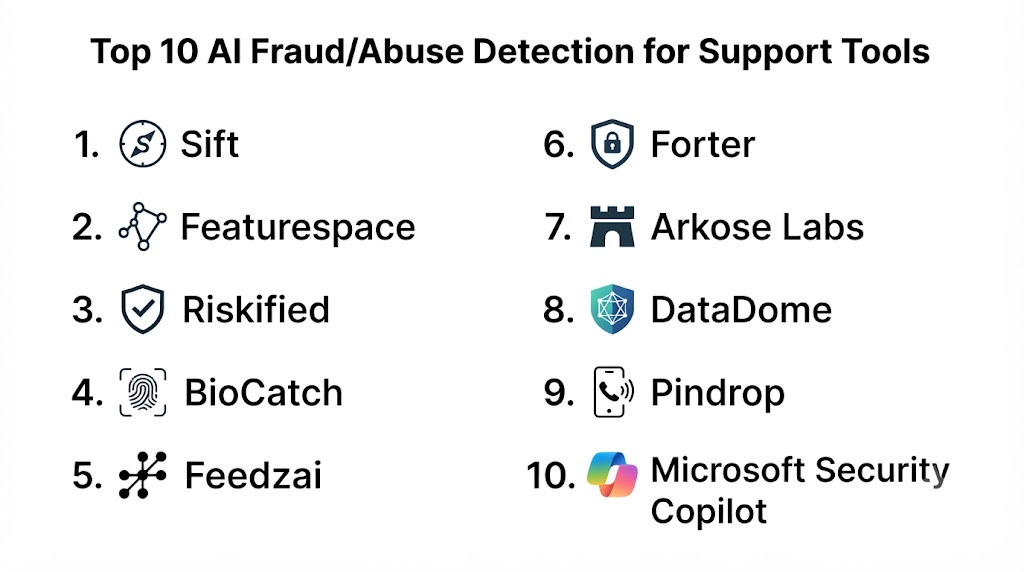
Top 10 AI Fraud/Abuse Detection for Support Tools
1 — Sift
One-line verdict: Best for digital businesses needing AI-powered fraud prevention across customer interactions and transactions.
Short description:
Sift provides AI-powered fraud detection solutions designed to help digital businesses identify suspicious behavior, account risks, and fraudulent activity. It is commonly used by online businesses, marketplaces, and platforms managing customer transactions.
Standout Capabilities
- AI-based fraud detection and risk scoring.
- Behavioral analysis for suspicious activity.
- Account abuse detection.
- Digital trust and safety workflows.
- Automated fraud investigation support.
- Real-time decision capabilities.
- Customer risk analysis.
AI-Specific Depth
- Model support: Proprietary AI fraud detection models.
- RAG / knowledge integration: N/A as a primary capability.
- Evaluation: Model performance evaluation depends on implementation and business workflows.
- Guardrails: Fraud policies and risk controls vary by configuration.
- Observability: Monitoring and fraud analytics capabilities vary.
Pros
- Strong focus on digital fraud prevention.
- Useful for high-volume customer platforms.
- Supports automated risk decision workflows.
Cons
- Primarily designed for fraud-focused use cases.
- Implementation may require technical resources.
- Costs may increase with larger transaction volumes.
Security & Compliance
Security capabilities depend on deployment configuration and customer requirements. Access controls, encryption, and governance features vary.
Specific certifications should be verified based on organizational needs.
Deployment & Platforms
- Cloud-based deployment.
- API-based integration.
- Supports enterprise application environments.
Integrations & Ecosystem
Sift can connect with digital business platforms and fraud prevention workflows.
Common integrations include:
- E-commerce platforms.
- Payment systems.
- Customer account systems.
- Risk management workflows.
- Custom applications.
Pricing Model
Usage-based or enterprise pricing model. Exact pricing depends on business requirements and usage volume.
Best-Fit Scenarios
- Online marketplaces.
- E-commerce businesses.
- Digital platforms managing customer accounts.
2 — Featurespace
One-line verdict: Best for organizations needing adaptive AI fraud detection with behavioral intelligence.
Short description:
Featurespace provides AI-powered fraud prevention technology focused on identifying unusual behavior patterns and transaction risks. It is commonly used by organizations that require advanced fraud analytics and adaptive detection.
Standout Capabilities
- Adaptive machine learning models.
- Behavioral pattern analysis.
- Real-time fraud risk assessment.
- Transaction monitoring.
- Anomaly detection.
- Fraud investigation support.
- Risk management workflows.
AI-Specific Depth
- Model support: Proprietary machine learning models.
- RAG / knowledge integration: N/A.
- Evaluation: Evaluation depends on customer implementation and fraud monitoring processes.
- Guardrails: Risk policies and detection rules vary.
- Observability: Monitoring and analytics capabilities vary.
Pros
- Strong behavioral analytics approach.
- Designed for evolving fraud patterns.
- Useful for complex risk environments.
Cons
- Enterprise implementation may require planning.
- May be more complex than basic fraud tools.
- Pricing information varies.
Security & Compliance
Security capabilities depend on deployment and organizational requirements. Specific compliance details should be verified according to business needs.
Deployment & Platforms
- Cloud-based deployment options.
- Enterprise integration capabilities.
- Deployment approach varies.
Integrations & Ecosystem
Featurespace integrates with fraud monitoring and business systems.
Common integrations include:
- Financial platforms.
- Transaction systems.
- Security workflows.
- Customer risk platforms.
Pricing Model
Enterprise pricing model. Exact pricing is not publicly stated.
Best-Fit Scenarios
- Financial services organizations.
- Large digital platforms.
- Businesses managing complex fraud risks.
3 — Riskified
One-line verdict: Best for e-commerce companies reducing fraud while improving customer approval experiences.
Short description:
Riskified provides AI-powered fraud prevention solutions focused on e-commerce transactions, customer trust, and risk decision automation. It helps businesses analyze customer behavior and identify potentially fraudulent activity.
Standout Capabilities
- AI-based fraud decisioning.
- E-commerce risk analysis.
- Customer behavior evaluation.
- Automated fraud screening.
- Chargeback risk reduction workflows.
- Real-time transaction assessment.
- Digital commerce protection.
AI-Specific Depth
- Model support: Proprietary AI models.
- RAG / knowledge integration: N/A as a primary capability.
- Evaluation: Performance evaluation depends on business metrics and implementation.
- Guardrails: Risk rules and controls vary.
- Observability: Fraud analytics and reporting capabilities vary.
Pros
- Strong e-commerce fraud focus.
- Helps automate fraud decisions.
- Designed for high-volume digital transactions.
Cons
- Primarily focused on commerce-related fraud.
- May not cover all support abuse scenarios.
- Enterprise pricing details vary.
Security & Compliance
Security capabilities depend on service configuration and organizational requirements.
Certification information should be verified based on specific needs.
Deployment & Platforms
- Cloud-based platform.
- API-based integrations.
- Designed for digital commerce environments.
Integrations & Ecosystem
Riskified integrates with online commerce workflows.
Common integrations include:
- E-commerce platforms.
- Payment systems.
- Order management systems.
- Customer data platforms.
Pricing Model
Enterprise pricing model. Pricing depends on business requirements and usage.
Best-Fit Scenarios
- Online retailers.
- Digital commerce platforms.
- Businesses managing payment-related fraud risks.
4 — BioCatch
One-line verdict: Best for financial organizations using behavioral intelligence to detect identity and account abuse.
Short description:
BioCatch is an AI-powered fraud detection platform focused on behavioral biometrics and user activity analysis. It helps organizations identify suspicious behavior patterns, account takeover attempts, and social engineering risks.
Standout Capabilities
- Behavioral biometrics analysis.
- Account takeover detection.
- User activity monitoring.
- Fraud pattern identification.
- Risk scoring based on behavior.
- Detection of suspicious customer interactions.
- Support for financial fraud prevention workflows.
AI-Specific Depth
- Model support: Proprietary AI and machine learning models.
- RAG / knowledge integration: N/A as a primary capability.
- Evaluation: Performance evaluation depends on fraud metrics and organizational implementation.
- Guardrails: Risk policies and detection controls vary by configuration.
- Observability: Analytics and monitoring capabilities vary.
Pros
- Strong focus on behavioral fraud detection.
- Useful for detecting subtle misuse patterns.
- Designed for high-risk digital environments.
Cons
- Primarily focused on fraud prevention rather than general support automation.
- Implementation may require specialized security teams.
- Enterprise deployments can require planning.
Security & Compliance
Security capabilities depend on deployment configuration and customer requirements. Access controls, encryption, and governance features vary.
Specific certifications and compliance details should be verified based on organizational needs.
Deployment & Platforms
- Cloud-based deployment options.
- Enterprise security environments.
- Integration-based deployment.
Integrations & Ecosystem
BioCatch can integrate with fraud prevention and customer security workflows.
Common integrations include:
- Banking platforms.
- Identity systems.
- Risk management systems.
- Security operations workflows.
- Customer account platforms.
Pricing Model
Enterprise pricing model. Exact pricing depends on implementation requirements.
Best-Fit Scenarios
- Financial institutions.
- Digital banking platforms.
- Organizations managing account security risks.
5 — Feedzai
One-line verdict: Best for enterprises requiring AI-driven fraud prevention across financial and digital ecosystems.
Short description:
Feedzai provides AI-based risk management and fraud detection solutions designed to analyze transactions, customer behavior, and suspicious activity. It is commonly used by organizations managing large-scale fraud prevention operations.
Standout Capabilities
- AI-powered fraud detection.
- Real-time risk analysis.
- Transaction monitoring.
- Behavioral analytics.
- Automated investigation workflows.
- Risk scoring capabilities.
- Fraud intelligence management.
AI-Specific Depth
- Model support: Proprietary AI and machine learning models.
- RAG / knowledge integration: N/A.
- Evaluation: Organizations typically evaluate performance through fraud detection metrics.
- Guardrails: Risk rules and policies depend on configuration.
- Observability: Monitoring and reporting capabilities vary.
Pros
- Built for large-scale fraud operations.
- Strong real-time risk assessment capabilities.
- Supports complex fraud detection scenarios.
Cons
- Mainly focused on financial fraud use cases.
- Enterprise deployment may require technical resources.
- Pricing information varies.
Security & Compliance
Security capabilities depend on deployment requirements. Organizations should verify available controls, access management, and governance features.
Deployment & Platforms
- Cloud-based options.
- Enterprise deployment models.
- Integration-driven architecture.
Integrations & Ecosystem
Feedzai connects with fraud monitoring and business security environments.
Common integrations include:
- Payment platforms.
- Banking systems.
- Risk management tools.
- Customer data platforms.
- Security workflows.
Pricing Model
Enterprise pricing model. Exact pricing is not publicly stated.
Best-Fit Scenarios
- Banks and financial organizations.
- Large digital payment platforms.
- Enterprises managing high fraud volumes.
6 — Forter
One-line verdict: Best for digital commerce companies needing automated fraud decisions and customer trust management.
Short description:
Forter provides AI-powered fraud prevention solutions designed for online businesses. It analyzes customer behavior and transaction signals to help organizations identify fraud risks while improving customer approval experiences.
Standout Capabilities
- AI-based fraud decisioning.
- Identity intelligence.
- Transaction risk assessment.
- Customer behavior analysis.
- Automated fraud review workflows.
- Digital trust evaluation.
- E-commerce protection.
AI-Specific Depth
- Model support: Proprietary AI models.
- RAG / knowledge integration: N/A.
- Evaluation: Fraud performance evaluation depends on business metrics.
- Guardrails: Risk policies and approval rules vary.
- Observability: Reporting and analytics capabilities vary.
Pros
- Strong e-commerce fraud prevention capabilities.
- Helps reduce manual fraud review.
- Supports customer trust workflows.
Cons
- Primarily designed for commerce environments.
- Less focused on general support abuse detection.
- Enterprise pricing may vary.
Security & Compliance
Security controls depend on implementation and organizational requirements.
Specific certifications should be verified before deployment.
Deployment & Platforms
- Cloud-based deployment.
- API integrations.
- Designed for digital commerce systems.
Integrations & Ecosystem
Forter integrates with digital commerce workflows.
Common integrations include:
- Online stores.
- Payment systems.
- Order management platforms.
- Customer data systems.
Pricing Model
Enterprise pricing model based on business requirements and usage.
Best-Fit Scenarios
- Online retailers.
- Marketplaces.
- Digital commerce companies.
7 — Arkose Labs
One-line verdict: Best for companies protecting customer support channels from automated abuse and fraud attacks.
Short description:
Arkose Labs provides fraud prevention solutions focused on stopping automated attacks, fake accounts, and malicious digital activity. It helps businesses protect customer-facing systems from abuse.
Standout Capabilities
- Bot and abuse detection.
- Account protection.
- Automated attack prevention.
- Risk-based authentication workflows.
- Digital abuse monitoring.
- Fraud investigation support.
- Customer interaction protection.
AI-Specific Depth
- Model support: Proprietary AI risk models.
- RAG / knowledge integration: N/A.
- Evaluation: Depends on attack prevention metrics.
- Guardrails: Security policies and challenge workflows vary.
- Observability: Security monitoring capabilities vary.
Pros
- Strong focus on digital abuse prevention.
- Helps protect customer-facing channels.
- Useful against automated attacks.
Cons
- More security-focused than support-focused.
- May require integration with existing systems.
- Advanced capabilities may require configuration.
Security & Compliance
Security features depend on deployment requirements. Organizations should verify compliance and governance requirements.
Deployment & Platforms
- Cloud-based deployment.
- API-based integration.
- Supports digital platforms.
Integrations & Ecosystem
Arkose Labs integrates with security and customer platforms.
Common integrations include:
- Websites.
- Applications.
- Authentication systems.
- Customer platforms.
- Security tools.
Pricing Model
Enterprise pricing model. Exact pricing varies.
Best-Fit Scenarios
- Online platforms facing abuse attacks.
- Businesses protecting customer accounts.
- Companies managing automated fraud risks.
8 — DataDome
One-line verdict: Best for organizations detecting automated abuse, bots, and suspicious customer traffic.
Short description:
DataDome provides AI-based online fraud and bot protection solutions. It helps organizations analyze traffic patterns, detect automated abuse, and protect customer-facing digital services.
Standout Capabilities
- AI-based bot detection.
- Automated abuse prevention.
- Traffic behavior analysis.
- Real-time threat detection.
- Digital platform protection.
- Automated security responses.
- Customer experience protection.
AI-Specific Depth
- Model support: Proprietary AI detection models.
- RAG / knowledge integration: N/A.
- Evaluation: Security performance metrics depend on deployment.
- Guardrails: Security policies vary by configuration.
- Observability: Threat analytics and monitoring capabilities vary.
Pros
- Strong automated abuse detection.
- Real-time security analysis.
- Protects digital customer channels.
Cons
- Primarily focused on online threats.
- May require technical integration.
- Less focused on human support conversations.
Security & Compliance
Security capabilities depend on deployment configuration and business requirements.
Deployment & Platforms
- Cloud-based deployment.
- Website and application integration.
- API availability.
Integrations & Ecosystem
DataDome integrates with digital security environments.
Common integrations include:
- Websites.
- Mobile applications.
- API platforms.
- Security workflows.
Pricing Model
Enterprise pricing model. Exact pricing depends on usage.
Best-Fit Scenarios
- Digital businesses.
- Online marketplaces.
- Companies experiencing automated abuse.
9 — Pindrop
One-line verdict: Best for organizations detecting voice fraud and suspicious customer support interactions.
Short description:
Pindrop provides AI-powered voice security and fraud detection solutions. It helps organizations analyze voice interactions and identify suspicious patterns in customer service environments.
Standout Capabilities
- Voice fraud detection.
- Call risk analysis.
- Audio intelligence.
- Identity verification support.
- Contact center security.
- Suspicious interaction detection.
- Fraud investigation support.
AI-Specific Depth
- Model support: Proprietary AI voice models.
- RAG / knowledge integration: N/A.
- Evaluation: Depends on fraud detection workflows.
- Guardrails: Security policies vary.
- Observability: Voice analytics capabilities vary.
Pros
- Specialized voice fraud detection.
- Useful for contact centers.
- Helps improve customer verification.
Cons
- Mainly focused on voice channels.
- Requires call infrastructure integration.
- Not designed for all fraud categories.
Security & Compliance
Security features depend on implementation and organizational requirements.
Deployment & Platforms
- Cloud-based options.
- Contact center integrations.
- Enterprise deployment models.
Integrations & Ecosystem
Common integrations include:
- Contact center platforms.
- Voice systems.
- Customer service tools.
- Identity verification workflows.
Pricing Model
Enterprise pricing model. Exact pricing is not publicly stated.
Best-Fit Scenarios
- Call centers.
- Financial customer support teams.
- Organizations handling voice-based fraud risks.
10 — Microsoft Security Copilot
One-line verdict: Best for organizations combining AI assistance with broader security investigation workflows.
Short description:
Microsoft Security Copilot uses AI capabilities to support security teams with investigation, analysis, and response workflows. It can help organizations analyze security events and assist with threat-related activities.
Standout Capabilities
- AI-assisted security investigation.
- Threat analysis support.
- Security workflow automation.
- Incident response assistance.
- Data-driven security insights.
- Integration with security ecosystems.
- Analyst productivity improvements.
AI-Specific Depth
- Model support: AI models integrated within Microsoft’s security ecosystem.
- RAG / knowledge integration: Can use connected security data sources depending on configuration.
- Evaluation: Depends on security workflow testing.
- Guardrails: Security controls vary by deployment.
- Observability: Security monitoring capabilities depend on connected systems.
Pros
- Strong enterprise security ecosystem.
- Helps security teams analyze complex information.
- Supports investigation workflows.
Cons
- Broader security focus rather than only support abuse.
- Requires security expertise.
- Best value comes with existing security infrastructure.
Security & Compliance
Security capabilities depend on Microsoft environment configuration. Organizations should verify required governance and compliance controls.
Deployment & Platforms
- Cloud-based deployment.
- Enterprise security environments.
- Integration with security platforms.
Integrations & Ecosystem
Common integrations include:
- Security platforms.
- Identity systems.
- Enterprise applications.
- Monitoring solutions.
Pricing Model
Enterprise pricing model. Pricing varies based on requirements and usage.
Best-Fit Scenarios
- Large enterprises.
- Security operations teams.
- Organizations combining fraud and security investigations.
Comparison Table (Top 10)
| Tool Name | Best For | Deployment | Model Flexibility | Strength | Watch-Out | Public Rating |
|---|---|---|---|---|---|---|
| Sift | Digital fraud prevention | Cloud | Hosted | Risk scoring | Implementation complexity | N/A |
| Featurespace | Adaptive fraud analytics | Cloud/Enterprise | Hosted | Behavioral detection | Enterprise setup | N/A |
| Riskified | E-commerce fraud | Cloud | Hosted | Commerce protection | Limited beyond commerce | N/A |
| BioCatch | Behavioral fraud detection | Cloud | Hosted | User behavior analysis | Industry focus | N/A |
| Feedzai | Enterprise fraud management | Cloud | Hosted | Large-scale detection | Complex deployment | N/A |
| Forter | Digital commerce trust | Cloud | Hosted | Automated decisions | Commerce focus | N/A |
| Arkose Labs | Abuse prevention | Cloud | Hosted | Bot protection | Security-focused | N/A |
| DataDome | Online abuse detection | Cloud | Hosted | Threat detection | Less support-focused | N/A |
| Pindrop | Voice fraud detection | Cloud | Hosted | Call security | Voice-only focus | N/A |
| Microsoft Security Copilot | Security investigation | Cloud | Hosted | Security workflows | Requires expertise | N/A |
Scoring & Evaluation (Transparent Rubric)
The scoring below provides a comparative evaluation of AI Fraud/Abuse Detection for Support Tools based on common business requirements. These scores are not absolute because the best platform depends on industry, fraud risk level, customer volume, security requirements, and existing technology infrastructure.
The evaluation considers detection capabilities, AI reliability, safety controls, integrations, usability, performance, security, and ecosystem support.
| Tool | Core Features | Reliability/Eval | Guardrails | Integrations | Ease | Perf/Cost | Security/Admin | Support | Weighted Total |
|---|---|---|---|---|---|---|---|---|---|
| Sift | 9 | 8 | 8 | 9 | 8 | 8 | 9 | 8 | 8.45 |
| Featurespace | 9 | 9 | 8 | 8 | 7 | 8 | 9 | 8 | 8.35 |
| Riskified | 8 | 8 | 8 | 8 | 9 | 8 | 8 | 8 | 8.10 |
| BioCatch | 9 | 9 | 8 | 8 | 7 | 8 | 9 | 8 | 8.35 |
| Feedzai | 9 | 9 | 8 | 9 | 7 | 8 | 9 | 8 | 8.45 |
| Forter | 8 | 8 | 8 | 8 | 9 | 8 | 8 | 8 | 8.10 |
| Arkose Labs | 8 | 8 | 9 | 8 | 8 | 8 | 9 | 8 | 8.25 |
| DataDome | 8 | 8 | 8 | 8 | 9 | 8 | 8 | 8 | 8.05 |
| Pindrop | 8 | 8 | 8 | 7 | 8 | 8 | 9 | 8 | 7.95 |
| Microsoft Security Copilot | 9 | 8 | 9 | 9 | 8 | 7 | 9 | 9 | 8.55 |
Top 3 for Enterprise
1. Microsoft Security Copilot
Best suited for organizations that want AI-assisted security investigation combined with broader enterprise security workflows.
2. Sift
A strong option for digital businesses requiring fraud scoring, customer risk analysis, and automated decisions.
3. Feedzai
Suitable for organizations managing large-scale fraud detection operations and complex risk environments.
Top 3 for SMB
1. Riskified
Useful for online businesses that need automated fraud protection without building complex security operations.
2. Forter
A practical choice for e-commerce businesses focusing on customer trust and transaction protection.
3. DataDome
Suitable for smaller digital businesses facing bot activity and online abuse challenges.
Top 3 for Developers
1. Sift
Provides flexible integration options for developers building fraud detection workflows.
2. Amazon-style API-based Security Integrations with Existing Platforms
Organizations can combine fraud detection services with custom applications through APIs depending on their architecture.
3. Microsoft Security Copilot
Useful for development teams working within enterprise security ecosystems.
Which AI Fraud/Abuse Detection for Support Tool Is Right for You?
Selecting the right AI fraud detection platform depends on your business model, fraud exposure, support channels, and operational requirements. Different organizations require different approaches.
Solo / Freelancer
Individuals and small teams usually need simple protection rather than complex enterprise fraud infrastructure.
Recommended approach:
- Use lightweight fraud prevention features from existing platforms.
- Prioritize ease of setup and affordability.
- Avoid unnecessary enterprise complexity.
Important considerations:
- Low operational overhead.
- Easy monitoring.
- Simple reporting.
- Minimal technical maintenance.
SMB
Small and medium businesses should focus on reducing customer abuse while maintaining a smooth support experience.
Recommended options:
- Riskified for e-commerce businesses.
- Forter for digital customer transactions.
- DataDome for automated abuse prevention.
SMBs should evaluate:
- Integration simplicity.
- Pricing flexibility.
- False positive reduction.
- Customer experience impact.
Mid-Market
Growing companies usually need more advanced detection, automation, and operational visibility.
Recommended options:
- Sift.
- Featurespace.
- Arkose Labs.
Important requirements:
- Real-time fraud scoring.
- Automated investigation workflows.
- Customer behavior analysis.
- API integrations.
- Reporting capabilities.
Enterprise
Large organizations need scalable fraud detection, governance, security controls, and integration with existing systems.
Recommended options:
- Microsoft Security Copilot.
- Feedzai.
- BioCatch.
- Sift.
Enterprise buyers should evaluate:
- Security architecture.
- Access management.
- Audit capabilities.
- Data governance.
- Fraud investigation workflows.
- Integration with existing security platforms.
Regulated Industries (Finance, Healthcare, Public Sector)
Organizations operating in regulated environments require stronger controls around customer information and decision-making processes.
Important evaluation areas:
- Data protection practices.
- Access restrictions.
- Audit visibility.
- Human review processes.
- Explainable AI decisions.
- Secure deployment options.
Recommended approach:
- Combine AI detection with human investigation.
- Maintain documented fraud response procedures.
- Regularly test detection accuracy.
Specific compliance certifications should always be verified based on organizational requirements.
Budget vs Premium
Budget-focused approach
Organizations with limited resources should prioritize:
- Simple deployment.
- Essential fraud detection.
- Easy integrations.
- Lower operational complexity.
Suitable options may include:
- DataDome.
- Riskified.
- Forter.
Premium enterprise approach
Large organizations should focus on:
- Advanced AI models.
- Real-time detection.
- Enterprise integrations.
- Governance controls.
- Investigation automation.
Suitable options may include:
- Feedzai.
- BioCatch.
- Microsoft Security Copilot.
- Sift.
Build vs Buy (When to DIY)
Building a custom AI fraud detection system may make sense when:
- Fraud detection is a core business capability.
- The organization has strong data science resources.
- Specialized detection models are required.
- Existing systems generate unique fraud signals.
Buying an existing platform is usually better when:
- Faster deployment is required.
- Fraud prevention is not the company’s primary product.
- The organization wants proven workflows.
- Security teams need immediate capabilities.
Common Mistakes & How to Avoid Them
- Relying only on traditional rules: Fraud patterns change quickly, requiring adaptive detection methods.
- Ignoring false positives: Too many incorrect fraud alerts can damage customer experience.
- Skipping AI evaluation: Organizations should test detection quality before full deployment.
- Collecting unnecessary customer data: Only required information should be processed.
- Ignoring explainability: Security teams need to understand why AI flagged activity.
- Over-automating decisions: High-impact actions may require human review.
- Not monitoring model performance: Fraud patterns evolve over time.
- Ignoring support channel risks: Fraud can happen through chat, email, voice, and account requests.
- Poor integration planning: Fraud tools should connect with existing workflows.
- Not preparing incident response: Teams need clear actions after fraud detection.
- Ignoring customer experience: Security measures should not create unnecessary friction.
- Not controlling operational costs: Large-scale detection can increase infrastructure expenses.
- Failing to update fraud policies: Attack techniques continuously evolve.
FAQs
1. What are AI Fraud/Abuse Detection for Support Tools?
AI Fraud/Abuse Detection for Support Tools use artificial intelligence to identify suspicious customer behavior, fraud attempts, and misuse across support channels and digital platforms.
2. How do AI fraud detection tools work?
They analyze patterns such as user behavior, conversations, transactions, device activity, and historical data to identify unusual activity.
3. Can AI detect customer support fraud?
Yes. AI systems can analyze support interactions to identify suspicious requests, manipulation attempts, account abuse, and social engineering patterns.
4. Do AI fraud detection tools replace security teams?
No. They support security teams by automating analysis, prioritizing risks, and improving investigation efficiency.
5. Are AI fraud detection tools accurate?
Accuracy depends on data quality, model capability, industry requirements, and implementation. Organizations should evaluate performance using real scenarios.
6. Can businesses integrate fraud detection with customer support systems?
Yes. Many platforms provide APIs and integrations for connecting fraud detection with CRM, help desk, and security workflows.
7. Do AI fraud tools require customer data?
Most fraud detection systems require some customer or activity data to identify patterns. Organizations should review privacy and data handling requirements.
8. Can AI fraud detection reduce false positives?
Yes. Advanced behavioral analysis can help distinguish legitimate users from suspicious activity, reducing unnecessary blocking.
9. Are AI fraud detection tools expensive?
Costs vary depending on transaction volume, features, deployment model, and business requirements.
10. Can small businesses use AI fraud detection?
Yes. Smaller companies can use simpler solutions focused on specific risks such as payment fraud, bots, or account abuse.
11. Can organizations build their own AI fraud detection system?
Yes, but building requires strong data science expertise, security knowledge, infrastructure, and continuous model improvement.
12. What should companies check before choosing a fraud detection platform?
Companies should evaluate accuracy, integrations, security controls, explainability, scalability, and operational costs.
Conclusion
AI Fraud/Abuse Detection for Support Tools are becoming important for organizations managing large volumes of digital customer interactions. These platforms help businesses identify suspicious behavior, reduce fraud risks, improve investigation speed, and protect customer experience
