Introduction
AI Audience Segmentation with Machine Learning tools help organizations automatically identify, group, and understand different customer segments using artificial intelligence, behavioral data, demographics, purchase patterns, engagement signals, and predictive analytics. These platforms analyze large volumes of customer information to discover meaningful audience groups that may not be visible through traditional segmentation methods.
Traditional audience segmentation often depends on predefined rules such as age, location, or purchase history. While useful, these methods may miss complex customer behaviors and changing preferences. AI-powered segmentation uses machine learning algorithms to identify patterns, predict customer interests, and create dynamic audience groups that evolve as new data becomes available.
Modern businesses use AI audience segmentation to improve personalization, marketing performance, customer engagement, and decision-making. These tools help teams deliver more relevant messages, optimize campaigns, improve customer experiences, and allocate resources more effectively across different audience groups.
Real-world use cases:
- Marketing teams creating personalized campaigns based on customer behavior and preferences.
- E-commerce companies grouping customers based on purchasing patterns and product interests.
- SaaS businesses identifying high-value users and predicting customer retention opportunities.
- Financial organizations analyzing customer needs for personalized services and communication.
- Media companies improving content recommendations through behavioral segmentation.
- Retail brands creating dynamic customer groups for targeted promotions and loyalty programs.
Evaluation Criteria for Buyers:
Organizations selecting AI Audience Segmentation with ML tools should evaluate:
- Accuracy of machine learning-based customer clustering.
- Ability to process large and diverse customer datasets.
- Support for real-time audience updates.
- Integration with CRM, CDP, analytics, and marketing platforms.
- Data privacy and security capabilities.
- Explainability of AI-generated audience segments.
- Support for predictive segmentation and customer scoring.
- Flexibility to create custom segmentation models.
- Quality of reporting and visualization.
- Support for first-party data strategies.
- Model monitoring and performance tracking.
- Scalability for enterprise-level customer data.
Best for: Marketing teams, growth teams, e-commerce businesses, SaaS companies, enterprises, customer experience teams, and organizations that need AI-driven personalization and advanced customer insights.
Not ideal for: Small businesses with limited customer data, organizations running simple marketing campaigns, or teams that do not require automated segmentation and predictive customer analysis.
What’s Changed in AI Audience Segmentation with ML Tools
AI Audience Segmentation platforms are moving beyond static customer groups and becoming intelligent systems that continuously learn from customer behavior. Modern solutions combine machine learning, automation, predictive analytics, and privacy-focused data processing.
Key changes include:
- Dynamic audience segmentation: AI models can automatically update customer groups as behaviors, interests, and engagement patterns change.
- Predictive customer analysis: Machine learning helps identify future customer actions such as purchase likelihood, churn risk, or engagement potential.
- Real-time personalization: Businesses are increasingly using AI-generated segments to deliver personalized experiences immediately.
- First-party data optimization: Organizations are focusing more on their own customer data because of increasing privacy requirements and changes in tracking methods.
- AI-powered customer scoring: Platforms are improving their ability to rank customers based on value, intent, and predicted behavior.
- Multimodal audience insights: Modern AI systems can combine multiple data types, including behavioral, transactional, text, and interaction data.
- Customer journey intelligence: AI segmentation is becoming connected with complete customer lifecycle analysis.
- Automated marketing activation: Segments can increasingly flow directly into campaigns, advertising systems, and customer engagement platforms.
- Explainable AI requirements: Businesses want to understand why customers are grouped into specific segments.
- Privacy-aware machine learning: Enterprises are prioritizing secure processing, access controls, and responsible AI practices.
Quick Buyer Checklist
Use this checklist when evaluating AI Audience Segmentation with ML Tools:
AI & Machine Learning Capabilities
- Does the platform use machine learning for automatic segmentation?
- Can it discover hidden customer patterns?
- Does it support predictive audience analysis?
Data Integration
- Can it connect with CRM systems?
- Does it support customer data platforms?
- Can it combine behavioral, transactional, and engagement data?
Segmentation Features
- Does it support dynamic audience creation?
- Can teams create custom segments?
- Are real-time updates available?
AI Transparency
- Can users understand why segments are created?
- Are AI recommendations explainable?
- Can teams validate segment quality?
Privacy & Security
- Does the platform provide data protection controls?
- Are access permissions available?
- Can organizations manage data retention?
Marketing Activation
- Can segments connect with advertising platforms?
- Does it integrate with marketing automation tools?
- Can teams personalize customer experiences?
Performance & Scalability
- Can it process large datasets?
- Are analytics results delivered quickly?
- Does pricing scale with usage?
Governance
- Are audit capabilities available?
- Can administrators manage users and permissions?
- Does the platform support responsible AI practices?
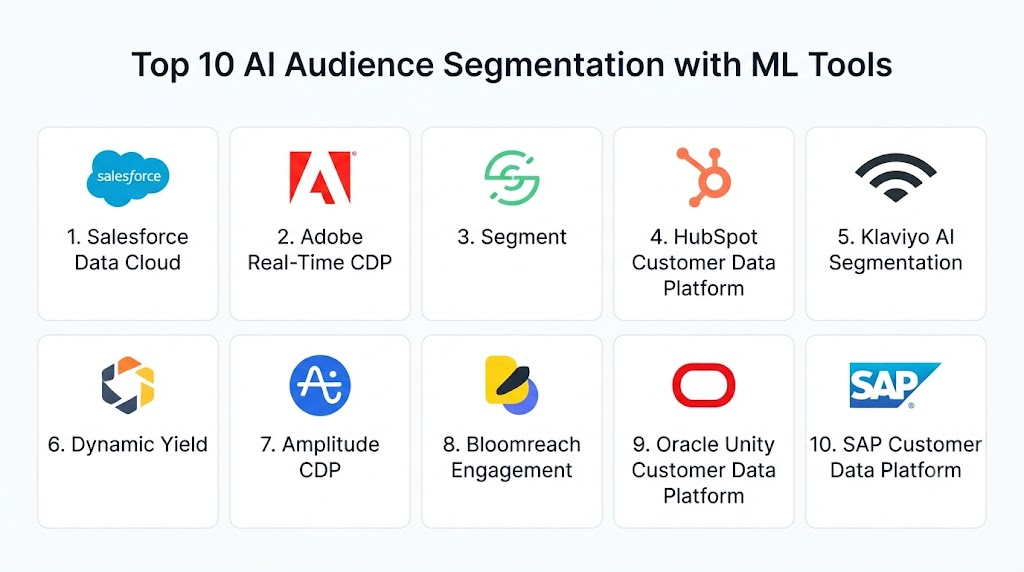
Top 10 AI Audience Segmentation with ML Tools
1 — Salesforce Data Cloud
One-line verdict: Best for enterprises needing AI-powered customer segmentation connected with CRM ecosystems.
Short description:
Salesforce Data Cloud is a customer data platform designed to unify customer information from multiple sources and create a complete customer profile. It helps organizations use AI-driven insights for personalization, segmentation, and customer engagement.
Standout Capabilities
- Unified customer profiles.
- AI-assisted audience segmentation.
- Customer data unification.
- Real-time customer insights.
- Marketing activation workflows.
- Enterprise data management.
- Personalization support.
- CRM ecosystem integration.
AI-Specific Depth
- Model support: Uses Salesforce AI capabilities; additional model flexibility varies.
- RAG / knowledge integration: Supports enterprise data connections depending on configuration.
- Evaluation: Audience performance measurement varies.
- Guardrails: Enterprise AI governance features available depending on setup.
- Observability: Data monitoring and analytics capabilities available.
Pros
- Strong enterprise customer data foundation.
- Deep CRM ecosystem integration.
- Supports large-scale personalization workflows.
Cons
- Can require significant implementation effort.
- May be complex for smaller teams.
- Advanced features depend on configuration.
Security & Compliance
Security features depend on Salesforce configuration and selected services. Specific certifications and compliance requirements should be verified based on organizational needs.
Deployment & Platforms
- Deployment: Cloud-based.
- Platforms: Web-based.
- Self-hosted: Not publicly stated.
Integrations & Ecosystem
Salesforce Data Cloud connects with customer experience and enterprise technology ecosystems.
Common integrations include:
- CRM platforms.
- Marketing automation tools.
- Data sources.
- Analytics systems.
- Customer engagement applications.
Pricing Model
Pricing depends on data usage, features, and enterprise requirements. Exact pricing is not publicly stated.
Best-Fit Scenarios
- Large enterprises managing complex customer data.
- Organizations using CRM-driven personalization.
- Businesses requiring enterprise audience management.
2 — Adobe Real-Time CDP
One-line verdict: Best for enterprises building AI-driven customer profiles and personalized audience experiences.
Short description:
Adobe Real-Time CDP helps organizations collect, unify, and activate customer data for personalized experiences. It supports audience creation, customer profile management, and marketing activation across multiple channels.
Standout Capabilities
- Real-time customer profiles.
- Audience segmentation.
- Data unification.
- Customer journey analysis.
- Marketing activation.
- Identity resolution capabilities.
- Enterprise personalization workflows.
AI-Specific Depth
- Model support: Uses Adobe AI capabilities; flexibility varies.
- RAG / knowledge integration: Data integration capabilities vary by implementation.
- Evaluation: Audience performance measurement available.
- Guardrails: Enterprise governance features vary.
- Observability: Data monitoring and reporting capabilities available.
Pros
- Strong enterprise customer data management.
- Supports complex audience strategies.
- Works well with Adobe marketing ecosystems.
Cons
- Requires technical expertise.
- Enterprise implementation can be complex.
- May not fit smaller organizations.
Security & Compliance
Security controls depend on implementation. Specific certifications and compliance details should be verified according to business requirements.
Deployment & Platforms
- Deployment: Cloud-based.
- Platform: Web-based.
- Self-hosted: Not publicly stated.
Integrations & Ecosystem
Adobe Real-Time CDP connects with marketing, analytics, and customer experience systems.
Common integrations include:
- Marketing platforms.
- Analytics tools.
- Advertising systems.
- Customer engagement solutions.
- Enterprise data sources.
Pricing Model
Pricing depends on data volume, features, and enterprise requirements. Exact pricing is not publicly stated.
Best-Fit Scenarios
- Enterprises requiring unified customer profiles.
- Marketing teams managing personalized campaigns.
- Organizations with complex customer data environments.
3 — Segment
One-line verdict: Best for businesses needing flexible customer data collection and AI-ready audience segmentation workflows.
Short description:
Segment is a customer data platform that helps organizations collect, unify, and activate customer information from multiple sources. It enables businesses to create customer profiles and support personalized marketing, analytics, and engagement strategies.
Standout Capabilities
- Customer data collection and unification.
- Audience creation and management.
- Event-based customer tracking.
- Data pipeline management.
- Customer profile building.
- Marketing activation workflows.
- Analytics integration support.
- First-party data management.
AI-Specific Depth
- Model support: AI capabilities vary by implementation; supports data workflows for AI applications.
- RAG / knowledge integration: Can connect customer data sources; specific AI knowledge workflows vary.
- Evaluation: Audience performance measurement depends on connected analytics systems.
- Guardrails: Data governance and access controls available depending on configuration.
- Observability: Data tracking and pipeline monitoring capabilities available.
Pros
- Strong customer data infrastructure.
- Flexible integration ecosystem.
- Useful foundation for AI-driven personalization.
Cons
- Requires proper data implementation.
- Advanced segmentation may need additional analytics tools.
- Setup complexity can increase for large organizations.
Security & Compliance
Security features depend on implementation and subscription level. Specific certifications and compliance details should be verified based on organizational requirements.
Deployment & Platforms
- Deployment: Cloud-based.
- Platforms: Web-based.
- Self-hosted: Not publicly stated.
Integrations & Ecosystem
Segment connects with customer data, analytics, marketing, and business systems.
Common integrations include:
- CRM platforms.
- Marketing automation tools.
- Analytics solutions.
- Data warehouses.
- Customer engagement platforms.
Pricing Model
Pricing depends on data volume, events, features, and business requirements. Exact pricing is not publicly stated.
Best-Fit Scenarios
- Companies building customer data platforms.
- Marketing teams needing unified customer insights.
- Organizations preparing data infrastructure for AI personalization.
4 — HubSpot Customer Data Platform
One-line verdict: Best for growing businesses needing customer segmentation connected with CRM and marketing automation.
Short description:
HubSpot Customer Data Platform helps organizations organize customer information and create targeted audience groups using CRM and marketing data. It supports personalized campaigns by connecting customer interactions across business functions.
Standout Capabilities
- Customer profile management.
- CRM-based segmentation.
- Marketing personalization.
- Customer lifecycle analysis.
- Audience targeting.
- Automated marketing workflows.
- Sales and marketing alignment.
- Customer engagement insights.
AI-Specific Depth
- Model support: Uses HubSpot AI capabilities; flexibility varies.
- RAG / knowledge integration: Supports business data connections depending on configuration.
- Evaluation: Campaign and audience performance measurement available.
- Guardrails: User permissions and data controls available.
- Observability: Analytics dashboards and reporting available.
Pros
- Easy adoption for marketing teams.
- Strong CRM integration.
- Useful for SMB and growing businesses.
Cons
- Advanced enterprise segmentation may require additional solutions.
- AI capabilities vary across features.
- Less specialized for complex ML modeling.
Security & Compliance
Security controls depend on subscription and configuration. Specific certifications and compliance details should be verified based on business requirements.
Deployment & Platforms
- Deployment: Cloud-based.
- Platforms: Web-based.
- Self-hosted: Not publicly stated.
Integrations & Ecosystem
HubSpot connects customer data with marketing, sales, and service workflows.
Common integrations include:
- CRM systems.
- Email marketing tools.
- Advertising platforms.
- Analytics solutions.
- Customer engagement applications.
Pricing Model
Pricing varies based on features, users, and business requirements. Exact pricing is not publicly stated.
Best-Fit Scenarios
- Small and medium businesses.
- Marketing teams using CRM workflows.
- Companies needing simple AI-assisted segmentation.
5 — Klaviyo AI Segmentation
One-line verdict: Best for e-commerce brands using AI-powered customer segmentation for personalized marketing campaigns.
Short description:
Klaviyo provides customer data and marketing automation capabilities designed for e-commerce businesses. It uses customer behavior, purchase history, and engagement signals to help brands create targeted audiences and personalized communications.
Standout Capabilities
- Customer behavior segmentation.
- Predictive customer insights.
- E-commerce audience targeting.
- Personalized campaign workflows.
- Customer lifecycle analysis.
- Automated marketing journeys.
- Revenue-focused segmentation.
AI-Specific Depth
- Model support: Uses proprietary AI capabilities; flexibility varies.
- RAG / knowledge integration: Customer data integration supported depending on setup.
- Evaluation: Campaign performance and customer engagement measurement available.
- Guardrails: Data controls and permissions vary.
- Observability: Marketing analytics and reporting available.
Pros
- Strong e-commerce focus.
- Useful predictive customer insights.
- Helps improve personalized campaigns.
Cons
- Mainly focused on marketing use cases.
- Less suitable for non-commerce industries.
- Advanced customization may require technical support.
Security & Compliance
Security features depend on configuration and plan. Specific certifications and compliance information should be verified according to organizational needs.
Deployment & Platforms
- Deployment: Cloud-based.
- Platforms: Web-based.
- Self-hosted: Not publicly stated.
Integrations & Ecosystem
Klaviyo integrates with e-commerce and marketing ecosystems.
Common integrations include:
- E-commerce platforms.
- Customer data sources.
- Advertising platforms.
- Analytics tools.
- Marketing automation systems.
Pricing Model
Pricing depends on customer profiles, usage, and selected features. Exact pricing is not publicly stated.
Best-Fit Scenarios
- Online retailers.
- Direct-to-consumer brands.
- Marketing teams improving customer personalization.
6 — Dynamic Yield
One-line verdict: Best for enterprises needing AI-driven personalization and dynamic audience targeting.
Short description:
Dynamic Yield is an experience optimization platform that helps organizations personalize digital experiences using customer data and machine learning. It supports audience segmentation, recommendations, and personalized customer journeys.
Standout Capabilities
- AI-powered personalization.
- Dynamic audience segmentation.
- Recommendation systems.
- Customer experience optimization.
- Behavioral targeting.
- Experimentation workflows.
- Real-time personalization.
AI-Specific Depth
- Model support: Uses proprietary machine learning capabilities.
- RAG / knowledge integration: N/A.
- Evaluation: Supports testing and personalization measurement.
- Guardrails: Brand and experience controls vary.
- Observability: Performance reporting and analytics available.
Pros
- Strong personalization capabilities.
- Useful for enterprise customer experiences.
- Supports real-time audience targeting.
Cons
- Enterprise-focused complexity.
- Requires quality customer data.
- Implementation may require technical resources.
Security & Compliance
Security and compliance details depend on implementation. Specific certifications are not publicly stated.
Deployment & Platforms
- Deployment: Cloud-based.
- Platforms: Web-based.
- Self-hosted: Not publicly stated.
Integrations & Ecosystem
Dynamic Yield integrates with digital experience and marketing platforms.
Common integrations include:
- Customer data platforms.
- Analytics systems.
- E-commerce platforms.
- Content management systems.
- Marketing tools.
Pricing Model
Pricing varies based on usage, features, and enterprise requirements. Exact pricing is not publicly stated.
Best-Fit Scenarios
- Large digital businesses.
- Retail and e-commerce organizations.
- Enterprises focused on personalization.
7 — Amplitude CDP
One-line verdict: Best for product-led companies using behavioral data for AI-powered audience insights.
Short description:
Amplitude CDP helps organizations collect, analyze, and activate customer behavioral data. It enables product and marketing teams to understand users, create segments, and improve customer experiences.
Standout Capabilities
- Behavioral audience segmentation.
- User journey analysis.
- Customer lifecycle insights.
- Product analytics.
- Cohort analysis.
- Data activation workflows.
- Experimentation support.
AI-Specific Depth
- Model support: Uses analytics and AI capabilities; flexibility varies.
- RAG / knowledge integration: N/A.
- Evaluation: Supports behavioral analysis and segment measurement.
- Guardrails: Access controls vary by configuration.
- Observability: Analytics dashboards and user tracking available.
Pros
- Strong behavioral analytics.
- Useful for product-led businesses.
- Helps identify user patterns.
Cons
- Requires proper event tracking.
- Not designed only for marketing segmentation.
- Advanced analysis may need analytics expertise.
Security & Compliance
Security capabilities depend on configuration and selected plans. Specific compliance details should be verified.
Deployment & Platforms
- Deployment: Cloud-based.
- Platforms: Web-based.
- Self-hosted: Not publicly stated.
Integrations & Ecosystem
Amplitude connects with product, marketing, and data ecosystems.
Common integrations include:
- Data warehouses.
- Marketing platforms.
- Customer engagement tools.
- Analytics systems.
- Developer tools.
Pricing Model
Pricing varies based on usage, data volume, and features. Exact pricing is not publicly stated.
Best-Fit Scenarios
- SaaS companies.
- Product teams analyzing user behavior.
- Growth teams improving customer engagement.
8 — Bloomreach Engagement
One-line verdict: Best for businesses combining AI segmentation with personalized customer engagement campaigns.
Short description:
Bloomreach Engagement is a customer data and marketing automation platform that helps organizations collect customer information, create audience segments, and deliver personalized experiences. It combines customer insights, automation, and analytics to improve engagement across multiple channels.
Standout Capabilities
- AI-assisted customer segmentation.
- Real-time audience creation.
- Customer journey automation.
- Personalized marketing campaigns.
- Behavioral data analysis.
- Customer profile management.
- Cross-channel engagement workflows.
- Predictive customer insights.
AI-Specific Depth
- Model support: Uses proprietary AI capabilities; additional model flexibility varies.
- RAG / knowledge integration: Customer data integration capabilities vary by implementation.
- Evaluation: Supports campaign performance analysis and audience measurement.
- Guardrails: Data governance and permission controls vary.
- Observability: Customer analytics and campaign reporting available.
Pros
- Strong customer engagement capabilities.
- Supports personalized marketing workflows.
- Useful for e-commerce and retail organizations.
Cons
- Can require technical expertise for advanced implementations.
- Primarily focused on customer engagement use cases.
- Smaller teams may find enterprise features complex.
Security & Compliance
Security features depend on configuration and business requirements. Specific certifications and compliance details should be verified based on organizational needs.
Deployment & Platforms
- Deployment: Cloud-based.
- Platforms: Web-based.
- Self-hosted: Not publicly stated.
Integrations & Ecosystem
Bloomreach Engagement connects with customer experience and marketing ecosystems.
Common integrations include:
- E-commerce platforms.
- CRM systems.
- Marketing automation tools.
- Analytics platforms.
- Customer data sources.
Pricing Model
Pricing depends on customer data volume, features, and implementation requirements. Exact pricing is not publicly stated.
Best-Fit Scenarios
- Retail and e-commerce brands.
- Companies managing personalized customer journeys.
- Marketing teams running automated campaigns.
9 — Oracle Unity Customer Data Platform
One-line verdict: Best for enterprises requiring large-scale customer data management and AI-driven segmentation.
Short description:
Oracle Unity Customer Data Platform helps enterprises unify customer information from different systems and create actionable audience segments. It supports customer intelligence, personalization, and marketing activation across enterprise environments.
Standout Capabilities
- Customer data unification.
- Enterprise audience segmentation.
- Identity resolution.
- Customer profile management.
- Marketing activation.
- Data-driven personalization.
- Enterprise analytics support.
- Cross-channel customer insights.
AI-Specific Depth
- Model support: Uses Oracle AI capabilities; flexibility varies.
- RAG / knowledge integration: Enterprise data connections vary by implementation.
- Evaluation: Audience and campaign measurement capabilities available.
- Guardrails: Enterprise governance and security controls available depending on configuration.
- Observability: Data monitoring and analytics capabilities available.
Pros
- Strong enterprise data management.
- Supports complex customer ecosystems.
- Suitable for large organizations.
Cons
- Requires significant implementation effort.
- May be complex for smaller companies.
- Advanced capabilities require technical expertise.
Security & Compliance
Security controls depend on Oracle configuration and selected services. Specific certifications and compliance details should be verified based on requirements.
Deployment & Platforms
- Deployment: Cloud-based.
- Platforms: Web-based.
- Self-hosted: Not publicly stated.
Integrations & Ecosystem
Oracle Unity CDP integrates with enterprise applications and data environments.
Common integrations include:
- CRM systems.
- Enterprise databases.
- Marketing platforms.
- Analytics solutions.
- Business applications.
Pricing Model
Pricing depends on enterprise requirements, data volume, and selected services. Exact pricing is not publicly stated.
Best-Fit Scenarios
- Large enterprises with complex customer data.
- Organizations requiring unified customer profiles.
- Businesses managing multiple customer channels.
10 — SAP Customer Data Platform
One-line verdict: Best for enterprises using SAP ecosystems for AI-powered customer intelligence and segmentation.
Short description:
SAP Customer Data Platform helps organizations unify customer information and create personalized experiences across marketing, sales, and service operations. It supports businesses that require connected customer insights across enterprise systems.
Standout Capabilities
- Customer identity management.
- Audience segmentation.
- Customer profile unification.
- Enterprise data integration.
- Personalized customer experiences.
- Marketing activation workflows.
- Customer intelligence capabilities.
AI-Specific Depth
- Model support: Uses SAP AI capabilities; flexibility varies.
- RAG / knowledge integration: Enterprise data connectivity varies.
- Evaluation: Customer analytics and campaign measurement capabilities available.
- Guardrails: Enterprise security and governance controls vary.
- Observability: Monitoring and analytics capabilities available.
Pros
- Strong enterprise ecosystem integration.
- Suitable for organizations using SAP systems.
- Supports large-scale customer data management.
Cons
- Best suited for SAP-oriented organizations.
- Implementation can require specialized skills.
- May not be ideal for smaller businesses.
Security & Compliance
Security capabilities depend on configuration and enterprise requirements. Specific certifications and compliance information should be verified before deployment.
Deployment & Platforms
- Deployment: Cloud-based.
- Platforms: Web-based.
- Self-hosted: Varies / N/A.
Integrations & Ecosystem
SAP Customer Data Platform connects with enterprise business systems.
Common integrations include:
- SAP business applications.
- CRM platforms.
- Marketing solutions.
- Analytics systems.
- Enterprise data environments.
Pricing Model
Pricing varies based on deployment, data requirements, and enterprise configuration. Exact pricing is not publicly stated.
Best-Fit Scenarios
- Enterprises using SAP ecosystems.
- Organizations managing large customer databases.
- Businesses requiring enterprise-level segmentation.
Comparison Table: Top 10 AI Audience Segmentation with ML Tools
| Tool Name | Best For | Deployment | Model Flexibility | Strength | Watch-Out | Public Rating |
|---|---|---|---|---|---|---|
| Salesforce Data Cloud | Enterprise customer segmentation | Cloud | Hosted AI | CRM-connected audience intelligence | Complex setup | N/A |
| Adobe Real-Time CDP | Enterprise personalization | Cloud | Hosted AI | Unified customer profiles | Requires expertise | N/A |
| Segment | Data infrastructure and segmentation | Cloud | Flexible data workflows | Customer data pipelines | Needs implementation effort | N/A |
| HubSpot CDP | SMB customer segmentation | Cloud | Hosted AI | CRM-based personalization | Limited advanced ML | N/A |
| Klaviyo AI Segmentation | E-commerce personalization | Cloud | Proprietary AI | Customer marketing automation | Commerce-focused | N/A |
| Dynamic Yield | Experience personalization | Cloud | Proprietary ML | Real-time personalization | Enterprise complexity | N/A |
| Amplitude CDP | Product behavior analysis | Cloud | Hosted AI | User analytics | Requires event tracking | N/A |
| Bloomreach Engagement | Customer engagement | Cloud | Proprietary AI | Marketing automation | Setup complexity | N/A |
| Oracle Unity CDP | Enterprise data management | Cloud | Hosted AI | Large-scale customer data | Implementation effort | N/A |
| SAP Customer Data Platform | SAP enterprise users | Cloud | Hosted AI | Enterprise ecosystem integration | SAP-focused | N/A |
Scoring & Evaluation: Transparent Rubric
The scoring below compares AI Audience Segmentation with ML platforms using common evaluation criteria. Scores are comparative and should be adjusted based on specific business needs, industry requirements, and available data maturity.
Evaluation weights:
- Core features – 20%
- AI reliability & evaluation – 15%
- Guardrails & safety – 10%
- Integrations & ecosystem – 15%
- Ease of use – 10%
- Performance & cost controls – 15%
- Security & admin – 10%
- Support & community – 5%
| Tool | Core | Reliability/Eval | Guardrails | Integrations | Ease | Perf/Cost | Security/Admin | Support | Weighted Total |
|---|---|---|---|---|---|---|---|---|---|
| Salesforce Data Cloud | 10 | 9 | 9 | 10 | 7 | 8 | 9 | 9 | 8.9 |
| Adobe Real-Time CDP | 10 | 9 | 9 | 10 | 6 | 8 | 9 | 8 | 8.8 |
| Segment | 9 | 8 | 8 | 10 | 8 | 8 | 8 | 8 | 8.6 |
| HubSpot CDP | 8 | 7 | 8 | 9 | 9 | 8 | 8 | 9 | 8.3 |
| Klaviyo AI Segmentation | 8 | 8 | 7 | 8 | 9 | 8 | 7 | 8 | 8.0 |
| Dynamic Yield | 9 | 8 | 8 | 8 | 7 | 8 | 8 | 7 | 8.0 |
| Amplitude CDP | 9 | 8 | 8 | 9 | 8 | 8 | 8 | 8 | 8.4 |
| Bloomreach Engagement | 8 | 8 | 8 | 8 | 7 | 8 | 8 | 8 | 7.9 |
| Oracle Unity CDP | 10 | 9 | 9 | 9 | 6 | 8 | 9 | 8 | 8.7 |
| SAP Customer Data Platform | 9 | 8 | 9 | 9 | 6 | 8 | 9 | 8 | 8.4 |
Top 3 for Enterprise
- Salesforce Data Cloud
- Adobe Real-Time CDP
- Oracle Unity Customer Data Platform
Top 3 for SMB
- HubSpot Customer Data Platform
- Klaviyo AI Segmentation
- Segment
Top 3 for Developers
- Segment
- Amplitude CDP
- Salesforce Data Cloud
Which AI Audience Segmentation with ML Tool Is Right for You?
Choosing the right AI Audience Segmentation with ML Tool depends on business size, customer data maturity, marketing goals, technical resources, and personalization requirements. Different organizations need different levels of automation and analytics capabilities. A small business may need simple customer grouping, while a global enterprise may require advanced AI models, real-time segmentation, and enterprise governance.
Solo / Freelancer
Solo marketers and independent consultants usually need lightweight solutions that provide useful audience insights without complex implementation.
Recommended options:
- HubSpot Customer Data Platform: Suitable for marketers who need CRM-connected segmentation and simple personalization.
- Klaviyo AI Segmentation: Useful for freelancers managing e-commerce marketing campaigns.
- Segment: Helpful for professionals building customer data workflows.
Important selection factors:
- Easy setup.
- Affordable pricing.
- Simple audience creation.
- Basic analytics capabilities.
- Minimal technical requirements.
Solo users should avoid complex enterprise customer data platforms unless they manage large client datasets or require advanced automation.
SMB
Small and medium businesses need AI segmentation tools that improve personalization while remaining easy to operate.
Recommended options:
- HubSpot Customer Data Platform: Good for businesses already using CRM and marketing automation.
- Klaviyo AI Segmentation: Suitable for online stores and direct-to-consumer brands.
- Segment: Useful for businesses building stronger customer data foundations.
Important selection factors:
- Customer profile management.
- Marketing integration.
- Automated audience creation.
- Campaign personalization.
- Scalable pricing.
SMBs should focus on tools that provide practical insights rather than unnecessary enterprise complexity.
Mid-Market
Mid-market companies usually manage multiple customer channels and require stronger segmentation capabilities.
Recommended options:
- Amplitude CDP: Useful for companies analyzing customer behavior and product engagement.
- Dynamic Yield: Suitable for businesses focused on personalization.
- Bloomreach Engagement: Helpful for customer engagement and marketing automation.
Important selection factors:
- Predictive segmentation.
- Customer journey analysis.
- Data integration.
- Real-time audience updates.
- Team collaboration.
Mid-market organizations should select platforms that balance AI capabilities with operational simplicity.
Enterprise
Large organizations require advanced customer data management, AI-powered segmentation, security controls, and scalable infrastructure.
Recommended options:
- Salesforce Data Cloud: Strong choice for organizations using CRM-driven customer intelligence.
- Adobe Real-Time CDP: Suitable for enterprise personalization and customer data unification.
- Oracle Unity Customer Data Platform: Useful for complex enterprise data environments.
Important selection factors:
- Enterprise security.
- Data governance.
- Identity resolution.
- Large-scale data processing.
- AI model management.
- Cross-channel activation.
Enterprise organizations should carefully evaluate implementation complexity because successful AI segmentation depends heavily on data quality and integration maturity.
Regulated Industries (Finance, Healthcare, Public Sector)
Organizations in regulated industries need stronger privacy controls and responsible AI practices when using customer segmentation platforms.
Important considerations:
- Protect sensitive customer information.
- Review data processing practices.
- Maintain strict access controls.
- Monitor AI-generated audience decisions.
- Keep human oversight for important customer decisions.
- Establish internal AI governance policies.
Recommended approach:
- Select platforms with strong enterprise security features.
- Validate compliance requirements before deployment.
- Use privacy-aware data strategies.
- Limit access to customer information.
Budget vs Premium
Budget-Friendly Approach
Suitable for startups, freelancers, and smaller businesses.
Recommended options:
- HubSpot Customer Data Platform.
- Klaviyo AI Segmentation.
- Segment.
Benefits:
- Faster implementation.
- Lower operational requirements.
- Easier team adoption.
- Simple personalization workflows.
Premium Enterprise Approach
Suitable for organizations managing large customer ecosystems.
Recommended options:
- Salesforce Data Cloud.
- Adobe Real-Time CDP.
- Oracle Unity Customer Data Platform.
Benefits:
- Advanced customer intelligence.
- Enterprise scalability.
- Strong governance.
- Complex segmentation capabilities.
Build vs Buy: When to DIY
Building a custom AI audience segmentation system may make sense when organizations have:
- Strong data engineering teams.
- Large internal customer datasets.
- Unique segmentation requirements.
- Existing machine learning infrastructure.
- Need for complete model control.
Buying a commercial platform is usually better when organizations need:
- Faster deployment.
- Ready-made integrations.
- Managed AI capabilities.
- Lower maintenance requirements.
- Enterprise support.
A hybrid approach is also common where businesses use customer data platforms while building custom machine learning models or analytics layers internally.
Implementation Playboo
Success metrics:
- Improved customer understanding.
- Faster audience creation.
- Better campaign targeting.
- Reduced manual segmentation effort.
Common Mistakes & How to Avoid Them
Organizations often struggle with AI audience segmentation because they focus on tools instead of data quality, governance, and strategy.
Common mistakes include:
- Using incomplete customer data: AI models require accurate and reliable information.
- Creating segments without business goals: Define clear objectives before building audiences.
- Ignoring privacy requirements: Protect customer information and follow responsible data practices.
- Relying completely on AI decisions: Maintain human oversight for important customer strategies.
- Poor data integration: Connect relevant customer sources for better segmentation.
- Ignoring data quality issues: Incorrect data creates unreliable audience groups.
- No segment performance measurement: Track whether segments improve business outcomes.
- Overcomplicating segmentation: Start with valuable segments before creating many complex groups.
- Ignoring AI transparency: Understand why customers are grouped together.
- Lack of governance: Establish ownership and review processes.
- Poor access management: Control who can view and use customer data.
- Ignoring scalability: Choose platforms that support future growth.
- Vendor lock-in risk: Maintain flexibility with data ownership and integrations.
- No model monitoring: Regularly review AI performance and segmentation accuracy.
FAQs
What is AI Audience Segmentation with ML?
AI Audience Segmentation with Machine Learning uses artificial intelligence algorithms to automatically group customers based on behavior, preferences, demographics, and interactions. It helps businesses create more personalized experiences.
How does machine learning improve audience segmentation?
Machine learning identifies hidden patterns in customer data and creates more accurate audience groups compared with traditional rule-based segmentation methods.
Are AI segmentation tools useful for small businesses?
Yes. Small businesses can use simpler AI segmentation platforms to improve customer targeting and personalization without requiring complex technical resources.
What data is needed for AI audience segmentation?
Common data sources include customer behavior, purchase history, website interactions, engagement data, CRM information, and marketing activity.
Can AI segmentation work with first-party data?
Yes. Many organizations use first-party customer data to create privacy-focused audience segments and improve personalization.
Are AI-generated segments accurate?
Accuracy depends on data quality, model performance, and business goals. Organizations should regularly evaluate whether segments produce meaningful outcomes.
Do AI segmentation tools replace marketers?
No. These platforms support marketers by providing insights and automation. Human strategy and decision-making remain important.
Are customer data platforms secure?
Security depends on the platform and configuration. Businesses should review access controls, privacy settings, and data protection practices.
Can businesses create custom audience segments?
Many platforms support custom segmentation based on business rules, customer behaviors, and marketing objectives.
How much do AI audience segmentation tools cost?
Pricing varies depending on features, users, data volume, and enterprise requirements. Exact costs depend on the selected platform.
Should companies build their own AI segmentation system?
Building internally may be suitable for organizations with strong engineering teams and unique requirements. Many businesses prefer commercial platforms for faster deployment.
How can companies measure segmentation success?
Success can be measured through improved engagement, conversion rates, customer retention, campaign performance, and personalization outcomes.
Conclusion
AI Audience Segmentation with ML Tools are becoming essential for businesses that want deeper customer understanding and more personalized experiences. These platforms help organizations discover hidden customer patterns, automate audience creation, and improve marketing effectiveness through data-driven insightsThe best platform depends on business requirements, data maturity, technical capabilities, and personalization goals. Smaller organizations may benefit from simpler customer data solutions, while enterprises often require advanced AI segmentation, governance, and scalability.
