Introduction
AI Feedback Mining & Theming Tools are intelligent platforms that help organizations collect, analyze, categorize, and understand customer feedback from multiple channels using artificial intelligence. These tools use natural language processing, machine learning, sentiment analysis, topic modeling, and automation to identify important patterns hidden inside large volumes of customer comments, reviews, surveys, support conversations, and product feedback.
Traditional feedback analysis often requires manual review of thousands of responses, making it difficult for teams to identify common issues, customer expectations, and emerging trends quickly. AI-powered feedback mining tools help businesses automatically discover themes, summarize opinions, identify sentiment, and convert unstructured feedback into actionable insights.
Modern AI feedback analysis platforms are becoming essential for product teams, customer experience teams, marketing departments, and support organizations. They help companies understand customer needs, improve products, reduce customer frustration, and make data-driven decisions.
Real-world use cases:
- Product teams analyze customer feedback to identify feature requests, usability issues, and product improvement opportunities.
- Customer support teams discover recurring complaints and improve support processes.
- Marketing teams analyze customer reviews and social media feedback to understand brand perception.
- SaaS companies monitor user feedback to improve customer retention and product adoption.
- Healthcare organizations analyze patient feedback to improve service quality and experiences.
- Enterprises combine feedback from surveys, emails, reviews, and support tickets to identify business trends.
Evaluation Criteria for Buyers:
Organizations evaluating AI Feedback Mining & Theming Tools should consider:
- Accuracy of AI-powered theme detection.
- Sentiment analysis capabilities.
- Support for multiple feedback sources.
- Natural language understanding quality.
- Automated categorization and tagging.
- Feedback summarization capabilities.
- Integration with CRM, support, and product tools.
- Search and filtering capabilities.
- Analytics and reporting features.
- Data privacy and security controls.
- Workflow automation options.
- Human review and correction capabilities.
- API availability and customization options.
Best for:
AI Feedback Mining & Theming Tools are best for product teams, customer experience departments, SaaS companies, e-commerce businesses, marketing teams, support organizations, and enterprises managing large volumes of customer feedback.
Not ideal for:
Small businesses receiving limited feedback may not need advanced AI analysis platforms. Organizations working with highly sensitive customer information should carefully evaluate privacy controls and data handling practices before implementation.
What’s Changed in AI Feedback Mining & Theming Tools
AI Feedback Mining & Theming Tools are evolving from basic survey analytics platforms into intelligent customer insight systems. Organizations are increasingly using AI to automatically understand customer opinions, identify trends, and support faster decision-making.
Key developments include:
- AI-powered theme discovery: Modern tools automatically identify recurring topics and patterns without requiring teams to manually create categories.
- Advanced sentiment understanding: AI systems are improving their ability to understand emotions, frustration, satisfaction, and customer intent.
- Multichannel feedback analysis: Organizations are combining feedback from surveys, reviews, support conversations, social media, and product interactions.
- AI-generated summaries: Teams can quickly understand large amounts of feedback through automated summaries and key insight extraction.
- Product intelligence workflows: Product teams are using AI feedback analysis to prioritize feature requests and improvements.
- Conversational feedback analysis: AI tools can analyze customer conversations from chat, email, and support channels to discover important issues.
- Real-time customer insights: Businesses are moving toward faster feedback monitoring instead of periodic manual analysis.
- AI-powered customer experience management: Feedback platforms are becoming connected with broader customer experience workflows.
- Human-in-the-loop analysis: Organizations combine AI automation with human review for better accuracy.
- Enterprise privacy controls: Businesses are focusing on secure feedback processing, data protection, and controlled access.
- Integration with business systems: Feedback intelligence is increasingly connected with CRM, product management, and support platforms.
- Predictive customer insights: Some platforms are moving toward identifying future customer needs and potential risks.
Quick Buyer Checklist (Scan-Friendly)
Before selecting an AI Feedback Mining & Theming Tool, check:
✅ Does the platform automatically identify feedback themes?
✅ Can it analyze multiple feedback sources?
✅ Does it support sentiment and emotion analysis?
✅ Can teams customize categories and tags?
✅ Does it provide AI-generated summaries?
✅ Can it connect with CRM and customer support systems?
✅ Does it support product management workflows?
✅ Can users search and filter feedback easily?
✅ Does it provide analytics and reporting?
✅ Does it protect customer data?
✅ Can administrators manage access permissions?
✅ Does it support APIs and integrations?
✅ Can human teams review and correct AI outputs?
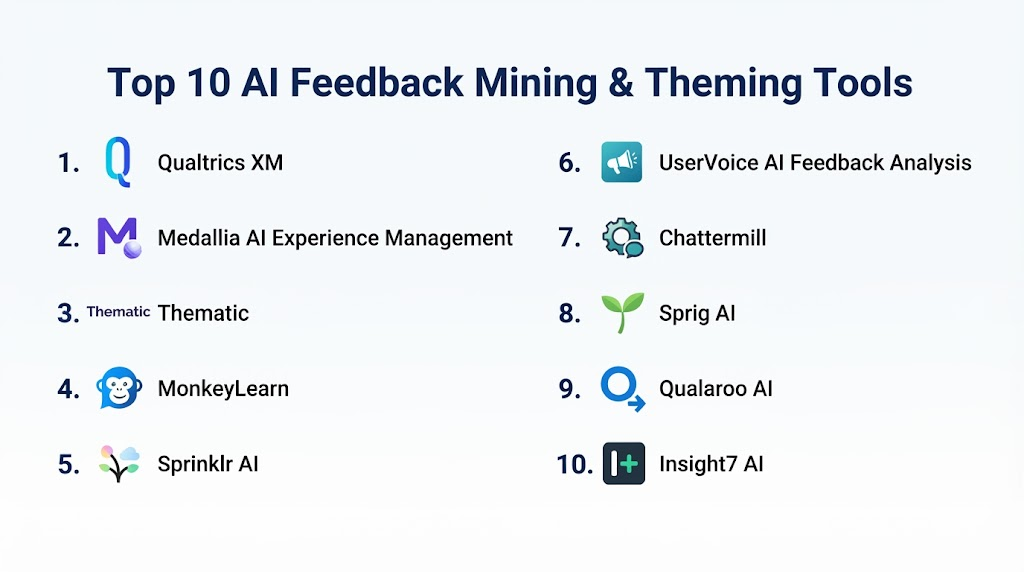
Top 10 AI Feedback Mining & Theming Tools
1 — Qualtrics XM
One-line verdict: Best for enterprises needing advanced customer experience analytics and feedback intelligence.
Short description:
Qualtrics XM provides experience management capabilities that help organizations collect, analyze, and understand customer feedback. AI-powered insights help businesses identify themes, sentiment, and customer experience trends across multiple channels.
Standout Capabilities
- AI-powered feedback analysis.
- Customer experience management.
- Survey analytics.
- Sentiment analysis.
- Theme identification.
- Multi-channel feedback collection.
- Enterprise reporting capabilities.
AI-Specific Depth
- Model support: Platform-provided AI capabilities.
- RAG / knowledge integration: Not primarily designed as a RAG platform.
- Evaluation: Feedback analytics and quality measurement depend on configuration.
- Guardrails: Data governance controls vary by deployment.
- Observability: Analytics and reporting capabilities vary.
Pros
- Strong enterprise experience management capabilities.
- Supports large-scale feedback programs.
- Provides advanced analytics workflows.
Cons
- Can be complex for smaller teams.
- Enterprise features may require configuration.
- Pricing information varies.
Security & Compliance
Security capabilities depend on deployment configuration and organizational requirements. Organizations should verify access controls, encryption, data handling, and compliance needs.
Specific certifications should be verified based on business requirements.
Deployment & Platforms
- Cloud-based platform.
- Web-based access.
- Enterprise application integrations.
Integrations & Ecosystem
Qualtrics XM integrates with business systems for collecting and analyzing customer feedback.
Common integrations include:
- CRM platforms.
- Customer support systems.
- Marketing tools.
- Business intelligence platforms.
- Enterprise applications.
Pricing Model
Enterprise subscription pricing model. Exact pricing varies based on requirements.
Best-Fit Scenarios
- Large enterprises.
- Customer experience teams.
- Organizations running complex feedback programs.
2 — Medallia AI Experience Management
One-line verdict: Best for organizations analyzing customer experiences across multiple interaction channels.
Short description:
Medallia provides AI-powered experience management solutions that help organizations understand customer feedback, identify trends, and improve customer experiences. It analyzes feedback from multiple channels to generate actionable insights.
Standout Capabilities
- Experience analytics.
- Customer feedback analysis.
- Sentiment detection.
- Theme identification.
- Multi-channel feedback processing.
- Customer journey insights.
- Enterprise reporting.
AI-Specific Depth
- Model support: Platform-provided AI capabilities.
- RAG / knowledge integration: N/A as a primary feature.
- Evaluation: Insight quality depends on feedback data and configuration.
- Guardrails: Data controls vary by deployment.
- Observability: Analytics capabilities depend on implementation.
Pros
- Strong customer experience focus.
- Supports enterprise-scale feedback analysis.
- Useful for understanding customer journeys.
Cons
- Primarily designed for larger organizations.
- Implementation may require planning.
- Advanced features may increase complexity.
Security & Compliance
Security capabilities depend on platform configuration and customer requirements.
Organizations should verify:
- Data protection controls.
- User access management.
- Governance capabilities.
Deployment & Platforms
- Cloud-based platform.
- Enterprise deployment.
- Web-based access.
Integrations & Ecosystem
Medallia integrates with customer experience and business systems.
Common integrations include:
- CRM platforms.
- Customer support systems.
- Analytics tools.
- Enterprise applications.
Pricing Model
Enterprise pricing model. Exact pricing is not publicly stated.
Best-Fit Scenarios
- Large customer experience programs.
- Enterprises analyzing customer journeys.
- Organizations managing multiple feedback channels.
3 — Thematic
One-line verdict: Best for teams using AI-powered text analysis to discover themes in customer feedback.
Short description:
Thematic is an AI-powered feedback analysis platform focused on automatically identifying themes and insights from customer comments. It helps organizations analyze large volumes of text feedback without requiring manual categorization.
Standout Capabilities
- Automated theme discovery.
- Text analytics.
- Customer feedback analysis.
- Sentiment understanding.
- Feedback categorization.
- Insight generation.
- Survey response analysis.
AI-Specific Depth
- Model support: AI-powered text analysis models.
- RAG / knowledge integration: N/A as a primary capability.
- Evaluation: Insight accuracy depends on data quality and review processes.
- Guardrails: Customization and controls vary.
- Observability: Analytics capabilities depend on platform features.
Pros
- Strong focus on feedback themes.
- Reduces manual analysis effort.
- Useful for customer insight teams.
Cons
- More specialized than broad CX platforms.
- Integration requirements should be evaluated.
- Advanced enterprise needs may require additional tools.
Security & Compliance
Security capabilities depend on platform configuration and organizational requirements.
Organizations should verify data handling practices and access controls.
Deployment & Platforms
- Cloud-based platform.
- Web access.
- Integration capabilities vary.
Integrations & Ecosystem
Thematic integrates with feedback collection and business analysis workflows.
Common integrations include:
- Survey platforms.
- Customer feedback systems.
- Data analysis tools.
- Business applications.
Pricing Model
Subscription-based pricing model. Costs vary based on usage and requirements.
Best-Fit Scenarios
- Product teams.
- Customer insight teams.
- Organizations analyzing large feedback datasets.
4 — MonkeyLearn
One-line verdict: Best for teams needing flexible AI text analysis and custom feedback categorization workflows.
Short description:
MonkeyLearn is an AI-powered text analysis platform that helps organizations classify, extract, and analyze information from customer feedback, surveys, reviews, and other text sources. It is commonly used for sentiment analysis, topic classification, and automated feedback processing.
Standout Capabilities
- AI-powered text classification.
- Custom feedback categories.
- Sentiment analysis.
- Keyword and topic extraction.
- Automated tagging.
- Text analytics dashboards.
- No-code AI model training options.
AI-Specific Depth
- Model support: Machine learning-based text analysis models.
- RAG / knowledge integration: N/A as a primary capability.
- Evaluation: Users can evaluate classification performance through model testing.
- Guardrails: Controls depend on model configuration.
- Observability: Analytics and model performance tracking vary.
Pros
- Flexible customization options.
- Useful for different text analysis scenarios.
- Reduces manual feedback categorization.
Cons
- Requires training for advanced customization.
- Enterprise workflows may need additional integration.
- AI accuracy depends on training data quality.
Security & Compliance
Security capabilities depend on platform configuration and organizational requirements. Users should verify data handling, access controls, and privacy practices.
Deployment & Platforms
- Cloud-based platform.
- API-based integration.
- Web-based interface.
Integrations & Ecosystem
MonkeyLearn can connect feedback data sources with AI analysis workflows.
Common integrations include:
- Survey platforms.
- Customer support tools.
- Spreadsheets.
- Business applications.
- Custom APIs.
Pricing Model
Pricing depends on usage, features, and deployment requirements.
Best-Fit Scenarios
- Customer feedback analysis.
- Support ticket classification.
- Organizations needing custom text analytics.
5 — Sprinklr AI
One-line verdict: Best for enterprises analyzing customer conversations across digital channels.
Short description:
Sprinklr AI provides customer experience management capabilities that help organizations analyze conversations, feedback, and customer interactions across multiple channels. It combines AI analysis with customer engagement workflows.
Standout Capabilities
- Multi-channel feedback analysis.
- Customer sentiment analysis.
- Conversation intelligence.
- Topic identification.
- Social listening capabilities.
- Customer experience analytics.
- Enterprise workflow automation.
AI-Specific Depth
- Model support: Platform-provided AI capabilities.
- RAG / knowledge integration: Can connect with enterprise knowledge sources depending on configuration.
- Evaluation: Insight quality depends on analytics workflows.
- Guardrails: AI governance controls vary by deployment.
- Observability: Analytics and monitoring capabilities depend on configuration.
Pros
- Strong multi-channel analysis.
- Useful for large customer experience teams.
- Supports enterprise communication workflows.
Cons
- Can be complex for smaller organizations.
- Requires implementation planning.
- Enterprise features may require dedicated resources.
Security & Compliance
Security features depend on configuration and organizational requirements.
Organizations should review:
- Access management.
- Data protection.
- Governance controls.
- Retention policies.
Deployment & Platforms
- Cloud-based platform.
- Enterprise deployment.
- Web-based access.
Integrations & Ecosystem
Sprinklr AI integrates with customer engagement and business systems.
Common integrations include:
- Social platforms.
- CRM systems.
- Customer support platforms.
- Marketing applications.
- Enterprise data systems.
Pricing Model
Enterprise pricing model. Exact pricing varies based on requirements.
Best-Fit Scenarios
- Large enterprises.
- Customer experience departments.
- Brands monitoring global customer conversations.
6 — UserVoice AI Feedback Analysis
One-line verdict: Best for product teams prioritizing customer feedback and feature request management.
Short description:
UserVoice helps product teams collect, organize, and analyze customer feedback. AI-powered capabilities can help identify patterns, prioritize requests, and improve product decision-making.
Standout Capabilities
- Product feedback collection.
- Feature request management.
- Feedback prioritization.
- Customer voting workflows.
- Product insight generation.
- Feedback categorization.
- Product roadmap support.
AI-Specific Depth
- Model support: AI capabilities depend on platform features.
- RAG / knowledge integration: N/A as a primary capability.
- Evaluation: Feedback prioritization quality depends on workflow usage.
- Guardrails: Controls vary by configuration.
- Observability: Analytics capabilities depend on available features.
Pros
- Strong product feedback focus.
- Helps prioritize customer requests.
- Useful for product management teams.
Cons
- More focused on product feedback than general customer experience.
- Requires active feedback management.
- Advanced AI capabilities may vary.
Security & Compliance
Security capabilities depend on configuration and organizational requirements.
Users should verify:
- Data access controls.
- Privacy settings.
- User permissions.
Deployment & Platforms
- Cloud-based platform.
- Web access.
- Integration-based workflows.
Integrations & Ecosystem
UserVoice integrates with product and customer workflows.
Common integrations include:
- Product management tools.
- Customer support platforms.
- CRM systems.
- Communication applications.
Pricing Model
Subscription-based pricing model. Costs vary based on users and features.
Best-Fit Scenarios
- SaaS product teams.
- Product managers.
- Companies managing feature requests.
7 — Chattermill
One-line verdict: Best for businesses combining customer feedback intelligence with customer experience analytics.
Short description:
Chattermill is an AI-powered customer feedback analytics platform designed to analyze customer conversations and identify trends. It helps organizations understand customer sentiment and improve service quality.
Standout Capabilities
- Customer feedback analysis.
- AI theme detection.
- Sentiment analysis.
- Customer experience insights.
- Conversation analysis.
- Feedback aggregation.
- Reporting dashboards.
AI-Specific Depth
- Model support: AI-powered analytics models.
- RAG / knowledge integration: N/A as a primary capability.
- Evaluation: Accuracy depends on data quality and review processes.
- Guardrails: Configuration-based controls.
- Observability: Analytics dashboards and reporting capabilities vary.
Pros
- Strong customer insight capabilities.
- Combines multiple feedback sources.
- Useful for customer experience improvement.
Cons
- Primarily focused on customer feedback analytics.
- Enterprise setup may require planning.
- Pricing information varies.
Security & Compliance
Security capabilities depend on platform configuration. Organizations should verify privacy and governance requirements.
Deployment & Platforms
- Cloud-based platform.
- Web access.
- Enterprise integrations.
Integrations & Ecosystem
Chattermill connects with customer communication systems.
Common integrations include:
- Customer support platforms.
- Survey systems.
- CRM tools.
- Communication applications.
Pricing Model
Enterprise pricing model. Exact pricing is not publicly stated.
Best-Fit Scenarios
- Customer experience teams.
- SaaS companies.
- Organizations analyzing customer conversations.
8 — Sprig AI
One-line verdict: Best for product teams collecting user feedback and understanding customer behavior.
Short description:
Sprig AI helps product teams collect and analyze user feedback through surveys, interviews, and product experience workflows. AI capabilities help summarize responses and identify important customer insights.
Standout Capabilities
- Product feedback collection.
- User research workflows.
- AI response analysis.
- Customer sentiment understanding.
- Survey automation.
- Product experience insights.
- User behavior analysis.
AI-Specific Depth
- Model support: Platform-provided AI capabilities.
- RAG / knowledge integration: N/A.
- Evaluation: Depends on research workflow quality.
- Guardrails: Data controls vary.
- Observability: Product analytics depend on configuration.
Pros
- Strong product research workflows.
- Helps teams understand user needs.
- Useful for customer discovery.
Cons
- Primarily product-focused.
- Not designed for all enterprise feedback scenarios.
- Advanced analytics may require additional tools.
Security & Compliance
Security capabilities depend on platform configuration and customer requirements.
Deployment & Platforms
- Cloud-based platform.
- Web access.
- Product analytics integrations.
Integrations & Ecosystem
Common integrations include:
- Product analytics tools.
- Customer platforms.
- Survey workflows.
- Collaboration tools.
Pricing Model
Subscription-based pricing model. Costs vary depending on requirements.
Best-Fit Scenarios
- Product teams.
- UX researchers.
- SaaS companies.
9 — Qualaroo AI
One-line verdict: Best for collecting targeted user feedback and analyzing customer responses.
Short description:
Qualaroo provides user feedback collection tools with AI-assisted analysis capabilities. It helps businesses gather insights through surveys, website feedback, and customer research workflows.
Standout Capabilities
- Website feedback collection.
- Customer surveys.
- AI-assisted response analysis.
- Sentiment insights.
- User research workflows.
- Feedback categorization.
- Customer experience improvement.
AI-Specific Depth
- Model support: Platform-provided AI capabilities.
- RAG / knowledge integration: N/A.
- Evaluation: Depends on feedback analysis workflows.
- Guardrails: Configuration-based controls.
- Observability: Analytics capabilities vary.
Pros
- Easy feedback collection.
- Useful for website and product insights.
- Simple adoption for teams.
Cons
- More focused on surveys than enterprise analytics.
- Complex feedback operations may need additional platforms.
- AI capabilities depend on features.
Security & Compliance
Security features depend on account configuration and organizational needs.
Deployment & Platforms
- Cloud-based.
- Web-based.
- Feedback collection integrations.
Integrations & Ecosystem
Common integrations include:
- Websites.
- Analytics platforms.
- CRM systems.
- Marketing tools.
Pricing Model
Subscription-based pricing model. Costs depend on features and usage.
Best-Fit Scenarios
- Website feedback.
- Customer surveys.
- Small and medium businesses.
10 — Insight7 AI
One-line verdict: Best for organizations analyzing customer conversations and extracting actionable insights.
Short description:
Insight7 uses AI-powered analysis to help organizations understand customer interviews, conversations, and qualitative feedback. It supports research teams by summarizing discussions and identifying important themes.
Standout Capabilities
- AI conversation analysis.
- Customer interview analysis.
- Theme identification.
- Research summarization.
- Qualitative feedback processing.
- Insight extraction.
- Research workflow support.
AI-Specific Depth
- Model support: AI analysis models vary.
- RAG / knowledge integration: Depends on implementation.
- Evaluation: Insight accuracy depends on review workflows.
- Guardrails: Data controls vary.
- Observability: Analytics capabilities depend on platform features.
Pros
- Useful for qualitative research.
- Reduces manual analysis effort.
- Helps identify customer patterns.
Cons
- More research-focused than enterprise CX management.
- May require human validation.
- Advanced integrations may vary.
Security & Compliance
Security capabilities depend on deployment configuration and organizational requirements.
Deployment & Platforms
- Cloud-based platform.
- Web access.
- Integration options vary.
Integrations & Ecosystem
Common integrations include:
- Research workflows.
- Customer feedback systems.
- Collaboration platforms.
- Data sources.
Pricing Model
Pricing varies based on usage and features.
Best-Fit Scenarios
- Research teams.
- Product discovery.
- Customer interview analysis.
Comparison Table (Top 10)
| Tool Name | Best For | Deployment | Model Flexibility | Strength | Watch-Out | Public Rating |
|---|---|---|---|---|---|---|
| Qualtrics XM | Enterprise experience analytics | Cloud | Hosted | Enterprise insights | Complexity | N/A |
| Medallia AI | Customer experience management | Cloud | Hosted | Multi-channel analysis | Enterprise setup | N/A |
| Thematic | Feedback theme discovery | Cloud | Hosted | AI categorization | Specialized use case | N/A |
| MonkeyLearn | Custom text analytics | Cloud | Hosted | Flexible classification | Requires setup | N/A |
| Sprinklr AI | Digital customer insights | Cloud | Hosted | Conversation analysis | Complexity | N/A |
| UserVoice AI | Product feedback | Cloud | Hosted | Feature prioritization | Product focus | N/A |
| Chattermill | CX analytics | Cloud | Hosted | Feedback intelligence | Enterprise focus | N/A |
| Sprig AI | Product research | Cloud | Hosted | User insights | Limited scope | N/A |
| Qualaroo AI | Surveys and feedback | Cloud | Hosted | Easy feedback collection | Less enterprise-focused | N/A |
| Insight7 AI | Qualitative research | Cloud | Hosted | Conversation insights | Research focus | N/A |
Scoring & Evaluation (Transparent Rubric)
The scoring below provides a comparative evaluation of AI Feedback Mining & Theming Tools based on common business requirements. These scores are comparative, not absolute, because the best solution depends on feedback volume, industry requirements, data sources, integration needs, security expectations, and team workflows.
The evaluation focuses on AI analysis capabilities, theme discovery, sentiment accuracy, integrations, usability, performance, security controls, and ecosystem maturity.
| Tool | Core Features | Reliability/Eval | Guardrails | Integrations | Ease | Perf/Cost | Security/Admin | Support | Weighted Total |
|---|---|---|---|---|---|---|---|---|---|
| Qualtrics XM | 10 | 9 | 9 | 9 | 7 | 7 | 10 | 9 | 8.90 |
| Medallia AI | 10 | 9 | 9 | 9 | 7 | 7 | 10 | 9 | 8.85 |
| Thematic | 9 | 9 | 8 | 8 | 8 | 8 | 8 | 8 | 8.45 |
| MonkeyLearn | 8 | 8 | 8 | 8 | 8 | 9 | 7 | 8 | 8.00 |
| Sprinklr AI | 10 | 9 | 9 | 10 | 7 | 7 | 9 | 9 | 8.85 |
| UserVoice AI | 8 | 8 | 8 | 8 | 9 | 8 | 8 | 8 | 8.10 |
| Chattermill | 9 | 9 | 8 | 8 | 8 | 8 | 8 | 8 | 8.40 |
| Sprig AI | 8 | 8 | 8 | 8 | 9 | 8 | 8 | 8 | 8.15 |
| Qualaroo AI | 8 | 7 | 7 | 8 | 9 | 9 | 7 | 8 | 8.00 |
| Insight7 AI | 8 | 8 | 7 | 7 | 9 | 8 | 7 | 8 | 7.85 |
Top 3 for Enterprise
1. Qualtrics XM
Best suited for large organizations running complex customer experience programs with multiple feedback channels.
2. Medallia AI Experience Management
A strong choice for enterprises focused on customer journey analysis and experience improvement.
3. Sprinklr AI
Useful for organizations analyzing customer conversations across multiple digital channels.
Top 3 for SMB
1. Thematic
A practical option for businesses that need AI-powered feedback theme discovery without complex enterprise systems.
2. MonkeyLearn
Suitable for teams wanting customizable text analysis workflows.
3. Qualaroo AI
Useful for businesses collecting website feedback and customer insights.
Top 3 for Developers
1. MonkeyLearn
Provides flexible text analysis capabilities that can be integrated into custom applications.
2. Thematic
Useful for teams building customer insight workflows around feedback data.
3. Insight7 AI
Suitable for organizations creating AI-assisted qualitative research workflows.
Which AI Feedback Mining & Theming Tool Is Right for You?
The right AI Feedback Mining & Theming Tool depends on your feedback sources, business objectives, data complexity, and the level of automation required.
Different teams need different capabilities. Product teams may prioritize feature discovery, while enterprises may require governance, analytics, and multi-channel intelligence.
Solo / Freelancer
Individuals and small consultants usually need simple feedback analysis without complex infrastructure.
Recommended options:
- Qualaroo AI for collecting customer feedback.
- MonkeyLearn for basic text analysis.
- Insight7 AI for customer interview insights.
Important considerations:
- Simple setup.
- Affordable pricing.
- Easy reporting.
- Minimal technical requirements.
Best use cases:
- Client feedback analysis.
- Survey interpretation.
- Research summaries.
SMB
Small and medium businesses need better customer understanding without enterprise complexity.
Recommended options:
- Thematic.
- MonkeyLearn.
- Qualaroo AI.
SMBs should focus on:
- Automated theme discovery.
- Customer sentiment analysis.
- Easy integrations.
- Actionable reports.
Best use cases:
- Product feedback.
- Customer reviews.
- Support issue analysis.
Mid-Market
Growing organizations require more structured feedback workflows and integrations.
Recommended options:
- Chattermill.
- UserVoice AI.
- Sprig AI.
Important requirements:
- Multiple feedback sources.
- Product insights.
- Team collaboration.
- Workflow automation.
Best use cases:
- Product improvement.
- Customer experience programs.
- User research.
Enterprise
Large organizations require advanced analytics, governance, security, and large-scale feedback processing.
Recommended options:
- Qualtrics XM.
- Medallia AI.
- Sprinklr AI.
Enterprise buyers should evaluate:
- Data governance.
- Access controls.
- Feedback source integrations.
- AI transparency.
- Reporting capabilities.
- Enterprise scalability.
Best use cases:
- Global customer experience programs.
- Brand monitoring.
- Large-scale feedback intelligence.
Regulated Industries (Finance, Healthcare, Public Sector)
Organizations managing sensitive customer information should prioritize privacy, security, and controlled data processing.
Important evaluation areas:
- Data protection practices.
- Access permissions.
- Audit capabilities.
- Data retention controls.
- Human review processes.
- Secure integrations.
Recommended approach:
- Use AI to analyze feedback patterns.
- Maintain human validation for sensitive insights.
- Establish clear governance processes.
Specific certifications and compliance details should always be verified based on organizational requirements.
Budget vs Premium
Budget-focused approach
Organizations with limited budgets should prioritize:
- Easy implementation.
- Essential feedback analysis.
- Simple integrations.
- Low maintenance.
Suitable options:
- Qualaroo AI.
- MonkeyLearn.
- Thematic.
Premium enterprise approach
Organizations needing advanced customer intelligence should prioritize:
- Multi-channel analysis.
- Enterprise security.
- Advanced analytics.
- Workflow automation.
Suitable options:
- Qualtrics XM.
- Medallia AI.
- Sprinklr AI.
Build vs Buy (When to DIY)
Building a custom AI feedback mining system may make sense when:
- Feedback analysis is a core business capability.
- Organizations have strong engineering resources.
- Specialized AI workflows are required.
- Custom data sources need processing.
Buying an existing platform is better when:
- Faster deployment is required.
- Standard analytics are sufficient.
- The organization wants reduced maintenance.
- Business teams need ready-made workflows.
Implementation Playbook (30 / 60 / 90 Days)
First 30 Days: Pilot and Define Success Metrics
The first phase focuses on understanding existing feedback challenges and testing AI analysis capabilities.
Key activities:
- Identify important feedback sources.
- Collect historical feedback data.
- Select priority business questions.
- Define success metrics.
- Test AI-generated themes.
- Review insight quality.
AI-specific tasks:
- Create feedback evaluation datasets.
- Test sentiment accuracy.
- Review AI categorization.
- Identify sensitive information.
- Establish data handling guidelines.
First 60 Days: Improve Security, Evaluation, and Rollout
The second phase focuses on expanding usage and improving insight quality.
Key activities:
- Connect feedback channels.
- Configure user permissions.
- Create reporting workflows.
- Train product and customer teams.
- Establish insight-sharing processes.
AI-specific tasks:
- Create evaluation workflows.
- Review incorrect classifications.
- Improve theme categories.
- Validate AI summaries.
- Monitor model performance.
First 90 Days: Optimize Cost, Performance, and Governance
The final phase focuses on scaling feedback intelligence across teams.
Key activities:
- Expand feedback sources.
- Automate recurring reports.
- Improve decision workflows.
- Measure business impact.
- Standardize feedback processes.
AI-specific tasks:
- Monitor AI insight quality.
- Track theme accuracy.
- Review feedback trends.
- Improve AI configurations.
- Maintain governance documentation.
Common Mistakes & How to Avoid Them
- Analyzing feedback without clear goals: Define what business questions the AI should answer.
- Ignoring data quality: Poor feedback data produces poor insights.
- Using only one feedback source: Combine surveys, reviews, support tickets, and conversations.
- Skipping AI evaluation: Validate theme accuracy before relying on insights.
- Ignoring human review: Important business decisions may require expert validation.
- Not managing sensitive data: Customer feedback may contain private information.
- Creating too many categories: Over-complicated themes reduce usefulness.
- Ignoring integration needs: Feedback tools should connect with existing workflows.
- Not measuring business impact: Track how insights improve products and services.
- Over-automating decisions: AI insights should support human decision-making.
- Ignoring customer sentiment changes: Feedback trends can change quickly.
- Not training teams: Users need guidance to interpret AI-generated insights.
- Poor access management: Feedback data should be protected.
- Failing to update AI workflows: Business needs and customer expectations change.
FAQs
1. What are AI Feedback Mining & Theming Tools?
AI Feedback Mining & Theming Tools use artificial intelligence to analyze customer feedback, identify patterns, discover themes, and generate actionable insights.
2. How do AI feedback tools identify themes?
They analyze text using natural language processing and machine learning to group similar feedback topics automatically.
3. Can AI tools analyze customer reviews?
Yes, many AI feedback platforms can analyze reviews, surveys, support conversations, and other customer comments.
4. Are AI feedback tools accurate?
Accuracy depends on data quality, language complexity, model performance, and human validation processes.
5. Can AI feedback tools detect customer sentiment?
Yes, many platforms can identify positive, negative, and neutral sentiment patterns.
6. Do AI feedback tools replace customer research teams?
No. They reduce manual analysis work and help teams focus on higher-value research and decision-making.
7. Can businesses connect multiple feedback sources?
Yes, many platforms support data from surveys, reviews, customer support, and product channels.
8. Are AI feedback tools secure?
Security depends on platform capabilities, data handling practices, and organizational configuration.
9. Can small businesses use AI feedback analysis?
Yes, smaller organizations can use lightweight solutions for customer insights and feedback analysis.
10. How much do AI feedback tools cost?
Costs vary depending on data volume, features, users, and enterprise requirements.
11. Can companies build custom feedback analysis systems?
Yes, organizations can build custom solutions using AI models, APIs, and data processing systems.
12. What should companies evaluate before choosing a feedback tool?
Companies should evaluate AI accuracy, integrations, security, scalability, usability, and reporting capabilities.
Conclusion
AI Feedback Mining & Theming Tools are helping organizations transform large amounts of customer feedback into meaningful business insights. These platforms reduce manual analysis, identify important customer trends, and help teams make better product and service decisionsThe right solution depends on business goals, feedback volume, industry requirements, and operational complexity. Enterprises may need advanced customer experience platforms, while smaller teams may prefer simpler AI analysis tools.
