Introduction
AI Marketing Content Generators are intelligent software tools that help businesses create, optimize, and manage marketing content using artificial intelligence. These platforms use natural language processing, machine learning, generative AI models, and automation capabilities to support content creation across blogs, social media posts, advertisements, emails, product descriptions, landing pages, and marketing campaigns.
Traditional content creation often requires significant time for research, writing, editing, personalization, and optimization. AI-powered marketing content tools help teams accelerate these processes by generating drafts, improving messaging, adapting content for different audiences, and supporting creative workflows.
Modern AI Marketing Content Generators are becoming valuable for marketing teams because they help improve productivity while allowing human teams to focus on strategy, creativity, brand positioning, and customer understanding. These tools are especially useful for organizations producing large volumes of content across multiple channels.
Real-world use cases:
- Marketing teams use AI content generators to create blog drafts, campaign ideas, and promotional content.
- E-commerce businesses use AI tools to generate product descriptions, category pages, and customer-focused copy.
- Social media teams use AI assistants to create posts, captions, engagement content, and campaign variations.
- Sales teams use AI-generated messaging for outreach emails, proposals, and customer communications.
- SaaS companies use AI content tools for documentation, newsletters, product announcements, and educational resources.
- Advertising teams use AI generators to create multiple campaign variations and test different messaging approaches.
Evaluation Criteria for Buyers:
Organizations evaluating AI Marketing Content Generators should consider:
- Content quality and accuracy.
- Brand voice customization.
- Support for multiple content formats.
- AI model capabilities.
- SEO optimization features.
- Content editing and rewriting options.
- Audience personalization capabilities.
- Workflow collaboration features.
- Integration with marketing platforms.
- Data privacy and security controls.
- Human review and approval workflows.
- Content performance analytics.
- API availability and customization options.
Best for:
AI Marketing Content Generators are best for marketing teams, content creators, agencies, SaaS companies, e-commerce businesses, startups, and enterprises that need to produce high-quality marketing content efficiently.
Not ideal for:
Organizations requiring completely human-created creative strategies or highly specialized industry content may still need expert writers and marketers. AI-generated content should be reviewed for accuracy, brand alignment, and originality before publishing.
What’s Changed in AI Marketing Content Generators
AI Marketing Content Generators are evolving from simple writing assistants into complete marketing productivity platforms. Businesses are increasingly using AI to support research, content creation, personalization, optimization, and campaign execution.
Key developments include:
- Generative AI content workflows: AI tools are moving beyond basic text generation to support complete content creation processes from idea generation to final optimization.
- Brand voice customization: Modern platforms allow organizations to create content that matches their tone, messaging style, and communication guidelines.
- Multichannel content generation: AI systems can create variations of content for blogs, emails, advertisements, social media, and websites.
- AI-powered personalization: Marketing teams are using AI to adapt messaging for different audiences, industries, and customer segments.
- SEO-focused content assistance: Many platforms help marketers improve structure, keyword usage, readability, and content optimization workflows.
- Content intelligence features: AI tools are increasingly analyzing existing content to identify improvement opportunities and performance patterns.
- AI marketing agents: New workflows are introducing AI assistants that help with campaign planning, content calendars, and marketing operations.
- Human-in-the-loop workflows: Businesses are combining AI speed with human creativity, editing, and approval processes.
- Multimodal content creation: AI marketing platforms are expanding into image, video, and multimedia content support.
- Enterprise governance: Companies are focusing on content security, approval workflows, access control, and responsible AI usage.
- Cost and efficiency optimization: Organizations are using AI to reduce repetitive content production costs while maintaining quality.
- Integration with marketing ecosystems: AI content tools are becoming connected with CRM, analytics, advertising, and marketing automation platforms.
Quick Buyer Checklist (Scan-Friendly)
Before selecting an AI Marketing Content Generator, check:
✅ Does the platform create high-quality marketing content?
✅ Can it maintain your brand voice?
✅ Does it support multiple content formats?
✅ Can it generate blogs, emails, ads, and social content?
✅ Does it provide SEO optimization features?
✅ Can teams customize prompts and workflows?
✅ Does it support content collaboration?
✅ Can it integrate with marketing tools?
✅ Does it provide analytics or performance insights?
✅ Does it protect business and customer data?
✅ Can administrators manage user access?
✅ Does it support human review workflows?
✅ Can it scale with increasing content needs?
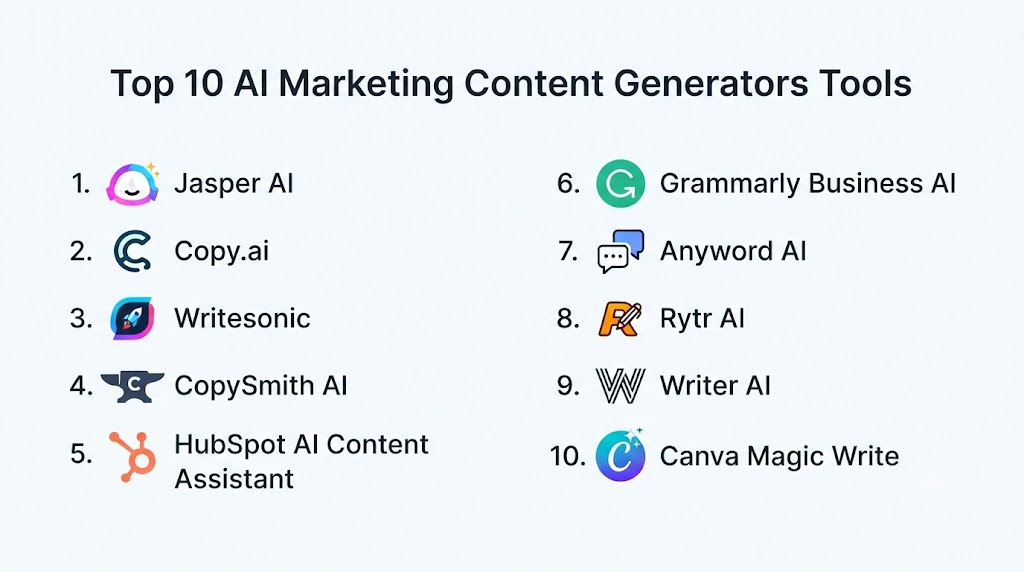
Top 10 AI Marketing Content Generators Tools
1 — Jasper AI
One-line verdict: Best for marketing teams needing AI-powered content creation with brand-focused workflows.
Short description:
Jasper AI is a marketing-focused AI content platform designed to help teams create, optimize, and manage marketing content. It supports businesses producing content across campaigns, websites, social media, and customer communication channels.
Standout Capabilities
- AI marketing content generation.
- Brand voice customization.
- Campaign content creation.
- Content rewriting and optimization.
- Marketing workflow assistance.
- Team collaboration features.
- Content planning support.
AI-Specific Depth
- Model support: Uses AI models and connected AI capabilities depending on configuration.
- RAG / knowledge integration: Supports brand and business information integration depending on features.
- Evaluation: Content review and optimization workflows depend on user processes.
- Guardrails: Brand controls and content policies vary by configuration.
- Observability: Usage analytics and content tracking capabilities vary.
Pros
- Strong marketing-focused workflows.
- Useful brand customization features.
- Helps teams scale content production.
Cons
- AI output still requires human review.
- Advanced features may require higher plans.
- Not a replacement for marketing strategy.
Security & Compliance
Security capabilities depend on platform configuration and organizational requirements.
Organizations should verify:
- Data handling practices.
- Access controls.
- Content governance options.
Specific certifications should be verified based on business requirements.
Deployment & Platforms
- Cloud-based platform.
- Web application.
- Team collaboration environment.
Integrations & Ecosystem
Jasper AI integrates with marketing workflows and business systems.
Common integrations include:
- Marketing platforms.
- Content management systems.
- Collaboration tools.
- Business applications.
Pricing Model
Subscription-based pricing model. Costs vary based on users, features, and requirements.
Best-Fit Scenarios
- Marketing departments.
- Content teams.
- Businesses creating large content volumes.
2 — Copy.ai
One-line verdict: Best for teams creating marketing copy, sales messaging, and campaign content quickly.
Short description:
Copy.ai is an AI content generation platform focused on marketing and sales workflows. It helps organizations create promotional content, customer messaging, social posts, and business communication materials.
Standout Capabilities
- Marketing copy generation.
- Sales content creation.
- Social media content.
- Email writing assistance.
- Campaign idea generation.
- Workflow automation.
- Content rewriting.
AI-Specific Depth
- Model support: AI capabilities depend on connected models and platform configuration.
- RAG / knowledge integration: Supports business context integration depending on workflow setup.
- Evaluation: Requires human review for accuracy and quality.
- Guardrails: Brand and content controls vary.
- Observability: Usage monitoring depends on available features.
Pros
- Easy for marketing teams to adopt.
- Useful for quick content creation.
- Supports multiple marketing workflows.
Cons
- Requires editing for brand consistency.
- Complex enterprise needs may require additional processes.
- AI-generated content may need fact checking.
Security & Compliance
Security features depend on account configuration and organizational requirements.
Deployment & Platforms
- Cloud-based platform.
- Web access.
- Team collaboration support.
Integrations & Ecosystem
Common integrations include:
- Marketing tools.
- Business applications.
- Workflow automation platforms.
- Content systems.
Pricing Model
Subscription-based pricing model. Costs vary based on features and usage.
Best-Fit Scenarios
- Marketing teams.
- Sales teams.
- Startups creating content quickly.
3 — Writesonic
One-line verdict: Best for businesses creating SEO-focused marketing content and digital campaigns.
Short description:
Writesonic is an AI writing platform designed to help businesses create marketing content, website copy, articles, advertisements, and SEO-focused content. It supports content teams looking to improve production speed.
Standout Capabilities
- AI article generation.
- Marketing copy creation.
- SEO content assistance.
- Content rewriting.
- Advertisement copy generation.
- Landing page content.
- Writing improvement tools.
AI-Specific Depth
- Model support: AI model capabilities vary by platform configuration.
- RAG / knowledge integration: Depends on available features and workflows.
- Evaluation: Requires human review for quality and accuracy.
- Guardrails: Content controls vary.
- Observability: Performance tracking depends on configuration.
Pros
- Strong content generation capabilities.
- Useful for SEO workflows.
- Supports multiple content formats.
Cons
- AI content requires editing.
- SEO recommendations should be reviewed.
- Advanced workflows may need customization.
Security & Compliance
Security capabilities depend on configuration and organizational needs.
Organizations should verify:
- Data privacy controls.
- Account permissions.
- Content handling practices.
Deployment & Platforms
- Cloud-based platform.
- Web application.
- Marketing workflow environment.
Integrations & Ecosystem
Writesonic integrates with content and marketing workflows.
Common integrations include:
- Content platforms.
- SEO tools.
- Marketing applications.
- Business systems.
Pricing Model
Subscription-based pricing model. Costs vary based on usage and selected features.
Best-Fit Scenarios
- Content marketing teams.
- SEO professionals.
- Businesses producing online content.
4 — CopySmith AI
One-line verdict: Best for e-commerce and marketing teams creating product-focused content at scale.
Short description:
CopySmith AI is a content generation platform designed to help businesses create marketing copy, product descriptions, advertising content, and brand communication materials. It focuses on helping teams produce consistent content across multiple channels.
Standout Capabilities
- Product description generation.
- Marketing copy creation.
- E-commerce content workflows.
- Content rewriting.
- Brand messaging support.
- Bulk content generation.
- Team collaboration features.
AI-Specific Depth
- Model support: AI capabilities depend on available platform models and configuration.
- RAG / knowledge integration: Business context integration depends on workflow setup.
- Evaluation: Content quality requires human review and optimization.
- Guardrails: Brand guidelines and content controls vary.
- Observability: Content usage tracking depends on platform features.
Pros
- Useful for large-scale product content creation.
- Supports marketing workflows.
- Helps improve content production speed.
Cons
- Requires human editing for accuracy.
- Best suited for marketing content use cases.
- Advanced customization may require setup.
Security & Compliance
Security capabilities depend on platform configuration and organizational requirements.
Organizations should verify:
- Data handling practices.
- Access controls.
- Content protection policies.
Deployment & Platforms
- Cloud-based platform.
- Web application.
- Marketing workflow environment.
Integrations & Ecosystem
CopySmith AI integrates with business and marketing workflows.
Common integrations include:
- E-commerce platforms.
- Content management systems.
- Marketing tools.
- Business applications.
Pricing Model
Subscription-based pricing model. Costs vary based on users, features, and usage.
Best-Fit Scenarios
- E-commerce businesses.
- Product marketing teams.
- Organizations creating large content catalogs.
5 — HubSpot AI Content Assistant
One-line verdict: Best for organizations combining AI content creation with CRM-driven marketing workflows.
Short description:
HubSpot AI Content Assistant provides AI-powered support for creating marketing content within a broader customer relationship management environment. It helps teams generate emails, blogs, social posts, and customer-facing communication.
Standout Capabilities
- AI marketing copy creation.
- Email content assistance.
- Blog writing support.
- Social media content generation.
- CRM-connected workflows.
- Marketing automation support.
- Content personalization.
AI-Specific Depth
- Model support: AI capabilities depend on HubSpot AI services.
- RAG / knowledge integration: Can use connected business information depending on configuration.
- Evaluation: Content effectiveness depends on marketing analytics.
- Guardrails: Brand and access controls vary.
- Observability: Marketing performance tracking depends on connected systems.
Pros
- Strong CRM ecosystem integration.
- Useful for customer-focused marketing.
- Supports multiple marketing channels.
Cons
- Best value comes within the HubSpot ecosystem.
- Advanced features may require additional services.
- AI-generated content requires review.
Security & Compliance
Security capabilities depend on account configuration and organizational requirements.
Organizations should evaluate:
- User permissions.
- Data management.
- Access controls.
Deployment & Platforms
- Cloud-based platform.
- Web access.
- Marketing automation environment.
Integrations & Ecosystem
HubSpot AI Content Assistant integrates with marketing and customer management systems.
Common integrations include:
- CRM platforms.
- Email marketing tools.
- Sales workflows.
- Analytics systems.
- Content platforms.
Pricing Model
Subscription-based pricing model. Costs vary based on selected products and features.
Best-Fit Scenarios
- Marketing departments.
- Sales and marketing alignment.
- CRM-driven campaigns.
6 — Grammarly Business AI
One-line verdict: Best for teams improving marketing content quality, clarity, and communication consistency.
Short description:
Grammarly Business AI helps organizations improve written communication through AI-powered writing assistance, editing, and content improvement features. It supports marketing teams by improving readability, tone, and messaging quality.
Standout Capabilities
- AI writing assistance.
- Grammar and style improvement.
- Tone adjustment.
- Content rewriting.
- Brand communication support.
- Team writing standards.
- Writing productivity improvements.
AI-Specific Depth
- Model support: AI writing models provided through the platform.
- RAG / knowledge integration: Business style and communication guidelines can be incorporated depending on features.
- Evaluation: Writing quality review depends on team workflows.
- Guardrails: Enterprise writing controls vary.
- Observability: Usage analytics depend on administration features.
Pros
- Improves content quality.
- Easy adoption across teams.
- Useful for marketing communication.
Cons
- More focused on writing improvement than content generation.
- Not a complete marketing automation platform.
- Advanced workflows may require additional tools.
Security & Compliance
Security capabilities depend on business configuration.
Organizations should verify:
- Data protection.
- Administrative controls.
- Content handling policies.
Deployment & Platforms
- Cloud-based platform.
- Browser and application integrations.
- Team collaboration environment.
Integrations & Ecosystem
Common integrations include:
- Productivity applications.
- Communication tools.
- Business writing environments.
- Marketing workflows.
Pricing Model
Subscription-based pricing model. Costs vary depending on users and features.
Best-Fit Scenarios
- Marketing teams.
- Business communication teams.
- Organizations improving content quality.
7 — Anyword AI
One-line verdict: Best for marketers optimizing content variations and performance-focused messaging.
Short description:
Anyword AI is a marketing content generation platform focused on creating and improving marketing copy. It helps teams generate content variations for advertisements, websites, emails, and campaigns.
Standout Capabilities
- Marketing copy generation.
- Content variation creation.
- Campaign messaging support.
- Audience-focused writing.
- Performance prediction features.
- Brand voice management.
- Copy optimization.
AI-Specific Depth
- Model support: AI capabilities depend on platform configuration.
- RAG / knowledge integration: Brand information integration varies.
- Evaluation: Content performance evaluation depends on marketing metrics.
- Guardrails: Brand controls vary.
- Observability: Performance insights depend on available features.
Pros
- Strong marketing-focused workflows.
- Useful for testing messaging variations.
- Helps improve campaign efficiency.
Cons
- Requires marketing expertise for best results.
- AI suggestions need review.
- Advanced features may require higher plans.
Security & Compliance
Security features depend on organizational configuration.
Deployment & Platforms
- Cloud-based platform.
- Web access.
- Marketing workflow support.
Integrations & Ecosystem
Common integrations include:
- Advertising platforms.
- Marketing tools.
- Content workflows.
- Business applications.
Pricing Model
Subscription-based pricing model. Costs vary based on features and usage.
Best-Fit Scenarios
- Advertising teams.
- Growth marketers.
- Campaign optimization workflows.
8 — Rytr AI
One-line verdict: Best for individuals and small teams needing affordable AI-assisted marketing content creation.
Short description:
Rytr AI provides AI writing assistance for creating marketing copy, blog ideas, emails, social media content, and other business communications. It is designed for users who need quick content generation.
Standout Capabilities
- Marketing copy generation.
- Blog writing assistance.
- Email content creation.
- Social media writing.
- Content rewriting.
- Idea generation.
- Writing improvement.
AI-Specific Depth
- Model support: AI writing models provided through the platform.
- RAG / knowledge integration: Limited or varies by configuration.
- Evaluation: Requires human review.
- Guardrails: Content controls vary.
- Observability: Usage tracking depends on available features.
Pros
- Easy to use.
- Suitable for beginners.
- Affordable content assistance.
Cons
- Less suitable for complex enterprise workflows.
- Requires editing for quality.
- Limited advanced marketing automation.
Security & Compliance
Security capabilities depend on platform configuration.
Deployment & Platforms
- Cloud-based platform.
- Web application.
- Writing assistant environment.
Integrations & Ecosystem
Common integrations include:
- Content workflows.
- Marketing applications.
- Writing tools.
Pricing Model
Subscription-based pricing model. Costs vary depending on features.
Best-Fit Scenarios
- Freelancers.
- Small businesses.
- Content creators.
9 — Writer AI
One-line verdict: Best for enterprises needing controlled AI content creation with brand governance.
Short description:
Writer AI is an enterprise-focused AI writing platform designed to help organizations create consistent content while maintaining brand standards and governance. It supports marketing, communication, and business content workflows.
Standout Capabilities
- Enterprise content generation.
- Brand voice control.
- Writing assistance.
- Content governance.
- Workflow collaboration.
- Business knowledge integration.
- AI writing management.
AI-Specific Depth
- Model support: Enterprise AI model capabilities vary by configuration.
- RAG / knowledge integration: Supports business knowledge integration depending on setup.
- Evaluation: Requires organization-specific review workflows.
- Guardrails: Enterprise governance and policy controls.
- Observability: Administrative analytics vary.
Pros
- Strong enterprise governance.
- Supports brand consistency.
- Useful for large content teams.
Cons
- Enterprise setup may require planning.
- May be more than small teams need.
- Pricing details vary.
Security & Compliance
Security capabilities depend on enterprise configuration.
Organizations should verify:
- Access controls.
- Data protection.
- Governance requirements.
Deployment & Platforms
- Cloud-based platform.
- Enterprise web environment.
- Integration capabilities.
Integrations & Ecosystem
Common integrations include:
- Business applications.
- Content systems.
- Collaboration platforms.
- Enterprise workflows.
Pricing Model
Enterprise subscription pricing model. Exact pricing varies.
Best-Fit Scenarios
- Large marketing teams.
- Enterprise content operations.
- Regulated organizations.
10 — Canva Magic Write
One-line verdict: Best for teams combining AI-generated marketing text with visual content creation.
Short description:
Canva Magic Write provides AI writing assistance within a visual content creation platform. It helps marketers create copy for presentations, social posts, campaigns, and branded content materials.
Standout Capabilities
- AI content generation.
- Social media copy creation.
- Marketing design workflows.
- Presentation content assistance.
- Brand asset integration.
- Visual content collaboration.
- Template-based creation.
AI-Specific Depth
- Model support: AI capabilities depend on platform services.
- RAG / knowledge integration: Brand information support varies.
- Evaluation: Content quality depends on user review.
- Guardrails: Brand controls depend on configuration.
- Observability: Usage analytics vary.
Pros
- Combines text and visual workflows.
- Easy for marketing teams.
- Strong collaboration features.
Cons
- Not focused only on advanced AI writing.
- Complex enterprise workflows may require additional tools.
- Content still requires review.
Security & Compliance
Security capabilities depend on account configuration and organizational requirements.
Deployment & Platforms
- Cloud-based platform.
- Web and application access.
- Design workflow environment.
Integrations & Ecosystem
Common integrations include:
- Marketing workflows.
- Design tools.
- Collaboration platforms.
- Content channels.
Pricing Model
Subscription-based pricing model. Costs vary depending on features and users.
Best-Fit Scenarios
- Social media teams.
- Marketing designers.
- Small and medium businesses.
Comparison Table (Top 10)
| Tool Name | Best For | Deployment | Model Flexibility | Strength | Watch-Out | Public Rating |
|---|---|---|---|---|---|---|
| Jasper AI | Marketing teams | Cloud | Hosted | Brand-focused content | Requires review | N/A |
| Copy.ai | Marketing copy | Cloud | Hosted | Fast content creation | Editing needed | N/A |
| Writesonic | SEO content | Cloud | Hosted | Content production | Quality review needed | N/A |
| CopySmith AI | Product content | Cloud | Hosted | E-commerce copy | Specialized use | N/A |
| HubSpot AI Content Assistant | CRM marketing | Cloud | Hosted | Marketing integration | Ecosystem dependency | N/A |
| Grammarly Business AI | Writing quality | Cloud | Hosted | Communication improvement | Limited generation focus | N/A |
| Anyword AI | Campaign messaging | Cloud | Hosted | Marketing optimization | Requires expertise | N/A |
| Rytr AI | Small teams | Cloud | Hosted | Affordable writing | Limited enterprise features | N/A |
| Writer AI | Enterprise content | Cloud | Hosted | Governance | Higher complexity | N/A |
| Canva Magic Write | Visual marketing | Cloud | Hosted | Text + design workflow | Less specialized | N/A |
Scoring & Evaluation (Transparent Rubric)
The scoring below provides a comparative evaluation of AI Marketing Content Generators based on common business requirements. These scores are comparative, not absolute, because the best solution depends on content volume, marketing goals, team size, brand requirements, security expectations, and existing marketing workflows.
The evaluation focuses on AI content quality, customization, marketing capabilities, integrations, usability, performance, security controls, and ecosystem support.
| Tool | Core Features | Reliability/Eval | Guardrails | Integrations | Ease | Perf/Cost | Security/Admin | Support | Weighted Total |
|---|---|---|---|---|---|---|---|---|---|
| Jasper AI | 9 | 9 | 9 | 8 | 8 | 7 | 9 | 9 | 8.55 |
| Copy.ai | 8 | 8 | 8 | 8 | 9 | 8 | 8 | 8 | 8.15 |
| Writesonic | 8 | 8 | 8 | 8 | 9 | 9 | 7 | 8 | 8.20 |
| CopySmith AI | 8 | 8 | 8 | 8 | 8 | 8 | 8 | 8 | 8.00 |
| HubSpot AI Content Assistant | 9 | 8 | 9 | 10 | 8 | 8 | 9 | 9 | 8.95 |
| Grammarly Business AI | 8 | 9 | 9 | 8 | 10 | 8 | 9 | 9 | 8.85 |
| Anyword AI | 8 | 8 | 8 | 8 | 9 | 8 | 8 | 8 | 8.15 |
| Rytr AI | 7 | 7 | 7 | 7 | 10 | 9 | 7 | 8 | 7.70 |
| Writer AI | 10 | 9 | 10 | 9 | 7 | 7 | 10 | 9 | 9.00 |
| Canva Magic Write | 8 | 8 | 8 | 9 | 10 | 9 | 8 | 9 | 8.70 |
Top 3 for Enterprise
1. Writer AI
Best suited for enterprises requiring controlled AI content creation, brand governance, and team collaboration.
2. HubSpot AI Content Assistant
A strong choice for organizations connecting AI content creation with CRM and marketing automation workflows.
3. Jasper AI
Useful for marketing teams producing large volumes of brand-focused content.
Top 3 for SMB
1. Canva Magic Write
A practical option for small businesses combining AI writing with visual marketing creation.
2. Writesonic
Suitable for businesses creating SEO content, website copy, and digital marketing materials.
3. Copy.ai
Useful for teams needing fast marketing copy generation without complex setup.
Top 3 for Developers
1. Writer AI
Useful for organizations building controlled AI content workflows with enterprise requirements.
2. Jasper AI
Suitable for teams integrating AI content creation into marketing operations.
3. Copy.ai
Useful for building marketing automation workflows around AI-generated content.
Which AI Marketing Content Generator Tool Is Right for You?
The right AI Marketing Content Generator depends on your business objectives, content requirements, team size, brand guidelines, and workflow complexity.
Different organizations need different capabilities. A startup may prioritize speed and affordability, while an enterprise may require governance, security, and controlled AI adoption.
Solo / Freelancer
Individuals usually need simple AI writing assistance for creating content faster.
Recommended options:
- Canva Magic Write.
- Rytr AI.
- Copy.ai.
Important considerations:
- Affordable pricing.
- Easy learning curve.
- Quick content generation.
- Simple editing workflows.
Best use cases:
- Blog drafts.
- Social media posts.
- Email writing.
- Client content projects.
SMB
Small and medium businesses need AI tools that balance content quality, productivity, and affordability.
Recommended options:
- Writesonic.
- Copy.ai.
- Canva Magic Write.
SMBs should focus on:
- Brand consistency.
- Marketing automation.
- SEO support.
- Content collaboration.
- Multi-channel publishing.
Best use cases:
- Website content.
- Product descriptions.
- Campaign materials.
- Social media marketing.
Mid-Market
Growing companies require better workflows, collaboration, and content management.
Recommended options:
- Jasper AI.
- Anyword AI.
- HubSpot AI Content Assistant.
Important requirements:
- Team collaboration.
- Marketing integrations.
- Brand management.
- Content approval workflows.
- Performance tracking.
Best use cases:
- Marketing campaigns.
- Customer communication.
- Product marketing.
- Lead generation.
Enterprise
Large organizations require AI content systems with governance, security, and scalability.
Recommended options:
- Writer AI.
- HubSpot AI Content Assistant.
- Jasper AI.
Enterprise buyers should evaluate:
- Brand controls.
- User permissions.
- Content approval processes.
- Data protection.
- AI governance.
- Integration capabilities.
Best use cases:
- Global marketing teams.
- Enterprise content operations.
- Multi-brand organizations.
Regulated Industries (Finance, Healthcare, Public Sector)
Organizations working with sensitive information should prioritize responsible AI usage.
Important evaluation areas:
- Data protection.
- Content review processes.
- Access management.
- Governance policies.
- Human approval workflows.
Recommended approach:
- Use AI for content assistance.
- Maintain human review for customer-facing communication.
- Establish clear content quality standards.
Specific certifications and compliance details should always be verified based on organizational requirements.
Budget vs Premium
Budget-focused approach
Organizations looking for affordable solutions should prioritize:
- Simple content generation.
- Easy adoption.
- Low maintenance.
- Basic marketing workflows.
Suitable options:
- Rytr AI.
- Canva Magic Write.
- Copy.ai.
Premium enterprise approach
Organizations requiring advanced content operations should prioritize:
- Brand governance.
- Collaboration.
- Security controls.
- Enterprise integrations.
Suitable options:
- Writer AI.
- Jasper AI.
- HubSpot AI Content Assistant.
Build vs Buy (When to DIY)
Building a custom AI marketing content system may make sense when:
- The organization has unique content requirements.
- Internal AI expertise is available.
- Custom workflows are necessary.
- Content generation is a core business capability.
Buying an existing solution is better when:
- Faster implementation is required.
- Standard marketing workflows are sufficient.
- Teams need ready-to-use capabilities.
- Maintenance resources are limited.
Common Mistakes & How to Avoid Them
- Publishing AI content without review: Human editing is necessary for accuracy and quality.
- Ignoring brand voice: AI content should match company messaging standards.
- Using generic prompts: Better instructions create better results.
- Skipping fact checking: AI-generated information should be verified.
- Ignoring SEO strategy: AI should support marketing strategy, not replace it.
- Creating low-quality content at scale: More content does not always mean better results.
- Not protecting business information: Sensitive data should be handled carefully.
- Ignoring content originality: AI outputs should be reviewed for uniqueness.
- Over-automating creative decisions: Human creativity remains important.
- Not training marketing teams: Teams need proper AI workflows.
- Ignoring analytics: Content performance should be measured.
- Using too many disconnected AI tools: A clear workflow reduces complexity.
- Not maintaining brand guidelines: AI systems require regular updates.
- Ignoring customer perspective: Marketing content should focus on audience needs.
FAQs
1. What are AI Marketing Content Generators?
AI Marketing Content Generators are tools that use artificial intelligence to help businesses create marketing materials such as blogs, emails, advertisements, and social media content.
2. Can AI marketing tools replace content writers?
No. They assist writers by improving productivity, generating ideas, and creating drafts, but human creativity and review remain important.
3. Are AI-generated marketing contents accurate?
Accuracy depends on the AI system, instructions, and review process. Human verification is recommended before publishing.
4. Can AI tools maintain brand voice?
Yes, many platforms provide customization options to help businesses maintain consistent messaging.
5. Can AI marketing tools create SEO content?
Yes, many tools support SEO-focused content creation, but strategic optimization still requires human expertise.
6. Are AI marketing tools secure?
Security depends on platform capabilities, data handling practices, and organizational configuration.
7. Can AI generate social media content?
Yes, AI tools can help create captions, post ideas, campaign messages, and content variations.
8. How much do AI content generators cost?
Costs vary based on features, users, content volume, and enterprise requirements.
9. Can businesses integrate AI content tools with marketing platforms?
Yes, many tools provide integrations with marketing systems, content platforms, and business applications.
10. Can enterprises use AI content generators?
Yes, enterprises can use them with proper governance, security controls, and approval workflows.
11. How should companies evaluate AI-generated content quality?
Companies should review accuracy, brand alignment, originality, readability, and audience relevance.
12. What is the future of AI marketing content generation?
AI marketing tools are expected to become more personalized, multimodal, workflow-driven, and integrated with marketing operations.
Conclusion
AI Marketing Content Generators are transforming how businesses plan, create, and optimize marketing content. These tools help teams increase productivity, generate creative ideas, personalize communication, and manage content workflows more efficiently.The best AI content generator depends on business requirements, marketing goals, team size, and governance needs. Small businesses may prefer simple and affordable solutions, while enterprises often require advanced controls, collaboration features, and secure AI workflows.Organizations should focus on using AI as a strategic marketing assistant that improves creativity and efficiency while maintaining human oversight, quality standards, and brand consistency.
