Introduction
AI Creative Testing & Optimization Platforms are AI-powered solutions that help businesses analyze, test, and improve marketing creatives such as advertisements, images, videos, headlines, product messaging, landing pages, and campaign assets. These platforms use artificial intelligence, machine learning, predictive analytics, and automation to identify which creative elements are more likely to engage audiences and improve campaign outcomes.
Modern marketing teams create thousands of creative variations across multiple channels. Manually testing every version is slow, expensive, and often unable to capture complex audience behaviors. AI-based creative optimization platforms help organizations accelerate experimentation, understand audience preferences, and make better decisions using data-driven insights.
As businesses adopt AI-driven marketing workflows, these platforms are becoming important for improving campaign efficiency, personalization, and creative performance while reducing manual analysis. They support teams by combining creative intelligence, automated testing, audience insights, and optimization recommendations.
Real-world use cases:
- Marketing teams testing different advertisement designs, headlines, and messaging variations before large campaigns.
- E-commerce companies optimizing product images, promotional creatives, and customer-focused messaging.
- Advertising agencies comparing creative performance across multiple clients and campaigns.
- Growth teams improving conversion rates through continuous creative experimentation.
- Mobile app companies testing onboarding screens, promotional content, and user engagement campaigns.
- Brand teams maintaining consistency while adapting creative content for different audiences.
Evaluation Criteria for Buyers:
Organizations selecting an AI Creative Testing & Optimization Platform should evaluate:
- AI accuracy in identifying high-performing creative variations.
- Support for different content formats including text, images, videos, and interactive assets.
- Automated testing and experimentation capabilities.
- Integration with advertising platforms, analytics tools, and marketing systems.
- Data privacy controls and creative asset protection.
- AI model flexibility and customization options.
- Quality of reporting, insights, and recommendations.
- Ability to manage large creative libraries.
- Collaboration and approval workflows.
- Security, governance, and administrative controls.
Best for: Marketing teams, advertising agencies, e-commerce companies, enterprise brands, growth teams, and organizations managing high volumes of digital campaigns that need faster creative decisions and continuous optimization.
Not ideal for: Small businesses running occasional campaigns, teams with limited creative testing requirements, or organizations that already have simple analytics workflows and do not need AI-based optimization.
What’s Changed in AI Creative Testing & Optimization Platforms
AI Creative Testing & Optimization Platforms are evolving from traditional experimentation systems into intelligent creative decision-making platforms. Businesses are increasingly looking for solutions that combine automation, personalization, analytics, and responsible AI practices.
Key changes include:
- AI-generated creative variations: Platforms are increasingly helping teams create multiple versions of advertisements, messages, and visual assets for testing.
- Multimodal creative analysis: AI systems can analyze combinations of text, images, videos, layouts, and audience responses to understand overall creative effectiveness.
- Agent-based marketing workflows: AI agents are being introduced to automate experiment planning, creative recommendations, reporting, and optimization activities.
- Predictive performance analysis: Instead of only measuring past results, platforms increasingly use AI to predict which creative variations may perform better.
- Personalized creative experiences: Businesses are moving toward delivering different creative experiences based on customer segments, behavior patterns, and preferences.
- Advanced experimentation methods: Organizations are adopting automated testing, multivariate experiments, and continuous optimization workflows.
- Privacy-focused AI processing: Companies are prioritizing secure data handling, controlled access, and transparent data usage practices.
- Improved AI evaluation: Buyers increasingly expect reliable measurement of AI recommendations, experiment quality, and optimization accuracy.
- Cost and performance optimization: AI tools are helping businesses reduce wasted advertising spend by identifying stronger-performing creative assets.
- Human approval workflows: Enterprises are combining AI recommendations with human review to maintain brand standards and creative quality.
Quick Buyer Checklist
Use this checklist to shortlist AI Creative Testing & Optimization Platforms quickly:
AI Capabilities
- Does the platform analyze creative performance using AI?
- Can it evaluate multiple content formats?
- Does it provide actionable recommendations instead of only reports?
Creative Testing Features
- Does it support A/B testing?
- Can it run multiple experiments simultaneously?
- Does it provide clear performance comparisons?
Data Privacy & Security
- Does the platform provide data retention controls?
- Are customer and creative assets protected?
- Are access permissions and administrative controls available?
Model Flexibility
- Does it support different AI models?
- Can organizations connect custom models or APIs?
- Does it reduce dependency on a single vendor?
Integration Support
- Can it connect with advertising platforms?
- Does it integrate with analytics and customer platforms?
- Are APIs available for custom workflows?
Evaluation & Monitoring
- Does it provide experiment validation?
- Can teams track performance changes over time?
- Are optimization recommendations measurable?
Cost Management
- Is pricing transparent?
- Does it support scalable usage?
- Can teams control AI processing costs?
Governance
- Are approval workflows available?
- Can teams maintain brand guidelines?
- Does it support enterprise governance requirements?
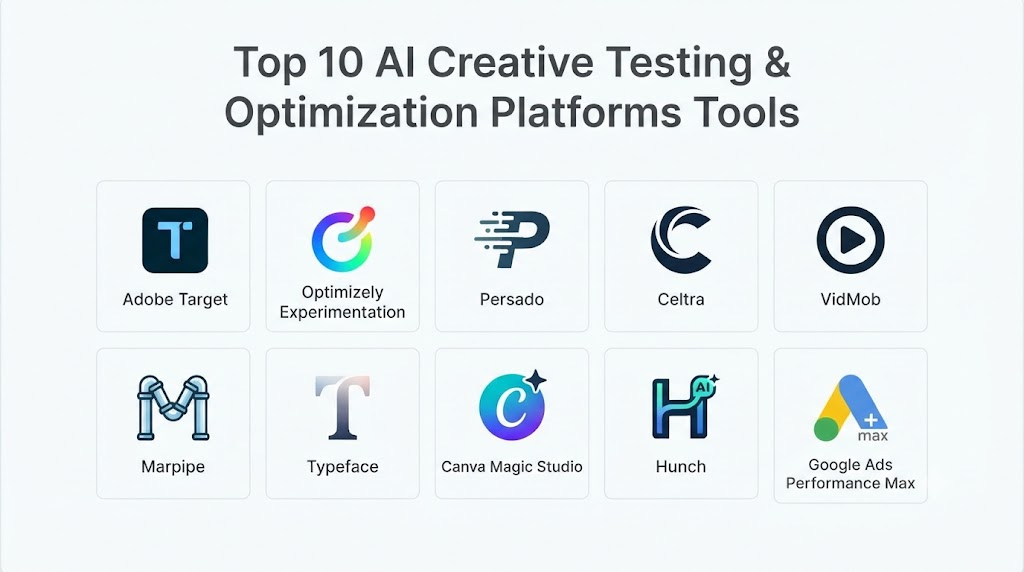
Top 10 AI Creative Testing & Optimization Platforms Tools
1 — Adobe Target
One-line verdict: Best for enterprises needing advanced personalization, testing, and AI-driven digital experience optimization.
Short description:
Adobe Target is an enterprise experimentation and personalization platform that helps organizations test digital experiences, content variations, and customer interactions. It is commonly used by large marketing teams that require structured experimentation and audience-based optimization.
Standout Capabilities
- AI-assisted personalization for digital experiences.
- Automated experimentation workflows.
- Audience segmentation and targeting.
- Experience optimization across digital channels.
- Integration with enterprise marketing ecosystems.
- Testing support for different customer journeys.
- Data-driven personalization strategies.
AI-Specific Depth
- Model support: Uses Adobe AI capabilities; additional model options vary.
- RAG / knowledge integration: N/A.
- Evaluation: Supports experimentation analysis and performance measurement.
- Guardrails: Workflow and governance controls vary by implementation.
- Observability: Analytics and reporting available; AI-specific tracing varies.
Pros
- Strong enterprise experimentation capabilities.
- Supports complex personalization requirements.
- Works well with large marketing technology environments.
Cons
- Implementation can require technical expertise.
- May be expensive for smaller teams.
- Advanced features can require dedicated resources.
Security & Compliance
Security features depend on deployment and configuration. Specific certifications, compliance details, and data residency options should be verified based on organizational requirements.
Deployment & Platforms
- Deployment: Cloud-based.
- Platform access: Web-based.
- Self-hosted option: Not publicly stated.
Integrations & Ecosystem
Adobe Target is designed to work with enterprise marketing and analytics ecosystems.
Common integrations include:
- Marketing analytics platforms.
- Customer experience platforms.
- Content management systems.
- Advertising technology solutions.
- Enterprise data systems.
Pricing Model
Pricing is typically based on enterprise requirements, usage, and selected capabilities. Exact pricing is not publicly stated.
Best-Fit Scenarios
- Large organizations running personalized digital campaigns.
- Enterprises managing multiple customer channels.
- Marketing teams requiring advanced experimentation programs.
2 — Optimizely Experimentation
One-line verdict: Best for product and growth teams running structured experiments to improve digital experiences.
Short description:
Optimizely Experimentation helps organizations test website experiences, product changes, and customer interactions. It supports teams that want a data-driven approach to improving engagement and conversion performance.
Standout Capabilities
- A/B testing workflows.
- Experiment management.
- Audience targeting.
- Digital experience optimization.
- Collaboration features.
- Data-driven decision support.
- Experiment performance tracking.
AI-Specific Depth
- Model support: AI capabilities vary by product configuration.
- RAG / knowledge integration: N/A.
- Evaluation: Strong experimentation measurement capabilities.
- Guardrails: Workflow controls vary.
- Observability: Experiment analytics available.
Pros
- Strong experimentation foundation.
- Useful for growth-focused organizations.
- Helps reduce guesswork in creative decisions.
Cons
- Advanced experimentation may require expertise.
- AI functionality varies by offering.
- Setup can be complex for smaller teams.
Security & Compliance
Security features vary by plan and implementation. Specific certifications are not publicly stated.
Deployment & Platforms
- Deployment: Cloud-based.
- Platform access: Web-based.
- Self-hosted: Varies / N/A.
Integrations & Ecosystem
Optimizely connects with digital experience and marketing ecosystems.
Common integrations include:
- Analytics platforms.
- Content management systems.
- Marketing automation tools.
- Customer experience platforms.
- APIs for custom workflows.
Pricing Model
Pricing depends on selected features, usage requirements, and organizational scale. Exact pricing is not publicly stated.
Best-Fit Scenarios
- Product teams optimizing user experiences.
- Growth teams running continuous experiments.
- Businesses improving conversion performance through testing.
3 — Persado
One-line verdict: Best for enterprise marketing teams optimizing emotional messaging and customer engagement.
Short description:
Persado is an AI-powered marketing platform focused on improving communication performance through machine learning and language optimization. It helps organizations test different messaging approaches and understand which language patterns connect better with audiences.
Standout Capabilities
- AI-driven marketing message optimization.
- Emotional language analysis for customer communications.
- Creative variation testing.
- Audience response prediction.
- Campaign messaging improvement.
- Enterprise marketing workflow support.
- Performance insights for communication strategies.
AI-Specific Depth
- Model support: Uses proprietary AI capabilities; additional model flexibility varies.
- RAG / knowledge integration: N/A.
- Evaluation: Uses performance measurement and campaign response analysis.
- Guardrails: Brand and messaging controls may vary.
- Observability: Campaign analytics available; AI-specific tracing varies.
Pros
- Strong focus on marketing language optimization.
- Helps teams test messaging at scale.
- Useful for customer communication improvements.
Cons
- Primarily focused on language-based optimization.
- May require existing campaign data for best results.
- Advanced enterprise features may not suit small teams.
Security & Compliance
Security capabilities depend on deployment and enterprise agreements. Specific certifications and compliance details are not publicly stated.
Deployment & Platforms
- Deployment: Cloud-based.
- Platform access: Web-based.
- Self-hosted: Not publicly stated.
Integrations & Ecosystem
Persado works with marketing technology environments to support campaign optimization.
Common integrations include:
- Marketing automation platforms.
- Customer engagement systems.
- Campaign management tools.
- Analytics platforms.
- Enterprise data environments.
Pricing Model
Pricing details are typically enterprise-based and depend on usage, campaign requirements, and implementation scope. Exact pricing is not publicly stated.
Best-Fit Scenarios
- Large brands optimizing customer messaging.
- Marketing teams managing high-volume communications.
- Enterprises focused on personalized customer engagement.
4 — Celtra
One-line verdict: Best for brands needing scalable AI-assisted creative production and campaign optimization.
Short description:
Celtra is a creative automation platform designed for large marketing teams and agencies managing digital advertising assets. It helps organizations create, manage, adapt, and optimize creative content across multiple advertising channels.
Standout Capabilities
- Creative production automation.
- Scalable asset management.
- Campaign creative adaptation.
- Collaboration workflows.
- Brand consistency management.
- Multi-channel creative operations.
- Performance-focused creative workflows.
AI-Specific Depth
- Model support: AI capabilities vary by product features.
- RAG / knowledge integration: N/A.
- Evaluation: Creative performance measurement varies.
- Guardrails: Brand controls and workflows available depending on configuration.
- Observability: Campaign reporting available.
Pros
- Supports large creative operations.
- Helps improve production efficiency.
- Useful for global marketing teams.
Cons
- Best suited for larger organizations.
- Creative optimization depth varies by implementation.
- Pricing may not fit smaller businesses.
Security & Compliance
Enterprise security details, certifications, and compliance information are not publicly stated.
Deployment & Platforms
- Deployment: Cloud-based.
- Platform access: Web-based.
- Self-hosted: Not publicly stated.
Integrations & Ecosystem
Celtra supports advertising and marketing workflows.
Common integrations include:
- Advertising platforms.
- Marketing technology systems.
- Creative asset workflows.
- Analytics solutions.
- Enterprise collaboration tools.
Pricing Model
Pricing generally depends on business requirements, creative volume, and enterprise usage. Exact pricing is not publicly stated.
Best-Fit Scenarios
- Global brands managing thousands of creative assets.
- Advertising agencies producing campaigns at scale.
- Marketing teams requiring creative workflow automation.
5 — VidMob
One-line verdict: Best for brands analyzing video creative performance through AI-powered insights.
Short description:
VidMob is a creative intelligence platform focused on helping brands understand how different creative elements influence advertising performance. It analyzes video and digital content to provide insights for improving future campaigns.
Standout Capabilities
- AI-based creative analytics.
- Video performance analysis.
- Creative element identification.
- Campaign optimization insights.
- Cross-platform creative measurement.
- Marketing performance intelligence.
- Creative learning systems.
AI-Specific Depth
- Model support: Proprietary AI capabilities; flexibility varies.
- RAG / knowledge integration: N/A.
- Evaluation: Creative performance evaluation and analysis.
- Guardrails: Brand controls vary.
- Observability: Reporting dashboards available.
Pros
- Strong focus on video creative analysis.
- Helps marketers understand creative impact.
- Useful for performance advertising teams.
Cons
- More specialized toward creative intelligence.
- May not replace complete experimentation platforms.
- Enterprise-focused capabilities may require larger budgets.
Security & Compliance
Security certifications and compliance details are not publicly stated.
Deployment & Platforms
- Deployment: Cloud-based.
- Platform access: Web-based.
- Self-hosted: Not publicly stated.
Integrations & Ecosystem
VidMob connects with advertising and marketing workflows.
Common integrations include:
- Advertising platforms.
- Marketing analytics systems.
- Campaign management tools.
- Brand measurement solutions.
- Data platforms.
Pricing Model
Pricing varies based on campaign requirements, creative volume, and services selected. Exact pricing is not publicly stated.
Best-Fit Scenarios
- Brands running large video advertising campaigns.
- Marketing teams analyzing creative effectiveness.
- Agencies managing performance-based advertising.
6 — Marpipe
One-line verdict: Best for advertisers needing structured creative testing and scalable advertising experiments.
Short description:
Marpipe is a creative testing platform designed to help advertising teams test multiple creative elements and identify combinations that perform better. It focuses on systematic experimentation for digital advertising campaigns.
Standout Capabilities
- Creative testing automation.
- Multivariate advertising experiments.
- Creative performance analysis.
- Campaign learning insights.
- Structured experimentation workflows.
- Asset comparison capabilities.
- Advertising optimization support.
AI-Specific Depth
- Model support: AI capabilities vary.
- RAG / knowledge integration: N/A.
- Evaluation: Supports creative experiment analysis.
- Guardrails: Testing controls vary.
- Observability: Performance reporting available.
Pros
- Strong creative experimentation approach.
- Helps teams move beyond simple A/B testing.
- Useful for paid advertising optimization.
Cons
- Primarily focused on advertising use cases.
- May need integration with existing marketing systems.
- Advanced workflows may require learning.
Security & Compliance
Specific certifications and compliance details are not publicly stated.
Deployment & Platforms
- Deployment: Cloud-based.
- Platform access: Web-based.
- Self-hosted: Not publicly stated.
Integrations & Ecosystem
Marpipe supports advertising workflows through integrations.
Common integrations include:
- Advertising platforms.
- Analytics tools.
- Marketing systems.
- Data connectors.
- Campaign management workflows.
Pricing Model
Pricing depends on usage, advertising requirements, and selected features. Exact pricing is not publicly stated.
Best-Fit Scenarios
- Performance marketing teams.
- Advertising agencies.
- Businesses running large creative testing programs.
7 — Typeface
One-line verdict: Best for enterprises creating and optimizing branded AI-generated marketing content.
Short description:
Typeface is an AI content creation platform designed for enterprise teams producing marketing and brand content. It combines generative AI capabilities with brand-focused workflows to help teams create and adapt creative assets.
Standout Capabilities
- AI-powered content creation.
- Brand-controlled creative generation.
- Marketing asset production.
- Content adaptation workflows.
- Enterprise collaboration.
- Creative scaling.
- Brand consistency management.
AI-Specific Depth
- Model support: Uses AI models with flexibility depending on configuration.
- RAG / knowledge integration: Supports brand knowledge integration capabilities; exact options vary.
- Evaluation: Creative review and workflow evaluation features vary.
- Guardrails: Brand controls and governance features available depending on setup.
- Observability: Usage monitoring varies.
Pros
- Helps teams scale content creation.
- Supports brand-focused AI workflows.
- Useful for enterprise marketing operations.
Cons
- More focused on content creation than pure testing.
- AI optimization depth may vary.
- Enterprise deployment may require planning.
Security & Compliance
Security, compliance certifications, and enterprise controls vary. Specific details should be verified based on organizational needs.
Deployment & Platforms
- Deployment: Cloud-based.
- Platform access: Web-based.
- Self-hosted: Not publicly stated.
Integrations & Ecosystem
Typeface supports enterprise content workflows.
Common integrations include:
- Marketing platforms.
- Content systems.
- Creative workflows.
- Enterprise applications.
- Collaboration tools.
Pricing Model
Pricing depends on usage, team size, and enterprise requirements. Exact pricing is not publicly stated.
Best-Fit Scenarios
- Enterprises creating large content volumes.
- Marketing teams needing AI-assisted creative workflows.
- Organizations maintaining strict brand guidelines.
8 — Canva Magic Studio
One-line verdict: Best for teams needing simple AI-powered creative generation, editing, and optimization workflows.
Short description:
Canva Magic Studio combines design tools with AI capabilities to help individuals, marketing teams, and businesses create, modify, and optimize visual content. It supports creative production workflows where teams need faster design iteration and content adaptation.
Standout Capabilities
- AI-assisted design creation.
- Automated image and content generation.
- Creative editing workflows.
- Template-based marketing asset production.
- Brand kit management.
- Team collaboration features.
- Fast creative experimentation.
AI-Specific Depth
- Model support: Uses Canva AI capabilities; external model flexibility varies.
- RAG / knowledge integration: Brand assets and content references supported depending on configuration.
- Evaluation: Creative review and performance measurement capabilities vary.
- Guardrails: Brand controls and content policies available depending on features.
- Observability: Usage analytics available; detailed AI tracing varies.
Pros
- Easy for non-designers to use.
- Strong creative production capabilities.
- Useful for rapid content experimentation.
Cons
- Advanced optimization capabilities may be limited compared with enterprise platforms.
- Better suited for creative production than complex experimentation.
- Enterprise customization varies.
Security & Compliance
Security controls depend on plan and configuration. Specific certifications, compliance details, and data residency options are not publicly stated.
Deployment & Platforms
- Deployment: Cloud-based.
- Platforms: Web, Windows, macOS, iOS, Android.
- Self-hosted: Not publicly stated.
Integrations & Ecosystem
Canva connects with creative, collaboration, and productivity workflows.
Common integrations include:
- Cloud storage platforms.
- Social media publishing tools.
- Marketing workflows.
- Collaboration platforms.
- Content management systems.
Pricing Model
Pricing generally follows free and subscription-based models with additional enterprise options. Exact pricing varies by plan and region.
Best-Fit Scenarios
- Small and medium marketing teams.
- Businesses creating frequent social content.
- Teams needing quick AI-assisted creative production.
9 — Hunch
One-line verdict: Best for performance marketers automating personalized advertising creative production.
Short description:
Hunch is a creative automation platform focused on helping advertisers produce, manage, and optimize personalized advertising assets. It is designed for teams running large-scale paid campaigns across multiple channels.
Standout Capabilities
- Automated creative production.
- Dynamic advertising personalization.
- Campaign workflow automation.
- Creative variation management.
- Performance-focused advertising workflows.
- Asset adaptation across channels.
- Marketing automation support.
AI-Specific Depth
- Model support: AI capabilities vary by implementation.
- RAG / knowledge integration: N/A.
- Evaluation: Campaign performance measurement available.
- Guardrails: Creative workflow controls vary.
- Observability: Advertising performance reporting available.
Pros
- Supports large-scale advertising workflows.
- Helps reduce manual creative production effort.
- Useful for personalized campaign execution.
Cons
- Mainly focused on advertising use cases.
- May require existing campaign infrastructure.
- Advanced AI capabilities vary.
Security & Compliance
Security certifications and compliance details are not publicly stated.
Deployment & Platforms
- Deployment: Cloud-based.
- Platform access: Web-based.
- Self-hosted: Not publicly stated.
Integrations & Ecosystem
Hunch supports advertising and campaign management ecosystems.
Common integrations include:
- Social advertising platforms.
- Marketing tools.
- Product catalogs.
- Data systems.
- Creative management workflows.
Pricing Model
Pricing varies based on advertising volume, features, and business requirements. Exact pricing is not publicly stated.
Best-Fit Scenarios
- Performance marketing teams.
- E-commerce advertisers.
- Agencies managing multiple advertising campaigns.
10 — Google Ads Performance Max Creative Optimization
One-line verdict: Best for advertisers using AI-powered campaign automation across Google advertising channels.
Short description:
Google Ads Performance Max uses AI-driven campaign optimization to help advertisers improve performance across Google’s advertising inventory. It automatically combines creative assets, audience signals, and campaign data to optimize delivery.
Standout Capabilities
- AI-powered campaign optimization.
- Automated creative asset combinations.
- Audience signal analysis.
- Cross-channel advertising delivery.
- Performance-focused recommendations.
- Automated bidding optimization.
- Campaign insights.
AI-Specific Depth
- Model support: Uses Google’s proprietary AI systems.
- RAG / knowledge integration: N/A for standard advertising workflows.
- Evaluation: Campaign performance measurement available.
- Guardrails: Advertising policy controls available.
- Observability: Campaign reporting and performance metrics available.
Pros
- Strong advertising automation capabilities.
- Uses large-scale campaign data signals.
- Useful for advertisers running multi-channel campaigns.
Cons
- Limited control compared with fully manual experimentation.
- Mostly focused on Google advertising ecosystem.
- AI decision transparency can vary.
Security & Compliance
Security and privacy controls depend on account configuration and Google’s advertising policies. Specific enterprise requirements should be reviewed based on usage.
Deployment & Platforms
- Deployment: Cloud-based.
- Platforms: Web-based.
- Self-hosted: Not applicable.
Integrations & Ecosystem
Google Ads Performance Max integrates with advertising and marketing environments.
Common integrations include:
- Google advertising products.
- Analytics platforms.
- Product feed systems.
- Conversion tracking tools.
- Marketing measurement solutions.
Pricing Model
Usage-based advertising model. Advertisers pay based on campaign activity and selected bidding strategies. Exact costs vary.
Best-Fit Scenarios
- Businesses running Google advertising campaigns.
- E-commerce companies managing product advertising.
- Marketing teams seeking automated campaign optimization.
Comparison Table: Top 10 AI Creative Testing & Optimization Platforms
| Tool Name | Best For | Deployment | Model Flexibility | Strength | Watch-Out | Public Rating |
|---|---|---|---|---|---|---|
| Adobe Target | Enterprise personalization | Cloud | Hosted AI | Enterprise experimentation | Complex setup | N/A |
| Optimizely Experimentation | Growth teams | Cloud | Hosted AI | Structured testing | Learning curve | N/A |
| Persado | AI marketing messaging | Cloud | Proprietary AI | Language optimization | Narrower use case | N/A |
| Celtra | Creative operations | Cloud | Hosted AI | Creative automation | Enterprise focus | N/A |
| VidMob | Video creative analytics | Cloud | Proprietary AI | Creative intelligence | Specialized focus | N/A |
| Marpipe | Advertising experiments | Cloud | Hosted AI | Creative testing | Paid media focus | N/A |
| Typeface | Enterprise AI content | Cloud | Multi-model options vary | Brand content generation | Testing depth varies | N/A |
| Canva Magic Studio | Fast creative production | Cloud | Hosted AI | Easy design workflows | Less enterprise experimentation | N/A |
| Hunch | Advertising automation | Cloud | Hosted AI | Personalized ads | Marketing-specific | N/A |
| Google Ads Performance Max | Advertising optimization | Cloud | Proprietary AI | Automated campaigns | Less control | N/A |
Scoring & Evaluation: Transparent Rubric
The following scoring framework compares platforms based on common enterprise requirements. Scores are comparative and represent overall category suitability rather than absolute product quality.
Evaluation weights:
- Core features – 20%
- AI reliability & evaluation – 15%
- Guardrails & safety – 10%
- Integrations & ecosystem – 15%
- Ease of use – 10%
- Performance & cost controls – 15%
- Security & admin – 10%
- Support & community – 5%
| Tool | Core | Reliability/Eval | Guardrails | Integrations | Ease | Perf/Cost | Security/Admin | Support | Weighted Total |
|---|---|---|---|---|---|---|---|---|---|
| Adobe Target | 9 | 8 | 8 | 10 | 6 | 8 | 9 | 8 | 8.3 |
| Optimizely Experimentation | 9 | 8 | 7 | 9 | 7 | 8 | 8 | 8 | 8.1 |
| Persado | 8 | 8 | 7 | 8 | 7 | 8 | 8 | 7 | 7.7 |
| Celtra | 8 | 7 | 7 | 9 | 7 | 8 | 8 | 7 | 7.7 |
| VidMob | 8 | 8 | 7 | 8 | 8 | 8 | 7 | 7 | 7.8 |
| Marpipe | 8 | 8 | 7 | 8 | 8 | 8 | 7 | 7 | 7.7 |
| Typeface | 8 | 7 | 8 | 8 | 8 | 7 | 8 | 7 | 7.7 |
| Canva Magic Studio | 8 | 7 | 7 | 8 | 10 | 8 | 7 | 9 | 8.0 |
| Hunch | 7 | 7 | 7 | 8 | 8 | 8 | 7 | 7 | 7.3 |
| Google Ads Performance Max | 9 | 8 | 8 | 10 | 8 | 9 | 8 | 9 | 8.8 |
Top 3 for Enterprise
- Google Ads Performance Max
- Adobe Target
- Optimizely Experimentation
Top 3 for SMB
- Canva Magic Studio
- Google Ads Performance Max
- Optimizely Experimentation
Top 3 for Developers
- Optimizely Experimentation
- Adobe Target
- Google Ads Performance Max
Which AI Creative Testing & Optimization Platform Is Right for You?
Choosing the right AI Creative Testing & Optimization Platform depends on business goals, creative volume, technical requirements, budget, and the level of automation needed. There is no single platform that works best for every organization. The right choice depends on whether the priority is creative production, experimentation, advertising optimization, personalization, or enterprise governance.
Solo / Freelancer
Individual marketers, consultants, and freelancers usually need simple tools that help create, test, and improve creative assets without complex implementation.
Recommended options:
- Canva Magic Studio: Suitable for quickly creating AI-assisted designs, social media creatives, and marketing assets.
- Google Ads Performance Max: Useful for freelancers managing advertising campaigns with automated optimization.
- Hunch: Helpful for marketers managing personalized advertising workflows.
Important selection factors:
- Easy setup.
- Affordable pricing model.
- Minimal technical requirements.
- Fast creative generation and testing.
SMB
Small and medium businesses need platforms that balance automation, usability, and cost efficiency. They usually require better creative decisions but may not have dedicated data science or engineering teams.
Recommended options:
- Canva Magic Studio: Good for teams creating frequent marketing content.
- Optimizely Experimentation: Useful for businesses focused on improving website and customer experiences.
- Google Ads Performance Max: Suitable for businesses running paid advertising campaigns.
Important selection factors:
- Integration with existing marketing tools.
- Simple reporting.
- Low operational complexity.
- Ability to scale as marketing needs grow.
Mid-Market
Mid-market organizations often require structured experimentation, campaign optimization, and better collaboration between marketing, product, and analytics teams.
Recommended options:
- Optimizely Experimentation: Strong choice for organizations running continuous experiments.
- Adobe Target: Suitable for companies needing personalization and advanced customer experience optimization.
- VidMob: Useful for teams focused on creative intelligence and advertising performance.
Important selection factors:
- Experiment management.
- Team collaboration.
- Performance analytics.
- Integration with marketing technology systems.
Enterprise
Large enterprises usually require advanced personalization, governance, security controls, and the ability to manage thousands of creative assets across regions and channels.
Recommended options:
- Adobe Target: Strong for enterprise personalization and digital experience optimization.
- Google Ads Performance Max: Useful for large advertising operations.
- Optimizely Experimentation: Suitable for enterprise experimentation programs.
Important selection factors:
- Enterprise security controls.
- Role-based access management.
- Data governance.
- Large-scale experimentation.
- Workflow approvals.
Regulated Industries (Finance, Healthcare, Public Sector)
Organizations operating in regulated industries need stronger governance, privacy controls, and careful management of customer data.
Recommended approach:
- Prioritize platforms with clear data handling policies.
- Review security documentation before deployment.
- Maintain human approval for AI-generated creative decisions.
- Avoid uploading sensitive customer information unless appropriate controls exist.
- Ensure marketing content follows industry regulations.
Important selection factors:
- Data retention controls.
- Audit capabilities.
- Access management.
- Privacy protection.
- Human review workflows.
Budget vs Premium
Budget-focused approach:
Best suited for startups and smaller teams.
Recommended options:
- Canva Magic Studio.
- Google Ads Performance Max.
- Basic experimentation tools.
Focus areas:
- Easy implementation.
- Lower operational cost.
- Quick creative improvements.
Premium enterprise approach:
Best suited for organizations managing large marketing operations.
Recommended options:
- Adobe Target.
- Optimizely Experimentation.
- Enterprise creative intelligence platforms.
Focus areas:
- Advanced testing.
- Governance.
- Personalization.
- Large-scale optimization.
Build vs Buy: When to DIY
Building a custom creative optimization system may make sense when organizations have:
- Large internal engineering teams.
- Unique experimentation requirements.
- Existing AI infrastructure.
- Specialized data pipelines.
- Need for complete control over models and workflows.
Buying a platform is usually better when organizations need:
- Faster implementation.
- Ready-made integrations.
- Managed AI capabilities.
- Vendor-supported workflows.
- Lower maintenance requirements.
A hybrid approach is also common, where businesses use commercial platforms while building custom analytics, evaluation, or workflow layers internally.
Important areas:
- Data protection.
- Access management.
- Model performance monitoring.
- Brand compliance.
Common Mistakes & How to Avoid Them
Organizations often struggle with AI Creative Testing & Optimization Platforms because they focus only on technology and ignore workflow, governance, and evaluation.
Common mistakes include:
- Testing without clear objectives: Define what success means before running experiments.
- Ignoring data quality: Poor data can lead to unreliable AI recommendations.
- No AI evaluation process: Regularly measure whether AI suggestions improve outcomes.
- Over-automating creative decisions: Maintain human review for important brand decisions.
- Ignoring privacy requirements: Protect customer information and creative assets.
- No access controls: Use proper permissions to prevent unauthorized usage.
- Skipping prompt and workflow documentation: Maintain records of AI processes.
- Not monitoring AI performance: Track whether recommendations remain accurate over time.
- Unexpected cost growth: Monitor usage and AI processing expenses.
- Vendor lock-in risk: Consider portability and integration flexibility.
- Poor brand governance: Ensure AI-generated creatives follow brand standards.
- Ignoring experimentation bias: Validate results across different audiences.
- No incident response plan: Prepare processes for handling AI mistakes.
FAQs
What are AI Creative Testing & Optimization Platforms?
AI Creative Testing & Optimization Platforms use artificial intelligence to analyze, test, and improve marketing creatives. They help teams identify stronger-performing content variations and optimize campaigns.
How do AI creative optimization tools work?
These platforms analyze creative assets, audience behavior, and campaign results using AI models. They identify patterns and provide recommendations for improving performance.
Are AI Creative Testing Platforms suitable for small businesses?
Yes. Small businesses can use simpler platforms focused on creative creation, advertising optimization, and basic experimentation. Enterprise platforms may be unnecessary for limited campaigns.
Do these platforms support image and video testing?
Many platforms support visual creative analysis, including images and videos. Available capabilities vary by tool.
Can businesses use their own AI models?
Some platforms support custom AI integrations or external models, while others rely mainly on proprietary systems. Availability varies.
Are AI Creative Testing Platforms secure?
Security depends on the platform, configuration, and organizational policies. Businesses should review privacy controls, access management, and data handling practices.
Do these tools replace human marketers?
No. AI platforms assist marketers by providing insights, automation, and recommendations. Human creativity and decision-making remain important.
How much do AI Creative Testing Platforms cost?
Pricing varies based on features, usage, users, and enterprise requirements. Exact pricing depends on the selected platform.
Can these platforms integrate with advertising tools?
Many platforms support integrations with advertising, analytics, and marketing systems. Available integrations vary.
What is AI evaluation in creative optimization?
AI evaluation measures how accurately AI recommendations improve creative performance. It helps organizations validate whether AI outputs provide real value.
Should companies choose hosted AI or build their own system?
Hosted platforms are usually faster to implement, while custom systems provide more control. The best choice depends on technical resources and business requirements.
How can organizations avoid AI vendor lock-in?
Companies can reduce lock-in by using flexible platforms, maintaining data ownership, and selecting tools with integration options.
Conclusion
AI Creative Testing & Optimization Platforms are becoming important for organizations that want faster experimentation, better personalization, and more efficient creative decision-making. These tools help marketing teams analyze performance, automate testing workflows, and discover opportunities that may be difficult to identify through manual processes.The best platform depends on business size, creative requirements, technical resources, security expectations, and optimization goals. Enterprises may prioritize governance and personalization, while smaller teams may value simplicity and affordability.Successful adoption requires more than selecting a tool. Organizations should create evaluation processes, maintain human oversight, protect data, and continuously improve AI workflo
