Introduction
AI Marketing Attribution Modeling Tools help businesses understand which marketing channels, campaigns, touchpoints, and customer interactions contribute most to conversions and revenue. These platforms use artificial intelligence, machine learning, predictive analytics, and automated analysis to identify the impact of different marketing activities across complex customer journeys.
Traditional attribution methods often struggle because modern customers interact with multiple channels before making a decision. A customer may discover a brand through social media, engage with email campaigns, visit a website, interact with advertisements, and convert through another channel. AI-powered attribution tools analyze these connected interactions to provide deeper insights into marketing performance.
As organizations invest more in digital marketing, AI attribution platforms are becoming increasingly important for improving budget allocation, campaign optimization, personalization, and customer journey analysis. They help marketing teams move beyond basic last-click measurement and understand the complete impact of their marketing ecosystem.
Real-world use cases:
- Marketing teams identifying which channels contribute most to sales and conversions.
- E-commerce businesses optimizing advertising spend across multiple campaigns.
- SaaS companies analyzing customer acquisition journeys and lifecycle touchpoints.
- Enterprise brands measuring the impact of online and offline marketing activities.
- Growth teams predicting future campaign performance using historical data.
- Agencies providing advanced attribution insights for multiple clients.
Evaluation Criteria for Buyers:
Organizations selecting AI Marketing Attribution Modeling Tools should evaluate:
- Accuracy of AI-driven attribution models.
- Support for multi-touch attribution analysis.
- Integration with advertising platforms, CRM systems, and analytics tools.
- Ability to process large customer journey datasets.
- Data privacy, security, and governance controls.
- Support for predictive analytics and forecasting.
- Transparency of AI recommendations and attribution logic.
- Real-time reporting and dashboard capabilities.
- Cost management and scalability.
- Flexibility for custom attribution models.
- Support for first-party data strategies.
- Ease of collaboration between marketing and analytics teams.
Best for: Marketing teams, growth teams, advertising agencies, e-commerce companies, SaaS businesses, and enterprises that need accurate measurement of marketing effectiveness across multiple customer touchpoints.
Not ideal for: Small businesses with limited marketing channels, teams running simple campaigns, or organizations that do not collect enough customer interaction data to support advanced attribution analysis.
What’s Changed in AI Marketing Attribution Modeling Tools
AI Marketing Attribution Modeling Tools are evolving from simple reporting solutions into intelligent marketing decision systems. Modern platforms focus on predictive insights, automated analysis, privacy-aware measurement, and better understanding of complex customer journeys.
Key changes include:
- AI-powered multi-touch attribution: Platforms are improving their ability to analyze multiple customer interactions instead of relying only on first-click or last-click attribution.
- Predictive marketing analytics: AI models are increasingly helping businesses forecast future campaign outcomes and identify potential revenue opportunities.
- Privacy-focused measurement: With increasing limitations around third-party tracking, businesses are adopting first-party data strategies and privacy-aware attribution approaches.
- Cross-channel customer journey analysis: Modern systems combine data from advertising, websites, email, mobile applications, CRM platforms, and sales systems.
- Automated budget optimization: AI tools are helping marketers identify where additional investment may generate better returns.
- Machine learning-based insights: Attribution platforms increasingly use machine learning to detect patterns that may not be visible through manual analysis.
- Real-time marketing intelligence: Teams expect faster reporting and quicker feedback loops for campaign decisions.
- AI explainability requirements: Organizations want clearer explanations of why AI models assign value to specific marketing channels.
- Data governance improvements: Enterprise buyers are prioritizing access controls, data protection, and responsible AI practices.
- Integration with AI marketing ecosystems: Attribution tools are increasingly connecting with customer data platforms, analytics systems, advertising platforms, and automation tools.
Quick Buyer Checklist
Use this checklist when evaluating AI Marketing Attribution Modeling Tools:
Attribution Capabilities
- Does the platform support multi-touch attribution?
- Can it analyze complete customer journeys?
- Does it support custom attribution models?
AI & Analytics
- Does it use machine learning for attribution analysis?
- Can it provide predictive insights?
- Are AI recommendations understandable?
Data Integration
- Can it connect with advertising platforms?
- Does it support CRM and customer data systems?
- Can it combine online and offline marketing data?
Privacy & Security
- Does it provide data protection controls?
- Are access permissions available?
- Does it support responsible data usage practices?
Model Flexibility
- Can teams customize attribution logic?
- Does it support different analytical approaches?
- Can businesses integrate external data sources?
Reporting & Monitoring
- Are dashboards customizable?
- Can teams monitor campaign performance?
- Are historical insights available?
Cost & Scalability
- Does pricing support business growth?
- Can the platform handle increasing data volumes?
- Are usage costs predictable?
Governance
- Are audit capabilities available?
- Can teams control user permissions?
- Does the platform support enterprise workflows?
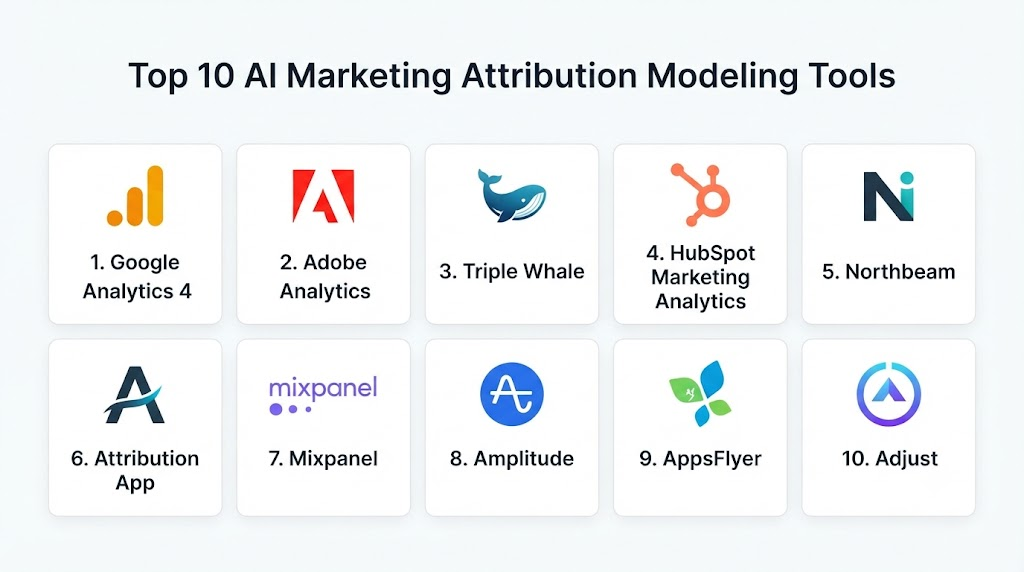
Top 10 AI Marketing Attribution Modeling Tools
1 — Google Analytics 4
One-line verdict: Best for businesses needing AI-powered analytics and cross-channel customer journey measurement.
Short description:
Google Analytics 4 is an analytics platform that uses machine learning capabilities to help businesses understand customer behavior across websites and applications. It provides attribution insights, predictive analytics features, and marketing performance measurement capabilities.
Standout Capabilities
- AI-assisted customer behavior analysis.
- Cross-platform measurement.
- Marketing channel performance tracking.
- Customer journey analysis.
- Conversion measurement.
- Audience insights.
- Predictive analytics capabilities.
- Integration with advertising ecosystems.
AI-Specific Depth
- Model support: Uses Google’s proprietary machine learning capabilities.
- RAG / knowledge integration: N/A.
- Evaluation: Provides analytics reporting and attribution measurement.
- Guardrails: Privacy and data controls vary based on configuration.
- Observability: Reporting dashboards and analytics monitoring available.
Pros
- Widely used analytics ecosystem.
- Strong integration capabilities.
- Useful for understanding customer journeys.
Cons
- Advanced attribution analysis may require expertise.
- Data interpretation can be complex.
- Custom enterprise needs may require additional solutions.
Security & Compliance
Security and privacy controls depend on account configuration and implementation. Specific certifications and compliance details are not publicly stated.
Deployment & Platforms
- Deployment: Cloud-based.
- Platforms: Web-based.
- Self-hosted: Not applicable.
Integrations & Ecosystem
Google Analytics 4 connects with marketing, advertising, and analytics ecosystems.
Common integrations include:
- Advertising platforms.
- Data warehouses.
- Marketing tools.
- Customer data systems.
- Reporting platforms.
Pricing Model
A standard version is available with additional enterprise capabilities. Exact pricing for enterprise requirements is not publicly stated.
Best-Fit Scenarios
- Businesses measuring digital marketing performance.
- Companies analyzing website and application journeys.
- Marketing teams needing integrated analytics.
2 — Adobe Analytics
One-line verdict: Best for enterprises requiring advanced customer journey analytics and attribution measurement.
Short description:
Adobe Analytics is an enterprise analytics platform designed to help organizations analyze customer behavior, marketing performance, and digital experiences. It supports advanced reporting and attribution workflows for large-scale organizations.
Standout Capabilities
- Enterprise customer journey analysis.
- Advanced marketing measurement.
- Multi-channel analytics.
- Audience segmentation.
- Custom reporting.
- Digital experience analytics.
- Enterprise data analysis.
AI-Specific Depth
- Model support: Uses Adobe AI capabilities; flexibility varies.
- RAG / knowledge integration: N/A.
- Evaluation: Analytics-based measurement and attribution analysis.
- Guardrails: Governance features vary by configuration.
- Observability: Reporting and analytics monitoring available.
Pros
- Strong enterprise analytics capabilities.
- Supports complex customer journeys.
- Flexible reporting options.
Cons
- Requires skilled teams for advanced usage.
- Implementation can be complex.
- May be costly for smaller organizations.
Security & Compliance
Security capabilities depend on enterprise configuration. Specific certifications and compliance details should be verified based on requirements.
Deployment & Platforms
- Deployment: Cloud-based.
- Platform: Web-based.
- Self-hosted: Not publicly stated.
Integrations & Ecosystem
Adobe Analytics integrates with enterprise marketing environments.
Common integrations include:
- Customer experience platforms.
- Marketing automation tools.
- Data management platforms.
- Advertising systems.
- Business intelligence tools.
Pricing Model
Enterprise pricing depends on implementation scope, data requirements, and selected features. Exact pricing is not publicly stated.
Best-Fit Scenarios
- Large enterprises measuring complex customer journeys.
- Organizations requiring advanced attribution analysis.
- Marketing teams managing multiple channels.
3 — Triple Whale
One-line verdict: Best for e-commerce brands needing AI-powered marketing attribution and revenue intelligence.
Short description:
Triple Whale is a marketing analytics and attribution platform designed primarily for e-commerce businesses. It combines data from multiple marketing channels to help brands understand customer acquisition performance, campaign effectiveness, and revenue contribution.
Standout Capabilities
- Multi-channel marketing attribution.
- Revenue and customer journey analysis.
- Marketing performance dashboards.
- E-commerce-focused analytics.
- Campaign performance monitoring.
- Customer acquisition insights.
- Automated reporting workflows.
AI-Specific Depth
- Model support: Uses proprietary analytics and AI capabilities; additional model flexibility varies.
- RAG / knowledge integration: N/A.
- Evaluation: Provides marketing performance measurement and attribution insights.
- Guardrails: Data controls and workflows vary.
- Observability: Analytics dashboards and performance reporting available.
Pros
- Strong focus on e-commerce attribution.
- Combines multiple marketing data sources.
- Provides actionable marketing insights.
Cons
- Primarily designed for e-commerce businesses.
- May not fit complex enterprise attribution needs.
- Advanced analytics requirements may need additional tools.
Security & Compliance
Security features depend on configuration and business requirements. Specific certifications and compliance details are not publicly stated.
Deployment & Platforms
- Deployment: Cloud-based.
- Platform access: Web-based.
- Self-hosted: Not publicly stated.
Integrations & Ecosystem
Triple Whale integrates with e-commerce and marketing technology environments.
Common integrations include:
- E-commerce platforms.
- Advertising platforms.
- Analytics systems.
- Customer data tools.
- Marketing applications.
Pricing Model
Pricing depends on business requirements, data volume, and selected features. Exact pricing is not publicly stated.
Best-Fit Scenarios
- Direct-to-consumer brands.
- E-commerce companies managing multiple advertising channels.
- Marketing teams needing revenue-focused attribution.
4 — HubSpot Marketing Analytics
One-line verdict: Best for businesses wanting attribution insights connected with CRM and marketing automation.
Short description:
HubSpot Marketing Analytics provides marketing measurement capabilities connected with CRM, sales, and customer engagement workflows. It helps organizations understand campaign performance and customer interactions throughout the buying journey.
Standout Capabilities
- Marketing campaign measurement.
- CRM-connected attribution insights.
- Customer lifecycle analysis.
- Lead source tracking.
- Marketing performance reporting.
- Customer journey visibility.
- Automation-based insights.
AI-Specific Depth
- Model support: Uses HubSpot AI capabilities; flexibility varies.
- RAG / knowledge integration: Supports business data integration depending on configuration.
- Evaluation: Marketing performance analysis and reporting available.
- Guardrails: User permissions and governance features vary.
- Observability: Analytics dashboards and reporting available.
Pros
- Strong CRM and marketing connection.
- Easy adoption for marketing teams.
- Useful for inbound marketing measurement.
Cons
- Advanced attribution needs may require higher-tier capabilities.
- Less specialized than dedicated attribution platforms.
- Large enterprises may need additional analytics systems.
Security & Compliance
Security controls depend on subscription and configuration. Specific certifications and compliance details should be verified according to business needs.
Deployment & Platforms
- Deployment: Cloud-based.
- Platforms: Web-based.
- Self-hosted: Not publicly stated.
Integrations & Ecosystem
HubSpot connects marketing, sales, customer service, and analytics workflows.
Common integrations include:
- CRM systems.
- Marketing automation tools.
- Advertising platforms.
- Analytics platforms.
- Customer engagement applications.
Pricing Model
Pricing typically depends on product package, users, features, and usage. Exact pricing is not publicly stated.
Best-Fit Scenarios
- SMBs using CRM-based marketing.
- Growing companies tracking customer journeys.
- Marketing teams needing connected sales and campaign insights.
5 — Northbeam
One-line verdict: Best for performance marketers requiring advanced attribution and marketing investment insights.
Short description:
Northbeam is a marketing attribution platform focused on helping businesses understand the impact of advertising channels and customer acquisition efforts. It provides analytics designed for companies managing significant marketing investments.
Standout Capabilities
- Multi-touch attribution analysis.
- Marketing channel measurement.
- Customer journey insights.
- Advertising performance analysis.
- Budget allocation insights.
- Revenue impact reporting.
- Marketing intelligence dashboards.
AI-Specific Depth
- Model support: Uses proprietary attribution methodologies; additional model support varies.
- RAG / knowledge integration: N/A.
- Evaluation: Attribution analysis and performance measurement.
- Guardrails: Data governance capabilities vary.
- Observability: Reporting dashboards and analytics tracking available.
Pros
- Focused on marketing attribution challenges.
- Helps improve advertising decisions.
- Useful for performance-focused teams.
Cons
- Primarily designed for marketing attribution use cases.
- Requires reliable data inputs.
- May not replace broader analytics platforms.
Security & Compliance
Security controls, certifications, and compliance details are not publicly stated.
Deployment & Platforms
- Deployment: Cloud-based.
- Platform access: Web-based.
- Self-hosted: Not publicly stated.
Integrations & Ecosystem
Northbeam connects with advertising and marketing systems.
Common integrations include:
- Advertising platforms.
- E-commerce systems.
- Analytics tools.
- Data sources.
- Marketing technology platforms.
Pricing Model
Pricing varies based on business size, data requirements, and platform usage. Exact pricing is not publicly stated.
Best-Fit Scenarios
- Brands investing heavily in paid advertising.
- Marketing teams optimizing acquisition costs.
- Companies needing advanced attribution insights.
6 — Attribution App
One-line verdict: Best for businesses needing lightweight attribution tracking and marketing performance visibility.
Short description:
Attribution App is a marketing measurement solution focused on helping businesses track customer journeys and understand how different marketing activities contribute to conversions.
Standout Capabilities
- Customer journey tracking.
- Multi-touch attribution reporting.
- Marketing channel analysis.
- Conversion path visualization.
- Campaign performance insights.
- Revenue attribution workflows.
AI-Specific Depth
- Model support: AI capabilities vary; specific model details are not publicly stated.
- RAG / knowledge integration: N/A.
- Evaluation: Provides attribution reporting and campaign analysis.
- Guardrails: Security and workflow controls vary.
- Observability: Reporting capabilities available.
Pros
- Focused attribution functionality.
- Helps visualize marketing impact.
- Suitable for teams needing straightforward measurement.
Cons
- May lack advanced enterprise AI capabilities.
- Features depend on implementation.
- Large-scale requirements may need additional platforms.
Security & Compliance
Specific certifications and security details are not publicly stated.
Deployment & Platforms
- Deployment: Cloud-based.
- Platform: Web-based.
- Self-hosted: Not publicly stated.
Integrations & Ecosystem
Attribution App supports marketing measurement workflows.
Common integrations include:
- Marketing platforms.
- Analytics systems.
- CRM tools.
- Advertising channels.
- Data sources.
Pricing Model
Pricing details vary based on features and usage. Exact pricing is not publicly stated.
Best-Fit Scenarios
- Small and medium businesses.
- Marketing teams needing attribution visibility.
- Organizations improving campaign measurement.
7 — Mixpanel
One-line verdict: Best for product teams analyzing user behavior and conversion journeys with advanced analytics.
Short description:
Mixpanel is a product analytics platform that helps organizations understand user behavior, engagement patterns, and conversion journeys. It is commonly used by product and growth teams to analyze customer interactions.
Standout Capabilities
- User behavior analytics.
- Event-based tracking.
- Customer journey analysis.
- Funnel measurement.
- Retention analysis.
- Product performance insights.
- Experiment measurement support.
AI-Specific Depth
- Model support: Uses analytics and AI capabilities; exact model flexibility varies.
- RAG / knowledge integration: N/A.
- Evaluation: Supports behavioral analysis and performance measurement.
- Guardrails: Access controls vary by configuration.
- Observability: Product analytics dashboards and monitoring available.
Pros
- Strong product analytics capabilities.
- Useful for understanding user behavior.
- Helps teams optimize customer journeys.
Cons
- Not a dedicated marketing attribution platform.
- Requires event tracking setup.
- Advanced analysis may need analytics expertise.
Security & Compliance
Security capabilities vary by plan and configuration. Specific certifications should be verified based on organizational requirements.
Deployment & Platforms
- Deployment: Cloud-based.
- Platforms: Web-based.
- Self-hosted: Not publicly stated.
Integrations & Ecosystem
Mixpanel integrates with product, marketing, and data ecosystems.
Common integrations include:
- Data warehouses.
- Customer platforms.
- Marketing tools.
- Analytics systems.
- Developer tools.
Pricing Model
Pricing varies based on data volume, features, and usage. Exact pricing is not publicly stated.
Best-Fit Scenarios
- Product-led companies.
- SaaS businesses analyzing user journeys.
- Growth teams improving conversion funnels.
8 — Amplitude
One-line verdict: Best for product and growth teams combining customer behavior analytics with marketing attribution insights.
Short description:
Amplitude is a digital analytics platform that helps organizations understand user behavior, customer journeys, and conversion patterns. It enables teams to analyze how different experiences and interactions influence engagement, retention, and business outcomes.
Standout Capabilities
- Customer journey analysis.
- Behavioral analytics.
- Conversion funnel tracking.
- User segmentation.
- Product and marketing performance insights.
- Experimentation measurement.
- Cross-functional analytics collaboration.
AI-Specific Depth
- Model support: Uses proprietary analytics and AI capabilities; additional model options vary.
- RAG / knowledge integration: N/A.
- Evaluation: Provides analytics measurement and behavioral analysis.
- Guardrails: Access controls and governance features vary.
- Observability: Analytics dashboards and reporting available.
Pros
- Strong user behavior analytics.
- Useful for product-led growth strategies.
- Helps connect customer actions with outcomes.
Cons
- Not a pure marketing attribution platform.
- Requires proper event tracking implementation.
- Advanced analysis may need experienced analysts.
Security & Compliance
Security controls depend on configuration and selected plan. Specific certifications and compliance details should be verified based on organizational requirements.
Deployment & Platforms
- Deployment: Cloud-based.
- Platforms: Web-based.
- Self-hosted: Not publicly stated.
Integrations & Ecosystem
Amplitude supports integrations across product, marketing, and data environments.
Common integrations include:
- Data warehouses.
- Customer data platforms.
- Marketing automation tools.
- Analytics platforms.
- Developer tools.
Pricing Model
Pricing varies based on usage, data volume, and selected features. Exact pricing is not publicly stated.
Best-Fit Scenarios
- SaaS companies analyzing customer journeys.
- Product teams improving user engagement.
- Growth teams measuring conversion behavior.
9 — AppsFlyer
One-line verdict: Best for mobile businesses needing AI-assisted attribution and marketing measurement.
Short description:
AppsFlyer is a mobile attribution and analytics platform designed to help organizations measure app marketing performance, user acquisition, and customer engagement. It helps mobile teams understand which campaigns and channels drive valuable user actions.
Standout Capabilities
- Mobile attribution measurement.
- User acquisition analytics.
- Campaign performance tracking.
- Customer journey insights.
- Fraud detection capabilities.
- Audience segmentation.
- Mobile marketing optimization.
AI-Specific Depth
- Model support: Uses proprietary analytics and machine learning capabilities; flexibility varies.
- RAG / knowledge integration: N/A.
- Evaluation: Provides attribution measurement and campaign analysis.
- Guardrails: Privacy and security controls available depending on configuration.
- Observability: Analytics dashboards and reporting features available.
Pros
- Strong mobile attribution capabilities.
- Useful for app marketing teams.
- Supports complex mobile customer journeys.
Cons
- Primarily focused on mobile applications.
- May not replace broader enterprise attribution systems.
- Requires proper mobile tracking implementation.
Security & Compliance
Security features depend on configuration. Specific certifications, compliance details, and data controls should be verified according to organizational needs.
Deployment & Platforms
- Deployment: Cloud-based.
- Platforms: Web-based.
- Self-hosted: Not publicly stated.
Integrations & Ecosystem
AppsFlyer connects with mobile marketing and analytics ecosystems.
Common integrations include:
- Mobile advertising platforms.
- Analytics systems.
- Customer engagement tools.
- Data warehouses.
- Marketing automation platforms.
Pricing Model
Pricing varies based on usage, attribution volume, and selected capabilities. Exact pricing is not publicly stated.
Best-Fit Scenarios
- Mobile app companies.
- User acquisition teams.
- Organizations measuring mobile advertising performance.
10 — Adjust
One-line verdict: Best for mobile marketers needing attribution analytics, campaign measurement, and user growth insights.
Short description:
Adjust is a mobile measurement and analytics platform that helps businesses understand advertising performance, user acquisition, and application growth. It provides tools for measuring marketing effectiveness across mobile channels.
Standout Capabilities
- Mobile attribution tracking.
- Campaign performance measurement.
- User acquisition analytics.
- Fraud prevention features.
- Audience insights.
- Marketing measurement workflows.
- Mobile growth analytics.
AI-Specific Depth
- Model support: Uses proprietary analytics capabilities; model flexibility varies.
- RAG / knowledge integration: N/A.
- Evaluation: Supports attribution analysis and marketing measurement.
- Guardrails: Security and privacy controls vary by implementation.
- Observability: Reporting and analytics dashboards available.
Pros
- Strong mobile marketing measurement.
- Helps optimize user acquisition campaigns.
- Provides detailed campaign insights.
Cons
- Focused mainly on mobile attribution.
- Not designed for all enterprise marketing analytics needs.
- Requires accurate tracking implementation.
Security & Compliance
Security features and compliance details depend on configuration. Specific certifications should be verified based on business requirements.
Deployment & Platforms
- Deployment: Cloud-based.
- Platform access: Web-based.
- Self-hosted: Not publicly stated.
Integrations & Ecosystem
Adjust supports mobile marketing ecosystems.
Common integrations include:
- Advertising networks.
- Mobile platforms.
- Analytics solutions.
- Data platforms.
- Customer engagement tools.
Pricing Model
Pricing varies depending on attribution volume, features, and business requirements. Exact pricing is not publicly stated.
Best-Fit Scenarios
- Mobile application businesses.
- Performance marketing teams.
- Companies optimizing mobile acquisition campaigns.
Comparison Table: Top 10 AI Marketing Attribution Modeling Tools
| Tool Name | Best For | Deployment | Model Flexibility | Strength | Watch-Out | Public Rating |
|---|---|---|---|---|---|---|
| Google Analytics 4 | Digital analytics and attribution | Cloud | Hosted AI | Broad analytics ecosystem | Complex reporting | N/A |
| Adobe Analytics | Enterprise analytics | Cloud | Hosted AI | Advanced customer journey analysis | Requires expertise | N/A |
| Triple Whale | E-commerce attribution | Cloud | Proprietary AI | Revenue intelligence | E-commerce focused | N/A |
| HubSpot Marketing Analytics | CRM-based attribution | Cloud | Hosted AI | Marketing and CRM connection | Advanced features vary | N/A |
| Northbeam | Performance marketing attribution | Cloud | Proprietary analytics | Marketing investment insights | Specialized use case | N/A |
| Attribution App | Lightweight attribution tracking | Cloud | Hosted | Simple attribution workflows | Limited enterprise depth | N/A |
| Mixpanel | Product analytics | Cloud | Hosted AI | User behavior insights | Not dedicated attribution | N/A |
| Amplitude | Product and growth analytics | Cloud | Hosted AI | Customer journey analytics | Requires tracking setup | N/A |
| AppsFlyer | Mobile attribution | Cloud | Proprietary AI | Mobile measurement | Mobile focused | N/A |
| Adjust | Mobile marketing analytics | Cloud | Proprietary AI | App growth measurement | Limited non-mobile use | N/A |
Scoring & Evaluation: Transparent Rubric
The scoring below provides a comparative view of AI Marketing Attribution Modeling Tools based on common business requirements. Scores are not absolute rankings because different organizations may prioritize different capabilities.
Evaluation weights:
- Core features – 20%
- AI reliability & evaluation – 15%
- Guardrails & safety – 10%
- Integrations & ecosystem – 15%
- Ease of use – 10%
- Performance & cost controls – 15%
- Security & admin – 10%
- Support & community – 5%
| Tool | Core | Reliability/Eval | Guardrails | Integrations | Ease | Perf/Cost | Security/Admin | Support | Weighted Total |
|---|---|---|---|---|---|---|---|---|---|
| Google Analytics 4 | 9 | 8 | 8 | 10 | 8 | 9 | 8 | 9 | 8.8 |
| Adobe Analytics | 10 | 9 | 9 | 10 | 6 | 8 | 9 | 8 | 8.9 |
| Triple Whale | 8 | 8 | 7 | 8 | 9 | 8 | 7 | 7 | 7.9 |
| HubSpot Marketing Analytics | 8 | 7 | 8 | 9 | 9 | 8 | 8 | 9 | 8.2 |
| Northbeam | 8 | 8 | 7 | 8 | 8 | 8 | 7 | 7 | 7.7 |
| Attribution App | 7 | 7 | 7 | 7 | 9 | 8 | 7 | 7 | 7.4 |
| Mixpanel | 9 | 8 | 8 | 9 | 8 | 8 | 8 | 8 | 8.4 |
| Amplitude | 9 | 8 | 8 | 9 | 8 | 8 | 8 | 8 | 8.4 |
| AppsFlyer | 9 | 8 | 8 | 9 | 8 | 8 | 8 | 8 | 8.4 |
| Adjust | 8 | 8 | 8 | 8 | 8 | 8 | 8 | 8 | 8.0 |
Top 3 for Enterprise
- Adobe Analytics
- Google Analytics 4
- Amplitude
Top 3 for SMB
- HubSpot Marketing Analytics
- Google Analytics 4
- Triple Whale
Top 3 for Developers
- Mixpanel
- Amplitude
- Google Analytics 4
Which AI Marketing Attribution Modeling Tool Is Right for You?
Selecting the right AI Marketing Attribution Modeling Tool depends on business size, marketing complexity, available data, technical resources, and measurement goals. Different organizations need different levels of attribution intelligence. Some teams need simple campaign measurement, while others require advanced AI-driven customer journey analysis across multiple channels.
Solo / Freelancer
Solo marketers and consultants usually need simple, affordable solutions that provide useful marketing insights without complex implementation.
Recommended options:
- Google Analytics 4: Suitable for understanding website traffic, campaign performance, and customer behavior.
- HubSpot Marketing Analytics: Useful for marketers managing CRM-based campaigns.
- Attribution App: Suitable for basic attribution tracking needs.
Important selection factors:
- Easy setup and management.
- Minimal technical requirements.
- Clear dashboards and reports.
- Affordable pricing structure.
- Simple campaign measurement.
Solo marketers should avoid overly complex enterprise attribution platforms unless they manage large client campaigns or require advanced analytics capabilities.
SMB
Small and medium businesses usually need attribution tools that help improve marketing decisions while remaining easy to operate.
Recommended options:
- Google Analytics 4: Good for measuring digital marketing activities.
- HubSpot Marketing Analytics: Useful for businesses already using CRM workflows.
- Triple Whale: Suitable for e-commerce brands managing multiple marketing channels.
Important selection factors:
- Integration with existing marketing platforms.
- Customer journey visibility.
- Campaign performance tracking.
- Simple reporting.
- Scalability as marketing operations grow.
SMBs should focus on platforms that provide actionable insights rather than unnecessary complexity.
Mid-Market
Mid-market companies often manage multiple marketing channels and need stronger attribution models to optimize budgets.
Recommended options:
- Mixpanel: Useful for product-led companies analyzing user journeys.
- Amplitude: Suitable for customer behavior and conversion analysis.
- Northbeam: Helpful for performance marketing measurement.
Important selection factors:
- Multi-channel attribution.
- Advanced segmentation.
- Data integration capabilities.
- Custom reporting.
- Collaboration between marketing and analytics teams.
Mid-market organizations should prioritize platforms that balance advanced analytics with operational simplicity.
Enterprise
Large enterprises typically require advanced attribution capabilities, strong governance, and the ability to process large volumes of customer data.
Recommended options:
- Adobe Analytics: Suitable for complex enterprise customer journey measurement.
- Google Analytics 4: Useful for organizations requiring broad digital analytics capabilities.
- Amplitude: Helpful for enterprises focused on product and customer behavior insights.
Important selection factors:
- Enterprise security controls.
- Large-scale data processing.
- Advanced attribution models.
- Data governance.
- Integration with existing technology ecosystems.
Enterprise organizations should evaluate implementation requirements carefully because successful attribution depends heavily on data quality and proper configuration.
Regulated Industries (Finance, Healthcare, Public Sector)
Organizations in regulated industries need stronger privacy, security, and governance practices when using AI attribution tools.
Important considerations:
- Review data collection and processing practices.
- Ensure customer information is handled responsibly.
- Use appropriate access controls.
- Maintain audit visibility.
- Apply human review for important marketing decisions.
- Avoid sharing sensitive information without proper safeguards.
Recommended approach:
- Prioritize platforms with strong enterprise controls.
- Validate privacy requirements before deployment.
- Create internal policies for AI-assisted marketing analytics.
Budget vs Premium
Budget-Friendly Approach
Suitable for startups, freelancers, and smaller marketing teams.
Common choices:
- Google Analytics 4.
- HubSpot Marketing Analytics.
- Attribution App.
Benefits:
- Lower implementation effort.
- Faster adoption.
- Basic attribution visibility.
- Easier team management.
Premium Enterprise Approach
Suitable for organizations with complex marketing operations.
Common choices:
- Adobe Analytics.
- Amplitude.
- Enterprise attribution platforms.
Benefits:
- Advanced analytics.
- Better customization.
- Larger data processing capabilities.
- Stronger governance options.
Build vs Buy: When to DIY
Building a custom AI attribution system may be suitable when organizations have:
- Strong internal engineering teams.
- Unique attribution requirements.
- Existing data infrastructure.
- Need for complete control over analytics models.
- Specialized customer journey analysis needs.
Buying a commercial platform is usually better when organizations need:
- Faster deployment.
- Pre-built integrations.
- Managed analytics capabilities.
- Vendor support.
- Lower maintenance requirements.
A hybrid approach is also possible where companies use commercial attribution platforms while creating custom reporting, analytics layers, or AI workflows internally.
Success metrics:
- Improved visibility into customer journeys.
- Faster marketing analysis.
- Better understanding of channel contribution.
- Reduced manual reporting effort.
focus areas:
- Data quality.
- Security controls.
- User access management.
- Attribution consistency.
Common Mistakes & How to Avoid Them
Organizations often fail to get value from AI attribution platforms because they focus only on technology instead of data, processes, and governance.
Common mistakes include:
- Using poor-quality data: AI attribution depends on accurate and complete marketing data.
- Choosing a platform without clear goals: Define business objectives before implementation.
- Ignoring customer privacy: Protect customer information and follow responsible data practices.
- Relying only on AI recommendations: Combine AI insights with human marketing expertise.
- Not validating attribution models: Regularly compare results against business outcomes.
- Ignoring offline interactions: Include important customer touchpoints beyond digital channels.
- Poor tracking implementation: Incorrect tracking creates unreliable attribution results.
- No governance process: Establish ownership and review workflows.
- Ignoring integration limitations: Ensure the platform connects with existing systems.
- Unexpected cost increases: Monitor usage and operational expenses.
- Overcomplicating attribution models: Start simple and improve gradually.
- No security review: Evaluate access controls and data protection features.
- Vendor dependency without flexibility: Maintain data ownership and integration options.
- Ignoring AI transparency: Understand how recommendations are generated.
FAQs
What are AI Marketing Attribution Modeling Tools?
AI Marketing Attribution Modeling Tools use artificial intelligence and analytics to determine how different marketing channels influence customer conversions. They help businesses understand the impact of campaigns across customer journeys.
How does AI improve marketing attribution?
AI improves attribution by analyzing large amounts of customer interaction data and identifying patterns that traditional models may miss. It helps teams understand channel contribution more accurately.
Are AI attribution tools useful for small businesses?
Yes. Small businesses can use simpler attribution solutions to understand campaign performance. Advanced enterprise platforms may be unnecessary unless marketing complexity increases.
Can AI attribution tools track multiple marketing channels?
Many attribution platforms support multiple channels, including advertising, websites, email, mobile applications, and CRM interactions. Available capabilities vary by platform.
Do AI attribution platforms replace marketers?
No. These tools support marketers by providing insights and recommendations. Human judgment remains important for strategy and decision-making.
Are customer data and marketing information secure in these platforms?
Security depends on the platform and configuration. Businesses should review privacy controls, data handling policies, and access management features.
Can companies use their own data with AI attribution tools?
Many platforms support integration with business data sources. The level of customization depends on the selected platform.
What is multi-touch attribution?
Multi-touch attribution assigns value across multiple customer interactions instead of giving all credit to a single marketing channel.
How much do AI Marketing Attribution Tools cost?
Pricing varies based on features, users, data volume, and business requirements. Exact costs depend on the selected platform.
Should companies build their own AI attribution system?
Building internally can make sense for organizations with strong technical teams and unique requirements. Most businesses benefit from using established platforms.
How do businesses measure AI attribution success?
Success can be measured through improved campaign decisions, better budget allocation, faster analysis, and improved understanding of customer journeys.
What should companies check before selecting an attribution platform?
Companies should evaluate data integration, privacy controls, attribution accuracy, reporting capabilities, scalability, and ease of use.
Conclusion
AI Marketing Attribution Modeling Tools are helping organizations better understand customer journeys, improve marketing investments, and make data-driven decisions. As marketing channels become more complex, AI-powered attribution provides deeper insights than traditional measurement approaches.The best platform depends on business goals, data maturity, marketing complexity, and technical requirements. Small businesses may prefer simpler analytics solutions, while enterprises often require advanced attribution models, governance, and scalability.
.
