Introduction
AI Social Listening & Trend Mining Tools use artificial intelligence and machine learning to monitor online conversations, analyze audience behavior, identify emerging trends, and provide insights from large volumes of digital discussions. These platforms collect and analyze signals from social networks, online communities, customer feedback channels, news sources, and digital platforms to help organizations understand public sentiment and market movements.
Traditional social listening methods often depend on manual monitoring, keyword tracking, and basic reporting. These approaches can make it difficult for businesses to detect fast-changing trends, understand customer opinions, and identify important conversations at scale. AI-powered social listening platforms solve these challenges by using natural language processing, sentiment analysis, machine learning, and automated trend detection.
Modern AI social listening tools help brands track customer sentiment, analyze competitor activity, discover market opportunities, identify potential risks, and understand audience preferences. They are becoming increasingly important as organizations manage real-time communication, brand reputation, customer experience, and digital marketing strategies.
AI-powered trend mining also helps businesses move from reactive monitoring to proactive decision-making. Instead of only responding to existing conversations, organizations can identify emerging topics, predict customer interests, and adjust strategies based on real-time intelligence.
Real-world use cases:
- Brands monitoring customer opinions and brand reputation.
- Marketing teams discovering trending topics and content opportunities.
- Companies analyzing competitor conversations and market movements.
- Customer experience teams identifying complaints and feedback patterns.
- Product teams collecting insights for feature improvements.
- Public relations teams detecting potential reputation risks.
Evaluation Criteria for Buyers:
Organizations selecting AI Social Listening & Trend Mining Tools should evaluate:
- Accuracy of sentiment analysis.
- AI-powered trend detection capabilities.
- Data source coverage.
- Real-time monitoring capabilities.
- Social media analytics features.
- Audience segmentation capabilities.
- Competitive intelligence features.
- AI explainability and insight quality.
- Data privacy and security controls.
- Integration with marketing and customer platforms.
- Reporting and visualization capabilities.
- Scalability for global monitoring.
Best for: Marketing teams, brand managers, customer experience teams, public relations professionals, enterprises, agencies, and organizations that need real-time market intelligence.
Not ideal for: Small businesses with limited digital presence, teams that do not actively monitor customer conversations, or organizations that do not need advanced audience analytics.
What’s Changed in AI Social Listening & Trend Mining Tools
AI Social Listening & Trend Mining Tools are evolving from simple keyword monitoring systems into intelligent market intelligence platforms. Modern solutions combine artificial intelligence, natural language processing, automation, and predictive analytics.
Key changes include:
- AI-powered sentiment analysis: Modern tools understand customer emotions, opinions, and context beyond simple positive or negative classification.
- Real-time trend discovery: AI helps organizations identify emerging conversations before they become major market trends.
- Multimodal analysis: Some platforms are expanding beyond text analysis to include images, videos, and other digital signals.
- Predictive trend intelligence: AI models help identify potential future interests, topics, and audience behaviors.
- Advanced audience segmentation: Businesses can analyze different customer groups based on interests, behaviors, and conversations.
- Competitive intelligence improvements: Organizations can monitor competitors and compare brand perception.
- Automated insight generation: AI summarizes large volumes of conversations into actionable business insights.
- Brand reputation monitoring: Companies are using AI to detect potential risks and customer concerns faster.
- Privacy and governance focus: Organizations are increasing attention toward responsible data usage and compliance.
- Workflow integration: Social listening insights are increasingly connected with marketing, customer service, and product teams.
Quick Buyer Checklist
Use this checklist when evaluating AI Social Listening & Trend Mining Tools:
AI Intelligence
- Does the platform provide accurate sentiment analysis?
- Can it identify emerging trends?
- Does it provide meaningful insights instead of only data?
Data Coverage
- Does it monitor relevant social platforms?
- Can it analyze multiple digital channels?
- Does it support global monitoring?
Trend Discovery
- Can it detect viral topics?
- Does it identify customer behavior changes?
- Can teams track industry movements?
Analytics & Reporting
- Are dashboards customizable?
- Can teams create automated reports?
- Are insights easy to understand?
AI Governance
- Are AI-generated insights explainable?
- Are data sources transparent?
- Can users control monitoring rules?
Security & Privacy
- Are customer conversations handled securely?
- Are access controls available?
- Can organizations manage data usage?
Integration
- Can it connect with marketing tools?
- Does it integrate with CRM platforms?
- Can insights flow into business workflows?
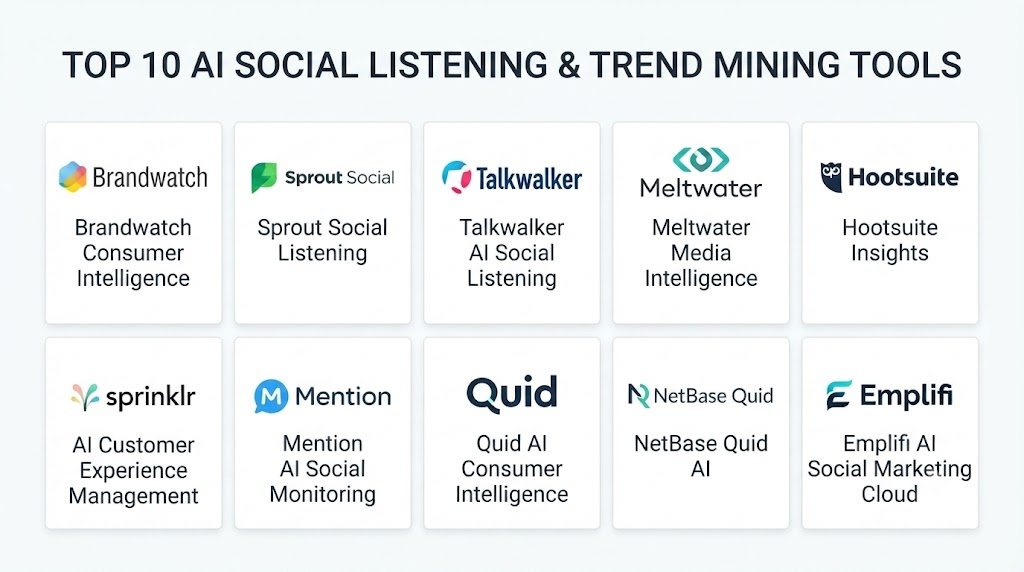
Top 10 AI Social Listening & Trend minning tools
1 — Brandwatch Consumer Intelligence
One-line verdict: Best for enterprises needing advanced AI-powered social insights and consumer intelligence.
Short description:
Brandwatch Consumer Intelligence helps organizations analyze online conversations, customer opinions, and market trends using artificial intelligence and analytics. It enables brands to understand audience behavior, monitor reputation, and identify emerging opportunities.
Standout Capabilities
- AI-powered social listening.
- Sentiment analysis.
- Consumer intelligence.
- Trend identification.
- Brand monitoring.
- Competitive analysis.
- Audience insights.
- Market research support.
AI-Specific Depth
- Model support: Uses AI and machine learning capabilities; specific model flexibility varies.
- RAG / knowledge integration: Data connections depend on configuration.
- Evaluation: Sentiment and trend analysis evaluation capabilities available.
- Guardrails: Data access and monitoring controls vary.
- Observability: Analytics dashboards and reporting available.
Pros
- Strong enterprise social intelligence capabilities.
- Helps identify consumer trends.
- Supports large-scale monitoring.
Cons
- Enterprise-focused pricing and complexity.
- Requires strategy for effective monitoring.
- Large datasets may require analysis expertise.
Security & Compliance
Security features depend on configuration. Specific certifications and compliance details should be verified before deployment.
Deployment & Platforms
- Deployment: Cloud-based.
- Platforms: Web-based.
- Self-hosted: Not publicly stated.
Integrations & Ecosystem
Brandwatch integrates with marketing and customer intelligence ecosystems.
Common integrations include:
- Marketing platforms.
- Customer experience tools.
- Analytics systems.
- Business intelligence platforms.
- Reporting solutions.
Pricing Model
Pricing varies based on users, features, data requirements, and monitoring scope. Exact pricing is not publicly stated.
Best-Fit Scenarios
- Enterprise brands.
- Global marketing teams.
- Organizations managing reputation at scale.
2 — Sprout Social Listening
One-line verdict: Best for businesses combining social management with AI-powered audience insights.
Short description:
Sprout Social Listening helps organizations monitor social conversations, analyze audience sentiment, and understand customer engagement patterns. It combines social management capabilities with analytics to support marketing and customer experience teams.
Standout Capabilities
- Social monitoring.
- Sentiment analysis.
- Audience insights.
- Trend tracking.
- Brand reputation management.
- Social analytics.
- Engagement analysis.
- Reporting automation.
AI-Specific Depth
- Model support: Uses AI capabilities for social analytics; specific model flexibility varies.
- RAG / knowledge integration: Uses connected social and business data depending on configuration.
- Evaluation: Social performance and sentiment analysis available.
- Guardrails: User permissions and workflow controls vary.
- Observability: Analytics dashboards and reporting available.
Pros
- Combines publishing and listening workflows.
- Strong social analytics capabilities.
- Useful for marketing teams.
Cons
- Best suited for social-focused organizations.
- Advanced intelligence may require higher plans.
- Depends on available social data.
Security & Compliance
Security features depend on configuration. Organizations should verify privacy controls and compliance requirements.
Deployment & Platforms
- Deployment: Cloud-based.
- Platforms: Web-based and mobile applications.
- Self-hosted: Not publicly stated.
Integrations & Ecosystem
Sprout Social integrates with social and marketing ecosystems.
Common integrations include:
- Social platforms.
- CRM systems.
- Customer service tools.
- Analytics platforms.
- Marketing applications.
Pricing Model
Pricing varies based on users, features, and requirements. Exact pricing is not publicly stated.
Best-Fit Scenarios
- Marketing teams.
- Social media managers.
- Customer engagement teams.
3 — Talkwalker AI Social Listening
One-line verdict: Best for global brands needing AI-powered monitoring, analytics, and trend intelligence.
Short description:
Talkwalker AI Social Listening helps organizations monitor digital conversations, analyze brand perception, and identify market trends across multiple channels. It uses artificial intelligence to transform large volumes of online data into actionable insights for marketing and business teams.
Standout Capabilities
- AI-powered social monitoring.
- Brand reputation tracking.
- Sentiment analysis.
- Consumer trend discovery.
- Competitive intelligence.
- Campaign performance analysis.
- Visual content monitoring.
- Audience insights.
AI-Specific Depth
- Model support: Uses AI and machine learning capabilities; specific model flexibility varies.
- RAG / knowledge integration: Data integration depends on configuration and connected sources.
- Evaluation: Sentiment analysis and trend measurement capabilities available.
- Guardrails: Monitoring controls and user permissions vary.
- Observability: Analytics dashboards, alerts, and reporting available.
Pros
- Strong global monitoring capabilities.
- Supports multiple data sources.
- Useful for enterprise brand intelligence.
Cons
- Can be complex for small teams.
- Requires strategy for effective monitoring.
- Pricing may be higher for advanced requirements.
Security & Compliance
Security capabilities depend on configuration and organizational requirements. Specific certifications and compliance details should be verified before deployment.
Deployment & Platforms
- Deployment: Cloud-based.
- Platforms: Web-based.
- Self-hosted: Not publicly stated.
Integrations & Ecosystem
Talkwalker integrates with marketing and business intelligence environments.
Common integrations include:
- Marketing platforms.
- Analytics tools.
- Customer experience systems.
- Business intelligence solutions.
- Reporting platforms.
Pricing Model
Pricing varies based on users, monitoring scope, features, and business requirements. Exact pricing is not publicly stated.
Best-Fit Scenarios
- Global brands.
- Enterprise marketing teams.
- Organizations tracking market trends.
4 — Meltwater Media Intelligence
One-line verdict: Best for organizations combining AI social listening with media monitoring and reputation management.
Short description:
Meltwater Media Intelligence helps businesses monitor online conversations, news coverage, and social discussions. AI capabilities support organizations in understanding brand reputation, public perception, and industry trends.
Standout Capabilities
- Social listening.
- Media monitoring.
- Sentiment analysis.
- Brand tracking.
- Competitive intelligence.
- Trend identification.
- Public relations analytics.
- Reporting automation.
AI-Specific Depth
- Model support: Uses AI and analytics capabilities; specific model flexibility varies.
- RAG / knowledge integration: Data integration depends on selected sources.
- Evaluation: Sentiment and media analysis capabilities available.
- Guardrails: User access and monitoring controls vary.
- Observability: Analytics reports and monitoring dashboards available.
Pros
- Combines media and social intelligence.
- Useful for reputation management.
- Supports PR teams.
Cons
- Broad capabilities may require training.
- Advanced analytics may need configuration.
- Smaller teams may not use all features.
Security & Compliance
Security features depend on configuration. Organizations should verify data handling practices and compliance requirements.
Deployment & Platforms
- Deployment: Cloud-based.
- Platforms: Web-based.
- Self-hosted: Not publicly stated.
Integrations & Ecosystem
Meltwater integrates with communication and analytics systems.
Common integrations include:
- Social platforms.
- CRM systems.
- Marketing tools.
- Analytics platforms.
- Reporting systems.
Pricing Model
Pricing varies based on features, users, monitoring requirements, and business needs. Exact pricing is not publicly stated.
Best-Fit Scenarios
- PR departments.
- Enterprise communication teams.
- Brands monitoring reputation.
5 — Hootsuite Insights
One-line verdict: Best for teams needing social management combined with AI-assisted listening and analytics.
Short description:
Hootsuite Insights helps organizations monitor social conversations, analyze engagement, and understand audience behavior. It combines social media management capabilities with analytics to support marketing and communication teams.
Standout Capabilities
- Social media monitoring.
- Audience analytics.
- Sentiment insights.
- Trend tracking.
- Engagement analysis.
- Content performance measurement.
- Brand monitoring.
- Reporting dashboards.
AI-Specific Depth
- Model support: Uses AI capabilities for social analytics; flexibility varies.
- RAG / knowledge integration: Uses connected social data depending on configuration.
- Evaluation: Social performance analysis available.
- Guardrails: User permissions and workflow controls available.
- Observability: Analytics dashboards and reporting available.
Pros
- Easy integration with social workflows.
- Useful for marketing teams.
- Supports social analytics operations.
Cons
- More focused on social management than advanced intelligence.
- Enterprise trend analysis may require additional capabilities.
- Dependent on social platform data.
Security & Compliance
Security features depend on configuration. Organizations should verify access controls and privacy requirements.
Deployment & Platforms
- Deployment: Cloud-based.
- Platforms: Web-based and mobile applications.
- Self-hosted: Not publicly stated.
Integrations & Ecosystem
Hootsuite integrates with social and marketing tools.
Common integrations include:
- Social networks.
- Marketing platforms.
- Customer support tools.
- Analytics systems.
- Content management tools.
Pricing Model
Pricing varies based on users, features, and business requirements. Exact pricing is not publicly stated.
Best-Fit Scenarios
- Social media teams.
- Marketing departments.
- Organizations managing multiple social channels.
6 — Sprinklr AI Customer Experience Management
One-line verdict: Best for enterprises managing large-scale customer conversations across digital channels.
Short description:
Sprinklr AI Customer Experience Management helps enterprises analyze customer conversations across social, messaging, and digital channels. It uses AI capabilities to support customer insights, sentiment analysis, and experience improvement.
Standout Capabilities
- AI-powered customer insights.
- Social listening.
- Sentiment analysis.
- Customer experience analytics.
- Conversation intelligence.
- Trend detection.
- Brand monitoring.
- Enterprise workflow management.
AI-Specific Depth
- Model support: Uses AI capabilities for customer experience analytics; specific model flexibility varies.
- RAG / knowledge integration: Enterprise data integration varies based on configuration.
- Evaluation: Customer sentiment and experience analysis available.
- Guardrails: Enterprise governance and access controls vary.
- Observability: Analytics dashboards and customer insights available.
Pros
- Strong enterprise customer intelligence.
- Supports multiple digital channels.
- Useful for large-scale operations.
Cons
- Enterprise complexity.
- Requires implementation planning.
- May be too advanced for smaller organizations.
Security & Compliance
Security features depend on configuration. Organizations should verify compliance requirements before deployment.
Deployment & Platforms
- Deployment: Cloud-based.
- Platforms: Web-based.
- Self-hosted: Not publicly stated.
Integrations & Ecosystem
Sprinklr integrates with customer experience ecosystems.
Common integrations include:
- Social platforms.
- CRM systems.
- Customer service tools.
- Marketing applications.
- Analytics platforms.
Pricing Model
Pricing varies based on users, modules, channels, and enterprise requirements. Exact pricing is not publicly stated.
Best-Fit Scenarios
- Enterprise customer experience teams.
- Global brands.
- Large digital engagement operations.
7 — Mention AI Social Monitoring
One-line verdict: Best for businesses needing simple AI-assisted brand monitoring and online mention tracking.
Short description:
Mention helps organizations monitor online conversations, track brand mentions, and analyze audience discussions. It provides social monitoring capabilities that help teams understand customer opinions and industry conversations.
Standout Capabilities
- Brand mention tracking.
- Social monitoring.
- Sentiment analysis.
- Competitor monitoring.
- Keyword tracking.
- Alert notifications.
- Reporting dashboards.
- Audience insights.
AI-Specific Depth
- Model support: Uses AI-assisted analytics capabilities; specific model flexibility varies.
- RAG / knowledge integration: Data integration depends on configuration.
- Evaluation: Mention analysis and sentiment tracking available.
- Guardrails: Monitoring rules and access controls vary.
- Observability: Reports, alerts, and dashboards available.
Pros
- Simple monitoring workflows.
- Useful for small and medium teams.
- Easy brand tracking.
Cons
- Less enterprise-focused.
- Advanced analytics may be limited.
- Depends on available online data sources.
Security & Compliance
Security features depend on configuration. Organizations should verify data handling practices.
Deployment & Platforms
- Deployment: Cloud-based.
- Platforms: Web-based.
- Self-hosted: Not publicly stated.
Integrations & Ecosystem
Mention integrates with communication and marketing workflows.
Common integrations include:
- Social platforms.
- Analytics tools.
- Reporting systems.
- Marketing applications.
- Business workflows.
Pricing Model
Pricing varies based on users, features, monitoring volume, and requirements. Exact pricing is not publicly stated.
Best-Fit Scenarios
- Small marketing teams.
- Brand monitoring needs.
- Businesses tracking online mentions.
8 — Quid AI Consumer Intelligence
One-line verdict: Best for organizations using AI-powered market intelligence to discover trends and consumer insights.
Short description:
Quid AI Consumer Intelligence helps businesses analyze large amounts of consumer conversations, market information, and digital signals. It uses artificial intelligence to identify patterns, emerging topics, and audience behaviors that support strategic decision-making.
Standout Capabilities
- AI-powered consumer research.
- Trend discovery.
- Market intelligence.
- Topic clustering.
- Audience analysis.
- Competitive intelligence.
- Sentiment analysis.
- Strategic insight generation.
AI-Specific Depth
- Model support: Uses AI and machine learning capabilities; specific model flexibility varies.
- RAG / knowledge integration: Data source integration depends on configuration.
- Evaluation: Trend analysis and consumer insight evaluation capabilities available.
- Guardrails: Access controls and data governance features vary.
- Observability: Analytics dashboards and insight reporting available.
Pros
- Strong market intelligence capabilities.
- Helps identify emerging trends.
- Useful for strategic research teams.
Cons
- Requires analytical expertise.
- More focused on research than daily social management.
- May be complex for small teams.
Security & Compliance
Security capabilities depend on configuration. Organizations should verify data handling and compliance requirements before deployment.
Deployment & Platforms
- Deployment: Cloud-based.
- Platforms: Web-based.
- Self-hosted: Not publicly stated.
Integrations & Ecosystem
Quid AI integrates with research and business intelligence environments.
Common integrations include:
- Analytics platforms.
- Business intelligence tools.
- Data sources.
- Research workflows.
- Reporting systems.
Pricing Model
Pricing varies based on users, features, data access, and enterprise requirements. Exact pricing is not publicly stated.
Best-Fit Scenarios
- Market research teams.
- Enterprise strategy teams.
- Companies tracking consumer trends.
9 — NetBase Quid AI
One-line verdict: Best for enterprises needing AI-driven consumer insights and large-scale trend analysis.
Short description:
NetBase Quid AI provides social listening, consumer intelligence, and market analysis capabilities. It helps organizations understand customer sentiment, brand perception, and industry movements using artificial intelligence.
Standout Capabilities
- AI social listening.
- Consumer sentiment analysis.
- Brand intelligence.
- Market trend analysis.
- Competitive monitoring.
- Audience segmentation.
- Conversation analytics.
- Insight visualization.
AI-Specific Depth
- Model support: Uses AI and machine learning technologies; specific model flexibility varies.
- RAG / knowledge integration: Data integration depends on available sources.
- Evaluation: Sentiment and trend analysis capabilities available.
- Guardrails: Data access and governance controls vary.
- Observability: Insight dashboards and analytics reporting available.
Pros
- Strong enterprise consumer intelligence.
- Supports large-scale analysis.
- Helps identify market opportunities.
Cons
- Enterprise-focused platform.
- Requires analytical knowledge.
- Implementation may require planning.
Security & Compliance
Security features depend on configuration. Organizations should verify security controls and compliance needs.
Deployment & Platforms
- Deployment: Cloud-based.
- Platforms: Web-based.
- Self-hosted: Not publicly stated.
Integrations & Ecosystem
NetBase Quid integrates with business intelligence and marketing environments.
Common integrations include:
- Social platforms.
- Analytics tools.
- Research systems.
- Marketing applications.
- Business intelligence platforms.
Pricing Model
Pricing depends on users, data sources, features, and business requirements. Exact pricing is not publicly stated.
Best-Fit Scenarios
- Enterprise brands.
- Consumer research teams.
- Organizations analyzing market trends.
10 — Emplifi AI Social Marketing Cloud
One-line verdict: Best for brands combining AI social analytics with customer engagement and marketing operations.
Short description:
Emplifi AI Social Marketing Cloud helps organizations manage social media activities, analyze customer interactions, and understand audience behavior. It combines social analytics, engagement management, and AI-powered insights.
Standout Capabilities
- AI social analytics.
- Customer engagement insights.
- Audience analysis.
- Social monitoring.
- Content performance analytics.
- Brand tracking.
- Customer experience insights.
- Reporting automation.
AI-Specific Depth
- Model support: Uses AI capabilities for social marketing workflows; specific model flexibility varies.
- RAG / knowledge integration: Integration with customer and social data depends on configuration.
- Evaluation: Engagement and audience performance analysis available.
- Guardrails: User permissions and workflow controls vary.
- Observability: Analytics dashboards and reporting available.
Pros
- Combines social marketing and analytics.
- Supports customer engagement teams.
- Useful for brand monitoring.
Cons
- More focused on marketing workflows.
- Advanced intelligence features may require configuration.
- Enterprise features may require additional planning.
Security & Compliance
Security capabilities depend on configuration. Organizations should verify privacy and compliance requirements.
Deployment & Platforms
- Deployment: Cloud-based.
- Platforms: Web-based.
- Self-hosted: Not publicly stated.
Integrations & Ecosystem
Emplifi integrates with social and marketing technology environments.
Common integrations include:
- Social networks.
- CRM systems.
- Marketing tools.
- Customer service platforms.
- Analytics solutions.
Pricing Model
Pricing varies based on users, features, channels, and business requirements. Exact pricing is not publicly stated.
Best-Fit Scenarios
- Marketing teams.
- Consumer brands.
- Organizations managing social engagement.
Comparison Table: Top 10 AI Social Listening & Trend Mining Tools
| Tool Name | Best For | Deployment | Model Flexibility | Strength | Watch-Out | Public Rating |
|---|---|---|---|---|---|---|
| Brandwatch Consumer Intelligence | Enterprise consumer insights | Cloud | AI-assisted | Social intelligence | Enterprise complexity | N/A |
| Sprout Social Listening | Social media teams | Cloud | AI-assisted | Social analytics | Limited advanced intelligence | N/A |
| Talkwalker AI Social Listening | Global brands | Cloud | AI-powered | Trend monitoring | Higher complexity | N/A |
| Meltwater Media Intelligence | PR and reputation teams | Cloud | AI-assisted | Media monitoring | Requires setup | N/A |
| Hootsuite Insights | Social management teams | Cloud | AI-assisted | Social workflow integration | Less advanced intelligence | N/A |
| Sprinklr AI Customer Experience Management | Enterprise CX teams | Cloud | AI-powered | Customer intelligence | Complex deployment | N/A |
| Mention AI Social Monitoring | SMB monitoring | Cloud | AI-assisted | Simple tracking | Limited enterprise features | N/A |
| Quid AI Consumer Intelligence | Market research teams | Cloud | AI-powered | Trend discovery | Requires expertise | N/A |
| NetBase Quid AI | Enterprise research | Cloud | AI-powered | Consumer insights | Enterprise focus | N/A |
| Emplifi AI Social Marketing Cloud | Brand marketing teams | Cloud | AI-assisted | Social engagement analytics | Marketing-focused | N/A |
Scoring & Evaluation: Transparent Rubric
The scoring below compares AI Social Listening & Trend Mining Tools based on important factors such as AI capabilities, data intelligence, integrations, usability, security, and scalability.
Evaluation weights:
- Core features – 20%
- AI reliability & evaluation – 15%
- Guardrails & safety – 10%
- Integrations & ecosystem – 15%
- Ease of use – 10%
- Performance & cost controls – 15%
- Security & admin – 10%
- Support & community – 5%
| Tool | Core | Reliability/Eval | Guardrails | Integrations | Ease | Perf/Cost | Security/Admin | Support | Weighted Total |
|---|---|---|---|---|---|---|---|---|---|
| Brandwatch Consumer Intelligence | 10 | 9 | 8 | 9 | 8 | 8 | 9 | 8 | 8.7 |
| Sprout Social Listening | 9 | 8 | 8 | 9 | 9 | 8 | 8 | 9 | 8.5 |
| Talkwalker AI Social Listening | 10 | 9 | 8 | 9 | 7 | 8 | 9 | 8 | 8.6 |
| Meltwater Media Intelligence | 9 | 8 | 8 | 9 | 8 | 8 | 8 | 8 | 8.3 |
| Hootsuite Insights | 8 | 8 | 8 | 9 | 9 | 8 | 8 | 9 | 8.4 |
| Sprinklr AI Customer Experience Management | 10 | 9 | 9 | 10 | 7 | 8 | 10 | 8 | 9.0 |
| Mention AI Social Monitoring | 8 | 8 | 8 | 8 | 9 | 8 | 8 | 8 | 8.1 |
| Quid AI Consumer Intelligence | 9 | 9 | 8 | 8 | 7 | 8 | 8 | 8 | 8.3 |
| NetBase Quid AI | 9 | 9 | 8 | 9 | 7 | 8 | 8 | 8 | 8.4 |
| Emplifi AI Social Marketing Cloud | 9 | 8 | 8 | 9 | 8 | 8 | 8 | 8 | 8.3 |
Top 3 for Enterprise
- Sprinklr AI Customer Experience Management
- Brandwatch Consumer Intelligence
- Talkwalker AI Social Listening
Top 3 for SMB
- Sprout Social Listening
- Hootsuite Insights
- Mention AI Social Monitoring
Top 3 for Developers
- Brandwatch Consumer Intelligence
- Talkwalker AI Social Listening
- NetBase Quid AI
Which AI Social Listening & Trend Mining Tool Is Right for You?
Choosing the right AI Social Listening & Trend Mining Tool depends on business size, industry, monitoring goals, data requirements, audience size, and the level of AI intelligence required. Different organizations need different capabilities. Some teams need simple brand monitoring, while others require enterprise-level consumer intelligence, predictive trend analysis, and global reputation management.
Solo / Freelancer
Individual professionals, consultants, and small creators usually need lightweight tools for tracking mentions, audience reactions, and industry conversations.
Recommended options:
- Mention AI Social Monitoring: Useful for simple brand mention tracking.
- Hootsuite Insights: Helpful for managing social channels and basic analytics.
- Sprout Social Listening: Suitable for social engagement monitoring.
Important selection factors:
- Easy setup.
- Affordable pricing.
- Simple dashboards.
- Basic sentiment analysis.
- Quick monitoring capabilities.
Solo users should avoid complex enterprise social intelligence platforms unless they manage large audiences or multiple brands.
SMB
Small and medium businesses need AI social listening tools that provide customer insights without requiring dedicated analytics teams.
Recommended options:
- Sprout Social Listening: Good for marketing teams managing social channels.
- Hootsuite Insights: Useful for social management and reporting.
- Mention AI Social Monitoring: Suitable for brand tracking.
Important selection factors:
- Social channel coverage.
- Customer sentiment analysis.
- Competitor monitoring.
- Reporting features.
- Ease of adoption.
SMBs should focus on tools that provide actionable insights while keeping workflows simple.
Mid-Market
Mid-market organizations often need stronger analytics, competitor intelligence, and trend discovery capabilities.
Recommended options:
- Talkwalker AI Social Listening: Useful for broader market monitoring.
- Meltwater Media Intelligence: Helpful for reputation and media tracking.
- Emplifi AI Social Marketing Cloud: Suitable for social marketing analytics.
Important selection factors:
- AI-powered insights.
- Brand monitoring.
- Audience segmentation.
- Trend identification.
- Integration with marketing systems.
Mid-market companies should choose platforms that balance advanced intelligence with manageable implementation.
Enterprise
Large enterprises require AI Social Listening & Trend Mining Tools that support global monitoring, multiple brands, complex customer environments, and governance requirements.
Recommended options:
- Sprinklr AI Customer Experience Management: Strong for enterprise customer intelligence.
- Brandwatch Consumer Intelligence: Suitable for large-scale consumer insights.
- Talkwalker AI Social Listening: Useful for global trend monitoring.
Important selection factors:
- Large-scale data processing.
- AI accuracy.
- Enterprise security.
- Global monitoring capabilities.
- Advanced analytics.
- Workflow integration.
Enterprise organizations should evaluate whether AI insights can support marketing, customer experience, product, and communication decisions.
Regulated Industries (Finance, Healthcare, Public Sector)
Organizations in regulated industries need careful handling of social data and AI-generated insights.
Important considerations:
- Protect customer information.
- Maintain responsible data usage practices.
- Control user access.
- Monitor AI-generated insights.
- Maintain audit visibility.
- Establish clear governance policies.
Recommended approach:
- Select platforms with strong security controls.
- Review data collection practices.
- Define acceptable monitoring policies.
- Maintain human review for important decisions.
Budget vs Premium
Budget-Friendly Approach
Suitable for startups, small brands, and growing marketing teams.
Recommended options:
- Mention AI Social Monitoring.
- Hootsuite Insights.
- Sprout Social Listening.
Benefits:
- Lower implementation effort.
- Faster adoption.
- Simple monitoring workflows.
- Easy reporting.
Premium Enterprise Approach
Suitable for global brands and organizations with advanced intelligence requirements.
Recommended options:
- Sprinklr AI Customer Experience Management.
- Brandwatch Consumer Intelligence.
- Talkwalker AI Social Listening.
Benefits:
- Advanced AI analysis.
- Large-scale monitoring.
- Better consumer intelligence.
- Enterprise workflow support.
Build vs Buy: When to DIY
Building a custom AI Social Listening & Trend Mining system may be suitable when organizations have:
- Large proprietary datasets.
- Strong AI engineering teams.
- Unique monitoring requirements.
- Custom sentiment models.
- Existing data infrastructure.
Buying a commercial platform is usually better when organizations need:
- Faster deployment.
- Ready-made data sources.
- Managed AI capabilities.
- Enterprise support.
- Lower maintenance effort.
A hybrid approach can also work where organizations use commercial tools while developing custom models for specific industries, audiences, or monitoring needs.
Implementation Playbook (30 / 60 / 90 Days)
Successful AI Social Listening implementation requires clear objectives, reliable data sources, proper governance, and continuous optimization.
First 30 Days: Pilot and Define Monitoring Goals
The first phase focuses on understanding business needs and testing AI listening capabilities.
Key activities:
- Define monitoring objectives.
- Identify important keywords and topics.
- Select pilot teams.
- Configure social monitoring channels.
- Establish reporting requirements.
- Train users.
AI-specific tasks:
- Evaluate sentiment accuracy.
- Review AI-generated insights.
- Identify important conversation patterns.
- Define alert rules.
- Establish human review processes.
Success metrics:
- Improved brand visibility.
- Faster issue detection.
- Better customer understanding.
- Reduced manual monitoring effort.
60 Days: Improve Insights and Expand Usage
After initial testing, organizations should improve monitoring quality and increase adoption.
Key activities:
- Expand monitoring across brands and regions.
- Improve keyword strategies.
- Connect additional data sources.
- Create regular reporting workflows.
- Gather team feedback.
AI-specific tasks:
- Compare AI insights with business outcomes.
- Improve sentiment analysis.
- Monitor trend accuracy.
- Refine audience segments.
- Optimize alert systems.
Important focus areas:
- Data quality.
- Insight accuracy.
- User adoption.
- Reporting efficiency.
90 Days: Scale and Optimize
The final phase focuses on creating a mature AI-powered social intelligence process.
Key activities:
- Automate reporting workflows.
- Expand trend analysis.
- Connect insights with business teams.
- Establish governance processes.
- Optimize platform usage.
AI-specific tasks:
- Monitor model performance.
- Review AI-generated recommendations.
- Improve data governance.
- Optimize monitoring costs.
- Maintain insight documentation.
Long-term goals:
- Faster market understanding.
- Better customer engagement.
- Improved reputation management.
- Data-driven decision-making.
Common Mistakes & How to Avoid Them
Organizations often struggle with AI Social Listening tools because they focus on collecting data without creating effective insight processes.
Common mistakes include:
- Tracking too many irrelevant keywords: Focus monitoring on business-critical topics.
- Ignoring sentiment accuracy: AI insights should be reviewed for context.
- Using incomplete data sources: Limited data reduces trend visibility.
- No clear monitoring goals: Define what business questions the tool should answer.
- Ignoring privacy requirements: Follow responsible data usage practices.
- Overreacting to short-term trends: Validate trends before making decisions.
- No human review process: Important insights require professional judgment.
- Ignoring competitor monitoring: Market intelligence requires competitive awareness.
- Poor team adoption: Train users to understand AI insights.
- No integration strategy: Connect insights with marketing and customer workflows.
- Ignoring AI bias: Review automated sentiment and classification results.
- No reporting framework: Create consistent insight-sharing processes.
- Vendor dependency without flexibility: Maintain access to important data.
- Ignoring security controls: Protect business and customer information.
FAQs
What are AI Social Listening & Trend Mining Tools?
AI Social Listening & Trend Mining Tools use artificial intelligence to monitor online conversations, analyze sentiment, and identify emerging market trends.
How does AI improve social listening?
AI analyzes large amounts of digital conversations faster than manual methods and identifies patterns, topics, and customer opinions.
Can AI social listening tools predict future trends?
Some platforms use AI analytics to identify emerging patterns and potential trends, but predictions depend on available data and market conditions.
Do AI social listening tools monitor all social platforms?
Coverage varies by platform. Organizations should evaluate whether a tool supports their required channels.
Are AI social listening tools useful for small businesses?
Yes. Smaller businesses can use simpler solutions for brand monitoring, customer feedback, and competitor tracking.
Can these tools analyze customer sentiment?
Yes. Many platforms provide sentiment analysis to understand customer opinions and emotions.
Are AI social listening platforms secure?
Security depends on the platform and configuration. Businesses should review privacy controls and data handling practices.
Can AI tools replace marketing teams?
No. They provide insights and automation, but human teams are needed for strategy and decision-making.
How much do AI Social Listening Tools cost?
Pricing varies based on features, users, monitoring volume, and business requirements. Exact pricing depends on the selected platform.
Can social listening tools integrate with CRM systems?
Many platforms support integrations with CRM, marketing, analytics, and customer experience systems.
Should companies build their own social listening AI system?
Building internally may work for organizations with strong technical teams and unique requirements. Commercial platforms are usually faster to deploy.
How can businesses improve social listening results?
Organizations can improve results by defining clear goals, selecting relevant data sources, and continuously reviewing AI insights.
Conclusion
AI Social Listening & Trend Mining Tools are becoming important solutions for organizations that want deeper customer understanding, faster trend detection, and improved digital decision-making. These platforms help businesses analyze conversations, monitor brand perception, and identify opportunities across online channels.The best tool depends on business size, industry, monitoring goals, audience requirements, and operational maturity. Small businesses may benefit from simple monitoring solutions, while enterprises may require advanced AI platforms with large-scale analytics and governance capabilities.Successful implementation requires more than collecting social data. Organizations should focus on data quality, responsible AI usageprivacy practices, insight accuracy, and connecting social intelligence with business decisions.
