Introduction
AI Expense Categorization Tools use artificial intelligence, machine learning, natural language processing, and financial data analysis to automatically classify business expenses, organize transactions, and improve financial reporting accuracy. These platforms analyze receipts, invoices, transaction descriptions, merchant information, and spending patterns to assign appropriate expense categories.
Traditional expense management often requires employees and finance teams to manually review transactions, select categories, and correct reporting errors. AI-powered expense categorization solutions reduce manual work by automatically identifying spending types, detecting inconsistencies, and improving expense processing workflows.
These tools help finance teams, accounting departments, businesses, and employees improve expense tracking, accelerate reimbursements, reduce reporting errors, and gain better visibility into organizational spending.
Real-world use cases:
- Automatic expense classification
- Receipt data extraction
- Invoice categorization
- Transaction analysis
- Accounting workflow automation
- Spend reporting improvement
- Policy compliance monitoring
- Duplicate expense detection
- Tax preparation support
- Financial data organization
Evaluation Criteria for Buyers:
- AI categorization accuracy
- Receipt and invoice processing
- Accounting integrations
- Automation capabilities
- Expense policy support
- Reporting and analytics
- Security and compliance controls
- Ease of employee adoption
Best for
Finance teams, accounting departments, enterprises, small businesses, and organizations managing large volumes of employee expenses.
Not ideal for
Organizations with very limited expenses or businesses that already have simple manual accounting workflows.
Key Trends
- AI-powered financial automation
- Automated receipt processing
- Intelligent expense classification
- Real-time spend analytics
- AI fraud detection
- Automated accounting workflows
- Smart reimbursement systems
- Financial data enrichment
- Predictive expense insights
- Integrated finance platforms
Methodology
- Selected platforms based on AI expense categorization capabilities
- Evaluated automation, accuracy, integrations, and reporting features
- Considered solutions for businesses of different sizes
- Prioritized platforms supporting modern finance operations
- Reviewed security, scalability, and usability capabilities
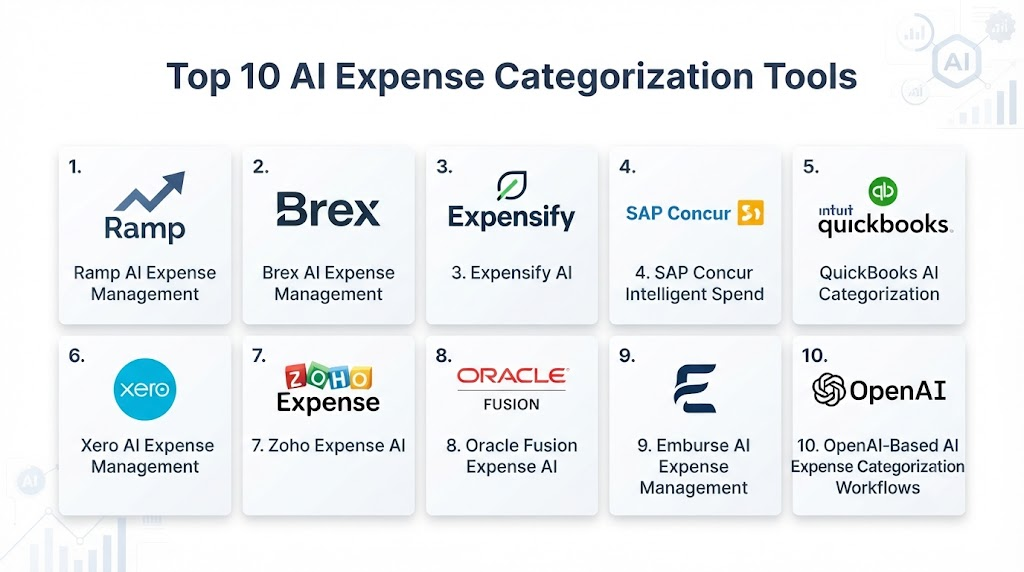
Top 10 AI Expense Categorization Tools
1. Ramp AI Expense Management
Verdict: AI-powered expense management platform with automated transaction categorization.
Short Description: Ramp AI helps organizations automatically categorize expenses, analyze spending patterns, manage receipts, and improve financial visibility.
Key Features:
- AI expense categorization
- Receipt matching
- Spend analytics
- Policy controls
- Accounting automation
Pros:
- Strong automation capabilities
- Excellent spend visibility
Cons:
- Best suited for business spending workflows
- Enterprise features require setup
Deployment: Cloud-based
Security & Compliance: Enterprise security controls
Integrations & Ecosystem: Accounting and finance platforms
Support & Community: Customer support
Pricing Model: Subscription-based
Best-Fit Scenarios: Modern finance teams
2. Brex AI Expense Management
Verdict: AI-enabled corporate expense platform with intelligent transaction analysis.
Short Description: Brex AI helps companies categorize expenses, automate reporting, and manage corporate spending workflows.
Key Features:
- AI transaction categorization
- Receipt management
- Spend controls
- Financial reporting
- Expense automation
Pros:
- Strong corporate spending features
- Good finance integrations
Cons:
- Focused mainly on business spending
- Requires adoption across teams
Deployment: Cloud-based
Security & Compliance: Enterprise security controls
Integrations & Ecosystem: Accounting and ERP systems
Support & Community: Customer support
Pricing Model: Subscription-based
Best-Fit Scenarios: Growing and enterprise companies
3. Expensify AI
Verdict: AI-powered expense reporting platform focused on automated expense processing.
Short Description: Expensify AI helps users capture receipts, categorize expenses, and simplify reimbursement workflows.
Key Features:
- Receipt scanning
- Expense categorization
- Automated reports
- Reimbursement workflows
- Policy management
Pros:
- Easy employee adoption
- Strong receipt automation
Cons:
- Advanced analytics vary
- Less focused on enterprise spend intelligence
Deployment: Cloud-based
Security & Compliance: Platform security controls
Integrations & Ecosystem: Accounting platforms
Support & Community: Customer support
Pricing Model: Subscription-based
Best-Fit Scenarios: Small and medium businesses
4. SAP Concur Intelligent Spend
Verdict: Enterprise AI expense management solution for global financial operations.
Short Description: SAP Concur Intelligent Spend helps organizations automate expense processing, categorize transactions, and improve compliance.
Key Features:
- AI expense classification
- Receipt processing
- Travel expense management
- Compliance monitoring
- Financial reporting
Pros:
- Strong enterprise capabilities
- Global expense management support
Cons:
- Complex implementation
- Enterprise-focused
Deployment: Cloud-based
Security & Compliance: Enterprise security standards
Integrations & Ecosystem: SAP and financial systems
Support & Community: Enterprise support
Pricing Model: Subscription-based
Best-Fit Scenarios: Large organizations
5. QuickBooks AI Expense Categorization
Verdict: AI-assisted accounting platform with automated expense classification.
Short Description: QuickBooks AI helps businesses organize transactions, categorize expenses, and simplify bookkeeping workflows.
Key Features:
- Expense categorization
- Transaction matching
- Receipt management
- Accounting automation
- Financial reports
Pros:
- Easy for small businesses
- Strong accounting integration
Cons:
- Less enterprise depth
- Advanced AI capabilities vary
Deployment: Cloud-based
Security & Compliance: Platform security controls
Integrations & Ecosystem: Accounting ecosystem
Support & Community: Customer support
Pricing Model: Subscription-based
Best-Fit Scenarios: Small businesses
6. Xero AI Expense Management
Verdict: AI-enabled accounting platform supporting automated expense organization.
Short Description: Xero AI helps businesses categorize transactions, process receipts, and improve bookkeeping accuracy.
Key Features:
- Transaction categorization
- Receipt capture
- Accounting automation
- Financial reporting
- Expense tracking
Pros:
- Strong accounting workflows
- Good usability
Cons:
- Limited advanced enterprise analytics
- Depends on accounting data quality
Deployment: Cloud-based
Security & Compliance: Platform security controls
Integrations & Ecosystem: Accounting and finance tools
Support & Community: Customer support
Pricing Model: Subscription-based
Best-Fit Scenarios: Small and medium businesses
7. Zoho Expense AI
Verdict: AI-powered expense management solution for automated expense tracking.
Short Description: Zoho Expense AI helps organizations classify expenses, automate approvals, and manage employee reimbursements.
Key Features:
- AI categorization
- Receipt scanning
- Approval workflows
- Expense reporting
- Policy management
Pros:
- Affordable for businesses
- Strong workflow automation
Cons:
- Enterprise analytics vary
- Requires configuration
Deployment: Cloud-based
Security & Compliance: Security controls available
Integrations & Ecosystem: Zoho ecosystem and accounting tools
Support & Community: Customer support
Pricing Model: Subscription-based
Best-Fit Scenarios: SMB finance teams
8. Oracle Fusion Expense AI
Verdict: Enterprise expense management platform with AI-driven financial automation.
Short Description: Oracle Fusion Expense AI helps organizations automate expense processing, analyze spending, and improve financial controls.
Key Features:
- Expense classification
- Receipt processing
- Policy validation
- Financial analytics
- Workflow automation
Pros:
- Enterprise financial integration
- Strong compliance capabilities
Cons:
- Complex deployment
- Requires Oracle expertise
Deployment: Cloud-based
Security & Compliance: Enterprise security standards
Integrations & Ecosystem: Oracle financial systems
Support & Community: Enterprise support
Pricing Model: Subscription-based
Best-Fit Scenarios: Large enterprises
9. Emburse AI Expense Management
Verdict: AI-enhanced expense management platform for automated financial workflows.
Short Description: Emburse AI helps organizations process expenses, categorize transactions, and improve reimbursement operations.
Key Features:
- Expense automation
- Receipt recognition
- Transaction categorization
- Reporting
- Approval workflows
Pros:
- Flexible expense solutions
- Good automation support
Cons:
- Features vary across products
- Requires configuration
Deployment: Cloud-based
Security & Compliance: Enterprise security controls
Integrations & Ecosystem: Finance and accounting platforms
Support & Community: Customer support
Pricing Model: Subscription-based
Best-Fit Scenarios: Corporate expense teams
10. OpenAI-Based AI Expense Categorization Workflows
Verdict: Custom AI approach for building organization-specific expense classification systems.
Short Description: AI workflows can analyze transaction descriptions, receipts, invoices, and accounting rules to automatically categorize expenses.
Key Features:
- Expense classification
- Receipt understanding
- Financial insights
- Custom accounting rules
- Automated workflows
Pros:
- Highly customizable
- Supports unique business requirements
Cons:
- Requires implementation effort
- Needs financial data governance
Deployment: API and custom environments
Security & Compliance: Depends on implementation
Integrations & Ecosystem: Accounting systems, ERP platforms, finance databases
Support & Community: Developer ecosystem
Pricing Model: Usage-based
Best-Fit Scenarios: Custom finance automation solutions
Comparison Table
| Platform | AI Categorization | Receipt Processing | Accounting Integration | Automation | Best Use |
|---|---|---|---|---|---|
| Ramp AI | Excellent | Excellent | High | Excellent | Corporate expenses |
| Brex AI | Excellent | High | High | Excellent | Business spending |
| Expensify AI | High | Excellent | High | High | Expense reports |
| SAP Concur AI | Excellent | Excellent | Excellent | Excellent | Enterprise finance |
| QuickBooks AI | High | High | Excellent | High | Small businesses |
| Xero AI | High | High | Excellent | High | Accounting workflows |
| Zoho Expense AI | High | High | High | High | SMB expenses |
| Oracle Fusion Expense AI | Excellent | High | Excellent | Excellent | Enterprise finance |
| Emburse AI | High | High | High | High | Corporate expense teams |
| OpenAI Workflows | Excellent | Custom | Custom | Excellent | Custom solutions |
Evaluation & Scoring Table
| Platform | AI Accuracy 25% | Categorization 15% | Automation 15% | Integrations 15% | Security 10% | Ease 10% | Value 10% | Total |
|---|---|---|---|---|---|---|---|---|
| Ramp AI | 25 | 15 | 15 | 14 | 10 | 9 | 9 | 97 |
| Brex AI | 25 | 15 | 15 | 14 | 10 | 9 | 8 | 96 |
| Expensify AI | 23 | 14 | 14 | 14 | 9 | 10 | 9 | 93 |
| SAP Concur AI | 25 | 15 | 15 | 15 | 10 | 8 | 8 | 96 |
| QuickBooks AI | 22 | 13 | 13 | 15 | 9 | 10 | 10 | 92 |
| Xero AI | 22 | 13 | 13 | 15 | 9 | 10 | 10 | 92 |
| Zoho Expense AI | 22 | 13 | 14 | 14 | 9 | 10 | 10 | 92 |
| Oracle Fusion Expense AI | 24 | 15 | 15 | 15 | 10 | 8 | 8 | 95 |
| Emburse AI | 22 | 13 | 14 | 14 | 9 | 9 | 9 | 90 |
| OpenAI Workflows | 25 | 15 | 15 | 12 | 8 | 8 | 9 | 92 |
Which AI Expense Categorization Tool Is Right for You?
- Enterprise Expense Management: SAP Concur AI, Oracle Fusion Expense AI
- Corporate Spend Management: Ramp AI, Brex AI
- Small Business Accounting: QuickBooks AI, Xero AI
- Expense Reporting Automation: Expensify AI, Zoho Expense AI
- Flexible Expense Workflows: Emburse AI
- Custom AI Finance Automation: OpenAI-based workflows
Implementation Playbook
30 Days
- Review current expense workflows
- Identify categorization challenges
- Prepare financial data sources
60 Days
- Connect accounting systems
- Configure AI expense rules
- Test transaction categorization
90 Days
- Automate expense processing
- Improve reporting accuracy
- Optimize financial workflows
Common Mistakes
- Using incomplete transaction data
- Ignoring accounting rules
- Not validating AI categories
- Poor receipt management
- Failing to monitor expense policies
Frequently Asked Questions
What are AI expense categorization tools?
They are AI-powered platforms that automatically classify and organize financial transactions.
How do AI expense tools categorize transactions?
They analyze receipts, merchant details, descriptions, and spending patterns.
Can AI reduce manual bookkeeping work?
Yes. AI automates repetitive expense classification tasks.
Do AI expense tools process receipts?
Yes. Many use OCR and AI to extract receipt information.
Can AI detect incorrect expenses?
Some platforms identify unusual spending patterns and policy issues.
Do these tools integrate with accounting software?
Most connect with accounting, ERP, and finance platforms.
Are AI expense categories always accurate?
Accuracy depends on transaction data and accounting rules.
Can small businesses use AI expense tools?
Yes. Many solutions support small and medium businesses.
Do AI tools replace accountants?
No. They assist finance professionals by reducing manual work.
Can AI support tax preparation?
Yes. Organized expense data can simplify financial reporting.
Are expense management platforms secure?
Organizations should review security and compliance controls.
How should companies implement AI expense categorization?
Start with clean financial data, test categories, and continuously improve workflows.
Conclusion
AI Expense Categorization Tools are helping organizations simplify financial operations by automating transaction classification, improving reporting accuracy, and reducing manual accounting effort. Platforms such as Ramp AI, Brex AI, SAP Concur Intelligent Spend, and Oracle Fusion Expense AI provide powerful capabilities for modern finance teams.Organizations should select solutions based on expense volume, accounting systems, automation goals, and compliance requirements. Combining AI-powered categorization with financial expertise helps businesses improve efficiency, maintain accurate records, and gain better control over spending.
