Introduction
AI Transaction Risk Scoring APIs use artificial intelligence, machine learning, behavioral analytics, and real-time decision engines to evaluate financial transactions and assign risk scores. These APIs analyze transaction details, customer behavior, device intelligence, location signals, payment history, and contextual data to help organizations identify potentially risky activities.
Traditional transaction monitoring systems often rely on static rules that struggle with evolving fraud patterns. AI-powered risk scoring APIs provide dynamic risk assessments by continuously learning from transaction data and generating real-time insights for fraud prevention, payment security, and compliance operations.
These solutions are widely used by banks, fintech companies, payment processors, ecommerce platforms, marketplaces, and digital businesses to automate transaction decisions, reduce fraud losses, and improve payment approval experiences.
Real-world use cases:
- Real-time payment risk scoring
- Fraud prevention for online transactions
- Credit and lending risk evaluation
- Digital wallet transaction monitoring
- Account takeover prevention
- Merchant risk assessment
- Payment gateway security
- Automated transaction approval decisions
- Suspicious activity detection
- Financial compliance monitoring
Evaluation Criteria for Buyers:
- AI risk scoring accuracy
- API response speed
- Machine learning capabilities
- Fraud signal coverage
- Integration flexibility
- Scalability for transaction volume
- Security and compliance controls
- Developer experience
Best for
Fintech companies, banks, payment providers, ecommerce platforms, marketplaces, and businesses requiring real-time transaction intelligence.
Not ideal for
Organizations with low transaction volumes or businesses without digital payment workflows.
Key Trends
- Real-time AI risk scoring
- Adaptive fraud intelligence
- Behavioral analytics APIs
- Machine learning decision engines
- Identity intelligence
- Payment security automation
- API-first financial security
- Automated fraud investigations
- Risk-based authentication
- Financial crime prevention
Methodology
- Selected platforms based on AI transaction risk scoring API capabilities
- Evaluated fraud detection, API flexibility, integrations, and scalability
- Considered financial and digital commerce use cases
- Prioritized solutions supporting real-time decisions
- Reviewed security, reliability, and developer usability
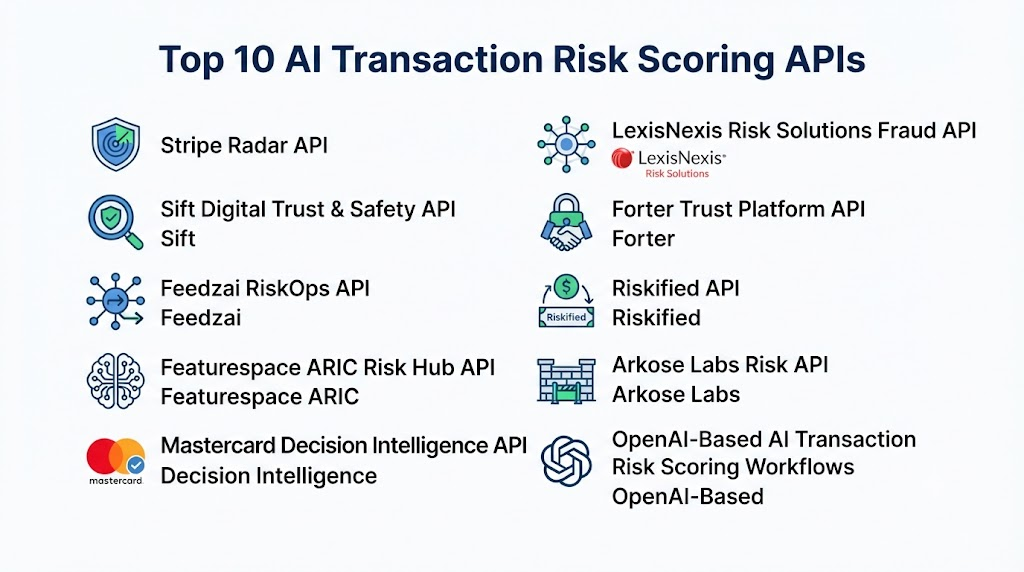
Top 10 AI Transaction Risk Scoring APIs
1. Stripe Radar API
Verdict: AI-powered payment risk scoring API designed for online transaction protection.
Short Description: Stripe Radar API uses machine learning models to evaluate payment risks, identify suspicious transactions, and help businesses prevent fraud.
Key Features:
- Real-time transaction scoring
- Fraud detection models
- Payment risk signals
- Automated blocking rules
- Developer APIs
Pros:
- Easy payment integration
- Strong ecommerce adoption
Cons:
- Best within Stripe ecosystem
- Less customizable for complex financial institutions
Deployment: Cloud-based API
Security & Compliance: Payment security controls
Integrations & Ecosystem: Payment platforms and ecommerce systems
Support & Community: Developer support
Pricing Model: Usage-based
Best-Fit Scenarios: Online payments
2. Sift Digital Trust & Safety API
Verdict: AI-powered risk scoring API for fraud prevention and digital trust management.
Short Description: Sift APIs analyze customer behavior, device information, and transaction patterns to generate fraud risk insights.
Key Features:
- Risk scoring API
- Behavioral intelligence
- Device analysis
- Fraud detection
- Account protection
Pros:
- Strong behavioral analytics
- Supports digital businesses
Cons:
- Requires data integration
- Enterprise-oriented
Deployment: Cloud API
Security & Compliance: Enterprise security controls
Integrations & Ecosystem: Ecommerce and digital platforms
Support & Community: Customer support
Pricing Model: Subscription-based
Best-Fit Scenarios: Digital businesses
3. Feedzai RiskOps API
Verdict: Enterprise AI risk scoring API for financial crime and payment protection.
Short Description: Feedzai RiskOps API helps organizations analyze transactions, detect suspicious activities, and automate financial risk decisions.
Key Features:
- Transaction risk scoring
- Fraud analytics
- Machine learning models
- Case management support
- Real-time decisions
Pros:
- Strong financial industry capabilities
- High-volume transaction support
Cons:
- Enterprise implementation
- Requires configuration
Deployment: Cloud and enterprise environments
Security & Compliance: Financial security standards
Integrations & Ecosystem: Banking and payment systems
Support & Community: Enterprise support
Pricing Model: Subscription-based
Best-Fit Scenarios: Banks and payment providers
4. Featurespace ARIC Risk Hub API
Verdict: Adaptive AI risk scoring platform for real-time payment fraud prevention.
Short Description: Featurespace ARIC APIs analyze transaction behavior and generate adaptive risk assessments for financial organizations.
Key Features:
- Adaptive machine learning
- Transaction monitoring
- Risk scoring
- Behavioral analytics
- Fraud detection
Pros:
- Strong adaptive models
- Financial services focus
Cons:
- Enterprise-focused
- Requires implementation expertise
Deployment: Cloud and enterprise environments
Security & Compliance: Enterprise security controls
Integrations & Ecosystem: Banking platforms
Support & Community: Enterprise support
Pricing Model: Subscription-based
Best-Fit Scenarios: Financial institutions
5. Mastercard Decision Intelligence API
Verdict: AI-powered payment intelligence API for transaction risk evaluation.
Short Description: Mastercard Decision Intelligence APIs analyze payment transactions and risk signals to improve fraud prevention decisions.
Key Features:
- Transaction scoring
- Payment intelligence
- Risk analytics
- Fraud detection
- Network insights
Pros:
- Strong payment expertise
- Large-scale transaction intelligence
Cons:
- Primarily payment-focused
- Enterprise-oriented
Deployment: Cloud API
Security & Compliance: Payment security standards
Integrations & Ecosystem: Payment networks
Support & Community: Enterprise support
Pricing Model: Subscription-based
Best-Fit Scenarios: Payment organizations
6. LexisNexis Risk Solutions Fraud API
Verdict: AI-powered risk intelligence API for transaction and identity assessment.
Short Description: LexisNexis Risk Solutions APIs provide fraud indicators, identity signals, and transaction risk insights.
Key Features:
- Risk scoring
- Identity intelligence
- Fraud analytics
- Data enrichment
- Transaction monitoring
Pros:
- Strong risk data coverage
- Broad financial applications
Cons:
- Complex product ecosystem
- Enterprise-focused
Deployment: Cloud API
Security & Compliance: Enterprise security controls
Integrations & Ecosystem: Financial platforms
Support & Community: Enterprise support
Pricing Model: Subscription-based
Best-Fit Scenarios: Risk management teams
7. Forter Trust Platform API
Verdict: AI-powered trust API for transaction approval and fraud prevention.
Short Description: Forter APIs analyze identity and behavioral data to evaluate transaction trust levels.
Key Features:
- Transaction approval scoring
- Identity intelligence
- Fraud prevention
- Behavioral analysis
- Customer trust evaluation
Pros:
- Strong ecommerce capabilities
- Improves customer experience
Cons:
- Primarily commerce-focused
- Integration effort required
Deployment: Cloud API
Security & Compliance: Enterprise security controls
Integrations & Ecosystem: Commerce platforms
Support & Community: Customer support
Pricing Model: Subscription-based
Best-Fit Scenarios: Ecommerce businesses
8. Riskified API
Verdict: AI transaction decision API focused on ecommerce payment protection.
Short Description: Riskified APIs help merchants evaluate transactions, reduce fraud, and improve approval rates.
Key Features:
- Transaction scoring
- Fraud prediction
- Chargeback prevention
- Customer behavior analysis
- Payment decisions
Pros:
- Ecommerce specialization
- Fraud reduction capabilities
Cons:
- Limited outside ecommerce
- Usage-based costs
Deployment: Cloud API
Security & Compliance: Enterprise security controls
Integrations & Ecosystem: Ecommerce platforms
Support & Community: Customer support
Pricing Model: Usage-based
Best-Fit Scenarios: Online retailers
9. Arkose Labs Risk API
Verdict: AI-powered fraud prevention API focused on identity and automated attack detection.
Short Description: Arkose Labs APIs help organizations identify fraudulent behavior, bots, and suspicious transaction activity.
Key Features:
- Risk scoring
- Bot detection
- Identity protection
- Fraud analytics
- Behavioral signals
Pros:
- Strong bot protection
- Good digital security focus
Cons:
- More security-focused
- Requires integration planning
Deployment: Cloud API
Security & Compliance: Enterprise security controls
Integrations & Ecosystem: Digital platforms
Support & Community: Customer support
Pricing Model: Subscription-based
Best-Fit Scenarios: Digital businesses
10. OpenAI-Based AI Transaction Risk Scoring Workflows
Verdict: Custom AI approach for building organization-specific transaction risk scoring systems.
Short Description: AI workflows can analyze transaction data, customer behavior, payment history, and business rules to create customized risk scoring solutions.
Key Features:
- Transaction analysis
- Risk prediction
- Fraud pattern detection
- Custom scoring models
- Automated alerts
Pros:
- Highly customizable
- Supports unique business requirements
Cons:
- Requires AI implementation expertise
- Needs strong security governance
Deployment: API and custom environments
Security & Compliance: Depends on implementation
Integrations & Ecosystem: Payment systems, databases, analytics platforms
Support & Community: Developer ecosystem
Pricing Model: Usage-based
Best-Fit Scenarios: Custom enterprise solutions
Comparison Table
| Platform | Risk Scoring | Real-Time Analysis | Fraud Detection | API Flexibility | Best Use |
|---|---|---|---|---|---|
| Stripe Radar API | Excellent | Excellent | Excellent | Excellent | Online payments |
| Sift API | Excellent | Excellent | Excellent | High | Digital fraud prevention |
| Feedzai API | Excellent | Excellent | Excellent | High | Banking fraud |
| Featurespace ARIC API | Excellent | Excellent | Excellent | High | Financial institutions |
| Mastercard Decision Intelligence | Excellent | Excellent | Excellent | High | Payment networks |
| LexisNexis Fraud API | Excellent | High | Excellent | High | Risk intelligence |
| Forter API | Excellent | Excellent | High | High | Ecommerce trust |
| Riskified API | High | High | Excellent | High | Online merchants |
| Arkose Labs API | High | High | High | High | Digital security |
| OpenAI Workflows | Excellent | Custom | Custom | Custom | Custom solutions |
Evaluation & Scoring Table
| Platform | AI Accuracy 25% | Risk Scoring 15% | Fraud Detection 15% | API Integration 15% | Security 10% | Ease 10% | Value 10% | Total |
|---|---|---|---|---|---|---|---|---|
| Stripe Radar API | 24 | 15 | 15 | 15 | 10 | 10 | 9 | 98 |
| Sift API | 24 | 15 | 15 | 14 | 10 | 9 | 9 | 96 |
| Feedzai API | 25 | 15 | 15 | 14 | 10 | 8 | 8 | 95 |
| Featurespace ARIC API | 25 | 15 | 15 | 13 | 10 | 8 | 8 | 94 |
| Mastercard Decision Intelligence | 25 | 15 | 15 | 14 | 10 | 8 | 8 | 95 |
| LexisNexis Fraud API | 24 | 14 | 15 | 14 | 10 | 8 | 8 | 93 |
| Forter API | 23 | 14 | 14 | 14 | 10 | 9 | 9 | 93 |
| Riskified API | 22 | 13 | 14 | 14 | 9 | 10 | 9 | 91 |
| Arkose Labs API | 22 | 13 | 13 | 14 | 10 | 9 | 9 | 90 |
| OpenAI Workflows | 25 | 15 | 15 | 12 | 8 | 8 | 9 | 92 |
Which AI Transaction Risk Scoring API Is Right for You?
- Online Payment Businesses: Stripe Radar API, Riskified API
- Banks and Financial Institutions: Feedzai API, Featurespace ARIC API, Mastercard Decision Intelligence
- Digital Platforms: Sift API, Forter API
- Identity and Risk Intelligence: LexisNexis Risk API
- Bot and Digital Attack Protection: Arkose Labs API
- Custom Risk Models: OpenAI-based workflows
Implementation Playbook
30 Days
- Define transaction risk requirements
- Identify fraud indicators
- Prepare transaction datasets
60 Days
- Integrate risk scoring APIs
- Configure decision rules
- Test transaction predictions
90 Days
- Automate fraud decisions
- Monitor risk performance
- Improve scoring models
Common Mistakes
- Using limited transaction signals
- Ignoring false positives
- Not updating risk models
- Poor API integration design
- Failing to protect customer data
Frequently Asked Questions
What are AI transaction risk scoring APIs?
They are APIs that use AI models to evaluate transaction risk and generate fraud scores.
How do AI risk scoring APIs work?
They analyze transaction details, customer behavior, and risk signals to calculate risk levels.
Can risk scoring APIs work in real time?
Yes. Many APIs provide instant transaction evaluation.
Can these APIs prevent payment fraud?
They help identify risky transactions before approval decisions.
Do AI risk APIs integrate with payment systems?
Yes. Most are designed for payment and financial integrations.
Can businesses customize risk scoring models?
Some platforms allow customization based on business requirements.
Are AI risk scores always accurate?
Accuracy depends on data quality, models, and implementation.
Can small businesses use transaction risk APIs?
Yes. Many API-based solutions support businesses of different sizes.
Do these APIs support compliance requirements?
Many help organizations improve fraud monitoring and risk controls.
Are transaction risk APIs secure?
Organizations should evaluate encryption, access controls, and compliance practices.
Can AI detect account takeover risks?
Many platforms analyze behavioral patterns to identify suspicious access.
How should companies implement AI risk scoring APIs?
Start with clear risk goals, integrate transaction data, test models, and continuously optimize.
Conclusion
AI Transaction Risk Scoring APIs are becoming essential components of modern payment security by providing real-time risk intelligence, fraud detection, and automated transaction decisions. Platforms such as Stripe Radar API, Feedzai RiskOps API, Featurespace ARIC, and Mastercard Decision Intelligence help organizations protect digital payments while improving customer experiences.Organizations should choose solutions based on transaction volume, fraud risks, integration requirements, and compliance needs. Combining AI-powered risk scoring with strong security practices helps businesses reduce fraud, improve payment confidence, and build safer digital ecosystems.
