Introduction
AI-Powered SOAR Automation Platforms combine artificial intelligence, machine learning, security orchestration, automation, and response capabilities to help cybersecurity teams detect threats, investigate incidents, and automate security operations workflows. These platforms analyze security alerts, threat intelligence, logs, and incident data to reduce manual effort and accelerate response times.
Traditional Security Orchestration, Automation, and Response (SOAR) solutions depend heavily on predefined playbooks and manual configuration. AI-enhanced SOAR platforms improve these processes by using intelligent recommendations, automated investigations, natural language analysis, threat prioritization, and adaptive workflows.
These solutions are widely used by security operations centers, enterprises, managed security service providers, and cybersecurity teams to reduce alert fatigue, improve incident response efficiency, and strengthen security operations.
Real-world use cases:
- Automated incident response
- Security alert investigation
- Threat intelligence enrichment
- Phishing investigation automation
- Malware analysis workflows
- Vulnerability response automation
- Security ticket automation
- Threat hunting assistance
- SOC analyst assistance
- Automated containment actions
Evaluation Criteria for Buyers:
- AI-driven automation capabilities
- Security workflow orchestration
- Incident response speed
- Threat intelligence integration
- Playbook flexibility
- Detection and investigation support
- Integration ecosystem
- Security governance features
Best for
Enterprise SOC teams, cybersecurity operations centers, managed security providers, and organizations handling large volumes of security alerts.
Not ideal for
Small teams with limited security operations requirements or organizations without mature incident response processes.
Key Trends
- AI-assisted SOC operations
- Autonomous incident response
- Security copilots
- Automated threat investigations
- Machine learning alert prioritization
- Natural language security workflows
- Intelligent playbook generation
- Threat intelligence automation
- Cloud security orchestration
- Human-AI security collaboration
Methodology
- Selected platforms based on AI-powered SOAR capabilities
- Evaluated automation, integrations, threat intelligence, and response features
- Considered enterprise cybersecurity requirements
- Prioritized platforms supporting security operations automation
- Reviewed scalability, usability, and governance capabilities
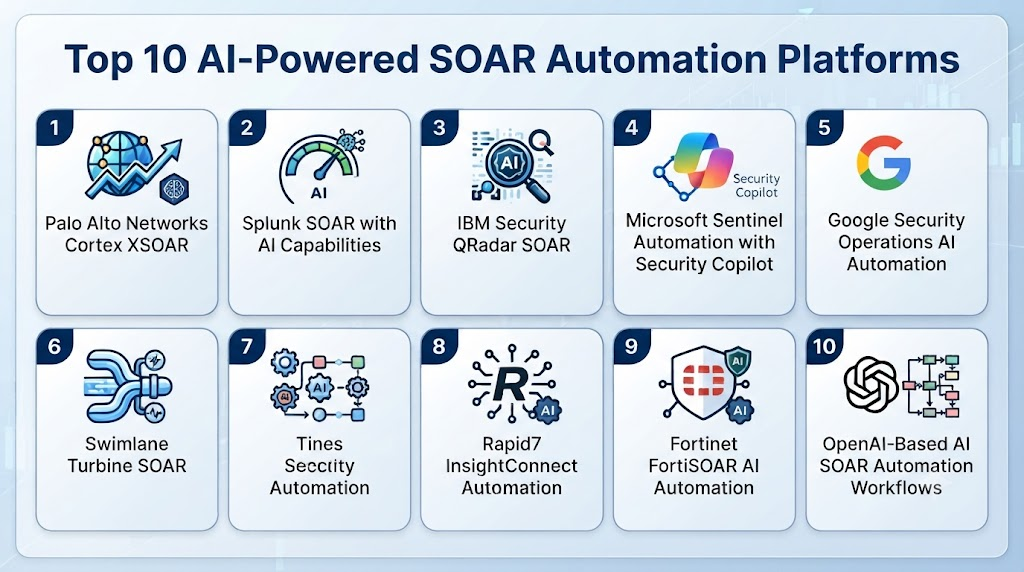
Top 10 AI-Powered SOAR Automation Platforms
1. Palo Alto Networks Cortex XSOAR
Verdict: Enterprise AI-powered SOAR platform for automated security operations and incident response.
Short Description: Cortex XSOAR helps security teams automate investigations, manage incidents, integrate security tools, and improve SOC efficiency.
Key Features:
- Incident orchestration
- Automated playbooks
- Threat intelligence management
- Investigation workflows
- Security automation
Pros:
- Extensive security integrations
- Strong enterprise capabilities
Cons:
- Complex configuration
- Requires security expertise
Deployment: Cloud and enterprise environments
Security & Compliance: Enterprise security controls
Integrations & Ecosystem: Large cybersecurity ecosystem
Support & Community: Enterprise support
Pricing Model: Subscription-based
Best-Fit Scenarios: Enterprise SOC teams
2. Splunk SOAR with AI Capabilities
Verdict: AI-enhanced security automation platform integrated with security analytics.
Short Description: Splunk SOAR helps organizations automate security workflows, investigate incidents, and connect security operations tools.
Key Features:
- Security orchestration
- Automated response playbooks
- Threat intelligence
- Incident management
- Workflow automation
Pros:
- Strong security analytics ecosystem
- Broad integrations
Cons:
- Requires Splunk expertise
- Enterprise-focused
Deployment: Cloud and enterprise environments
Security & Compliance: Enterprise security standards
Integrations & Ecosystem: Security tools and SIEM platforms
Support & Community: Enterprise support
Pricing Model: Subscription-based
Best-Fit Scenarios: Large SOC environments
3. IBM Security QRadar SOAR
Verdict: AI-assisted SOAR platform for enterprise incident response automation.
Short Description: IBM QRadar SOAR helps security teams automate response workflows, manage incidents, and improve threat investigation processes.
Key Features:
- Incident management
- Automated workflows
- Threat intelligence
- Case management
- Response orchestration
Pros:
- Strong enterprise security background
- Good integration capabilities
Cons:
- Complex deployment
- Requires skilled administrators
Deployment: Cloud and enterprise environments
Security & Compliance: Enterprise security controls
Integrations & Ecosystem: IBM security ecosystem
Support & Community: Enterprise support
Pricing Model: Subscription-based
Best-Fit Scenarios: Enterprise security operations
4. Microsoft Sentinel Automation with Security Copilot
Verdict: AI-powered security operations platform combining SIEM, automation, and AI assistance.
Short Description: Microsoft Sentinel with AI capabilities helps security teams investigate threats, automate responses, and improve SOC productivity.
Key Features:
- AI threat investigation
- Automated workflows
- Security analytics
- Incident response
- Cloud security integration
Pros:
- Strong cloud security ecosystem
- AI-assisted investigations
Cons:
- Best within Microsoft ecosystem
- Requires cloud expertise
Deployment: Cloud-based
Security & Compliance: Enterprise security framework
Integrations & Ecosystem: Microsoft security ecosystem
Support & Community: Enterprise support
Pricing Model: Usage-based
Best-Fit Scenarios: Microsoft-focused organizations
5. Google Security Operations AI Automation
Verdict: AI-driven security operations platform supporting automated threat detection and response.
Short Description: Google Security Operations helps organizations analyze threats, automate investigations, and improve security workflows.
Key Features:
- Threat investigation
- AI security analytics
- Automated response
- Threat intelligence
- Security workflows
Pros:
- Strong AI capabilities
- Cloud-native architecture
Cons:
- Requires Google Cloud expertise
- Enterprise-oriented
Deployment: Cloud-based
Security & Compliance: Enterprise cloud security
Integrations & Ecosystem: Security and cloud platforms
Support & Community: Enterprise support
Pricing Model: Usage-based
Best-Fit Scenarios: Cloud security teams
6. Swimlane Turbine SOAR
Verdict: Low-code AI-enabled SOAR platform for security automation.
Short Description: Swimlane Turbine helps security teams build automated workflows, manage incidents, and improve SOC operations.
Key Features:
- Low-code automation
- Security workflows
- Case management
- Threat response
- Integration management
Pros:
- Flexible automation design
- User-friendly workflows
Cons:
- Requires process planning
- Advanced use cases need expertise
Deployment: Cloud and enterprise environments
Security & Compliance: Enterprise security controls
Integrations & Ecosystem: Security tools
Support & Community: Customer support
Pricing Model: Subscription-based
Best-Fit Scenarios: Security automation teams
7. Tines AI Security Automation
Verdict: Flexible AI-powered workflow automation platform for security teams.
Short Description: Tines helps organizations automate security processes, investigations, and repetitive operational tasks.
Key Features:
- Workflow automation
- Security orchestration
- Incident workflows
- Data enrichment
- API integrations
Pros:
- Simple automation design
- Flexible workflows
Cons:
- Requires workflow design
- Less traditional SOAR approach
Deployment: Cloud-based
Security & Compliance: Enterprise security controls
Integrations & Ecosystem: API-based integrations
Support & Community: Customer support
Pricing Model: Subscription-based
Best-Fit Scenarios: Modern security teams
8. Rapid7 InsightConnect AI Automation
Verdict: Security orchestration platform for automated incident response.
Short Description: Rapid7 InsightConnect helps security teams automate investigation and response workflows across security environments.
Key Features:
- Security automation
- Incident response
- Workflow orchestration
- Threat intelligence
- Integration management
Pros:
- Good security ecosystem
- Easy workflow automation
Cons:
- Requires Rapid7 environment
- Advanced workflows need expertise
Deployment: Cloud-based
Security & Compliance: Enterprise security controls
Integrations & Ecosystem: Security platforms
Support & Community: Customer support
Pricing Model: Subscription-based
Best-Fit Scenarios: Security operations teams
9. Fortinet FortiSOAR AI Automation
Verdict: AI-enhanced SOAR platform for security operations automation.
Short Description: FortiSOAR helps organizations automate threat response, coordinate security tools, and manage incidents.
Key Features:
- Security orchestration
- Incident automation
- Threat intelligence
- Case management
- Security workflows
Pros:
- Strong security ecosystem
- Good enterprise integration
Cons:
- Best with Fortinet products
- Requires configuration
Deployment: Cloud and enterprise environments
Security & Compliance: Enterprise security controls
Integrations & Ecosystem: Fortinet security ecosystem
Support & Community: Enterprise support
Pricing Model: Subscription-based
Best-Fit Scenarios: Enterprise security teams
10. OpenAI-Based AI SOAR Automation Workflows
Verdict: Custom AI approach for building intelligent security automation systems.
Short Description: AI workflows can analyze alerts, summarize incidents, recommend responses, enrich investigations, and automate security operations tasks.
Key Features:
- AI incident analysis
- Threat investigation assistance
- Automated response recommendations
- Security workflow automation
- Custom playbooks
Pros:
- Highly customizable
- Supports unique SOC workflows
Cons:
- Requires security expertise
- Needs strong governance
Deployment: API and custom environments
Security & Compliance: Depends on implementation
Integrations & Ecosystem: SIEM, EDR, threat intelligence, ticketing systems
Support & Community: Developer ecosystem
Pricing Model: Usage-based
Best-Fit Scenarios: Custom security automation solutions
Comparison Table
| Platform | AI Automation | Incident Response | Integrations | Threat Intelligence | Best Use |
|---|---|---|---|---|---|
| Cortex XSOAR | Excellent | Excellent | Excellent | Excellent | Enterprise SOC |
| Splunk SOAR | Excellent | Excellent | Excellent | High | Security operations |
| QRadar SOAR | High | Excellent | High | High | Enterprise security |
| Microsoft Sentinel AI | Excellent | Excellent | Excellent | Excellent | Cloud security |
| Google Security Operations | Excellent | High | High | Excellent | Cloud SOC |
| Swimlane Turbine | Excellent | High | High | High | Automation teams |
| Tines | High | High | Excellent | Medium | Workflow automation |
| Rapid7 InsightConnect | High | High | High | High | Security teams |
| FortiSOAR | High | High | High | High | Fortinet environments |
| OpenAI SOAR Workflows | Excellent | Custom | Custom | Custom | Custom SOC automation |
Evaluation & Scoring Table
| Platform | AI Accuracy 25% | Automation 15% | Response 15% | Integrations 15% | Security 10% | Ease 10% | Value 10% | Total |
|---|---|---|---|---|---|---|---|---|
| Cortex XSOAR | 25 | 15 | 15 | 15 | 10 | 8 | 9 | 97 |
| Splunk SOAR | 24 | 15 | 15 | 15 | 10 | 8 | 8 | 95 |
| QRadar SOAR | 24 | 14 | 15 | 14 | 10 | 8 | 8 | 93 |
| Microsoft Sentinel AI | 25 | 15 | 15 | 15 | 10 | 9 | 9 | 98 |
| Google Security Operations | 25 | 14 | 14 | 14 | 10 | 8 | 8 | 93 |
| Swimlane Turbine | 23 | 15 | 14 | 14 | 10 | 9 | 9 | 94 |
| Tines | 22 | 14 | 13 | 15 | 9 | 10 | 9 | 92 |
| Rapid7 InsightConnect | 22 | 14 | 14 | 14 | 10 | 9 | 8 | 91 |
| FortiSOAR | 23 | 14 | 14 | 14 | 10 | 8 | 8 | 91 |
| OpenAI SOAR Workflows | 25 | 15 | 15 | 12 | 8 | 8 | 9 | 92 |
Which AI-Powered SOAR Automation Platform Is Right for You?
- Large Enterprise SOCs: Cortex XSOAR, Splunk SOAR, IBM QRadar SOAR
- Cloud Security Teams: Microsoft Sentinel AI, Google Security Operations
- Low-Code Security Automation: Swimlane Turbine, Tines
- Fortinet Security Environments: FortiSOAR
- Custom AI SOC Automation: OpenAI-based workflows
Implementation Playbook
30 Days
- Identify security automation opportunities
- Review existing SOC workflows
- Define response priorities
60 Days
- Connect security tools
- Build automation playbooks
- Test incident workflows
90 Days
- Deploy automated responses
- Monitor SOC improvements
- Optimize AI workflows
Common Mistakes
- Automating without proper testing
- Poor playbook design
- Ignoring analyst feedback
- Lack of security governance
- Not monitoring automation outcomes
Frequently Asked Questions
What are AI-powered SOAR automation platforms?
They are security platforms that use AI and automation to improve threat detection, investigation, and response.
How does AI improve SOAR?
AI helps analyze alerts, prioritize threats, and recommend response actions.
Can AI automate incident response?
Yes. AI-powered SOAR platforms automate many repetitive security tasks.
Do SOAR platforms replace security analysts?
No. They assist analysts by reducing manual workload.
Can AI reduce alert fatigue?
Yes. AI helps prioritize important security alerts.
Do AI SOAR tools integrate with SIEM and EDR platforms?
Most enterprise solutions support security ecosystem integrations.
Are AI SOAR platforms secure?
Organizations should evaluate access controls and security governance.
Can small security teams use SOAR automation?
Yes, especially with low-code automation platforms.
Can AI investigate phishing attacks?
Yes. Many platforms automate phishing analysis workflows.
Do AI SOAR tools support cloud security?
Many solutions support cloud-based security operations.
Can AI create security playbooks?
Some AI capabilities can assist in generating workflow recommendations.
How should organizations implement AI SOAR automation?
Start with repetitive workflows, test playbooks, monitor results, and expand gradually.
Conclusion
AI-Powered SOAR Automation Platforms are transforming security operations by enabling faster incident response, intelligent investigations, and automated security workflows. Platforms such as Microsoft Sentinel AI, Palo Alto Cortex XSOAR, Splunk SOAR, and IBM QRadar SOAR provide advanced capabilities for modern SOC environments.Organizations should select solutions based on security maturity, integration requirements, automation goals, and operational complexity. Combining AI-powered automation with skilled security teams helps organizations reduce response time, improve threat handling, and build stronger cybersecurity operations.
