Introduction
AI Identity Threat Detection Tools use artificial intelligence, machine learning, behavioral analytics, and anomaly detection to identify risks associated with compromised identities, insider threats, unauthorized access, account takeover, and identity misuse across networks, applications, and cloud environments. These tools analyze authentication patterns, user behavior, access anomalies, contextual risk signals, and threat intelligence to detect suspicious identity activity and prevent security breaches.
Traditional identity security approaches rely heavily on static access policies and rule‑based alerting, which can lead to high false positives and limited detection of subtle threats. AI‑powered identity threat detection improves visibility by learning normal user behavior, detecting anomalies, correlating signals, and prioritizing high‑risk identity events.
These platforms are widely used by enterprise security teams, identity and access management (IAM) teams, SOCs, risk and compliance teams, and security orchestration programs to enhance identity security and prevent data breaches.
Real‑world use cases:
- Account takeover detection
- Compromised credential detection
- Privileged account abuse detection
- Identity behavioral analytics
- Anomalous access detection
- Insider threat detection
- Risk‑based authentication alerts
- Cross‑platform identity correlation
- Threat intelligence‑informed identity risk
- Automated alert prioritization
Evaluation Criteria for Buyers:
- AI‑based anomaly detection accuracy
- Behavioral identity analytics
- Integration with IAM systems
- Real‑time threat detection
- Context and risk scoring
- Automation and response workflows
- Scalability for enterprise environments
- Reporting and visualization
Best for
Enterprise security teams, identity governance teams, SOC operations, identity and access management teams, and organizations with critical access control requirements.
Not ideal for
Small organizations with limited users, simple access control, and no dedicated security operations.
Key Trends
- AI‑powered identity threat analytics
- Behavioral biometrics for identity insights
- Risk‑based access detection
- Anomaly detection with ML
- Identity linkage across cloud and on‑prem
- Automated alert prioritization
- Integration with SIEM/SOAR
- AI‑driven insider threat detection
- Identity risk dashboards
- Correlated threat intelligence
Methodology
- Selected platforms based on AI identity threat detection capabilities
- Evaluated behavioral analytics, anomaly detection, integrations, and automation
- Considered enterprise IAM, cloud, and hybrid environments
- Prioritized platforms with strong identity risk detection features
- Reviewed reporting, scalability, and security controls
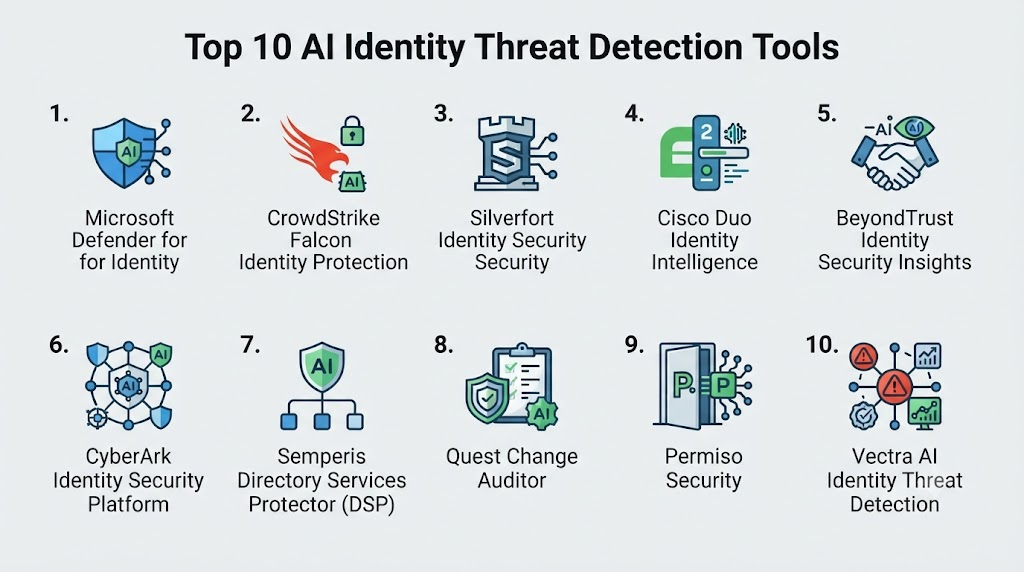
Top 10 AI Identity Threat Detection Tools
1. Microsoft Defender for Identity AI
Verdict: AI‑driven identity threat detection integrated with Microsoft security ecosystems.
Short Description: Microsoft Defender for Identity uses machine learning and behavioral analytics to detect compromised credentials, lateral movement, and insider risks.
Key Features:
- Behavioral analytics
- Anomaly detection
- Identity risk scoring
- Integration with Microsoft security
- Automated alerts
Pros:
- Deep integration with Microsoft ecosystem
- Real‑time identity monitoring
Cons:
- Best with Microsoft environments
- Requires configuration
Deployment: Cloud‑based
Security & Compliance: Enterprise security framework
Integrations & Ecosystem: Microsoft security stack
Support & Community: Enterprise support
Pricing Model: Subscription
Best‑Fit Scenarios: Microsoft‑centric enterprises
2. CrowdStrike Falcon Identity Protection AI
Verdict: AI‑enhanced identity threat detection integrated with endpoint security.
Short Description: CrowdStrike Falcon Identity Protection uses machine learning to detect compromised credentials, lateral movements, and identity risk signals across endpoints and cloud.
Key Features:
- Identity anomaly detection
- Behavioral analytics
- Threat intelligence enrichment
- Cross‑platform monitoring
- Automated alerting
Pros:
- Strong endpoint‑to‑identity correlation
- Real‑time detection
Cons:
- Best within CrowdStrike ecosystem
- Enterprise‑oriented
Deployment: Cloud‑based
Security & Compliance: Enterprise security controls
Integrations & Ecosystem: CrowdStrike security suite
Support & Community: Enterprise support
Pricing Model: Subscription
Best‑Fit Scenarios: Endpoint security and identity teams
3. Splunk UBA (User Behavior Analytics)
Verdict: AI‑powered identity and user threat detection tool within security analytics platforms.
Short Description: Splunk UBA applies machine learning to detect anomalous user behavior, insider threats, and credential misuse.
Key Features:
- User behavior analytics
- Anomaly detection
- Risk scoring
- Threat correlation
- Alert prioritization
Pros:
- Strong analytics and visualization
- Flexible deployment
Cons:
- Requires Splunk expertise
- Enterprise complexity
Deployment: Cloud and enterprise
Security & Compliance: Enterprise security standards
Integrations & Ecosystem: SIEM and security platforms
Support & Community: Enterprise support
Pricing Model: Subscription
Best‑Fit Scenarios: Large SOCs and analytics teams
4. Exabeam Advanced Identity Threat Detection
Verdict: AI‑driven identity analytics and threat detection platform.
Short Description: Exabeam uses machine learning to analyze user behavior, detect insider threats, compromised accounts, and risky identity activities.
Key Features:
- Behavioral analytics
- Threat detection models
- Anomaly scoring
- Identity risk insights
- Response automation
Pros:
- Good behavior‑centric detection
- Flexible threat models
Cons:
- Requires tuning
- Enterprise setup
Deployment: Cloud and on‑prem
Security & Compliance: Enterprise security controls
Integrations & Ecosystem: SIEM, IAM systems
Support & Community: Enterprise support
Pricing Model: Subscription
Best‑Fit Scenarios: SOC and identity teams
5. Securonix UEBA & Identity Threat Analytics
Verdict: AI‑powered UEBA for identity risk detection and threat prioritization.
Short Description: Securonix combines machine learning, anomaly detection, and identity correlation to identify suspicious access, insider threats, and compromised credentials.
Key Features:
- ML‑based analytics
- Identity behavior profiling
- Anomaly detection
- Risk scoring
- Alert automation
Pros:
- Strong identity threat models
- Good correlation capabilities
Cons:
- Enterprise‑oriented
- Requires skilled analysts
Deployment: Cloud‑based
Security & Compliance: Enterprise security controls
Integrations & Ecosystem: SIEM, IAM, SOAR
Support & Community: Enterprise support
Pricing Model: Subscription
Best‑Fit Scenarios: Identity risk and SOC teams
6. IBM Security QRadar Identity Analytics
Verdict: AI‑assisted identity threat detection integrated into SIEM.
Short Description: QRadar Identity Analytics uses machine learning and analytics to detect anomalous identity activities and prioritizes identity risks.
Key Features:
- Identity risk scoring
- Behavioral analytics
- Anomaly detection
- Threat correlation
- SIEM integration
Pros:
- Integrated SIEM analytics
- Strong threat context
Cons:
- Requires QRadar expertise
- Enterprise complexity
Deployment: Cloud & enterprise
Security & Compliance: Enterprise controls
Integrations & Ecosystem: IBM security platform
Support & Community: Enterprise support
Pricing Model: Subscription
Best‑Fit Scenarios: SIEM‑centric security teams
7. Lookout Identity Protection AI
Verdict: AI‑driven identity threat detection for cloud and mobile applications.
Short Description: Lookout uses machine learning to analyze access patterns, risky authentication attempts, and compromised credentials across cloud and mobile vectors.
Key Features:
- Identity risk analysis
- Compromised credential detection
- Behavioral analytics
- Threat intelligence enrichment
- Cloud application monitoring
Pros:
- Strong cloud/mobile focus
- Good risk scoring
Cons:
- Focused on cloud/mobile
- Requires integration setup
Deployment: Cloud‑based
Security & Compliance: Enterprise security controls
Integrations & Ecosystem: Cloud apps, IAM
Support & Community: Customer support
Pricing Model: Subscription
Best‑Fit Scenarios: Cloud and mobile security teams
8. CyberArk Identity Threat Analytics
Verdict: AI‑enhanced identity threat detection tied to privileged access management.
Short Description: CyberArk analyzes privileged activity, identity anomalies, and risk signals using AI to detect misuse and potential breaches.
Key Features:
- Privileged identity analytics
- Anomaly detection
- Risk scoring
- PAM integration
- Threat intelligence
Pros:
- Strong privileged monitoring
- Good context with PAM
Cons:
- Best in CyberArk ecosystem
- Requires PAM deployment
Deployment: Cloud & enterprise
Security & Compliance: Enterprise security controls
Integrations & Ecosystem: PAM and IAM systems
Support & Community: Enterprise support
Pricing Model: Subscription
Best‑Fit Scenarios: Privileged access and identity teams
9. Gurucul AI Identity Threat Detection
Verdict: Behavior‑centric AI identity threat platform for enterprise security.
Short Description: Gurucul uses machine learning to detect identity anomalies, insider threats, and access risks across users and entities.
Key Features:
- Behavioral analytics
- Anomaly detection
- Risk scoring
- Threat prioritization
- UEBA integration
Pros:
- Strong analytics for identity risks
- Flexible deployment
Cons:
- Requires tuning
- Enterprise focus
Deployment: Cloud & enterprise
Security & Compliance: Enterprise controls
Integrations & Ecosystem: SIEM, SOAR
Support & Community: Enterprise support
Pricing Model: Subscription
Best‑Fit Scenarios: Identity and SOC teams
10. OpenAI‑Based AI Identity Threat Detection Workflows
Verdict: Custom AI approach for tailored identity threat detection systems.
Short Description: Custom AI workflows integrate identity logs, authentication patterns, behavior profiles, threat feeds, and ML models to identify compromised credentials and anomalous access.
Key Features:
- ML‑based anomaly detection
- Identity behavior analysis
- Risk scoring
- Threat intelligence enrichment
- Customizable detection
Pros:
- Highly customizable
- Can adapt to unique environments
Cons:
- Requires AI and security expertise
- Must be validated and governed
Deployment: API and custom environments
Security & Compliance: Depends on implementation
Integrations & Ecosystem: SIEM, IAM, authentication logs
Support & Community: Developer ecosystem
Pricing Model: Usage‑based
Best‑Fit Scenarios: Custom identity threat programs
Comparison Table
| Platform | ML Anomaly Detection | Identity Analytics | IAM Integration | Threat Intelligence | Best Use |
|---|---|---|---|---|---|
| Microsoft Defender | Excellent | Excellent | Excellent | High | Microsoft environments |
| CrowdStrike Falcon | Excellent | Excellent | High | High | Endpoint + identity |
| Splunk UBA | Excellent | Excellent | High | High | SOC analytics |
| Exabeam | Excellent | Excellent | High | High | Behavior-centric detection |
| Securonix | Excellent | Excellent | Excellent | High | Identity + UEBA |
| IBM QRadar | High | Excellent | High | High | SIEM-centric teams |
| Lookout Identity | High | High | Excellent | High | Cloud & mobile |
| CyberArk ITA | High | Excellent | Excellent | High | Privileged identity |
| Gurucul | Excellent | Excellent | High | High | Identity analytics |
| OpenAI Workflows | Excellent | Custom | Custom | Custom | Custom detection |
Evaluation & Scoring Table
| Platform | AI Accuracy 25% | Detection 15% | Integration 15% | Analytics 15% | Security 10% | Ease 10% | Value 10% | Total |
|---|---|---|---|---|---|---|---|---|
| Microsoft Defender | 25 | 15 | 15 | 14 | 10 | 9 | 9 | 97 |
| CrowdStrike Falcon | 24 | 15 | 14 | 14 | 10 | 9 | 9 | 95 |
| Splunk UBA | 24 | 15 | 14 | 15 | 10 | 8 | 8 | 94 |
| Exabeam | 24 | 15 | 14 | 15 | 10 | 8 | 8 | 94 |
| Securonix | 24 | 15 | 15 | 14 | 10 | 8 | 8 | 94 |
| IBM QRadar | 23 | 14 | 14 | 14 | 10 | 9 | 8 | 92 |
| Lookout Identity | 23 | 14 | 15 | 13 | 10 | 9 | 9 | 93 |
| CyberArk ITA | 23 | 14 | 15 | 13 | 10 | 8 | 8 | 91 |
| Gurucul | 24 | 15 | 14 | 14 | 10 | 8 | 8 | 93 |
| OpenAI Workflows | 25 | 15 | 12 | 12 | 8 | 8 | 9 | 89 |
Which AI Identity Threat Detection Tool Is Right for You?
- Microsoft‑centric Infrastructure: Microsoft Defender for Identity
- Endpoint + Identity Correlation: CrowdStrike Falcon Identity
- SOC and Analytics Teams: Splunk UBA, Exabeam
- Identity + UEBA Focus: Securonix, Gurucul
- SIEM‑centric Security Programs: IBM QRadar Identity Analytics
- Cloud and Mobile Protection: Lookout Identity Protection
- Privileged Identity Monitoring: CyberArk Identity Threat Analytics
- Custom Identity Detection Requirements: OpenAI‑based workflows
Implementation Playbook
30 Days
- Collect identity logs and IAM data
- Define high‑risk identity scenarios
- Integrate identity sources into detection tools
60 Days
- Tune ML anomaly detection models
- Configure alert thresholds and workflows
- Integrate SIEM/SOAR
90 Days
- Automate response playbooks
- Monitor detection results
- Refine models and reduce false positives
Common Mistakes
- Ignoring contextual risk scoring
- Overly broad rules with high false positives
- Not correlating identity across platforms
- Lacking integration with IAM and SIEM
- Not validating ML models
Frequently Asked Questions
What are AI identity threat detection tools?
They are AI‑powered platforms that detect compromised credentials, anomalous access, insider threats, and identity misuse.
How does AI detect identity threats?
AI analyzes behavior, authentication patterns, anomalies, and risk signals to identify suspicious identity events.
Do these tools integrate with IAM?
Yes. Most integrate with identity and access management systems to provide context.
Can AI detect account takeovers?
Yes. Behavioral analytics and anomaly detection can reveal compromised credentials.
Are these tools suitable for cloud environments?
Many support cloud identity sources and authentication logs.
Can identity threats be detected in real time?
Yes. Most platforms provide near real‑time threat detection.
Do these tools require SIEM?
Some integrate with SIEM, while others provide standalone analytics.
Can AI reduce false positives?
ML models help reduce false alerts by learning normal behavior.
Are identity threat tools secure?
Yes, enterprise solutions incorporate security controls and governance.
Can small teams use these tools?
Cloud‑based options can support smaller security operations.
Do these tools help insider threat detection?
Yes. Identity analytics can reveal insider risk patterns.
How should organizations implement identity threat detection?
Integrate identity logs, tune models, validate alerts, and refine over time.
Conclusion
AI Identity Threat Detection Tools are transforming how organizations detect compromised credentials, anomalous access, and insider threats. Platforms like Microsoft Defender for Identity, CrowdStrike Falcon Identity Protection, Splunk UBA, and Securonix provide advanced capabilities for mapping identity risks and alerting security teams. Choosing the right tool depends on your IAM ecosystem, security maturity, integrations, and operational needs.AI‑driven identity threat detection helps teams improve visibility, reduce breach risk, and respond faster to emerging identity threats.
