Introduction
AI Network Anomaly Detection tools leverage artificial intelligence, machine learning (ML), statistical analysis, and behavioral modeling to monitor network traffic and detect unusual patterns that could indicate security threats, performance issues, or operational faults. By learning “normal” network behavior over time, these tools can identify deviations — such as unusual traffic spikes, unknown devices, lateral movement, data exfiltration, or suspicious protocol usage — without relying solely on static rules or signatures.
Traditional network monitoring approaches often struggle to accurately detect novel threats, zero‑day attacks, insider misuse, and subtle performance anomalies. AI‑enhanced network anomaly detection improves detection accuracy, reduces false positives, and accelerates response by correlating signals, contextualizing events, and prioritizing alerts based on potential impact.
These platforms are widely used by enterprise security teams, SOC analysts, network operations engineers, cloud security teams, and managed security providers to strengthen network visibility, threat detection, and incident investigation.
Real‑World Use Cases
- Detecting lateral movement
- Identifying unusual traffic spikes
- Unknown asset and rogue device detection
- Detecting data exfiltration
- Suspicious protocol or port usage
- Encrypted traffic analysis
- Zero‑trust network monitoring
- Network performance anomaly alerts
- Automated alert prioritization
- Correlation with threat intelligence
Evaluation Criteria for Buyers
- AI/ML detection accuracy
- Real‑time or near‑real‑time monitoring
- Behavioral modeling strength
- Integration with SIEM/SOAR/WAF/IDS
- Visual analytics & reporting
- Threat context enrichment
- Scalability across hybrid environments
- Automated alert prioritization & response
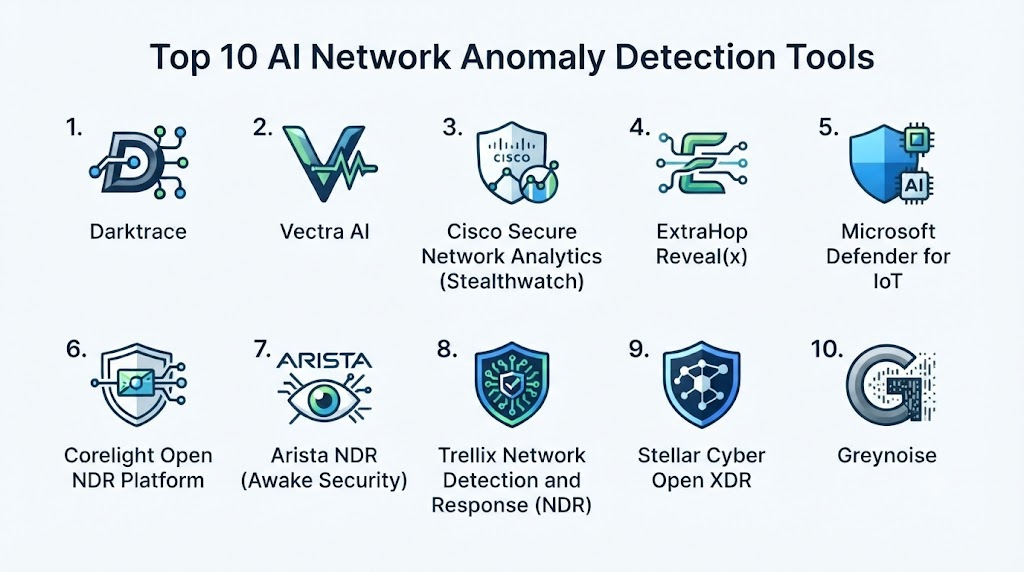
Top 10 AI Network Anomaly Detection Tools
1. Darktrace Network AI
Verdict: Leading AI‑driven network anomaly detection and cyber defense platform.
Short Description: Darktrace uses machine learning and unsupervised modeling to establish dynamic baselines of “normal” and intelligently detect deviations — flagging threats ranging from insider misuse to advanced attacks.
Key Features:
- Self‑learning AI models
- Encrypted traffic analysis
- Real‑time anomaly detection
- Autonomous response options
- High‑risk deviation scoring
Pros:
- Strong unsupervised modeling
- Excellent for unknown/zero‑day anomalies
Cons:
- Enterprise‑oriented
- Requires tuning and analyst expertise
Deployment: Cloud and on‑prem
Integrations: SIEM, SOAR, threat intel
Best For: Enterprise SOC & security teams
2. Cisco Secure Network Analytics (Stealthwatch)
Verdict: Robust ML‑driven network behavior analysis and anomaly detection.
Short Description: Cisco Secure Network Analytics uses behavioral analytics to monitor network traffic, detect anomalies, and surface threats across hybrid environments.
Key Features:
- ML behavior models
- Threat detection and correlation
- Encrypted traffic insights
- Network visualization
- Incident context
Pros:
- Strong integration with Cisco ecosystems
- Enterprise network scale
Cons:
- Best in Cisco environments
- Licensing can be complex
Deployment: Cloud, on‑prem, hybrid
Integrations: Cisco security stack, SIEM
Best For: Cisco‑centric enterprises
3. Vectra AI Cognito
Verdict: AI network threat detection and response platform.
Short Description: Vectra uses deep learning to spot network anomalies, compromised hosts, lateral movement, and stealthy threats.
Key Features:
- AI/ML detection models
- Compromise detection
- Behavioral analytics
- Threat prioritization
- Incident scoring
Pros:
- Excellent threat prioritization
- High fidelity alerts
Cons:
- Enterprise focus
- Setup effort required
Deployment: Cloud & enterprise
Integrations: SIEM, SOAR, endpoint telemetry
Best For: Attack detection and prioritization
4. Microsoft Defender for Networks (Azure)
Verdict: AI‑driven anomaly detection for cloud and hybrid networks.
Short Description: Microsoft integrates AI to monitor network traffic, detect anomalies, and correlate signals across cloud and hybrid environments.
Key Features:
- Cloud and hybrid network analysis
- AI‑powered detection
- Integration with Defender ecosystem
- Automated alerting
- Threat intelligence enrichment
Pros:
- Deep integration with Azure environments
- Cloud‑native analytics
Cons:
- Best for Microsoft stacks
- Requires Defender suite licensing
Deployment: Cloud & hybrid
Integrations: Azure Sentinel, SIEM
Best For: Azure and hybrid network security
5. Splunk UBA (User & Entity Behavior Analytics)
Verdict: Analytics platform with strong ML for network behavior anomalies.
Short Description: Splunk UBA applies machine learning to network logs and entities to detect anomalous behavior that may indicate threats or performance anomalies.
Key Features:
- ML anomaly modeling
- Risk scoring
- Network behavior insights
- Anomaly correlation
- Visual dashboards
Pros:
- Integrates well within Splunk ecosystem
- Strong analytics and visualization
Cons:
- Requires Splunk expertise
- Enterprise complexity
Deployment: Cloud & on‑prem
Integrations: SIEM, SOAR
Best For: SOC teams using Splunk
6. IBM Security QRadar Network Insights
Verdict: AI‑enhanced network behavior analytics within SIEM.
Short Description: IBM QRadar analyzes network telemetry and applies AI models to detect anomalies, correlate with events, and prioritize security incidents.
Key Features:
- Anomaly detection
- Behavior analytics
- Threat correlation
- Real‑time alerts
- SIEM integration
Pros:
- SIEM‑centric analytics
- Good visibility
Cons:
- Requires QRadar expertise
- Enterprise setup
Deployment: Cloud & enterprise
Integrations: SIEM, SOAR
Best For: QRadar security environments
7. ExtraHop Reveal(x)
Verdict: ML‑driven network detection and response with anomaly analytics.
Short Description: ExtraHop uses machine learning to detect network anomalies, lateral movement, data exfiltration, and suspicious behavior across enterprise environments.
Key Features:
- Real‑time anomaly detection
- Behavioral analytics
- Threat scoring
- Automated investigation workflows
- Strong visualization
Pros:
- Real‑time network insights
- Easy‑to‑use UI
Cons:
- Enterprise focus
- Requires deployment planning
Deployment: Cloud & hybrid
Integrations: SIEM/SOAR
Best For: NDR and SOC teams
8. Fortinet FortiNDR
Verdict: AI‑powered network detection solution with anomaly analytics.
Short Description: FortiNDR uses AI to detect anomalous traffic, threat patterns, lateral movement, and suspicious network flows.
Key Features:
- ML anomaly detection
- Threat visibility
- Behavior analytics
- Correlation with Fortinet ecosystem
- Dashboard reporting
Pros:
- Integrated Fortinet security stack
- Good lateral movement detection
Cons:
- Best with Fortinet products
- Requires ecosystem expertise
Deployment: Cloud & on‑prem
Integrations: Fortinet security products, SIEM
Best For: Fortinet security environments
9. Cisco Meraki Network Health & AI Insights
Verdict: AI‑based network behavior and performance anomaly detection for Meraki networks.
Short Description: Cisco Meraki uses analytics and AI to detect unusual traffic, performance issues, and network anomalies across Meraki‑managed infrastructure.
Key Features:
- Real‑time anomaly alerts
- AI insights and trends
- Network health monitoring
- Traffic pattern detection
- Cloud Web‑based dashboards
Pros:
- Easy deployment
- Strong for network performance anomalies
Cons:
- Primarily Meraki networks
- Less security‑centric than other tools
Deployment: Cloud‑managed
Integrations: Meraki ecosystem
Best For: Meraki infrastructure and performance monitoring
10. OpenAI‑Based AI Network Anomaly Detection Workflows
Verdict: Custom ML and AI workflows for tailored network anomaly detection.
Short Description: Customizable AI workflows use ML models, network telemetry, threat feeds, and behavior analytics to detect anomalies specific to an organization’s traffic and patterns.
Key Features:
- Custom ML models
- Anomaly classification
- Behavior analytics
- Visualization & reporting
- Threat correlation
Pros:
- Highly customizable
- Tailored detection per environment
Cons:
- Requires AI and network security expertise
- Needs validation and governance
Deployment: API and custom environments
Integrations: SIEM, network tools, threat intel
Best For: Custom security analytics programs
Comparison Table
| Platform | ML Detection | Real‑time Monitoring | Threat Context | Integrations | Best Use |
|---|---|---|---|---|---|
| Darktrace Network AI | Excellent | Excellent | High | High | Enterprise SOC |
| Cisco Secure Network Analytics | Excellent | High | High | Excellent | Cisco environments |
| Vectra AI Cognito | Excellent | High | High | High | Threat prioritization |
| Microsoft Defender for Networks | High | Excellent | High | Excellent | Azure/hybrid networks |
| Splunk UBA | High | High | High | Excellent | SOC analytics |
| IBM QRadar | High | High | High | Excellent | SIEM environments |
| ExtraHop Reveal(x) | Excellent | Excellent | High | High | NDR and SOC teams |
| Fortinet FortiNDR | High | High | High | High | Fortinet security stack |
| Cisco Meraki AI Insights | Medium | High | Medium | High | Network performance |
| OpenAI Workflows | Excellent | Custom | Custom | Custom | Custom analytics |
Evaluation & Scoring Table
| Platform | AI/ML Accuracy 25% | Detection Speed 15% | Integration 15% | Analytics 15% | Security 10% | Ease 10% | Value 10% | Total |
|---|---|---|---|---|---|---|---|---|
| Darktrace Network AI | 25 | 15 | 14 | 15 | 10 | 8 | 9 | 96 |
| Cisco Secure Network Analytics | 25 | 14 | 15 | 14 | 10 | 8 | 8 | 94 |
| Vectra AI Cognito | 24 | 14 | 15 | 14 | 10 | 8 | 8 | 93 |
| Microsoft Defender | 23 | 15 | 15 | 14 | 10 | 9 | 9 | 95 |
| Splunk UBA | 23 | 14 | 15 | 15 | 10 | 8 | 8 | 93 |
| IBM QRadar | 23 | 14 | 15 | 14 | 10 | 9 | 8 | 93 |
| ExtraHop Reveal(x) | 24 | 15 | 14 | 15 | 10 | 8 | 8 | 94 |
| Fortinet FortiNDR | 22 | 14 | 14 | 13 | 10 | 8 | 8 | 89 |
| Cisco Meraki AI | 18 | 14 | 12 | 12 | 9 | 10 | 8 | 83 |
| OpenAI Workflows | 25 | 15 | 12 | 12 | 8 | 8 | 9 | 89 |
Which AI Network Anomaly Detection Tool Is Right for You?
- Enterprise Security Operations: Darktrace, ExtraHop Reveal(x)
- Cisco Infrastructure Environments: Cisco Secure Network Analytics, Meraki AI Insights
- Threat Prioritization & Detection: Vectra AI Cognito
- Azure & Hybrid Networks: Microsoft Defender for Networks
- SIEM‑centric Security Teams: Splunk UBA, IBM QRadar
- Fortinet Security Stack: Fortinet FortiNDR
- Custom AI Detection Needs: OpenAI‑based workflows
Implementation Playbook
30 Days
- Integrate network data feeds and telemetry
- Define normal baselines
- Configure AI detection modules
60 Days
- Tune detection thresholds
- Correlate with SIEM/SOAR
- Validate alerts with analysts
90 Days
- Automate response workflows
- Monitor anomaly trends
- Optimize models and reduce false positives
Common Mistakes
- Overreliance on static rules
- Poor data quality feeding models
- Ignoring encrypted traffic visibility
- Not correlating security context
- Delayed analyst feedback loops
Frequently Asked Questions
What is AI network anomaly detection?
It uses machine learning and behavioral analytics to identify unusual network behavior that could signal threats or operational issues.
Does AI reduce false positives?
Yes — by learning normal behavior and contextualizing deviations, AI reduces noise.
Can AI detect zero‑day attacks?
AI can flag unknown behavior patterns, helping identify previously unseen threats.
Is this real‑time?
Many platforms support near‑real‑time monitoring and alerting.
Do these tools integrate with SIEM/SOAR?
Yes — most enterprise solutions integrate with security ecosystems.
Does AI handle encrypted traffic?
Solutions vary, but many provide visibility into encrypted flows and anomalies.
Are these tools suitable for cloud networks?
Yes — many support hybrid and cloud environments.
Can small teams use them?
Cloud‑based options can be suitable, though enterprise‑grade tools require expertise.
Do they help performance monitoring?
Some offer performance anomaly insights alongside security detections.
How do I start with network anomaly detection?
Integrate telemetry, establish baselines, tune thresholds, and correlate with context.
Conclusion
AI Network Anomaly Detection tools are revolutionizing network security and operations by helping teams detect subtle deviations, unknown threats, and unusual activity with high accuracy and reduced false positives. Platforms such as Darktrace, ExtraHop Reveal(x), and Cisco Secure Network Analytics deliver powerful AI‑driven visibility, while custom OpenAI‑based workflows offer tailored solutions for unique environments.
