Introduction
AI Root Cause Analysis (RCA) for Incidents tools help IT operations, Site Reliability Engineering (SRE), DevOps, Security Operations Centers (SOCs), and cloud engineering teams rapidly identify the underlying causes of service outages, security incidents, application failures, infrastructure issues, and performance degradation. By leveraging artificial intelligence (AI), machine learning (ML), causal analysis, anomaly detection, and topology mapping, these platforms correlate data across logs, metrics, traces, events, and dependencies to pinpoint the true source of an incident.
Traditional incident investigations often require engineers to manually analyze logs, dashboards, alerts, and infrastructure dependencies, leading to prolonged Mean Time to Resolution (MTTR) and increased operational costs. AI-powered Root Cause Analysis platforms automate this process by identifying patterns, correlating telemetry from multiple systems, ranking probable causes, and recommending remediation actions. Instead of treating symptoms, these tools help teams quickly understand why an incident occurred and what actions are required to prevent recurrence.
Modern AI RCA solutions integrate with observability platforms, AIOps tools, Security Information and Event Management (SIEM) systems, cloud monitoring services, Kubernetes environments, application performance monitoring (APM), and incident management platforms. They support proactive operations by reducing alert noise, accelerating troubleshooting, and improving service reliability across hybrid and multi-cloud infrastructures.
Organizations increasingly rely on AI Root Cause Analysis to improve operational resilience, reduce downtime, automate investigations, and enhance collaboration between IT, DevOps, and security teams.
Real-world Use Cases
- Production incident investigation
- Application performance troubleshooting
- Infrastructure failure analysis
- Cloud outage diagnosis
- Kubernetes incident analysis
- Security incident root cause identification
- Network failure investigation
- Database performance analysis
- Automated incident correlation
- Service dependency analysis
Evaluation Criteria for Buyers
When evaluating AI Root Cause Analysis platforms, consider:
- AI correlation accuracy
- Root cause detection quality
- Log, metric, and trace correlation
- Topology and dependency mapping
- Incident automation
- Cloud-native support
- Integrations with observability platforms
- Scalability
- Visualization capabilities
- Ease of deployment
Best For
- Site Reliability Engineering teams
- DevOps organizations
- IT Operations teams
- Enterprise SOCs
- Cloud operations teams
- Managed service providers
Not Ideal For
Organizations with minimal monitoring infrastructure or environments lacking centralized telemetry collection.
Key Trends
- AI-powered AIOps
- Automated incident correlation
- Predictive root cause analysis
- Full-stack observability
- Intelligent dependency mapping
- AI-assisted troubleshooting
- Cloud-native RCA
- Autonomous operations
- Event intelligence
- Explainable AI for operations
Methodology
The platforms below were evaluated based on:
- AI root cause analysis
- Incident correlation
- Observability integration
- Automation capabilities
- Multi-cloud support
- Visualization
- Enterprise readiness
- Overall operational value
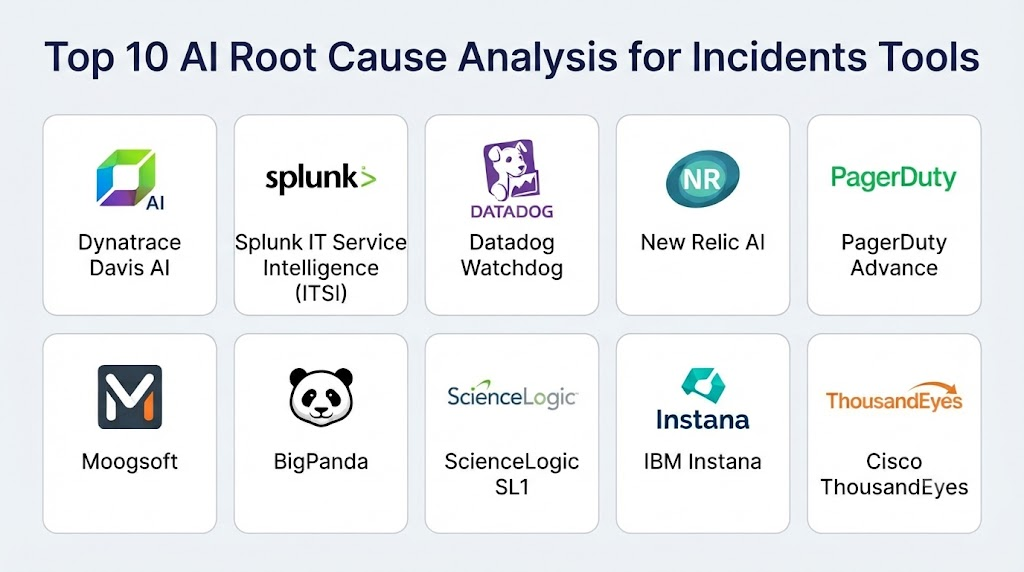
Top 10 AI Root Cause Analysis for Incidents Tools
1. Dynatrace Davis AI
Verdict: Best overall AI platform for automated root cause analysis across modern enterprise environments.
Short Description: Dynatrace Davis AI automatically analyzes logs, metrics, traces, events, dependencies, and application topology to identify the precise root cause of incidents. It continuously evaluates infrastructure health, correlates telemetry, prioritizes business impact, and recommends remediation actions, significantly reducing Mean Time to Resolution.
Key Features
- Automatic root cause analysis
- AI dependency mapping
- Distributed tracing
- Topology discovery
- Business impact analysis
- Anomaly detection
- Cloud-native monitoring
- Incident prioritization
Pros
- Industry-leading AI engine
- Excellent automation
- Full-stack observability
- Highly accurate RCA
Cons
- Premium enterprise pricing
- Advanced implementation
Deployment: SaaS & Managed
Security & Compliance: Enterprise-grade controls
Integrations & Ecosystem: Kubernetes, AWS, Azure, Google Cloud, ServiceNow, PagerDuty, SIEM platforms
Support & Community: Enterprise support
Pricing Model: Subscription
Best-Fit Scenarios: Large enterprise observability and AIOps
2. New Relic AI
Verdict: Comprehensive AI-powered observability platform with intelligent incident diagnosis.
Short Description: New Relic AI correlates logs, traces, metrics, infrastructure telemetry, and application events to identify probable root causes, prioritize incidents, and reduce troubleshooting time across distributed systems.
Key Features
- AI incident intelligence
- Log correlation
- Distributed tracing
- Infrastructure monitoring
- Root cause recommendations
- Anomaly detection
Pros
- Unified observability
- Strong cloud support
- Excellent dashboards
Cons
- Usage-based pricing
3. Datadog Watchdog
Verdict: Intelligent AI monitoring platform with automated incident investigations.
Short Description: Datadog Watchdog continuously monitors cloud infrastructure, applications, containers, and services to detect anomalies, correlate events, and automatically identify likely root causes before they impact users.
Key Features
- AI anomaly detection
- Root cause analysis
- Event correlation
- Cloud monitoring
- Distributed tracing
- Service dependency analysis
Pros
- Excellent cloud-native capabilities
- Strong automation
Cons
- Large deployments can become expensive
4. Splunk IT Service Intelligence (ITSI)
Verdict: Enterprise AIOps platform for intelligent service health analysis.
Short Description: Splunk ITSI combines machine learning, event correlation, topology mapping, and service intelligence to identify root causes and reduce alert fatigue in complex enterprise environments.
Key Features
- Event correlation
- AI service health
- Predictive analytics
- Root cause analysis
- KPI monitoring
Pros
- Mature enterprise platform
- Excellent analytics
Cons
- Requires Splunk expertise
5. IBM Instana
Verdict: AI-powered application observability and automated root cause analysis.
Short Description: IBM Instana automatically discovers application dependencies, collects telemetry, detects anomalies, and identifies root causes across modern cloud-native applications and microservices.
Key Features
- Automatic discovery
- AI diagnostics
- Distributed tracing
- Application monitoring
- Incident correlation
Pros
- Excellent Kubernetes support
- Strong automation
Cons
- Enterprise-focused
6. Cisco AppDynamics
Verdict: Business-centric AI platform for application root cause analysis.
Short Description: AppDynamics uses AI to analyze application performance, infrastructure health, and business transactions to rapidly identify the source of application issues and service degradation.
Key Features
- Business transaction monitoring
- AI diagnostics
- Root cause analysis
- Application performance monitoring
- Infrastructure visibility
Pros
- Strong business context
- Excellent application insights
Cons
- Premium pricing
7. LogicMonitor Edwin AI
Verdict: AI-assisted infrastructure monitoring and incident analysis platform.
Short Description: LogicMonitor Edwin AI automates infrastructure monitoring, event analysis, anomaly detection, and root cause identification while reducing operational workload for IT teams.
Key Features
- Infrastructure monitoring
- AI recommendations
- Event correlation
- Root cause analysis
- Hybrid cloud monitoring
Pros
- Easy deployment
- Strong hybrid infrastructure support
Cons
- Smaller ecosystem than market leaders
8. Moogsoft AIOps
Verdict: AI-powered event correlation and incident management platform.
Short Description: Moogsoft applies machine learning to correlate alerts, suppress duplicate events, identify probable root causes, and automate incident investigations for enterprise IT operations.
Key Features
- Alert correlation
- AI event clustering
- Root cause detection
- Incident automation
- Noise reduction
Pros
- Excellent alert reduction
- Mature AIOps platform
Cons
- Initial tuning required
9. BigPanda
Verdict: AI-driven operations platform for incident intelligence.
Short Description: BigPanda centralizes alerts from multiple monitoring tools, applies AI correlation, identifies root causes, and enables faster incident resolution through intelligent operational insights.
Key Features
- Alert correlation
- Incident intelligence
- Root cause analysis
- AI automation
- Service topology
Pros
- Excellent integrations
- Strong enterprise scalability
Cons
- Enterprise licensing
10. OpenAI-Based Custom RCA Platform
Verdict: Flexible AI-powered incident investigation platform tailored to enterprise operations.
Short Description: Organizations can build custom AI Root Cause Analysis platforms using large language models integrated with observability platforms, SIEM, APM, logs, traces, metrics, cloud telemetry, and incident management systems to automate investigations, summarize incidents, recommend remediation, and improve operational resilience.
Key Features
- AI incident investigation
- Intelligent log analysis
- Telemetry correlation
- Root cause summaries
- Workflow automation
Pros
- Highly customizable
- Flexible integrations
- Organization-specific intelligence
Cons
- Requires AI engineering expertise
- Governance and validation required
Comparison Table
| Platform | AI RCA | Event Correlation | Observability | Automation | Best Use |
|---|---|---|---|---|---|
| Dynatrace Davis AI | Excellent | Excellent | Excellent | Excellent | Enterprise AIOps |
| New Relic AI | Excellent | High | Excellent | High | Cloud Observability |
| Datadog Watchdog | Excellent | High | Excellent | High | Cloud Operations |
| Splunk ITSI | High | Excellent | High | High | Enterprise IT |
| IBM Instana | High | High | Excellent | High | Kubernetes |
| Cisco AppDynamics | High | High | High | Medium | Application Monitoring |
| LogicMonitor Edwin AI | High | High | High | High | Hybrid Infrastructure |
| Moogsoft | Excellent | Excellent | High | Excellent | AIOps |
| BigPanda | High | Excellent | High | Excellent | Incident Management |
| OpenAI Custom | Custom | Custom | Custom | Custom | Custom Operations |
Evaluation & Scoring Table
| Platform | AI Features 20% | RCA Accuracy 20% | Integrations 15% | Automation 15% | Performance 10% | Ease 10% | Value 10% | Total |
|---|---|---|---|---|---|---|---|---|
| Dynatrace Davis AI | 20 | 20 | 15 | 15 | 10 | 8 | 8 | 96 |
| Datadog Watchdog | 19 | 19 | 14 | 14 | 10 | 9 | 8 | 93 |
| New Relic AI | 19 | 19 | 14 | 14 | 10 | 9 | 8 | 93 |
| Splunk ITSI | 18 | 19 | 15 | 14 | 10 | 8 | 8 | 92 |
| IBM Instana | 18 | 18 | 14 | 14 | 10 | 8 | 8 | 90 |
| Moogsoft | 18 | 18 | 14 | 14 | 9 | 8 | 8 | 89 |
| BigPanda | 17 | 18 | 15 | 13 | 9 | 8 | 8 | 88 |
| Cisco AppDynamics | 17 | 17 | 14 | 13 | 10 | 8 | 8 | 87 |
| LogicMonitor Edwin AI | 17 | 17 | 13 | 13 | 9 | 9 | 8 | 86 |
| OpenAI Custom | 20 | 19 | 12 | 15 | 8 | 7 | 9 | 90 |
Which AI Root Cause Analysis Tool Is Right for You?
| If your priority is… | Recommended Platform |
|---|---|
| Enterprise AIOps | Dynatrace Davis AI |
| Cloud-native observability | Datadog Watchdog |
| Full-stack monitoring | New Relic AI |
| Enterprise IT operations | Splunk ITSI |
| Kubernetes environments | IBM Instana |
| Business transaction monitoring | Cisco AppDynamics |
| Hybrid infrastructure | LogicMonitor Edwin AI |
| Event correlation | Moogsoft |
| Incident intelligence | BigPanda |
| Custom AI workflows | OpenAI-Based RCA Platform |
Implementation Playbook
First 30 Days
- Inventory monitoring tools
- Connect logs, metrics, traces, and events
- Build service topology
- Validate telemetry quality
Days 31–60
- Enable AI correlation
- Configure RCA workflows
- Integrate incident management
- Train operations teams
Days 61–90
- Automate investigations
- Optimize AI recommendations
- Measure MTTR improvements
- Continuously refine RCA models
Common Mistakes
- Incomplete telemetry collection
- Missing dependency mapping
- Ignoring topology relationships
- Weak observability integrations
- Excessive alert noise
- Poor incident documentation
- Limited automation
- Failure to validate AI recommendations
Frequently Asked Questions
1. What is AI Root Cause Analysis for Incidents?
It uses AI to correlate telemetry, identify the underlying cause of incidents, and recommend remediation steps automatically.
2. How is AI RCA different from traditional monitoring?
Traditional monitoring reports symptoms, while AI RCA identifies the actual cause by analyzing relationships across logs, metrics, traces, and events.
3. Can these tools integrate with observability platforms?
Yes. Most platforms integrate with APM, SIEM, cloud monitoring, Kubernetes, and incident management solutions.
4. Do AI RCA tools reduce Mean Time to Resolution (MTTR)?
Yes. By automating investigations and identifying likely root causes, they significantly reduce troubleshooting time.
5. Can they analyze cloud-native environments?
Yes. Most enterprise platforms support containers, Kubernetes, serverless applications, and multi-cloud infrastructure.
6. Are these platforms suitable for DevOps teams?
Yes. They are widely used by DevOps, SRE, IT operations, and cloud engineering teams.
7. Can AI automatically correlate incidents across multiple systems?
Yes. AI correlates telemetry from applications, infrastructure, networks, and cloud services to identify related events.
8. How do these platforms improve operational efficiency?
They automate investigations, reduce alert noise, prioritize incidents, and provide actionable recommendations.
9. What integrations are most important?
Logs, metrics, traces, SIEM, APM, cloud platforms, Kubernetes, ITSM, and incident management systems.
10. What should organizations evaluate before selecting a platform?
Assess AI capabilities, telemetry coverage, automation, integrations, scalability, visualization, governance, and operational fit.
Conclusion
AI Root Cause Analysis for Incidents platforms have become a cornerstone of modern AIOps and observability strategies by helping organizations rapidly identify the underlying causes of outages, performance issues, and security incidents. By combining AI-driven event correlation, dependency mapping, telemetry analysis, and automated recommendations, these solutions reduce operational complexity while significantly improving incident response efficiency.Organizations should select an AI RCA platform based on infrastructure complexity, observability maturity, integration requirements, automation capabilities, and cloud strategy. Solutions such as Dynatrace Davis AI, Datadog Watchdog, New Relic AI, Splunk ITSI, and IBM Instana provide enterprise-grade capabilities that accelerate incident resolution, improve service reliability, and strengthen overall operational resilience.
