Introduction
AI Log Parsing & Normalization tools help organizations transform massive volumes of raw machine-generated logs into structured, searchable, and standardized data for security, observability, IT operations, and compliance. Using artificial intelligence (AI), machine learning (ML), natural language processing (NLP), and automation, these platforms automatically identify log patterns, extract meaningful fields, normalize data into common schemas, enrich events with contextual intelligence, and prepare logs for downstream analytics.
Modern enterprises generate billions of log events daily from cloud infrastructure, Kubernetes clusters, applications, databases, operating systems, firewalls, identity platforms, APIs, network devices, and security tools. Since every system produces logs in different formats, manually parsing and normalizing this data is time-consuming, error-prone, and difficult to scale. AI-powered platforms eliminate this complexity by automatically recognizing new log formats, mapping fields to standardized schemas, detecting anomalies, and continuously improving parsing accuracy.
These tools are fundamental components of Security Information and Event Management (SIEM), Extended Detection and Response (XDR), observability platforms, Security Operations Centers (SOCs), DevOps pipelines, and cloud monitoring solutions. By standardizing telemetry from diverse sources, they improve search accuracy, accelerate investigations, reduce alert fatigue, and enable more effective threat detection and operational analytics.
As organizations continue adopting hybrid and multi-cloud architectures, AI-powered log parsing and normalization have become critical capabilities for improving security visibility, operational efficiency, compliance reporting, and real-time incident response.
Real-world Use Cases
- Security log normalization
- SIEM data ingestion
- Multi-cloud log processing
- Kubernetes log analysis
- Application log parsing
- Infrastructure monitoring
- Threat detection enrichment
- Compliance reporting
- Incident investigations
- Observability data pipelines
Evaluation Criteria for Buyers
When selecting an AI Log Parsing & Normalization platform, evaluate:
- AI parsing accuracy
- Automatic schema mapping
- Supported log formats
- Search and indexing performance
- SIEM and observability integrations
- Automation capabilities
- Cloud-native support
- Scalability
- Security and compliance
- Ease of deployment
Best For
- Security Operations Centers (SOCs)
- DevOps teams
- Site Reliability Engineers (SREs)
- Cloud operations teams
- Observability engineers
- Enterprise IT operations
Not Ideal For
Organizations generating minimal log volumes or environments without centralized monitoring.
Key Trends
- AI-powered telemetry pipelines
- Intelligent log enrichment
- OpenTelemetry adoption
- AI-assisted observability
- Real-time log analytics
- Automated schema mapping
- Security data lakes
- Cloud-native logging
- AI anomaly detection
- Unified observability platforms
Methodology
The tools below were evaluated based on:
- AI parsing capabilities
- Normalization accuracy
- Supported log sources
- Performance at enterprise scale
- Security integrations
- Automation
- Deployment flexibility
- Overall value
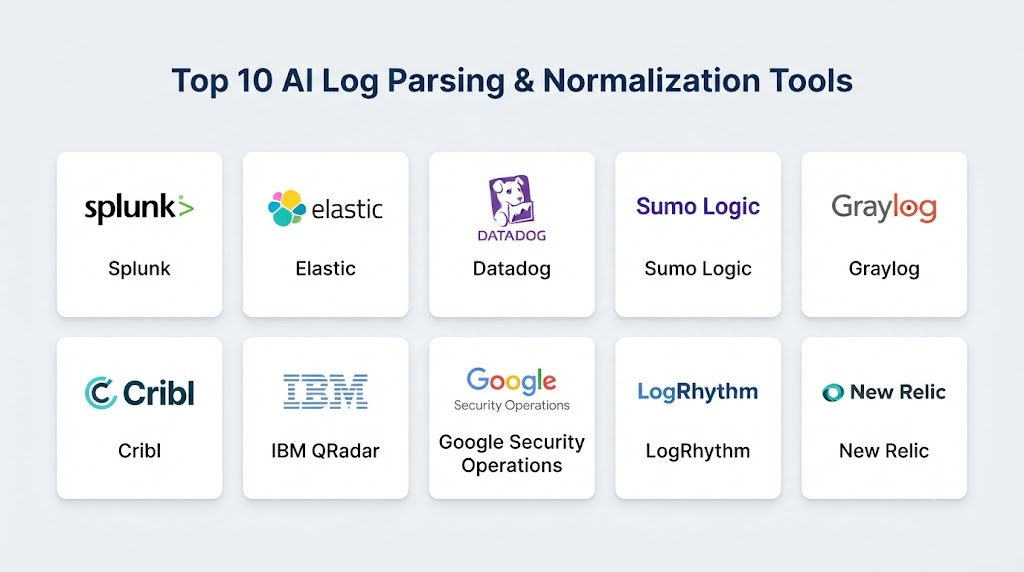
Top 10 AI Log Parsing & Normalization Tools
1. Splunk Platform with AI Assistant
Verdict: Best overall enterprise platform for AI-powered log parsing, normalization, and security analytics.
Short Description: Splunk combines AI-assisted field extraction, intelligent parsing, schema normalization, and advanced search capabilities to process massive log volumes from thousands of data sources. Its AI capabilities accelerate investigations, improve search accuracy, and enable enterprise-scale security analytics and observability.
Key Features
- AI-assisted log parsing
- Automatic field extraction
- Intelligent normalization
- Schema mapping
- Real-time indexing
- AI-powered search
- Security analytics
- Log enrichment
Pros
- Excellent enterprise scalability
- Extensive integration ecosystem
- Powerful search capabilities
- Mature analytics platform
Cons
- Premium licensing
- Steep learning curve
Deployment: Cloud & On-premises
Security & Compliance: Enterprise-grade security
Integrations & Ecosystem: SIEM, SOAR, Kubernetes, cloud platforms, DevOps tools
Support & Community: Enterprise support
Pricing Model: Subscription
Best-Fit Scenarios: Enterprise SOCs and observability teams
2. Elastic Stack with Elastic AI Assistant
Verdict: Flexible AI-powered platform for log parsing, normalization, and observability.
Short Description: Elastic Stack combines Elasticsearch, Logstash, Kibana, Beats, and Elastic AI Assistant to automatically parse logs, normalize events, perform intelligent searches, and support enterprise observability with machine learning and AI-driven analytics.
Key Features
- AI-assisted parsing
- Logstash pipelines
- Schema normalization
- Full-text search
- OpenTelemetry support
- Machine learning analytics
Pros
- Highly customizable
- Strong open ecosystem
- Excellent search performance
Cons
- Requires deployment expertise
3. Cribl Stream
Verdict: Best AI-powered telemetry pipeline for optimizing and normalizing enterprise log data.
Short Description: Cribl Stream intelligently parses, transforms, filters, enriches, and routes log data before it reaches SIEM or observability platforms, helping organizations reduce storage costs while improving data quality and operational efficiency.
Key Features
- Intelligent log routing
- Data transformation
- AI-assisted optimization
- Schema normalization
- Multi-destination delivery
- Pipeline management
Pros
- Excellent pipeline flexibility
- Reduces SIEM ingestion costs
- High-performance processing
Cons
- Requires pipeline planning
4. Datadog Log Management
Verdict: Cloud-native AI log analytics platform with automatic parsing and normalization.
Short Description: Datadog automatically collects, parses, enriches, and analyzes logs across cloud-native environments while integrating seamlessly with infrastructure monitoring, APM, security monitoring, and distributed tracing.
Key Features
- Automatic parsing
- AI log analytics
- Cloud monitoring
- Threat detection
- Distributed tracing
- Intelligent search
Pros
- Excellent cloud integrations
- Easy deployment
- Unified observability
Cons
- Usage-based pricing
5. Microsoft Sentinel
Verdict: Enterprise SIEM with AI-powered log normalization and security analytics.
Short Description: Microsoft Sentinel automatically ingests, parses, normalizes, and enriches logs from Microsoft and third-party environments, improving security investigations through AI-driven analytics and threat intelligence.
Key Features
- AI log normalization
- Security analytics
- Threat intelligence
- KQL support
- Cloud-native SIEM
- Automated investigations
Pros
- Strong Microsoft integration
- Enterprise-grade analytics
Cons
- Best within Microsoft ecosystem
6. Sumo Logic
Verdict: Cloud-native AI platform for log management and security analytics.
Short Description: Sumo Logic uses AI and machine learning to parse logs, normalize events, detect anomalies, and improve cloud observability and security monitoring across modern distributed systems.
Key Features
- AI log parsing
- Security analytics
- Cloud observability
- Machine learning
- Threat detection
Pros
- Fully managed SaaS
- Strong cloud monitoring
Cons
- Higher costs at very large scale
7. IBM QRadar SIEM
Verdict: Enterprise SIEM with intelligent log normalization capabilities.
Short Description: IBM QRadar automatically normalizes logs from diverse sources, enriches events, correlates telemetry, and supports enterprise threat detection using AI-assisted investigations.
Key Features
- Log normalization
- Event correlation
- Security analytics
- AI investigations
- Compliance reporting
Pros
- Mature SIEM platform
- Strong enterprise capabilities
Cons
- Enterprise-oriented deployment
8. Google Cloud Logging
Verdict: AI-powered cloud logging platform for Google Cloud environments.
Short Description: Google Cloud Logging automatically parses, indexes, and normalizes cloud telemetry while integrating with Google’s monitoring, observability, and security services.
Key Features
- Cloud log parsing
- AI analytics
- Search
- Monitoring integration
- Log routing
Pros
- Excellent Google Cloud integration
- Strong scalability
Cons
- Best for Google Cloud workloads
9. Graylog
Verdict: Enterprise log management platform with AI-enhanced analytics.
Short Description: Graylog centralizes log collection, parsing, normalization, and analysis while supporting operational monitoring, security investigations, and compliance reporting across enterprise environments.
Key Features
- Centralized logging
- Parsing pipelines
- Normalization
- Search
- Alerting
Pros
- Flexible deployment
- Strong community support
Cons
- AI capabilities less advanced than premium competitors
10. OpenAI-Based Custom Log Intelligence Platform
Verdict: Highly customizable AI-powered log parsing and normalization solution.
Short Description: Organizations can build custom AI-powered log intelligence platforms using large language models integrated with SIEM, OpenTelemetry, cloud platforms, observability tools, and security data lakes to automate parsing, enrichment, summarization, and incident investigations.
Key Features
- Intelligent parsing
- Schema normalization
- AI enrichment
- Log summarization
- Custom automation
Pros
- Highly customizable
- Flexible integrations
- Organization-specific intelligence
Cons
- Requires AI and platform engineering expertise
- Governance and validation required
Comparison Table
| Platform | AI Parsing | Normalization | Scalability | Integrations | Best Use |
|---|---|---|---|---|---|
| Splunk | Excellent | Excellent | Excellent | Excellent | Enterprise SOC |
| Elastic Stack | Excellent | Excellent | Excellent | Excellent | Observability |
| Cribl Stream | Excellent | Excellent | Excellent | Excellent | Telemetry Pipelines |
| Datadog | Excellent | High | Excellent | High | Cloud Monitoring |
| Microsoft Sentinel | High | Excellent | High | Excellent | Microsoft Security |
| Sumo Logic | High | High | High | High | SaaS Observability |
| IBM QRadar | High | Excellent | High | High | Enterprise SIEM |
| Google Cloud Logging | High | High | Excellent | High | Google Cloud |
| Graylog | High | High | High | High | Enterprise Logging |
| OpenAI Custom | Custom | Custom | Custom | Custom | Custom Pipelines |
Evaluation & Scoring Table
| Platform | AI Features 20% | Parsing 20% | Integrations 15% | Automation 15% | Performance 10% | Ease 10% | Value 10% | Total |
|---|---|---|---|---|---|---|---|---|
| Splunk | 20 | 20 | 15 | 15 | 10 | 8 | 8 | 96 |
| Elastic Stack | 19 | 20 | 15 | 14 | 10 | 8 | 9 | 95 |
| Cribl Stream | 19 | 19 | 15 | 15 | 10 | 8 | 8 | 94 |
| Datadog | 18 | 19 | 14 | 14 | 10 | 9 | 8 | 92 |
| Microsoft Sentinel | 18 | 18 | 15 | 14 | 10 | 8 | 8 | 91 |
| Sumo Logic | 18 | 18 | 14 | 13 | 9 | 9 | 8 | 89 |
| IBM QRadar | 17 | 18 | 14 | 13 | 10 | 8 | 8 | 88 |
| Google Cloud Logging | 17 | 18 | 14 | 13 | 10 | 9 | 8 | 89 |
| Graylog | 16 | 17 | 13 | 12 | 9 | 9 | 9 | 85 |
| OpenAI Custom | 20 | 19 | 12 | 15 | 8 | 7 | 9 | 90 |
Which AI Log Parsing & Normalization Tool Is Right for You?
| If your priority is… | Recommended Platform |
|---|---|
| Enterprise log analytics | Splunk Platform |
| Open-source flexibility | Elastic Stack |
| Telemetry pipelines | Cribl Stream |
| Cloud-native monitoring | Datadog |
| Microsoft security | Microsoft Sentinel |
| SaaS observability | Sumo Logic |
| Enterprise SIEM | IBM QRadar |
| Google Cloud logging | Google Cloud Logging |
| Flexible log management | Graylog |
| Custom AI workflows | OpenAI-Based Log Intelligence Platform |
Implementation Playbook
First 30 Days
- Inventory log sources
- Define normalization standards
- Connect critical systems
- Validate parser accuracy
Days 31–60
- Configure enrichment pipelines
- Integrate SIEM and observability platforms
- Enable AI anomaly detection
- Train operations teams
Days 61–90
- Automate parsing workflows
- Optimize storage and routing
- Measure search performance
- Continuously improve normalization models
Common Mistakes
- Ingesting logs without normalization
- Ignoring schema consistency
- Poor retention planning
- Weak parser validation
- Missing cloud-native telemetry
- Limited automation
- Inefficient pipeline design
- Failing to monitor parser performance
Frequently Asked Questions
1. What are AI Log Parsing & Normalization Tools?
They use AI to automatically parse, structure, normalize, and enrich logs from multiple systems for security, monitoring, and analytics.
2. Why is log normalization important?
Normalization enables logs from different technologies to follow a common schema, making searching, correlation, reporting, and investigations much easier.
3. Can these platforms integrate with SIEM solutions?
Yes. Most enterprise solutions integrate with SIEM, SOAR, XDR, observability platforms, cloud services, and security analytics tools.
4. Do AI log parsing tools improve threat detection?
Yes. Better parsing and normalization improve event correlation, reduce false positives, and enhance threat visibility.
5. Are these tools suitable for Kubernetes and containers?
Yes. Most modern platforms support Kubernetes, containers, microservices, and cloud-native workloads.
6. Which log formats are commonly supported?
Syslog, JSON, Common Event Format (CEF), Log Event Extended Format (LEEF), OpenTelemetry, cloud logs, application logs, and custom formats.
7. Can AI automatically recognize unknown log formats?
Many platforms use machine learning to identify new log patterns and improve parsing accuracy over time.
8. How do these platforms help observability teams?
They centralize, normalize, and enrich telemetry, enabling faster troubleshooting and more accurate performance monitoring.
9. Who benefits the most from these solutions?
Security analysts, DevOps engineers, SREs, cloud operations teams, compliance professionals, and enterprise IT teams.
10. What should organizations evaluate before deployment?
Consider AI capabilities, supported log sources, scalability, integrations, automation, deployment flexibility, governance, and total cost of ownership.
Conclusion
AI Log Parsing & Normalization tools are foundational technologies for modern security operations and observability, enabling organizations to transform fragmented, unstructured log data into standardized, actionable intelligence. Through AI-powered parsing, schema normalization, enrichment, and automation, these platforms accelerate investigations, improve threat detection, enhance compliance reporting, and reduce operational complexity across hybrid and multi-cloud environments.Organizations should select a platform based on log volume, infrastructure complexity, cloud strategy, integration requirements, automation capabilities, and operational maturity. Solutions such as Splunk Platform, Elastic Stack, Cribl Stream, Datadog, and Microsoft Sentinel provide enterprise-grade capabilities, while custom AI-powered log intelligence platforms offer maximum flexibility for organizations with specialized telemetry processing and analytics requirements.
