Introduction
AI Auto-Remediation (AIOps) platforms use artificial intelligence (AI), machine learning (ML), predictive analytics, automation, and orchestration to automatically detect, diagnose, and resolve IT infrastructure, cloud, application, and security issues with minimal human intervention. These platforms continuously analyze logs, metrics, traces, events, alerts, and telemetry from across enterprise environments to identify anomalies, determine root causes, and execute predefined or AI-generated remediation workflows.
Modern enterprises operate highly distributed environments spanning public clouds, private clouds, Kubernetes clusters, virtual machines, microservices, edge infrastructure, and SaaS applications. Traditional IT operations teams often struggle with alert overload, manual troubleshooting, and lengthy incident resolution times. AI Auto-Remediation platforms address these challenges by combining observability, event correlation, root cause analysis, workflow automation, and intelligent decision-making to resolve incidents before they significantly impact business operations.
Unlike traditional automation platforms that rely solely on static rules, AI-powered AIOps solutions learn from historical incidents, operational patterns, infrastructure dependencies, and business context. They continuously improve remediation accuracy, prioritize high-impact issues, recommend corrective actions, and execute automated workflows while maintaining governance and human oversight where required.
These platforms are widely used by IT Operations, Site Reliability Engineering (SRE), DevOps, cloud operations, Network Operations Centers (NOCs), Security Operations Centers (SOCs), and enterprise infrastructure teams to reduce Mean Time to Detect (MTTD), Mean Time to Resolution (MTTR), operational costs, and service disruptions.
Real-world Use Cases
- Automated incident remediation
- Infrastructure self-healing
- Cloud resource optimization
- Application performance recovery
- Kubernetes auto-remediation
- Automated service restarts
- Intelligent alert correlation
- Network issue remediation
- Security incident response automation
- Predictive infrastructure maintenance
Evaluation Criteria for Buyers
When evaluating AI Auto-Remediation platforms, consider:
- AI-driven remediation accuracy
- Incident detection capabilities
- Root cause analysis
- Workflow automation
- Infrastructure coverage
- Cloud-native support
- ITSM and observability integrations
- Governance and approvals
- Scalability
- Ease of deployment
Best For
- Enterprise IT Operations
- Site Reliability Engineering teams
- DevOps organizations
- Cloud operations teams
- Network Operations Centers
- Managed Service Providers
Not Ideal For
Organizations with limited automation requirements or environments lacking centralized monitoring and operational telemetry.
Key Trends
- Autonomous IT operations
- AI-powered self-healing infrastructure
- Intelligent workflow orchestration
- Predictive incident remediation
- Kubernetes automation
- Cloud-native AIOps
- AI-driven operational intelligence
- Event correlation automation
- Intelligent runbook execution
- Human-in-the-loop automation
Methodology
The platforms below were evaluated based on:
- AI remediation capabilities
- Automation maturity
- Root cause analysis
- Integration ecosystem
- Cloud support
- Scalability
- Enterprise readiness
- Overall operational value
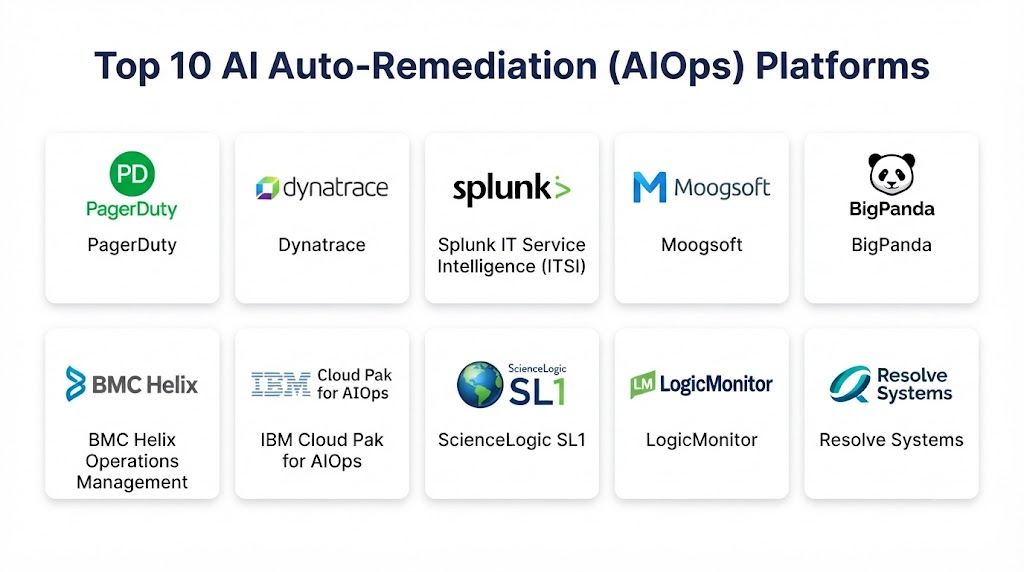
Top 10 AI Auto-Remediation (AIOps) Platforms
1. Dynatrace Davis AI
Verdict: Best overall AI-powered AIOps platform for autonomous incident detection and remediation.
Short Description: Dynatrace Davis AI continuously monitors applications, infrastructure, containers, cloud services, and business transactions to automatically identify root causes, recommend corrective actions, and execute intelligent remediation workflows. Its topology-aware AI engine enables proactive self-healing operations while reducing downtime and operational complexity.
Key Features
- AI root cause analysis
- Automated remediation
- Dependency mapping
- Predictive analytics
- Full-stack observability
- Kubernetes automation
- Cloud monitoring
- Business impact analysis
Pros
- Industry-leading AI engine
- Excellent automation
- Highly accurate root cause detection
- Enterprise scalability
Cons
- Premium pricing
- Advanced implementation requirements
Deployment: SaaS & Managed
Security & Compliance: Enterprise-grade controls
Integrations & Ecosystem: AWS, Azure, Google Cloud, Kubernetes, ServiceNow, PagerDuty, Jenkins
Support & Community: Enterprise support
Pricing Model: Subscription
Best-Fit Scenarios: Large enterprise AIOps environments
2. IBM Watson AIOps
Verdict: Enterprise AI platform for intelligent incident management and automated remediation.
Short Description: IBM Watson AIOps combines AI, event correlation, automation, and predictive analytics to identify operational issues, determine root causes, and automate remediation across hybrid cloud and enterprise environments.
Key Features
- AI incident management
- Root cause analysis
- Event correlation
- Automation workflows
- Predictive analytics
- Hybrid cloud support
Pros
- Mature enterprise platform
- Strong automation
- Broad integrations
Cons
- Enterprise deployment complexity
3. Splunk IT Service Intelligence (ITSI)
Verdict: AI-driven service intelligence platform with intelligent remediation workflows.
Short Description: Splunk ITSI analyzes operational telemetry, correlates events, predicts service degradation, and automates incident response through AI-powered analytics and workflow orchestration.
Key Features
- Event correlation
- Predictive analytics
- Service health monitoring
- Automated workflows
- AI recommendations
Pros
- Powerful analytics
- Excellent observability integration
Cons
- Requires Splunk expertise
4. Moogsoft AIOps
Verdict: AI-powered event intelligence and automated incident response platform.
Short Description: Moogsoft applies machine learning to suppress alert noise, correlate incidents, identify root causes, and automate remediation workflows for enterprise IT operations.
Key Features
- Event correlation
- Alert reduction
- Root cause analysis
- Automation
- Incident management
Pros
- Significant alert reduction
- Mature AIOps capabilities
Cons
- Initial tuning required
5. BigPanda
Verdict: AI operations platform focused on intelligent incident correlation and remediation.
Short Description: BigPanda consolidates alerts from monitoring tools, applies AI to identify high-priority incidents, and automates remediation workflows while improving collaboration across operations teams.
Key Features
- Alert correlation
- AI incident intelligence
- Root cause analysis
- Workflow automation
- Service topology
Pros
- Strong enterprise integrations
- Excellent scalability
Cons
- Enterprise-focused licensing
6. PagerDuty AIOps
Verdict: AI-powered incident response and automation platform.
Short Description: PagerDuty AIOps combines event intelligence, automation, incident response, and AI-driven recommendations to accelerate operational recovery and reduce service disruptions.
Key Features
- AI event intelligence
- Incident automation
- Workflow orchestration
- Alert prioritization
- Runbook automation
Pros
- Excellent incident management
- Strong automation ecosystem
Cons
- Advanced automation requires configuration
7. BMC Helix AIOps
Verdict: Enterprise AIOps platform with predictive remediation capabilities.
Short Description: BMC Helix AIOps uses machine learning and predictive analytics to detect anomalies, identify root causes, automate remediation, and improve IT service reliability.
Key Features
- AI anomaly detection
- Root cause analysis
- Automation
- Service health analytics
- Predictive monitoring
Pros
- Strong ITSM integration
- Enterprise-ready platform
Cons
- Complex deployment
8. ScienceLogic SL1
Verdict: Intelligent infrastructure monitoring and automated operations platform.
Short Description: ScienceLogic SL1 combines infrastructure monitoring, AI analytics, dependency mapping, and workflow automation to proactively detect and remediate operational issues.
Key Features
- Infrastructure monitoring
- AI recommendations
- Dependency mapping
- Automated workflows
- Hybrid cloud monitoring
Pros
- Broad infrastructure coverage
- Strong automation
Cons
- Requires implementation planning
9. LogicMonitor Edwin AI
Verdict: AI-powered infrastructure operations platform with intelligent remediation.
Short Description: LogicMonitor Edwin AI automates monitoring, anomaly detection, incident analysis, and remediation recommendations across hybrid infrastructure environments.
Key Features
- AI monitoring
- Automated diagnostics
- Incident recommendations
- Capacity analytics
- Infrastructure optimization
Pros
- Easy deployment
- Strong hybrid support
Cons
- Smaller ecosystem than market leaders
10. OpenAI-Based Custom AIOps Platform
Verdict: Highly customizable AI platform for intelligent IT operations and automated remediation.
Short Description: Organizations can build custom AIOps solutions using large language models integrated with observability platforms, ITSM systems, cloud infrastructure, monitoring tools, and automation engines to detect incidents, recommend remediation, execute workflows, and continuously improve operational efficiency.
Key Features
- AI incident analysis
- Automated remediation
- Intelligent runbooks
- Workflow orchestration
- Infrastructure optimization
Pros
- Highly customizable
- Flexible integrations
- Organization-specific automation
Cons
- Requires AI engineering expertise
- Governance and validation required
Comparison Table
| Platform | AI Detection | Auto-Remediation | Root Cause Analysis | Automation | Best Use |
|---|---|---|---|---|---|
| Dynatrace Davis AI | Excellent | Excellent | Excellent | Excellent | Enterprise AIOps |
| IBM Watson AIOps | Excellent | Excellent | Excellent | High | Hybrid Cloud |
| Splunk ITSI | High | High | Excellent | High | Enterprise Operations |
| Moogsoft | High | Excellent | Excellent | Excellent | Event Intelligence |
| BigPanda | High | High | Excellent | High | Incident Operations |
| PagerDuty AIOps | High | High | High | Excellent | Incident Response |
| BMC Helix AIOps | High | High | High | High | ITSM |
| ScienceLogic SL1 | High | High | High | High | Infrastructure Operations |
| LogicMonitor Edwin AI | High | Medium | High | High | Hybrid Monitoring |
| OpenAI Custom | Custom | Custom | Custom | Custom | Custom AIOps |
Evaluation & Scoring Table
| Platform | AI Features 20% | Automation 20% | Integrations 15% | RCA 15% | Performance 10% | Ease 10% | Value 10% | Total |
|---|---|---|---|---|---|---|---|---|
| Dynatrace Davis AI | 20 | 20 | 15 | 15 | 10 | 8 | 8 | 96 |
| IBM Watson AIOps | 19 | 19 | 15 | 15 | 10 | 8 | 8 | 94 |
| Splunk ITSI | 18 | 18 | 15 | 15 | 10 | 8 | 8 | 92 |
| Moogsoft | 18 | 19 | 14 | 14 | 9 | 8 | 8 | 90 |
| PagerDuty AIOps | 18 | 19 | 14 | 13 | 9 | 9 | 8 | 90 |
| BigPanda | 17 | 18 | 15 | 14 | 9 | 8 | 8 | 89 |
| BMC Helix AIOps | 17 | 17 | 14 | 14 | 9 | 8 | 8 | 87 |
| ScienceLogic SL1 | 17 | 17 | 14 | 13 | 9 | 8 | 8 | 86 |
| LogicMonitor Edwin AI | 16 | 16 | 13 | 13 | 9 | 9 | 8 | 84 |
| OpenAI Custom | 20 | 19 | 12 | 15 | 8 | 7 | 9 | 90 |
Which AI Auto-Remediation Platform Is Right for You?
| If your priority is… | Recommended Platform |
|---|---|
| Enterprise AIOps | Dynatrace Davis AI |
| Hybrid cloud operations | IBM Watson AIOps |
| Service intelligence | Splunk ITSI |
| Event correlation | Moogsoft |
| Incident operations | BigPanda |
| Incident response automation | PagerDuty AIOps |
| ITSM integration | BMC Helix AIOps |
| Infrastructure monitoring | ScienceLogic SL1 |
| Hybrid infrastructure | LogicMonitor Edwin AI |
| Custom AI workflows | OpenAI-Based Custom AIOps Platform |
Implementation Playbook
First 30 Days
- Connect monitoring and observability platforms
- Inventory automation workflows
- Define remediation policies
- Validate AI recommendations
Days 31–60
- Enable automated runbooks
- Integrate ITSM and alerting platforms
- Configure approval workflows
- Train operations teams
Days 61–90
- Expand self-healing automation
- Measure MTTR improvements
- Optimize remediation workflows
- Continuously refine AI models
Common Mistakes
- Automating without governance
- Ignoring approval workflows
- Poor monitoring coverage
- Weak dependency mapping
- Excessive automation without validation
- Incomplete incident documentation
- Missing rollback procedures
- Failing to monitor automation performance
Frequently Asked Questions
1. What are AI Auto-Remediation (AIOps) platforms?
They use AI to detect operational issues, identify root causes, and automatically execute remediation workflows to resolve incidents.
2. How are AIOps platforms different from traditional automation tools?
Traditional automation follows predefined rules, while AIOps platforms learn from operational data, correlate events, predict issues, and make intelligent remediation decisions.
3. Can these platforms support hybrid and multi-cloud environments?
Yes. Most enterprise AIOps solutions support AWS, Microsoft Azure, Google Cloud, Kubernetes, virtual infrastructure, and on-premises environments.
4. Do AI Auto-Remediation platforms reduce Mean Time to Resolution (MTTR)?
Yes. They automate incident detection, diagnosis, and remediation, significantly reducing operational response times.
5. Are these platforms suitable for Kubernetes workloads?
Yes. Many provide automated remediation for containers, Kubernetes clusters, and cloud-native applications.
6. Can AI automatically restart failed services?
Yes. Depending on configured policies and governance, these platforms can restart services, scale infrastructure, execute scripts, or trigger workflows.
7. Which teams benefit most from AIOps?
IT Operations, SRE, DevOps, cloud engineering, infrastructure management, and Network Operations Center teams.
8. How do these platforms improve operational efficiency?
They reduce manual work, suppress alert noise, automate investigations, improve incident response, and enable proactive infrastructure management.
9. What integrations are most important?
Observability platforms, monitoring tools, ITSM systems, cloud providers, automation engines, Kubernetes, and incident management platforms.
10. What should organizations evaluate before selecting an AIOps platform?
Assess AI capabilities, remediation automation, governance, integrations, scalability, deployment model, operational maturity, and total cost of ownership.
Conclusion
AI Auto-Remediation (AIOps) platforms are transforming IT operations by enabling intelligent, automated incident detection, diagnosis, and resolution across increasingly complex hybrid and multi-cloud environments. By combining AI-driven analytics, root cause analysis, workflow automation, and self-healing capabilities, these solutions help organizations reduce downtime, improve service reliability, lower operational costs, and enhance overall infrastructure resilience.Organizations should choose an AIOps platform based on infrastructure complexity, automation goals, cloud strategy, integration requirements, and governance needs. Platforms such as Dynatrace Davis AI, IBM Watson AIOps, Splunk ITSI, Moogsoft, and PagerDuty AIOps provide enterprise-grade capabilities that empower IT teams to move from reactive operations to proactive, intelligent, and autonomous infrastructure management.
