Introduction
AI Change Risk Prediction Tools help IT operations, DevOps, Site Reliability Engineering (SRE), platform engineering, and software delivery teams assess the potential impact and risk of infrastructure, application, and configuration changes before deployment. Using artificial intelligence (AI), machine learning (ML), predictive analytics, and historical operational data, these platforms analyze previous deployments, incidents, code changes, infrastructure dependencies, testing outcomes, and production telemetry to estimate the likelihood that a change will cause failures, outages, security issues, or performance degradation.
Modern organizations deploy software multiple times a day across cloud-native environments, Kubernetes clusters, microservices, virtual machines, databases, and distributed applications. Traditional change approval processes often rely on manual reviews and static checklists that cannot accurately predict production risks. AI-powered Change Risk Prediction platforms continuously learn from deployment history, incident patterns, service dependencies, observability data, and operational metrics to identify high-risk releases before they reach production.
These platforms integrate with CI/CD pipelines, Git repositories, Infrastructure as Code (IaC), Application Performance Monitoring (APM), observability platforms, IT Service Management (ITSM), cloud infrastructure, and incident management systems. By providing predictive risk scores, deployment recommendations, automated approvals, and rollback guidance, AI Change Risk Prediction tools help organizations improve deployment reliability while maintaining rapid software delivery.
Organizations adopt these platforms to reduce deployment failures, shorten recovery times, improve software quality, strengthen governance, and increase confidence in continuous delivery.
Real-world Use Cases
- Deployment risk assessment
- CI/CD pipeline optimization
- Release readiness evaluation
- Infrastructure change validation
- Kubernetes deployment analysis
- Application release prediction
- Automated change approvals
- Rollback recommendations
- DevOps governance
- Change advisory support
Evaluation Criteria for Buyers
When selecting an AI Change Risk Prediction platform, evaluate:
- AI prediction accuracy
- Historical deployment analysis
- CI/CD integration
- Observability and telemetry support
- Root cause correlation
- Automation capabilities
- Change governance
- Scalability
- Reporting and dashboards
- Ease of deployment
Best For
- DevOps teams
- Site Reliability Engineering teams
- Platform engineering
- IT Operations
- Enterprise software development
- Cloud engineering teams
Not Ideal For
Organizations with infrequent software releases or environments without structured deployment pipelines.
Key Trends
- AI-powered deployment intelligence
- Predictive release analytics
- Intelligent change approvals
- DevOps AI assistants
- Automated rollback recommendations
- Release observability
- CI/CD intelligence
- AI-assisted software delivery
- Risk-aware deployments
- Continuous verification
Methodology
The platforms below were evaluated based on:
- AI prediction capabilities
- Deployment analytics
- CI/CD integrations
- Automation
- Cloud-native support
- Governance features
- Enterprise readiness
- Operational value
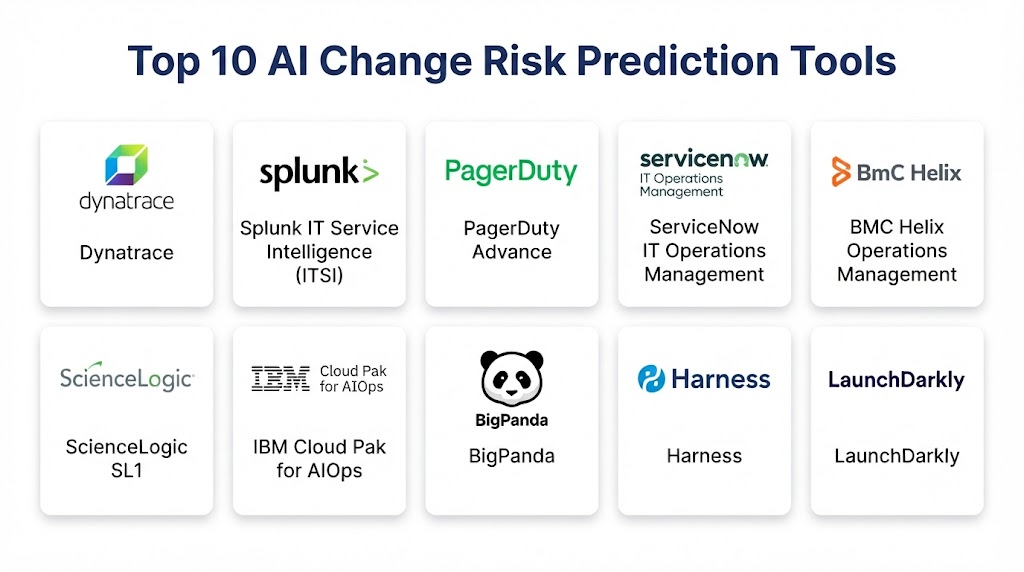
Top 10 AI Change Risk Prediction Tools
1. Harness Continuous Verification
Verdict: Best overall AI-powered platform for deployment verification and change risk prediction.
Short Description: Harness Continuous Verification analyzes deployment telemetry, application metrics, logs, and historical release data using AI to predict deployment risks, detect anomalies, validate production changes, and automatically recommend rollbacks before customer impact occurs.
Key Features
- AI deployment risk scoring
- Continuous verification
- Automated rollback
- Deployment analytics
- Change intelligence
- CI/CD integration
- Observability analysis
- Anomaly detection
Pros
- Excellent deployment intelligence
- Strong automation
- Cloud-native architecture
- Mature DevOps capabilities
Cons
- Enterprise pricing
- Best suited for mature CI/CD environments
Deployment: SaaS & Hybrid
Security & Compliance: Enterprise-grade controls
Integrations & Ecosystem: Kubernetes, Jenkins, GitHub, GitLab, Argo CD, Datadog, Dynatrace, New Relic, Splunk
Support & Community: Enterprise support
Pricing Model: Subscription
Best-Fit Scenarios: Enterprise DevOps and continuous delivery
2. Dynatrace Davis AI
Verdict: AI-powered observability platform with predictive deployment risk analysis.
Short Description: Dynatrace Davis AI correlates deployment events, application dependencies, infrastructure telemetry, and user experience metrics to predict change-related risks and identify production issues before they escalate.
Key Features
- AI risk prediction
- Deployment correlation
- Dependency mapping
- Root cause analysis
- Continuous monitoring
- Performance verification
Pros
- Excellent observability
- Accurate dependency analysis
Cons
- Premium pricing
3. LaunchDarkly
Verdict: Intelligent feature management platform with AI-assisted release risk reduction.
Short Description: LaunchDarkly enables progressive delivery using feature flags while helping organizations minimize deployment risks through controlled rollouts, experimentation, monitoring, and automated rollback strategies.
Key Features
- Feature flag management
- Progressive delivery
- Canary releases
- Deployment monitoring
- Automated rollback
Pros
- Excellent release control
- Easy progressive deployment
Cons
- Focuses on feature delivery rather than full infrastructure analysis
4. Datadog Cloud Deployment Tracking
Verdict: AI-powered deployment monitoring and risk analysis platform.
Short Description: Datadog correlates deployments with infrastructure metrics, application performance, logs, and traces to detect anomalies, assess deployment impact, and improve release reliability.
Key Features
- Deployment tracking
- AI anomaly detection
- Infrastructure monitoring
- Distributed tracing
- Deployment dashboards
Pros
- Strong cloud-native support
- Unified observability
Cons
- Usage-based pricing
5. New Relic AI
Verdict: Intelligent observability platform for release validation.
Short Description: New Relic AI analyzes deployment events, application telemetry, and user experience metrics to identify risky releases and improve software delivery quality.
Key Features
- Release monitoring
- AI analytics
- Deployment intelligence
- Performance validation
- Distributed tracing
Pros
- Excellent APM integration
- Strong dashboards
Cons
- Enterprise features require advanced licensing
6. GitLab Duo
Verdict: AI-powered DevOps platform supporting intelligent software delivery.
Short Description: GitLab Duo enhances CI/CD workflows by providing AI-assisted code reviews, deployment insights, pipeline recommendations, and software delivery intelligence that help reduce deployment risks.
Key Features
- AI code assistance
- Pipeline intelligence
- Merge request analysis
- Deployment insights
- CI/CD automation
Pros
- Integrated DevOps platform
- Strong developer experience
Cons
- Focus extends beyond change risk prediction
7. Azure Monitor with Microsoft Copilot
Verdict: AI-enhanced cloud monitoring and deployment analytics platform.
Short Description: Azure Monitor and Microsoft Copilot analyze deployment events, infrastructure health, cloud telemetry, and application performance to identify risky production changes and recommend corrective actions.
Key Features
- AI monitoring
- Deployment analytics
- Cloud observability
- Incident correlation
- Intelligent recommendations
Pros
- Excellent Azure integration
- Enterprise cloud support
Cons
- Best for Microsoft environments
8. IBM Instana
Verdict: AI-powered application observability platform with deployment intelligence.
Short Description: IBM Instana automatically detects deployment-related issues by correlating application dependencies, infrastructure telemetry, and distributed traces to accelerate root cause analysis.
Key Features
- Deployment monitoring
- AI diagnostics
- Root cause analysis
- Dependency mapping
- Performance analytics
Pros
- Excellent Kubernetes visibility
- Strong automation
Cons
- Enterprise-oriented platform
9. Splunk IT Service Intelligence (ITSI)
Verdict: Enterprise AIOps platform with predictive change analytics.
Short Description: Splunk ITSI uses AI to correlate deployment events, operational telemetry, and service health metrics to predict change-related risks and improve release management.
Key Features
- Predictive analytics
- Service intelligence
- Event correlation
- Deployment analytics
- AI recommendations
Pros
- Mature enterprise platform
- Excellent analytics
Cons
- Requires Splunk expertise
10. OpenAI-Based Custom Change Intelligence Platform
Verdict: Flexible AI-powered platform for deployment risk analysis and release governance.
Short Description: Organizations can build custom AI Change Risk Prediction solutions using large language models integrated with Git repositories, CI/CD systems, observability platforms, cloud infrastructure, ITSM tools, and deployment pipelines to assess release risks, generate deployment summaries, and recommend mitigation strategies.
Key Features
- AI risk assessment
- Deployment summarization
- Release recommendations
- Workflow automation
- Change governance
Pros
- Highly customizable
- Flexible integrations
- Organization-specific intelligence
Cons
- Requires AI engineering expertise
- Governance and validation required
Comparison Table
| Platform | AI Risk Prediction | CI/CD Integration | Automation | Observability | Best Use |
|---|---|---|---|---|---|
| Harness Continuous Verification | Excellent | Excellent | Excellent | Excellent | Enterprise DevOps |
| Dynatrace Davis AI | Excellent | High | High | Excellent | Full-Stack Observability |
| LaunchDarkly | High | Excellent | Excellent | High | Progressive Delivery |
| Datadog | High | High | High | Excellent | Cloud Operations |
| New Relic AI | High | High | Medium | Excellent | APM |
| GitLab Duo | High | Excellent | High | Medium | DevOps Platform |
| Azure Monitor | High | High | High | Excellent | Microsoft Cloud |
| IBM Instana | High | High | High | Excellent | Kubernetes |
| Splunk ITSI | High | Medium | High | High | Enterprise AIOps |
| OpenAI Custom | Custom | Custom | Custom | Custom | Custom Deployment Intelligence |
Evaluation & Scoring Table
| Platform | AI Features 20% | Prediction 20% | Integrations 15% | Automation 15% | Performance 10% | Ease 10% | Value 10% | Total |
|---|---|---|---|---|---|---|---|---|
| Harness Continuous Verification | 20 | 20 | 15 | 15 | 10 | 8 | 8 | 96 |
| Dynatrace Davis AI | 19 | 19 | 15 | 14 | 10 | 8 | 8 | 93 |
| Datadog | 18 | 18 | 14 | 14 | 10 | 9 | 8 | 91 |
| LaunchDarkly | 18 | 18 | 15 | 14 | 9 | 9 | 8 | 91 |
| New Relic AI | 18 | 18 | 14 | 13 | 10 | 9 | 8 | 90 |
| GitLab Duo | 18 | 17 | 15 | 13 | 9 | 9 | 8 | 89 |
| IBM Instana | 17 | 18 | 14 | 13 | 10 | 8 | 8 | 88 |
| Azure Monitor | 17 | 17 | 14 | 13 | 10 | 8 | 8 | 87 |
| Splunk ITSI | 17 | 17 | 14 | 13 | 10 | 8 | 8 | 87 |
| OpenAI Custom | 20 | 19 | 12 | 15 | 8 | 7 | 9 | 90 |
Which AI Change Risk Prediction Tool Is Right for You?
| If your priority is… | Recommended Platform |
|---|---|
| Deployment verification | Harness Continuous Verification |
| Enterprise observability | Dynatrace Davis AI |
| Progressive delivery | LaunchDarkly |
| Cloud-native deployments | Datadog |
| Application performance | New Relic AI |
| Integrated DevOps | GitLab Duo |
| Microsoft cloud | Azure Monitor with Microsoft Copilot |
| Kubernetes environments | IBM Instana |
| Enterprise AIOps | Splunk ITSI |
| Custom AI workflows | OpenAI-Based Change Intelligence Platform |
Implementation Playbook
First 30 Days
- Connect CI/CD pipelines
- Import deployment history
- Integrate observability tools
- Define risk thresholds
Days 31–60
- Enable AI risk scoring
- Configure deployment policies
- Validate prediction accuracy
- Train DevOps teams
Days 61–90
- Automate deployment approvals
- Implement rollback workflows
- Measure deployment success rates
- Continuously improve prediction models
Common Mistakes
- Ignoring historical deployment data
- Limited observability integration
- Weak rollback planning
- Poor dependency mapping
- Overriding AI recommendations without review
- Missing change governance
- Incomplete CI/CD integration
- Failing to monitor post-deployment performance
Frequently Asked Questions
1. What are AI Change Risk Prediction Tools?
They use AI to evaluate software, infrastructure, and configuration changes before deployment to predict the likelihood of failures, outages, or performance issues.
2. How do these tools improve software delivery?
They analyze historical deployments, telemetry, dependencies, and application behavior to reduce deployment failures and improve release quality.
3. Can they integrate with CI/CD pipelines?
Yes. Most platforms integrate with Git repositories, Jenkins, GitHub Actions, GitLab CI/CD, Argo CD, Azure DevOps, and similar delivery tools.
4. Do they support Kubernetes deployments?
Yes. Many enterprise platforms analyze Kubernetes workloads, containers, and cloud-native deployments.
5. Can AI automatically recommend rollbacks?
Yes. Many platforms identify failed deployments and recommend or automate rollback actions based on configured policies.
6. Are these tools suitable for DevOps teams?
Yes. They are designed for DevOps, SRE, platform engineering, cloud operations, and IT operations teams.
7. How accurate are AI deployment risk predictions?
Accuracy depends on telemetry quality, historical deployment data, observability coverage, and continuous model refinement.
8. What integrations are most important?
CI/CD platforms, Git repositories, observability tools, APM solutions, cloud infrastructure, ITSM systems, and monitoring platforms.
9. Can these tools improve deployment frequency?
Yes. By reducing uncertainty and automating validation, they enable safer and more frequent deployments.
10. What should organizations evaluate before selecting a platform?
Consider AI capabilities, deployment analytics, automation, integrations, governance, scalability, reporting, and total cost of ownership.
Conclusion
AI Change Risk Prediction Tools are transforming modern software delivery by enabling organizations to assess deployment risks before production releases occur. Through predictive analytics, deployment intelligence, observability integration, and automated verification, these platforms reduce release failures, improve application stability, accelerate recovery, and strengthen DevOps governance across increasingly complex cloud-native environments.Organizations should choose a platform based on deployment maturity, CI/CD strategy, observability ecosystem, cloud infrastructure, and automation goals. Solutions such as Harness Continuous Verification, Dynatrace Davis AI, LaunchDarkly, Datadog, and New Relic AI provide enterprise-grade capabilities that help teams deploy software more confidently while maintaining reliability, performance, and operational resilience.
