Introduction
AI Pathology Slide Analysis tools use artificial intelligence (AI), deep learning, computer vision, and machine learning (ML) to analyze digital pathology images, whole-slide images (WSI), and tissue samples to assist pathologists in disease detection, classification, quantification, and clinical decision support. These platforms help healthcare organizations improve diagnostic accuracy, accelerate pathology workflows, and manage increasing volumes of complex diagnostic cases.
Traditional pathology workflows require pathologists to manually review microscope slides, identify abnormal tissue patterns, perform measurements, and prepare diagnostic reports. With growing cancer screening demands, personalized medicine requirements, and increasing diagnostic complexity, pathology departments face challenges related to workload, turnaround time, and diagnostic consistency.
AI-powered digital pathology platforms analyze high-resolution slide images to detect cancer cells, identify biomarkers, measure tumor characteristics, classify tissue structures, and highlight areas of clinical interest. These tools support pathologists by providing additional insights, improving workflow efficiency, and enabling quantitative analysis that may be difficult to perform manually.
Modern AI Pathology Slide Analysis platforms integrate with Digital Pathology Systems, Laboratory Information Systems (LIS), Electronic Health Records (EHR), image management platforms, and clinical research workflows. They support applications across oncology, molecular pathology, hematopathology, dermatopathology, breast pathology, and precision medicine.
Healthcare organizations increasingly adopt AI pathology solutions to improve diagnostic workflows, accelerate cancer detection, support personalized treatment decisions, and enhance collaboration between pathology teams.
Real-world Use Cases
- Cancer detection and classification
- Tumor segmentation
- Biomarker analysis
- Breast cancer pathology
- Prostate cancer grading
- Lung cancer analysis
- Tissue classification
- Cell counting and quantification
- Clinical research analysis
- Digital pathology workflow optimization
Evaluation Criteria for Buyers
When selecting an AI Pathology Slide Analysis platform, consider:
- AI image analysis accuracy
- Clinical validation
- Whole-slide image support
- Digital pathology integration
- Biomarker analysis capabilities
- Workflow automation
- Regulatory compliance
- Scalability
- Reporting capabilities
- Deployment flexibility
Best For
- Hospitals
- Pathology laboratories
- Cancer centers
- Research institutions
- Pharmaceutical companies
- Academic medical centers
Not Ideal For
Organizations without digital pathology infrastructure or those expecting AI to independently replace expert pathologists.
Key Trends
- AI-assisted digital pathology
- Whole-slide image analysis
- Computational pathology
- Precision medicine support
- AI biomarker discovery
- Automated cancer grading
- Cloud-based pathology platforms
- Quantitative pathology
- Explainable medical AI
- Integrated laboratory workflows
Methodology
The platforms below were evaluated based on:
- AI pathology capabilities
- Image analysis accuracy
- Clinical workflow integration
- Digital pathology support
- Automation capabilities
- Scalability
- Enterprise readiness
- Overall clinical value
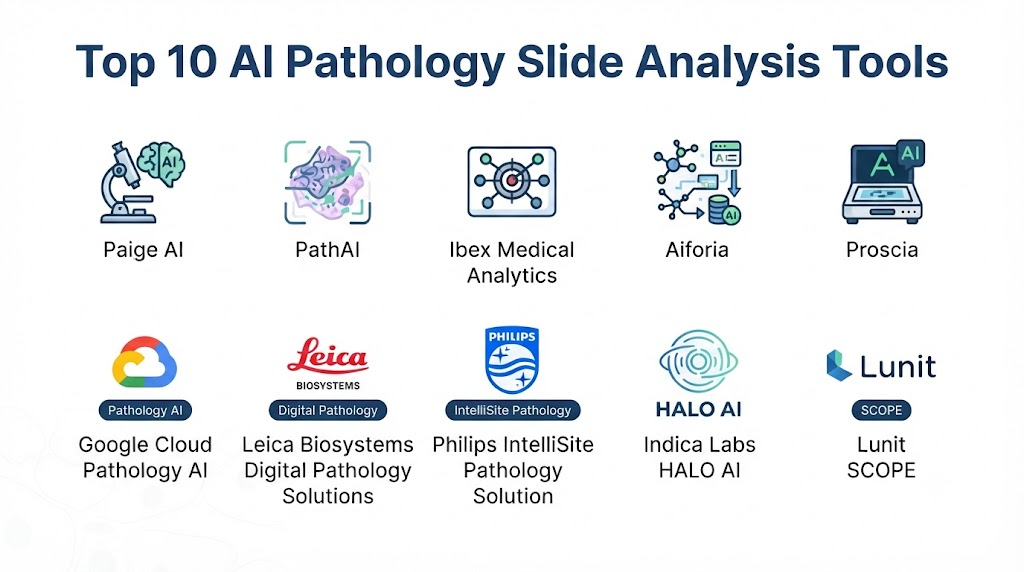
Top 10 AI Pathology Slide Analysis Tools
1. Paige AI
Verdict: Best overall AI platform for digital pathology analysis and cancer diagnosis support.
Short Description: Paige AI provides AI-powered pathology solutions designed to assist pathologists in detecting and analyzing cancer patterns within digital pathology slides. The platform uses deep learning to identify clinically relevant findings and improve diagnostic confidence.
Key Features
- AI slide analysis
- Cancer detection support
- Whole-slide image processing
- Digital pathology workflow integration
- Quantitative analysis
- Diagnostic assistance
Pros
- Strong pathology-focused AI
- Advanced cancer analysis capabilities
- Clinical workflow support
Cons
- Enterprise healthcare deployment
- Requires digital pathology infrastructure
Deployment: Cloud & Enterprise
Security & Compliance: Healthcare-grade security controls
Integrations & Ecosystem: Digital pathology systems, LIS, clinical workflows
Support & Community: Enterprise healthcare support
Pricing Model: Custom enterprise pricing
Best-Fit Scenarios: Hospitals and cancer centers
2. PathAI
Verdict: Leading AI pathology platform for diagnostics and pharmaceutical research.
Short Description: PathAI develops AI-powered pathology solutions that assist pathologists with diagnosis, biomarker analysis, clinical trials, and drug development workflows.
Key Features
- AI tissue analysis
- Biomarker quantification
- Clinical trial support
- Drug development analytics
- Digital pathology workflows
Pros
- Strong research capabilities
- Excellent pharmaceutical applications
- Advanced AI models
Cons
- Enterprise and research focused
3. Tempus
Verdict: AI-driven precision medicine platform combining pathology and clinical data.
Short Description: Tempus uses AI and large-scale healthcare data analysis to support cancer diagnostics, molecular insights, and personalized treatment decisions through integrated pathology and clinical intelligence.
Key Features
- Digital pathology analysis
- Oncology insights
- AI diagnostics
- Clinical data integration
- Precision medicine support
Pros
- Strong oncology ecosystem
- Data-driven healthcare approach
Cons
- Broader healthcare focus beyond pathology
4. Ibex Medical Analytics
Verdict: AI pathology assistant for cancer detection and diagnostic support.
Short Description: Ibex provides AI-powered pathology solutions that analyze tissue slides to identify cancer features, improve diagnostic consistency, and support pathologists during routine workflows.
Key Features
- Cancer detection
- Tissue classification
- AI-assisted diagnosis
- Workflow integration
- Quality improvement
Pros
- Strong pathology specialization
- Clinical workflow focus
Cons
- Primarily focused on selected pathology areas
5. Sectra Digital Pathology
Verdict: Enterprise digital pathology platform with AI integration capabilities.
Short Description: Sectra Digital Pathology provides image management, workflow tools, and AI integration capabilities that enable efficient digital pathology operations across healthcare organizations.
Key Features
- Whole-slide image management
- AI integration
- Digital workflows
- Collaboration tools
- Enterprise imaging
Pros
- Strong healthcare infrastructure
- Excellent interoperability
Cons
- Large enterprise implementation
6. Leica Biosystems Digital Pathology
Verdict: Comprehensive digital pathology ecosystem with AI-powered analysis support.
Short Description: Leica Biosystems provides digital pathology solutions that combine slide scanning, image management, and AI-powered analysis tools to improve laboratory workflows.
Key Features
- Slide scanning
- Image analysis
- AI applications
- Laboratory workflow support
- Clinical integration
Pros
- Strong pathology ecosystem
- Trusted laboratory presence
Cons
- Enterprise-focused platform
7. Philips IntelliSite Pathology Solution
Verdict: Enterprise digital pathology platform supporting AI-based slide analysis.
Short Description: Philips IntelliSite enables digital pathology workflows by managing whole-slide images, supporting AI applications, and improving collaboration among pathology teams.
Key Features
- Whole-slide image management
- AI application support
- Pathology workflow management
- Clinical integration
- Image visualization
Pros
- Strong healthcare integration
- Enterprise scalability
Cons
- Complex deployment requirements
8. Google Cloud Healthcare AI
Verdict: Cloud AI infrastructure for developing pathology analysis solutions.
Short Description: Google Cloud Healthcare AI provides AI tools, data infrastructure, and machine learning capabilities that organizations can use to build and deploy medical image analysis workflows, including digital pathology applications.
Key Features
- AI model development
- Healthcare data management
- Cloud analytics
- Machine learning tools
- Medical imaging support
Pros
- Powerful AI infrastructure
- Flexible development environment
Cons
- Requires AI expertise
9. Aiforia
Verdict: AI-powered image analysis platform for pathology research and diagnostics.
Short Description: Aiforia provides deep learning-based image analysis tools that help researchers and pathologists analyze tissue images, quantify biomarkers, and automate pathology workflows.
Key Features
- Deep learning image analysis
- Tissue classification
- Biomarker quantification
- Research workflows
- AI model development
Pros
- Strong research capabilities
- Flexible AI models
Cons
- Requires specialized expertise
10. OpenAI-Based Custom Pathology Analysis Assistant
Verdict: Flexible AI workflow solution for pathology documentation and analysis support.
Short Description: Healthcare organizations can build custom AI pathology assistants using AI models integrated with digital pathology platforms, laboratory systems, reporting workflows, and clinical databases to support documentation, case summarization, workflow coordination, and research activities. Such systems should complement validated pathology AI models and expert review.
Key Features
- Pathology report assistance
- Case summarization
- Workflow automation
- Research support
- Clinical documentation
Pros
- Highly customizable
- Flexible integrations
- Organization-specific workflows
Cons
- Requires AI expertise
- Clinical governance required
Comparison Table
| Platform | AI Slide Analysis | Digital Pathology | Clinical Support | Integration | Best Use |
|---|---|---|---|---|---|
| Paige AI | Excellent | Excellent | Excellent | High | Cancer Diagnosis |
| PathAI | Excellent | Excellent | High | High | Research & Pharma |
| Tempus | High | High | Excellent | High | Precision Medicine |
| Ibex Medical Analytics | Excellent | High | Excellent | High | Pathology Workflow |
| Sectra Digital Pathology | High | Excellent | High | Excellent | Enterprise Pathology |
| Leica Biosystems | High | Excellent | High | High | Laboratory Workflow |
| Philips IntelliSite | High | Excellent | High | Excellent | Healthcare Networks |
| Google Cloud Healthcare AI | Custom | High | Custom | Excellent | AI Development |
| Aiforia | Excellent | High | High | Medium | Research Analysis |
| OpenAI Custom | Custom | Custom | Custom | Custom | Custom Workflows |
Evaluation & Scoring Table
| Platform | AI Features 20% | Analysis Accuracy 20% | Integration 15% | Workflow 15% | Security 10% | Ease 10% | Value 10% | Total |
|---|---|---|---|---|---|---|---|---|
| Paige AI | 20 | 20 | 15 | 15 | 10 | 8 | 8 | 96 |
| PathAI | 20 | 19 | 14 | 14 | 10 | 8 | 8 | 93 |
| Ibex Medical Analytics | 19 | 19 | 14 | 14 | 10 | 8 | 8 | 92 |
| Tempus | 18 | 19 | 14 | 14 | 10 | 8 | 8 | 91 |
| Sectra | 18 | 18 | 15 | 14 | 10 | 8 | 8 | 91 |
| Leica Biosystems | 18 | 18 | 14 | 14 | 10 | 8 | 8 | 90 |
| Philips IntelliSite | 18 | 18 | 14 | 13 | 10 | 8 | 8 | 89 |
| Aiforia | 18 | 18 | 13 | 13 | 9 | 8 | 8 | 87 |
| Google Healthcare AI | 17 | 17 | 15 | 13 | 10 | 7 | 8 | 87 |
| OpenAI Custom | 18 | 16 | 12 | 15 | 8 | 7 | 9 | 85 |
Which AI Pathology Slide Analysis Tool Is Right for You?
| If your priority is… | Recommended Platform |
|---|---|
| Cancer diagnosis support | Paige AI |
| Pharmaceutical research | PathAI |
| Precision oncology | Tempus |
| AI pathology workflow | Ibex Medical Analytics |
| Enterprise digital pathology | Sectra |
| Laboratory ecosystem | Leica Biosystems |
| Healthcare imaging network | Philips IntelliSite |
| AI development platform | Google Cloud Healthcare AI |
| Research image analysis | Aiforia |
| Custom workflow automation | OpenAI-Based Pathology Assistant |
Implementation Playbook
First 30 Days
- Assess digital pathology infrastructure
- Identify clinical use cases
- Integrate slide management systems
- Define validation requirements
Days 31–60
- Deploy AI analysis workflows
- Train pathology teams
- Validate AI performance
- Configure reporting workflows
Days 61–90
- Expand AI-supported cases
- Monitor diagnostic improvements
- Optimize workflows
- Establish continuous quality review
Common Mistakes
- Expecting AI to replace pathologists
- Using AI without clinical validation
- Poor digital pathology infrastructure
- Ignoring regulatory requirements
- Limited staff training
- Weak integration planning
- Not monitoring AI performance
- Selecting tools without scalability planning
Frequently Asked Questions
1. What are AI Pathology Slide Analysis tools?
They use AI and computer vision to analyze digital pathology slides and assist pathologists with diagnosis, classification, and quantitative analysis.
2. Can AI replace pathologists?
No. AI supports pathologists by improving efficiency, highlighting findings, and providing additional analysis.
3. What types of diseases can AI pathology tools analyze?
Many solutions focus on cancers, tissue abnormalities, biomarkers, and disease classification.
4. What are whole-slide images?
Whole-slide images are high-resolution digital scans of microscope slides used for computer-based pathology analysis.
5. Do these platforms integrate with laboratory systems?
Yes. Enterprise solutions commonly integrate with digital pathology systems, LIS, and healthcare workflows.
6. How does AI improve pathology workflows?
AI reduces manual analysis time, provides quantitative measurements, and helps identify important regions of tissue.
7. Are AI pathology platforms regulated?
Many medical AI solutions require regulatory clearance depending on their intended clinical use and region.
8. Who benefits from AI pathology solutions?
Pathologists, hospitals, cancer centers, research organizations, and pharmaceutical companies.
9. What should healthcare organizations evaluate before adoption?
Clinical validation, workflow integration, AI accuracy, security, scalability, and regulatory requirements.
10. Can AI pathology tools support personalized medicine?
Yes. AI analysis can help identify biomarkers and provide insights that support personalized treatment strategies.
Conclusion
AI Pathology Slide Analysis tools are transforming modern pathology by combining digital imaging, artificial intelligence, and advanced analytics to support faster and more consistent diagnostic workflows. These platforms help pathologists analyze complex tissue samples, identify important patterns, quantify biomarkers, and improve clinical decision-making.Healthcare organizations should select AI pathology solutions based on clinical requirements, digital pathology maturity, integration capabilities, regulatory considerations, and workflow goals. Platforms such as Paige AI, PathAI, Ibex Medical Analytics, Sectra Digital Pathology, and Leica Biosystems provide advanced capabilities for hospitals, laboratories, and research organizations looking to improve pathology operations and support precision medicine.
