Introduction
AI Clinical Decision Support Systems (CDSS) use artificial intelligence (AI), machine learning (ML), natural language processing (NLP), and healthcare data analytics to assist physicians, nurses, and healthcare professionals in making informed clinical decisions. These systems analyze patient information such as electronic health records (EHR), laboratory results, medical imaging, medications, clinical guidelines, patient history, and real-time health data to provide recommendations, alerts, risk predictions, and treatment insights.
Healthcare providers manage increasingly complex patient cases while dealing with large volumes of medical information. Traditional decision-making processes often require reviewing multiple sources of data manually, which can increase workload and create challenges in delivering timely, personalized care. AI-powered Clinical Decision Support Systems help reduce this burden by identifying patterns, predicting risks, highlighting important findings, and supporting evidence-based clinical workflows.
Modern AI CDSS platforms integrate with EHR systems, hospital information systems, laboratory systems, pharmacy platforms, medical devices, and healthcare analytics environments. They support a wide range of specialties, including oncology, cardiology, emergency medicine, primary care, radiology, infectious diseases, and chronic disease management.
These systems are designed to augment healthcare professionals by improving diagnostic confidence, supporting treatment decisions, reducing medical errors, optimizing workflows, and enabling more personalized patient care.
Real-world Use Cases
- Clinical diagnosis assistance
- Patient risk prediction
- Treatment recommendation support
- Drug interaction checking
- Early disease detection
- Hospital workflow optimization
- Chronic disease management
- Emergency care prioritization
- Clinical documentation support
- Personalized medicine support
Evaluation Criteria for Buyers
When selecting an AI Clinical Decision Support System, consider:
- AI recommendation accuracy
- Clinical validation
- EHR integration capabilities
- Medical specialty coverage
- Explainability of AI decisions
- Workflow integration
- Regulatory compliance
- Data security and privacy
- Scalability
- User experience
Best For
- Hospitals
- Healthcare networks
- Clinics
- Academic medical centers
- Specialty care organizations
- Research institutions
Not Ideal For
Organizations without digital health infrastructure or those expecting AI to replace clinical expertise and judgment.
Key Trends
- AI-assisted diagnosis
- Predictive healthcare analytics
- Personalized medicine
- Clinical workflow automation
- Generative AI healthcare assistants
- Real-time patient monitoring
- Explainable medical AI
- EHR-integrated AI tools
- Healthcare data intelligence
- Preventive care analytics
Methodology
The platforms below were evaluated based on:
- AI clinical capabilities
- Data integration
- Decision support accuracy
- Workflow automation
- Healthcare interoperability
- Security and compliance
- Scalability
- Overall clinical value
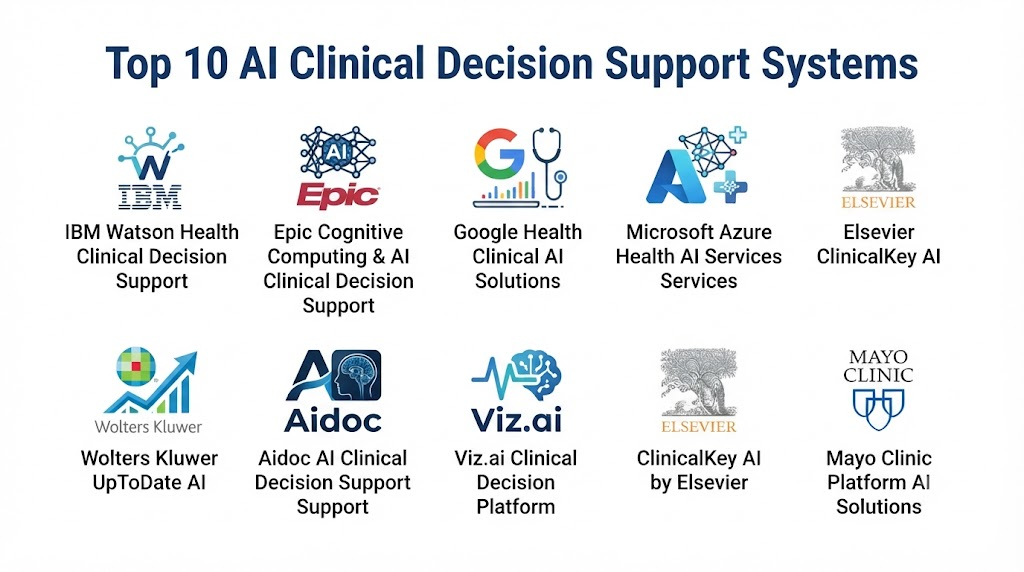
Top 10 AI Clinical Decision Support Systems
1. IBM Watson Health Clinical Decision Support
Verdict: Enterprise-grade AI platform for clinical insights and healthcare decision support.
Short Description: IBM Watson Health solutions use AI, healthcare data analytics, and clinical knowledge resources to support diagnosis, treatment planning, evidence-based recommendations, and healthcare decision-making across multiple specialties.
Key Features
- AI clinical insights
- Evidence-based recommendations
- Patient data analysis
- Treatment support
- Healthcare analytics
- Clinical workflow integration
Pros
- Strong healthcare expertise
- Enterprise scalability
- Advanced analytics capabilities
Cons
- Complex implementation
- Enterprise-focused deployment
Deployment: Cloud & Enterprise
Security & Compliance: Healthcare-grade security
Integrations & Ecosystem: EHR, healthcare platforms, clinical systems
Support & Community: Enterprise healthcare support
Pricing Model: Custom enterprise pricing
Best-Fit Scenarios: Large healthcare organizations
2. Microsoft Azure Health Bot
Verdict: AI-powered healthcare assistant platform for clinical interactions and decision support.
Short Description: Microsoft Azure Health Bot enables healthcare organizations to build AI-powered conversational assistants that provide symptom guidance, patient engagement, clinical workflows, and healthcare information support.
Key Features
- AI healthcare conversations
- Symptom assessment
- Patient guidance
- Clinical workflows
- Healthcare integrations
Pros
- Strong cloud infrastructure
- Flexible development platform
Cons
- Requires customization
3. Google Cloud Healthcare AI
Verdict: Cloud AI platform for developing advanced clinical decision support applications.
Short Description: Google Cloud Healthcare AI provides healthcare data management, machine learning tools, and AI capabilities that help organizations build clinical decision support solutions using medical data and analytics.
Key Features
- Healthcare data analytics
- AI model development
- Medical data processing
- Predictive analytics
- Clinical applications
Pros
- Powerful AI infrastructure
- Strong healthcare data capabilities
Cons
- Requires AI expertise
4. Epic Cognitive Computing & AI Solutions
Verdict: AI-enabled clinical decision support integrated into healthcare workflows.
Short Description: Epic integrates AI capabilities into its electronic health record ecosystem to support clinical workflows, patient risk identification, documentation, and healthcare decision-making.
Key Features
- EHR-integrated AI
- Clinical alerts
- Patient risk prediction
- Documentation support
- Workflow assistance
Pros
- Deep EHR integration
- Strong hospital adoption
Cons
- Primarily focused on Epic environments
5. Elsevier Clinical Decision Support
Verdict: Evidence-based clinical intelligence platform for healthcare professionals.
Short Description: Elsevier Clinical Decision Support provides medical knowledge, evidence-based guidance, and AI-supported insights to help clinicians make informed decisions during patient care.
Key Features
- Clinical guidelines
- Medical knowledge resources
- Evidence-based recommendations
- Drug information
- Point-of-care support
Pros
- Trusted medical content
- Strong clinical resources
Cons
- More knowledge-focused than automation-focused
6. Wolters Kluwer Clinical Decision Support
Verdict: Comprehensive healthcare intelligence platform for evidence-based decisions.
Short Description: Wolters Kluwer provides clinical decision support solutions that combine medical knowledge, patient data, and healthcare analytics to assist providers with diagnosis and treatment decisions.
Key Features
- Clinical recommendations
- Drug information
- Evidence-based medicine
- Patient safety alerts
- Healthcare analytics
Pros
- Strong clinical content
- Widely used by healthcare professionals
Cons
- Enterprise licensing
7. Aidoc AI Clinical Platform
Verdict: AI-driven clinical workflow support for imaging-based decisions.
Short Description: Aidoc assists clinicians by analyzing medical images, identifying critical findings, and prioritizing cases to support faster clinical decisions.
Key Features
- AI imaging analysis
- Clinical alerts
- Workflow prioritization
- Emergency case detection
- Radiology integration
Pros
- Strong imaging AI
- Fast clinical workflows
Cons
- Primarily imaging-focused
8. Viz.ai Clinical AI Platform
Verdict: AI-powered care coordination and emergency decision support platform.
Short Description: Viz.ai uses AI to identify time-sensitive medical conditions and coordinate care teams, particularly in stroke and cardiovascular workflows.
Key Features
- AI disease detection
- Care coordination
- Emergency alerts
- Clinical communication
- Workflow automation
Pros
- Strong emergency workflows
- Improves care coordination
Cons
- Specialty-focused
9. Tempus AI
Verdict: AI-powered precision medicine platform supporting personalized clinical decisions.
Short Description: Tempus uses AI, clinical data, and molecular insights to support oncology decision-making, treatment planning, and personalized healthcare approaches.
Key Features
- AI clinical insights
- Oncology analytics
- Molecular data analysis
- Treatment support
- Precision medicine
Pros
- Strong oncology capabilities
- Data-driven approach
Cons
- Specialized healthcare focus
10. OpenAI-Based Custom Clinical Decision Support Assistant
Verdict: Flexible AI assistant for healthcare workflow support and clinical information management.
Short Description: Healthcare organizations can build custom AI clinical assistants using large language models integrated with EHR systems, clinical databases, medical guidelines, healthcare workflows, and analytics platforms. These systems can support documentation, summarization, patient information retrieval, and workflow coordination while requiring appropriate clinical validation and governance.
Key Features
- Clinical summarization
- Healthcare documentation
- Patient information assistance
- Workflow automation
- Medical knowledge support
Pros
- Highly customizable
- Flexible integrations
- Organization-specific workflows
Cons
- Requires healthcare AI expertise
- Clinical governance required
Comparison Table
| Platform | AI Decision Support | EHR Integration | Clinical Coverage | Automation | Best Use |
|---|---|---|---|---|---|
| IBM Watson Health | Excellent | Excellent | Excellent | High | Enterprise Healthcare |
| Microsoft Azure Health Bot | High | High | High | High | Healthcare Assistants |
| Google Healthcare AI | Excellent | High | Custom | High | AI Development |
| Epic AI Solutions | High | Excellent | Excellent | High | Hospital Systems |
| Elsevier CDS | High | High | Excellent | Medium | Evidence-Based Care |
| Wolters Kluwer CDS | High | High | Excellent | Medium | Clinical Knowledge |
| Aidoc | Excellent | High | Medium | High | Imaging Decisions |
| Viz.ai | Excellent | High | Medium | Excellent | Emergency Care |
| Tempus AI | Excellent | High | High | High | Precision Medicine |
| OpenAI Custom | Custom | Custom | Custom | Custom | Custom Clinical AI |
Evaluation & Scoring Table
| Platform | AI Features 20% | Clinical Accuracy 20% | Integration 15% | Workflow 15% | Security 10% | Ease 10% | Value 10% | Total |
|---|---|---|---|---|---|---|---|---|
| IBM Watson Health | 20 | 20 | 15 | 14 | 10 | 8 | 8 | 95 |
| Epic AI Solutions | 19 | 19 | 15 | 15 | 10 | 8 | 8 | 94 |
| Tempus AI | 19 | 19 | 14 | 14 | 10 | 8 | 8 | 92 |
| Google Healthcare AI | 20 | 18 | 14 | 13 | 10 | 7 | 8 | 90 |
| Microsoft Azure Health Bot | 18 | 18 | 14 | 14 | 10 | 9 | 8 | 91 |
| Elsevier CDS | 18 | 19 | 14 | 12 | 10 | 9 | 8 | 90 |
| Wolters Kluwer CDS | 18 | 19 | 14 | 12 | 10 | 8 | 8 | 89 |
| Aidoc | 18 | 18 | 13 | 14 | 10 | 9 | 8 | 90 |
| Viz.ai | 18 | 18 | 13 | 14 | 10 | 9 | 8 | 90 |
| OpenAI Custom | 20 | 16 | 12 | 15 | 8 | 7 | 9 | 87 |
Which AI Clinical Decision Support System Is Right for You?
| If your priority is… | Recommended Platform |
|---|---|
| Enterprise healthcare AI | IBM Watson Health |
| Hospital EHR integration | Epic AI Solutions |
| Healthcare AI development | Google Cloud Healthcare AI |
| Conversational healthcare assistant | Microsoft Azure Health Bot |
| Evidence-based medicine | Elsevier CDS |
| Clinical knowledge support | Wolters Kluwer CDS |
| Imaging decisions | Aidoc |
| Emergency care coordination | Viz.ai |
| Precision oncology | Tempus AI |
| Custom clinical workflows | OpenAI-Based Clinical Assistant |
Implementation Playbook
First 30 Days
- Identify clinical use cases
- Review healthcare data sources
- Assess EHR integration requirements
- Define clinical validation goals
Days 31–60
- Integrate AI decision support workflows
- Train healthcare users
- Validate recommendations
- Monitor clinical adoption
Days 61–90
- Expand AI-supported departments
- Measure workflow improvements
- Improve clinical governance
- Continuously evaluate AI performance
Common Mistakes
- Expecting AI to replace clinicians
- Deploying without clinical validation
- Poor EHR integration
- Ignoring data privacy requirements
- Limited healthcare staff training
- Using outdated medical knowledge sources
- Lack of governance processes
- Not monitoring AI performance
Frequently Asked Questions
1. What are AI Clinical Decision Support Systems?
They are AI-powered platforms that analyze healthcare data and provide recommendations, alerts, and insights to support clinical decision-making.
2. Can AI CDSS replace doctors?
No. These systems assist healthcare professionals but do not replace clinical judgment.
3. What data do these systems analyze?
They may analyze EHR records, medical history, laboratory results, imaging data, medications, and other healthcare information.
4. How do AI decision support systems improve patient care?
They help identify risks, support diagnosis, improve treatment planning, and reduce workflow delays.
5. Do AI CDSS platforms integrate with EHR systems?
Yes. Many enterprise solutions integrate with major healthcare information systems.
6. Are these systems used in hospitals?
Yes. Hospitals, clinics, research centers, and healthcare networks use AI CDSS solutions.
7. Are AI recommendations always accurate?
No. Healthcare professionals must review AI-generated insights before making clinical decisions.
8. Which medical specialties use AI CDSS?
Oncology, cardiology, emergency medicine, radiology, primary care, and chronic disease management commonly use these systems.
9. What compliance considerations are important?
Organizations should evaluate healthcare data privacy, security controls, regulatory requirements, and clinical validation.
10. What should organizations evaluate before selecting a CDSS platform?
Consider AI accuracy, clinical evidence, integrations, usability, security, scalability, and workflow impact.
Conclusion
AI Clinical Decision Support Systems are transforming healthcare by helping clinicians analyze complex medical information, identify patient risks, improve diagnosis, and support evidence-based treatment decisions. These platforms combine artificial intelligence, healthcare data analytics, and clinical knowledge to enhance healthcare delivery while keeping medical professionals at the center of decision-making.Healthcare organizations should select AI CDSS solutions based on clinical requirements, data infrastructure, integration capabilities, regulatory needs, and workflow objectives. Platforms such as IBM Watson Health, Epic AI Solutions, Microsoft Azure Health Bot, Tempus AI, and specialized clinical AI platforms provide valuable capabilities for improving patient care, increasing operational efficiency, and supporting the future of personalized healthcare.
