Introduction
AI Public Health Outbreak Detection tools use artificial intelligence (AI), machine learning (ML), natural language processing (NLP), epidemiological modeling, and real-time data analytics to identify, monitor, and predict potential disease outbreaks. These platforms analyze diverse data sources such as health reports, laboratory results, clinical records, environmental signals, social trends, mobility patterns, and public health surveillance data to detect unusual patterns and emerging health threats.
Traditional outbreak monitoring methods often depend on manual reporting, laboratory confirmations, and retrospective analysis, which can delay response efforts. AI-powered outbreak detection systems help public health organizations identify abnormal disease activity earlier, assess potential risks, and support faster decision-making during infectious disease events.
Modern AI outbreak intelligence platforms assist governments, healthcare organizations, research institutions, and global health agencies by providing early warning signals, disease trend analysis, geographic risk mapping, and predictive outbreak modeling. These tools support responses to infectious diseases, seasonal outbreaks, emerging pathogens, and public health emergencies.
AI Public Health Outbreak Detection solutions integrate with epidemiological databases, healthcare surveillance systems, laboratory networks, environmental monitoring platforms, and public health dashboards. They are designed to support epidemiologists and public health professionals rather than replace expert investigation, clinical diagnosis, or government decision-making.
Real-world Use Cases
- Infectious disease outbreak monitoring
- Early warning detection
- Epidemic trend forecasting
- Geographic disease mapping
- Public health surveillance
- Pandemic preparedness
- Environmental health monitoring
- Disease spread modeling
- Healthcare resource planning
- Emergency response coordination
Evaluation Criteria for Buyers
When selecting an AI Public Health Outbreak Detection platform, consider:
- Early detection capability
- Data source coverage
- Epidemiological modeling accuracy
- Real-time analytics
- Geographic intelligence
- Public health integrations
- Alert management
- Data privacy and security
- Scalability
- Reporting capabilities
Best For
- Government health agencies
- Public health departments
- Global health organizations
- Research institutions
- Healthcare networks
- Epidemiology teams
Not Ideal For
Organizations expecting AI systems to independently confirm outbreaks or replace epidemiological investigation.
Key Trends
- AI-powered disease surveillance
- Real-time outbreak intelligence
- Predictive epidemiology
- Global health monitoring
- Machine learning disease modeling
- Climate and health analytics
- Digital epidemiology
- Wastewater surveillance analytics
- Public health data platforms
- AI emergency response systems
Methodology
The platforms below were evaluated based on:
- AI outbreak detection capabilities
- Data intelligence
- Public health integration
- Predictive analytics
- Real-time monitoring
- Scalability
- Research and government readiness
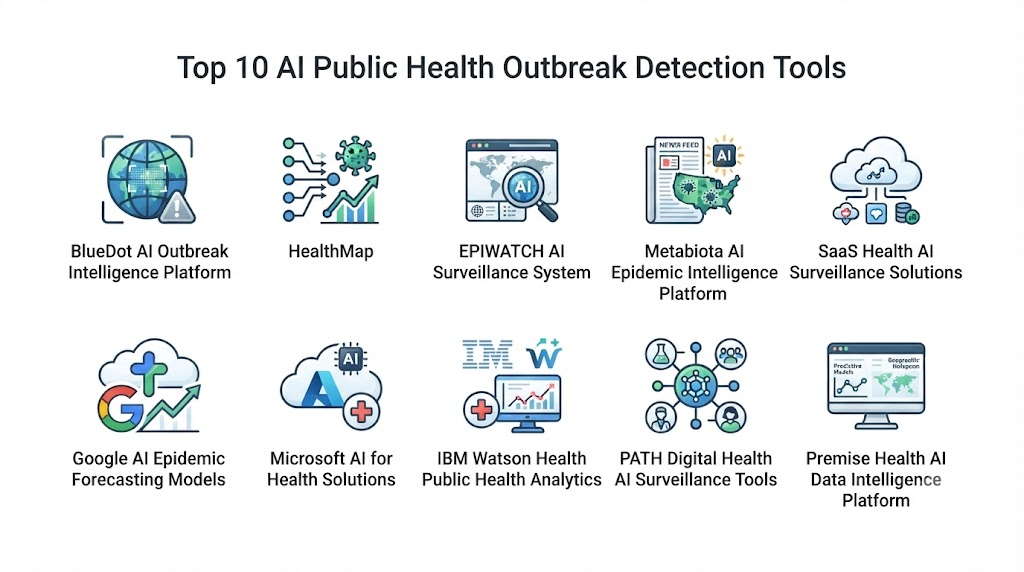
Top 10 AI Public Health Outbreak Detection Tools
1. BlueDot
Verdict: Best overall AI-powered global outbreak intelligence platform.
Short Description: BlueDot uses artificial intelligence, epidemiological modeling, and global health data analysis to identify infectious disease risks and provide early outbreak intelligence.
Key Features
- AI disease surveillance
- Global outbreak monitoring
- Risk assessment
- Geographic analysis
- Epidemiological intelligence
- Travel-related disease monitoring
Pros
- Strong AI-driven surveillance
- Global health focus
- Early warning capabilities
Cons
- Primarily designed for organizations
Deployment: Cloud-based
Security & Compliance: Enterprise data security controls
Integrations & Ecosystem: Public health data sources and analytics systems
Support & Community: Enterprise and research support
Pricing Model: Custom enterprise pricing
Best-Fit Scenarios: Governments, healthcare organizations, global health teams
2. HealthMap
Verdict: AI-assisted disease monitoring platform for global health surveillance.
Short Description: HealthMap combines data analytics, automated monitoring, and visualization techniques to track infectious disease events from multiple sources.
Key Features
- Disease surveillance
- Global health monitoring
- Outbreak visualization
- Automated data collection
- Health event tracking
Pros
- Broad disease monitoring
- Public health research value
Cons
- Research-focused platform
3. Metabiota
Verdict: AI-powered epidemic risk intelligence platform.
Short Description: Metabiota provides infectious disease risk analytics, outbreak modeling, and preparedness intelligence to help organizations understand and manage biological risks.
Key Features
- Disease risk modeling
- Epidemic forecasting
- Outbreak analytics
- Risk assessment
- Health intelligence
Pros
- Strong risk modeling
- Global health expertise
Cons
- Enterprise and institutional focus
4. EpiWATCH
Verdict: AI-supported public health event monitoring platform.
Short Description: EpiWATCH uses automated monitoring and artificial intelligence techniques to identify potential infectious disease events from publicly available information sources.
Key Features
- Automated surveillance
- Disease event detection
- Public information monitoring
- Health intelligence
- Outbreak tracking
Pros
- Supports early detection
- Useful for surveillance teams
Cons
- Requires expert validation
5. ProMED-mail AI Surveillance
Verdict: AI-enhanced infectious disease reporting and monitoring resource.
Short Description: ProMED provides global infectious disease outbreak reporting and community-driven health surveillance, supported by technology-assisted monitoring approaches.
Key Features
- Disease event reporting
- Global surveillance
- Expert-reviewed alerts
- Infectious disease tracking
- Health intelligence
Pros
- Strong expert community
- Global disease coverage
Cons
- Human review remains essential
6. Google Cloud Healthcare AI Analytics
Verdict: Flexible AI infrastructure for building outbreak intelligence systems.
Short Description: Google Cloud healthcare technologies provide AI, analytics, and data processing capabilities that organizations can use to develop disease surveillance and public health intelligence solutions.
Key Features
- Healthcare data analytics
- Machine learning models
- Data processing
- Predictive modeling
- Custom AI solutions
Pros
- Flexible AI capabilities
- Strong cloud infrastructure
Cons
- Requires technical expertise
7. Microsoft Cloud for Healthcare AI
Verdict: Enterprise healthcare AI platform supporting public health analytics.
Short Description: Microsoft Cloud for Healthcare provides AI and data capabilities that organizations can use for healthcare intelligence, analytics, and public health monitoring applications.
Key Features
- Healthcare data analytics
- AI modeling
- Data integration
- Public health workflows
- Dashboard development
Pros
- Strong enterprise ecosystem
- Customizable platform
Cons
- Requires implementation expertise
8. SAS Health Analytics
Verdict: Advanced analytics platform for epidemiology and public health decision support.
Short Description: SAS provides analytics and AI capabilities that help healthcare organizations analyze population health data, detect trends, and support public health planning.
Key Features
- Predictive analytics
- Population health analysis
- Statistical modeling
- Health intelligence
- Data visualization
Pros
- Strong analytics capabilities
- Mature enterprise platform
Cons
- Requires analytics expertise
9. Palantir Foundry Healthcare Analytics
Verdict: Data integration platform supporting complex public health analytics.
Short Description: Palantir Foundry helps organizations integrate large-scale datasets, analyze patterns, and develop intelligence solutions for healthcare and public sector operations.
Key Features
- Data integration
- Analytics workflows
- Operational intelligence
- Data visualization
- Decision support
Pros
- Strong data integration
- Handles complex datasets
Cons
- Enterprise-focused deployment
10. OpenAI-Based Custom Outbreak Intelligence Assistant
Verdict: Flexible AI solution for customized public health monitoring workflows.
Short Description: Public health organizations can build custom AI outbreak intelligence assistants using large language models integrated with epidemiological databases, surveillance systems, laboratory data, environmental information, and public health dashboards. These systems can summarize health signals, analyze trends, support reporting, and assist experts while requiring strict validation and governance.
Key Features
- Outbreak trend summaries
- Health data analysis
- Alert explanation
- Epidemiological reporting support
- Custom intelligence workflows
Pros
- Highly customizable
- Flexible data integration
- Organization-specific solutions
Cons
- Requires AI and public health expertise
- Expert validation required
Comparison Table
| Platform | AI Detection | Data Intelligence | Public Health Integration | Prediction | Best Use |
|---|---|---|---|---|---|
| BlueDot | Excellent | Excellent | Excellent | Excellent | Global Outbreak Intelligence |
| HealthMap | Excellent | High | High | High | Disease Monitoring |
| Metabiota | Excellent | Excellent | High | Excellent | Risk Modeling |
| EpiWATCH | High | High | High | High | Surveillance |
| ProMED | Medium | High | High | Medium | Disease Reporting |
| Google Healthcare AI | High | Excellent | High | High | Custom AI Systems |
| Microsoft Healthcare AI | High | Excellent | High | High | Enterprise Analytics |
| SAS Health Analytics | High | Excellent | High | High | Public Health Analytics |
| Palantir Foundry | High | Excellent | High | High | Data Intelligence |
| OpenAI Custom | Custom | Custom | Custom | Custom | Custom Outbreak AI |
Evaluation & Scoring Table
| Platform | AI Features 20% | Detection Accuracy 20% | Data Coverage 15% | Analytics 15% | Security 10% | Ease 10% | Value 10% | Total |
|---|---|---|---|---|---|---|---|---|
| BlueDot | 20 | 20 | 15 | 15 | 10 | 8 | 8 | 96 |
| Metabiota | 20 | 19 | 15 | 15 | 10 | 8 | 8 | 95 |
| HealthMap | 19 | 19 | 14 | 14 | 10 | 9 | 8 | 93 |
| SAS Health Analytics | 18 | 18 | 14 | 15 | 10 | 8 | 8 | 91 |
| Microsoft Healthcare AI | 18 | 17 | 15 | 14 | 10 | 8 | 8 | 90 |
| Google Healthcare AI | 18 | 17 | 15 | 14 | 10 | 8 | 8 | 90 |
| Palantir Foundry | 18 | 17 | 15 | 14 | 10 | 8 | 8 | 90 |
| EpiWATCH | 17 | 17 | 13 | 13 | 10 | 9 | 8 | 87 |
| ProMED | 16 | 16 | 14 | 12 | 10 | 9 | 8 | 85 |
| OpenAI Custom | 20 | 16 | 12 | 15 | 8 | 7 | 9 | 87 |
Which AI Public Health Outbreak Detection Tool Is Right for You?
| If your priority is… | Recommended Platform |
|---|---|
| Global outbreak intelligence | BlueDot |
| Epidemic risk modeling | Metabiota |
| Disease surveillance | HealthMap |
| Automated health monitoring | EpiWATCH |
| Expert disease reporting | ProMED |
| Custom public health AI | Google Cloud Healthcare AI |
| Enterprise healthcare analytics | Microsoft Cloud for Healthcare |
| Population health analytics | SAS Health Analytics |
| Large-scale data intelligence | Palantir Foundry |
| Custom outbreak assistant | OpenAI-Based AI Assistant |
Implementation Playbook
First 30 Days
- Define outbreak monitoring goals
- Identify required data sources
- Review surveillance workflows
- Establish alert criteria
Days 31–60
- Integrate health data sources
- Configure AI monitoring models
- Train public health teams
- Validate alerts
Days 61–90
- Expand surveillance coverage
- Improve prediction models
- Automate reporting workflows
- Establish continuous monitoring
Common Mistakes
- Treating AI alerts as confirmed outbreaks
- Ignoring expert validation
- Using incomplete data sources
- Poor data governance
- Lack of response workflows
- Ignoring regional differences
- Over-relying on automated predictions
- Weak security controls
Frequently Asked Questions
1. What are AI Public Health Outbreak Detection tools?
They are AI-powered platforms that analyze health data to identify potential disease outbreaks and emerging public health risks.
2. How does AI detect outbreaks?
AI analyzes disease reports, health signals, environmental data, and population patterns to identify unusual trends.
3. Can AI predict pandemics?
AI can support early warning and risk assessment, but outbreak prediction requires expert analysis and multiple data sources.
4. Who uses outbreak detection platforms?
Governments, public health agencies, researchers, healthcare organizations, and global health institutions.
5. What data sources do these systems analyze?
They may analyze health reports, laboratory data, environmental signals, mobility data, and public information sources.
6. Can AI replace epidemiologists?
No. AI supports epidemiologists by providing insights and faster analysis.
7. Are AI outbreak alerts always accurate?
Accuracy depends on data quality, model performance, and expert validation.
8. Do these platforms support pandemic preparedness?
Yes. They help organizations monitor risks and improve emergency response planning.
9. Are public health AI platforms secure?
Organizations should evaluate data protection, privacy controls, and governance practices.
10. What should buyers consider before selecting a platform?
Evaluate data coverage, AI capabilities, scalability, integration options, security, and expert validation workflows.
Conclusion
AI Public Health Outbreak Detection tools are transforming disease surveillance by enabling faster analysis of health signals, improved risk assessment, and more proactive public health responses. By combining artificial intelligence, epidemiological modeling, and large-scale data analytics, these platforms help organizations identify potential threats earlier and improve preparedness.Public health organizations should select outbreak intelligence solutions based on data availability, analytical capabilities, response workflows, security requirements, and collaboration needs. Platforms such as BlueDot, Metabiota, HealthMap, SAS Health Analytics, and enterprise AI platforms demonstrate how artificial intelligence can strengthen global health monitoring and support more informed public health decisions.
